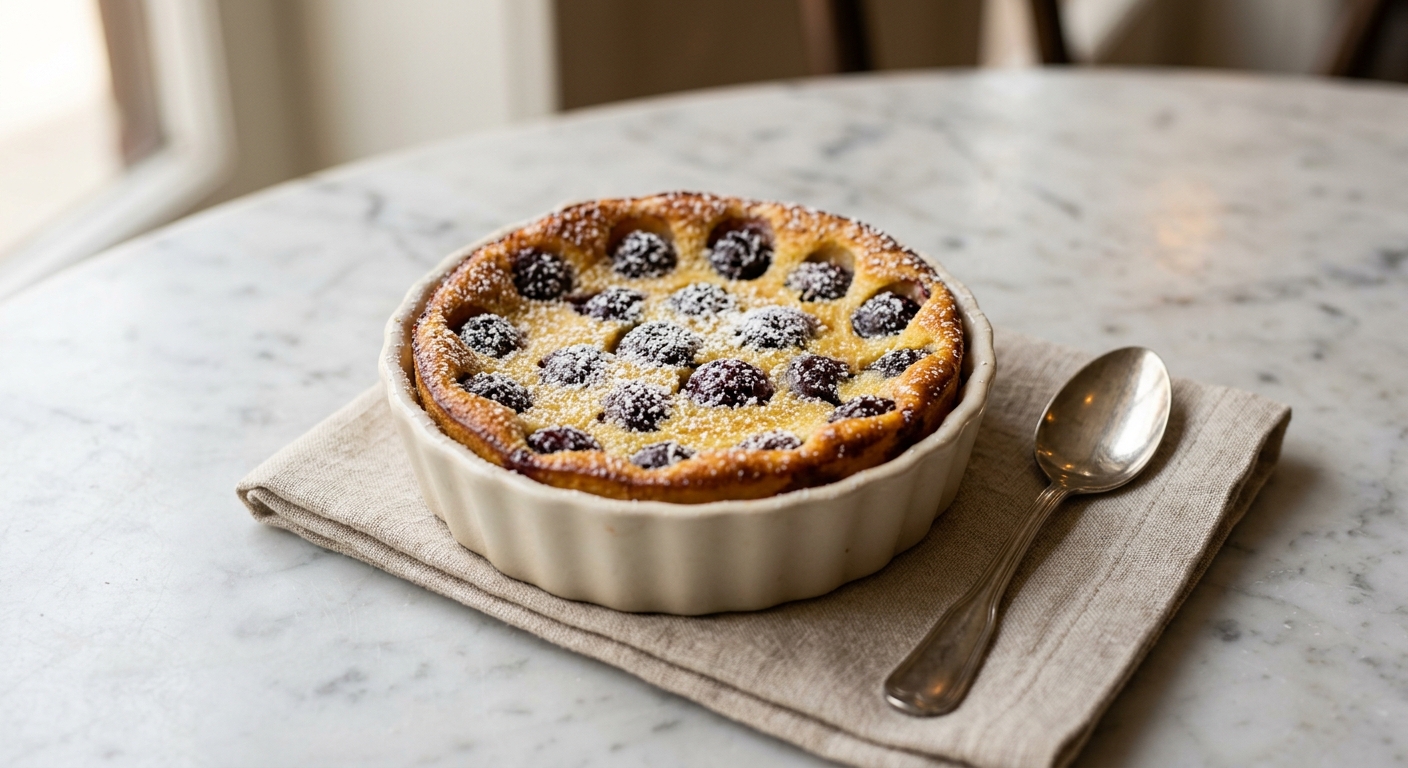
There is a particular kind of dessert magic that happens when something this simple produces something this beautiful. A classic clafoutis, born in the Limousin region of France, is little more than a pourable custard batter poured over fresh black cherries and baked until bronzed and billowing. It emerges from the oven dramatically puffed, dusted with powdered sugar, and smelling of warm vanilla and caramelized fruit. It will deflate within minutes, and that is perfectly fine. That gentle collapse is part of its charm, and the texture underneath, somewhere between a creamy flan and a tender Dutch baby, is entirely the point.
What sets this version apart is the decision to leave the cherries whole and unpitted, which is traditional and intentional. The pits release a faint almond-like flavor from the amygdalin they contain, adding a subtle, almost marzipan-like depth to the finished custard that you simply cannot replicate any other way. If you prefer to pit your cherries for easier eating, you absolutely can, but warn your guests either way. The batter itself is built on a higher ratio of eggs to flour than most recipes suggest, which keeps the texture closer to a baked custard than a pancake, and a touch of crème fraîche alongside the whole milk adds a gentle tang that keeps the sweetness in check.
This is a medium-difficulty recipe in name only. The technique is genuinely approachable, and the only real skill involved is resisting the urge to overbake it. It is perfect for confident beginners who want to impress, for weekend brunches, lazy summer dinner parties, or any occasion where you want something elegant without hours of effort. If you have fresh black cherries and thirty minutes, you have clafoutis.
Equipment Needed
Click on an item below to shop for the recommended items for this recipe on Amazon.
As an Amazon Associate, we earn from qualifying purchases.
8
Ingredients
- Greasing The Dish
- 500 gfresh black cherries (about 3.5 cups), stems removed, left whole and unpitted (or pitted if preferred)
- 3 largeeggs, at room temperature
- 100 ggranulated sugar (about 1/2 cup), divided
- 60 gall-purpose flour (about 1/2 cup, spooned and leveled)
- 240 mlwhole milk (1 cup), at room temperature
- 80 gcrème fraîche (about 1/3 cup) – sour cream works in a pinch
- 2 tsppure vanilla extract
- 1 tbspkirsch (cherry brandy), optional but traditional
- 20 gunsalted butter (about 1.5 tbsp), softened
- —Pinch of Colima Sea SaltMicroplastic Free Salt
- Dusting Before Serving
- —Powdered sugar
Ingredient Substitutions
Instructions
- Preheat your oven to 375°F (190°C). Generously butter a 10-inch ceramic or glass baking dish, a cast iron skillet, or a shallow gratin dish. Sprinkle 1 tablespoon of the granulated sugar evenly over the buttered surface and tip the dish to coat. This creates a lightly caramelized, lacy crust on the bottom.
- Arrange the cherries in a single layer across the bottom of the prepared dish. They should fit snugly but not be piled on top of each other.
- In a large bowl, whisk the eggs and remaining sugar together vigorously for about 1 minute until the mixture is pale and slightly thickened. Add the flour and salt, and whisk until smooth with no lumps. Pour in the milk gradually while whisking, then add the crème fraîche, vanilla extract, and kirsch if using. Whisk until the batter is completely smooth and pourable, about the consistency of heavy cream. Alternatively, blend all batter ingredients in a blender for 30 seconds for an ultra-smooth result.
- Pour the batter slowly and evenly over the cherries. The cherries may float slightly; that is perfectly fine.
- Bake on the center rack for 35 to 40 minutes, until the clafoutis is deeply golden on top, puffed at the edges, and just set in the center with only a very slight wobble when you gently shake the dish. A knife inserted 1 inch from the center should come out clean. Do not overbake – the center will firm up as it cools.
- Remove from the oven and let rest for at least 10 minutes. The clafoutis will deflate as it cools, which is expected. Dust generously with powdered sugar just before serving. Serve warm or at room temperature, directly from the dish.
- Butter a 7-inch or 8-inch round metal or ceramic baking dish that fits inside your air fryer basket. Sprinkle 1 tablespoon of sugar over the buttered surface to coat. Arrange the cherries in a single snug layer across the bottom of the dish.
- Prepare the batter exactly as in the oven method: whisk eggs and remaining sugar until pale, whisk in flour and salt, then gradually add milk, crème fraîche, vanilla, and kirsch. Whisk until perfectly smooth.
- Pour the batter over the cherries. The dish should be no more than two-thirds full to allow for puffing.
- Preheat your air fryer to 320°F (160°C) for 3 minutes. Place the dish carefully into the air fryer basket. Bake for 25 to 28 minutes. Check at 22 minutes: the top should be deep golden and the edges fully set. If the top is browning too quickly, lay a small piece of foil loosely over the dish for the last 5 minutes.
- The clafoutis is done when a knife inserted near the center comes out clean and the center has only a very faint wobble. Rest for 10 minutes in the dish before dusting with powdered sugar and serving.
- Place a 10-inch cast iron skillet over medium-low heat. Add the butter and let it melt and coat the pan. Sprinkle 1 tablespoon of sugar evenly over the base and let it cook undisturbed for 1 to 2 minutes until it just begins to caramelize at the edges and smells nutty. Do not let it burn.
- Carefully arrange the cherries in a single layer over the caramelized sugar base. Let them cook gently for 2 minutes to warm through and start releasing a little juice.
- Prepare the batter as in the oven method: whisk eggs and remaining sugar until pale, then whisk in flour and salt. Gradually add milk, crème fraîche, vanilla, and kirsch, whisking until completely smooth.
- Pour the batter over the cherries in the warm skillet. The bottom edges will begin to set almost immediately. Reduce the heat to low and cook uncovered on the stovetop for 10 to 12 minutes, until the batter is set about two-thirds of the way up the sides and the bottom is golden (you can lift the edge gently with a spatula to check), but the center is still liquid and jiggly.
- Move the oven rack to the top position and preheat the broiler to high. Slide the skillet under the broiler for 4 to 5 minutes, watching closely, until the top is deeply golden and puffed and the center is just set with a slight wobble. It will brown fast under the broiler, so do not walk away.
- Remove from the broiler and rest for 5 to 8 minutes. The center will firm up quickly. Dust with powdered sugar and serve directly from the skillet while warm.
Nutrition Per Serving
Per 1 serving (makes one 10-inch round clafoutis)
Why This Recipe Works
Clafoutis sits at the crossroads of a baked custard and a crêpe batter, and understanding that balance explains every ingredient choice here. The relatively high egg-to-flour ratio (3 eggs to just 60g of flour) means the structure of the batter comes primarily from egg proteins coagulating during baking rather than gluten development, which is why the finished texture is so tender and custardy rather than bready or cakey. Whisking the eggs vigorously with the sugar before adding the flour incorporates a little air and helps dissolve the sugar fully, which promotes even baking and that characteristic golden, lightly crisp top.
The crème fraîche is doing more than adding richness. Its mild acidity very slightly tenderizes the batter and provides a counterbalance to the sweetness of the cherries and sugar, making the flavor more complex without any single note overpowering the others. Buttering the dish and coating it with sugar is a technique borrowed from cake baking: as the clafoutis bakes, the sugar caramelizes against the hot dish, creating a subtly crisp, golden crust on the bottom and sides that you would never get from butter alone. This is a small step that makes a real textural difference.
The traditional practice of leaving the cherry pits in is grounded in real flavor science. Cherry pits contain amygdalin, a compound that breaks down during gentle heat into benzaldehyde, the same compound that gives marzipan and almond extract their characteristic aroma. The result is a faint, haunting nuttiness in the custard that is difficult to place but unmistakably present. It does not make the dessert unsafe to eat (the amounts released are negligible), but it does make it taste more authentically of summer. If your clafoutis ever comes out rubbery or tough, the culprit is almost always overbaking: pull it when the very center still has a slight tremble, and let carryover heat finish the job as it rests.
Baker’s Tips
- Bring your eggs and milk to room temperature before making the batter. Cold eggs can cause the batter to appear curdled or uneven, and a room-temperature batter bakes more evenly from the start.
- For the smoothest possible custard, make the batter in a blender: combine all batter ingredients and blend for 30 seconds. Let the foam settle for 5 minutes before pouring over the cherries.
- Do not skip the sugar coating on the buttered dish. It creates a delicate caramelized crust on the base and sides that is one of the best textural contrasts in the whole dessert.
- The clafoutis is done when the edges are fully set and puffed but the very center still has a gentle wobble, similar to a just-set cheesecake. It will firm up as it cools. Overbaking leads to a rubbery, eggy texture.
- If using jarred or frozen cherries, pat them very thoroughly dry with paper towels. Excess moisture will thin the batter, prevent proper setting, and make the bottom soggy.
- Serve warm or at room temperature, never piping hot, which lets the custard texture fully develop. A dollop of crème fraîche or a scoop of vanilla ice cream alongside is never a bad idea.
- Always dust with powdered sugar just before serving, not ahead of time, as it will absorb into the warm custard and disappear.
Variations
- Pear and Cardamom Clafoutis: Replace cherries with 2 ripe pears, peeled and thinly sliced, and add 1/2 tsp ground cardamom to the batter. Omit the kirsch and use 1 tbsp pear brandy instead.
- Blueberry and Lemon: Replace cherries with 400g fresh blueberries, add the zest of 1 lemon to the batter, and replace the kirsch with 1 tsp fresh lemon juice.
- Chocolate Cherry Clafoutis: Whisk 20g of Dutch-process cocoa powder into the flour before adding to the batter, and increase sugar by 20g. The bittersweet custard against the cherries is stunning.
- Dairy-Free Version: Replace the whole milk with full-fat oat milk, replace the crème fraîche with coconut cream, and use vegan butter to grease the dish. The texture will be slightly lighter but still delicious.
Troubleshooting & FAQ
My clafoutis is still completely liquid in the center after the recommended bake time. What happened?
Why is my clafoutis rubbery and eggy instead of silky and custard-like?
My clafoutis has a soggy, wet bottom. How do I prevent this?
The top of my clafoutis is browning too fast before the center is set. What should I do?
Can I make this without a 10-inch dish? I only have an 8-inch or a 9-inch.
Storage & Make-Ahead
- Storage: Cover the clafoutis loosely and refrigerate for up to 3 days. Reheat individual slices in a 300°F (150°C) oven for 8 to 10 minutes, or enjoy cold straight from the fridge (it is genuinely delicious this way). Clafoutis does not freeze well, as the custard texture becomes grainy after thawing.
- Make-Ahead: The batter can be made up to 24 hours ahead and stored covered in the refrigerator. Whisk it briefly before pouring over the cherries. The cherries can be arranged in the buttered dish and refrigerated up to 4 hours ahead. The fully baked clafoutis is best served the day it is made but holds well in the fridge for next-day enjoyment.