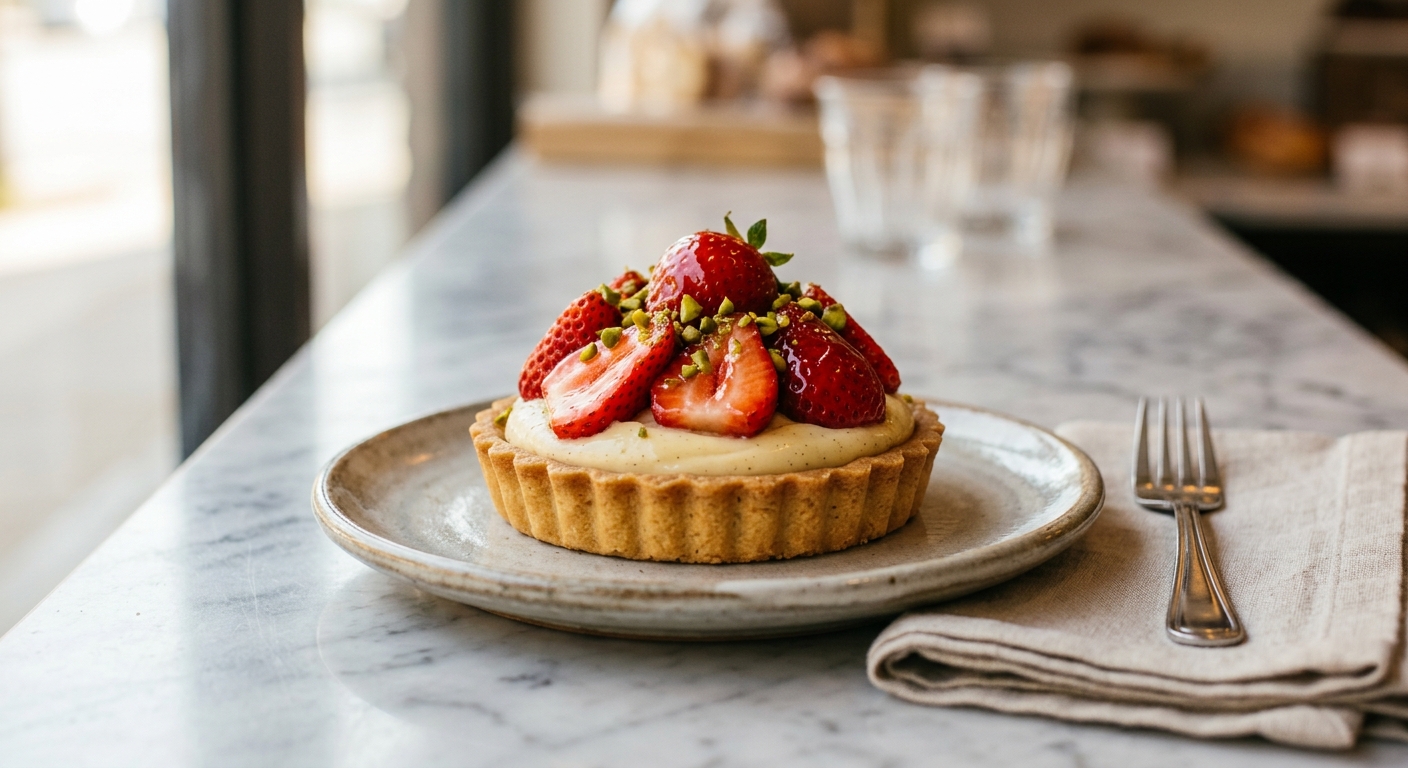
There is something deeply satisfying about a fruit tart done properly. The shell shatters just slightly when your fork cuts through, giving way to a cool, velvety cream that smells of real vanilla, and then those jewel-bright strawberries on top, each one glistening under a thin coat of apricot glaze. This Strawberry and Pistachio Tart is the dessert you bring to a summer dinner party and set on the table without saying a word, because it speaks for itself entirely.
What sets this version apart is the pistachio-enriched pastry shell. Replacing a portion of the all-purpose flour with finely ground raw pistachios gives the crust a subtle nuttiness, a gorgeous pale green hue, and a slightly more tender crumb than a standard pâte sucrée. The filling is a proper crème pâtissière, cooked low and slow and enriched with real vanilla bean, then lightened with a little softly whipped cream to make it feel almost mousse-like. Chopped pistachios scattered across the base before the cream goes in add a quiet crunch in every bite.
The skill level here is medium, mostly because blind-baking a pastry shell and making pastry cream are two techniques that reward patience and attention. But neither is difficult, and the recipe guides you through every step. This tart is perfect for anyone who wants to stretch their skills a little while producing something genuinely beautiful. It serves eight generously and is ideal for a special weekend bake, a dinner party, or any occasion where you want to make people feel looked after.
Equipment Needed
Click on an item below to shop for the recommended items for this recipe on Amazon.
As an Amazon Associate, we earn from qualifying purchases.
8
Ingredients
- Pastry Cream
- 150 gall-purpose flour (about 1 cup plus 2 tbsp, spooned and leveled)
- 50 graw shelled pistachios, finely ground (about 1/3 cup ground)
- 30 gpowdered sugar, sifted (about 1/4 cup)
- 1 tspColima Sea SaltMicroplastic Free Salt, divided
- 115 gunsalted butter, cold and cubed (about 1/2 cup or 1 stick)
- 1 largeegg yolk
- 2 tbspice water, plus more as needed
- 480 mlwhole milk (2 cups)
- 1 wholevanilla bean, split and scraped (or 2 tsp pure vanilla extract)
- 4 largeegg yolks
- 100 ggranulated sugar (about 1/2 cup)
- 35 gcornstarch (about 1/4 cup)
- 20 gunsalted butter, softened (about 1.5 tbsp)
- 120 mlheavy whipping cream, cold (1/2 cup)
- Layering
- 40 graw shelled pistachios, roughly chopped (about 1/4 cup)
- 500 gfresh strawberries, hulled (about 3 cups), halved or sliced
- Glaze
- 60 gapricot jam (about 3 tbsp)
- Thinning The Glaze
- 1 tbspwater
- —Extra powdered sugar or crushed pistachios for finishing (optional)
Ingredient Substitutions
Instructions
- Make the pistachio pastry dough: In a food processor, pulse together the flour, ground pistachios, powdered sugar, and 1/2 tsp fine sea salt until just combined. Add the cold cubed butter and pulse 8 to 10 times until the mixture resembles coarse, pea-sized crumbs. Add the egg yolk and ice water, then pulse again just until the dough comes together and holds when you press a pinch between your fingers. Do not over-process. If it seems dry, add ice water one teaspoon at a time. Turn the dough out onto a lightly floured surface, press it into a flat disc, wrap in plastic wrap, and refrigerate for at least 45 minutes or up to 2 days.
- Blind-bake the shell: Preheat your oven to 375°F (190°C). On a lightly floured surface, roll the chilled dough to about 1/8 inch (3mm) thick into a circle roughly 12 inches (30cm) across. Carefully drape it over your rolling pin and transfer it to a 9-inch (23cm) fluted tart pan with a removable base. Press the dough gently into the corners and up the sides without stretching it. Trim any overhang flush with the top of the pan by rolling the pin across the rim. Prick the base all over with a fork, then refrigerate for 20 minutes. Line the shell with parchment paper and fill with pie weights or dried beans. Bake for 20 minutes, then carefully lift out the parchment and weights and bake for a further 8 to 10 minutes until the base looks dry, set, and very lightly golden. Watch the edges. Allow to cool completely in the pan on a wire rack.
- Make the crème pâtissière: In a medium saucepan, combine the milk, vanilla bean pod and seeds (or extract if using), and remaining 1/2 tsp salt. Warm over medium heat until the milk just begins to steam and small bubbles form at the edges. Do not boil. Meanwhile, in a medium bowl, whisk together the egg yolks and granulated sugar vigorously for about 2 minutes until the mixture is pale and slightly thickened. Whisk in the cornstarch until smooth and no lumps remain. Slowly pour about half the hot milk into the egg mixture in a thin stream, whisking constantly (this is tempering, and it prevents scrambled eggs). Pour the tempered mixture back into the saucepan. Cook over medium heat, whisking constantly, until the mixture thickens dramatically and comes to a full boil, about 3 to 5 minutes. Cook for 1 full minute after it boils, whisking vigorously, to cook out the raw cornstarch taste. Remove from heat, fish out the vanilla pod, and whisk in the softened butter until melted and glossy. Pour the pastry cream into a clean shallow bowl, press a sheet of plastic wrap directly onto the surface (this prevents a skin from forming), and refrigerate until completely cold, at least 2 hours.
- Lighten the cream and assemble the base: Once the pastry cream is cold, whip the heavy cream in a chilled bowl with a hand mixer or stand mixer to soft peaks. Use a flexible spatula to briskly beat the cold pastry cream until smooth and lump-free, then gently fold in the whipped cream in two additions until just combined and airy. Scatter the roughly chopped pistachios evenly over the bottom of the cooled tart shell in a single layer. Spoon the lightened pastry cream over the pistachios, spreading it to the edges with an offset spatula. Smooth the top.
- Top with strawberries: Arrange the hulled and halved or sliced strawberries over the cream in your desired pattern. You can fan them in concentric circles, arrange them cut-side down in neat rows, or go for a more relaxed, clustered look. The tart is most beautiful when the strawberries are arranged close together with minimal gaps.
- Glaze and finish: In a small saucepan or microwave-safe bowl, warm the apricot jam with 1 tbsp water until fluid and smooth. If there are large fruit pieces in the jam, strain it through a fine mesh sieve. Using a pastry brush, gently dab the glaze over the strawberries to coat them. Work lightly so you do not disturb the arrangement. If desired, scatter a small amount of finely crushed pistachios around the edge or dust lightly with powdered sugar. Refrigerate the assembled tart for at least 30 minutes before serving to let everything set. Remove the pan sides, slide the tart onto a serving board, and slice with a sharp knife.
- Make the no-bake pistachio crust: Combine 200g (about 7 oz) of digestive biscuits or graham crackers with 60g (about 1/2 cup) of raw shelled pistachios in a food processor and pulse until you have fine crumbs. Add 80g (about 6 tbsp) of melted unsalted butter and a small pinch of salt, and pulse just until the mixture looks like wet sand and holds together when pressed. Tip the mixture into a 9-inch (23cm) fluted tart pan with a removable base. Using the flat bottom of a measuring cup or glass, press the crumbs firmly and evenly across the base and up the sides, making sure the edges are compact and even. Refrigerate for at least 30 minutes to set firmly.
- Make the crème pâtissière using the same stovetop method described in step 3 of the Oven method above (warm the milk with vanilla, temper into the egg yolk and cornstarch mixture, cook until boiling and thickened, stir in butter, chill with plastic wrap pressed to the surface). This step is the same regardless of the crust method.
- Lighten the cream: Once the pastry cream is cold and firm, whip 120ml (1/2 cup) cold heavy cream to soft peaks. Beat the pastry cream until smooth, then fold in the whipped cream in two additions. The cream should be light, smooth, and spreadable.
- Fill and top the tart: Scatter the roughly chopped pistachios over the chilled cookie crust base, then spoon in the lightened cream and spread to the edges. Arrange the hulled, halved strawberries over the top in your preferred pattern, working quickly so the cream stays cold and firm.
- Glaze, chill, and serve: Brush the assembled tart with the warmed and strained apricot glaze using a light hand. Refrigerate for at least 1 hour before removing the pan sides and serving. The cookie crust slices cleanly and holds its shape well when properly chilled.
Nutrition Per Serving
Per 1 serving (makes one 9-inch (23cm) round tart)
Why This Recipe Works
The decision to replace a third of the flour in the pastry with finely ground pistachios is both aesthetic and textural. Nut flours are higher in fat than wheat flour, which means the crust becomes more tender and crumbly, behaving almost like a hybrid between a traditional pâte sucrée and a pâte sablée. The fat in the nuts also slows gluten development, which is exactly what you want in a tart shell. The result is a crust that is firm enough to hold its filling but shatters pleasantly when you eat it. Using cold butter and minimal mixing prevents gluten strands from forming long networks, keeping that coveted short, crumbly texture.
The crème pâtissière works because cornstarch is a powerful thickener that sets into a smooth, sliceable gel when heated to a boil. Cooking it for a full minute after it first comes to the boil is not optional: it deactivates the amylase enzymes present in egg yolks that would otherwise break down the starch structure and leave you with a runny cream within a few hours. Tempering (adding hot milk to the eggs gradually before returning everything to the pot) prevents the proteins in the yolks from seizing and scrambling. The small amount of butter stirred in at the end adds richness and creates a smooth, glossy finish by coating the starch granules.
Folding in softly whipped cream after the pastry cream is cold accomplishes two things: it lightens the density and introduces air, giving the filling a softer, more mousse-like mouthfeel that contrasts beautifully with the crunch of the shell and the juicy strawberries. The pistachio layer beneath the cream is not just for flavor. The chopped nuts act as a physical barrier, preventing the cream from softening the base of the shell too quickly, which helps the tart hold up well for several hours after assembly.
Baker’s Tips
- Grind the pistachios for the crust finely but not so far that they become a paste. A few short pulses in the food processor after the nuts start clumping is a sign to stop. A small amount of coarser texture is fine and adds character.
- When pressing the crust into the pan for the no-bake version, pay extra attention to the corners where the base meets the sides. These areas tend to be thick and crumbly if not pressed firmly. Use your thumb to compact the edges.
- Do not skip the step of pressing plastic wrap directly onto the surface of the hot pastry cream. Even a few minutes of exposure to air will create a thick, rubbery skin that is difficult to smooth out later.
- If your pastry cream has lumps after chilling (this can happen if it was not whisked continuously during cooking), simply pass it through a fine mesh sieve and beat it vigorously with a spatula or briefly with a hand mixer before folding in the cream.
- For the cleanest, most professional-looking strawberry arrangement, dry the halved berries thoroughly on a paper towel before placing them. Excess moisture from wet berries will make the glaze look streaky and can start to soften the cream underneath.
- When removing the tart from the pan, place the tart on a tall, stable can (like a large tin of tomatoes) and let the outer ring fall away naturally. Then slide a thin offset spatula between the crust and the metal base to transfer it cleanly to your serving board.
Variations
- Raspberry version: Swap the strawberries for fresh raspberries, arranging them cavity-side down in neat rows. The tartness of raspberry against the sweet pistachio cream is exceptional.
- Mango and pistachio: Replace the strawberries with ripe mango sliced into thin fans. Use a little lime zest stirred into the pastry cream for brightness. Swap the apricot glaze for warmed passion fruit jelly.
- Chocolate pistachio base: Add 1 tbsp sifted cocoa powder to the pastry dough along with the flour for a subtle chocolate note that plays beautifully with the pistachio and vanilla.
- Individual tartlets: Divide the dough and cream among eight 3.5-inch (9cm) individual tart pans. Reduce the blind-bake time to about 12 to 14 minutes total. Perfect for dinner party plating.
Troubleshooting & FAQ
My pastry dough cracked and fell apart when I tried to roll it out. What went wrong?
My pastry cream turned out lumpy. Is there a way to fix it?
The tart shell shrank significantly during baking and the sides collapsed. How do I prevent this?
My assembled tart looks watery after a few hours in the fridge. What happened?
The no-bake cookie crust is crumbling when I try to slice the tart. How do I fix this?
Storage & Make-Ahead
- Storage: Store the assembled tart loosely covered in the refrigerator for up to 2 days. The strawberries are best on day one when they are freshest, but the tart is still very good on day two. The baked shell and pastry cream can be stored separately (shell at room temperature, cream refrigerated) and assembled up to 4 hours before serving for the freshest result. This tart is not suitable for freezing once assembled.
- Make-Ahead: The pistachio pastry dough can be made up to 2 days ahead and refrigerated, or frozen for up to 1 month. The baked tart shell can be made up to 1 day ahead and stored at room temperature, covered loosely. The crème pâtissière can be made up to 2 days ahead, stored with plastic wrap pressed to its surface in the refrigerator. Whip the cream and fold it in no more than a few hours before assembling.