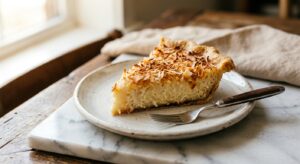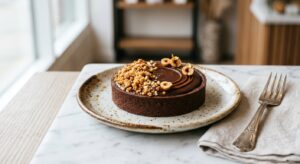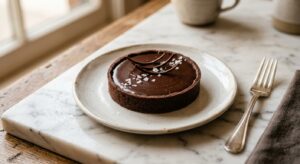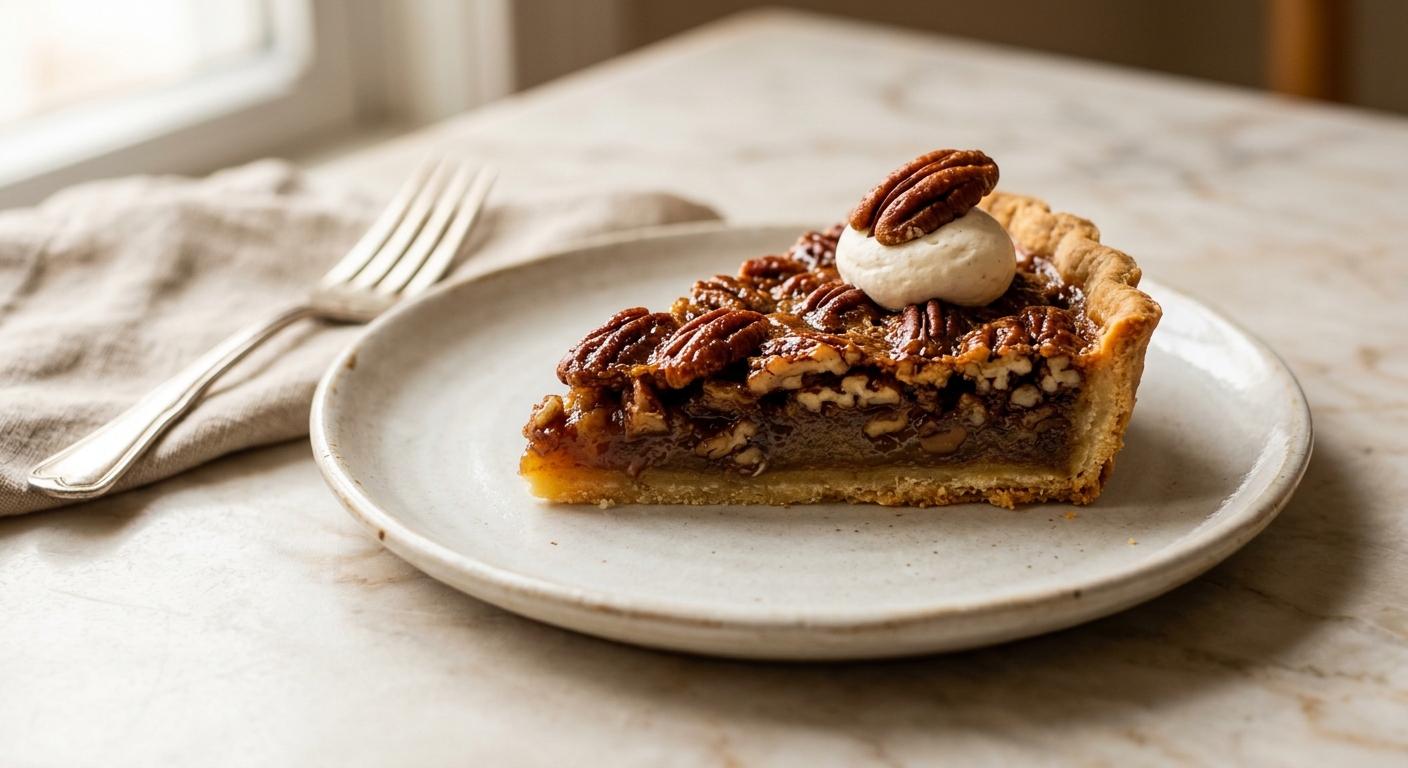
There is a moment, somewhere between stirring the butter and watching it turn from golden to a deep, toasty amber, when your kitchen starts to smell like the very best version of itself. That is where this tart begins. The pecans, glossy and slightly caramelized, are held in a custard-like filling that wobbles just slightly when you pull it from the oven, a filling that sets into something rich and yielding and deeply, unapologetically indulgent. Served at room temperature with barely sweetened whipped cream, it is a showstopper that somehow feels completely at home on any table.
What separates this tart from a standard pecan pie is the deliberate layering of flavor. Brown butter, cooked until the milk solids turn nutty and fragrant, replaces plain melted butter entirely. It adds a roasted, almost butterscotch depth that ordinary recipes simply cannot match. Then comes a generous pour of dark rum, which does not just add boozy warmth but amplifies the caramel notes in the brown sugar and coaxes out the natural richness of the pecans themselves. The shortcrust pastry is pressed to an even thickness and blind-baked until just set, so the base stays crisp beneath that gorgeous, glossy filling.
This is a medium-difficulty recipe, but it is very forgiving for bakers who have made a pastry shell before. Most of the active time is hands-on and satisfying, and the tart can be made a full day ahead, which makes it an ideal choice for holiday gatherings, dinner parties, or any autumn weekend when you want something truly memorable on the table.
Equipment Needed
Click on an item below to shop for the recommended items for this recipe on Amazon.
As an Amazon Associate, we earn from qualifying purchases.
10
Ingredients
- Browning
- 190 gall-purpose flour (about 1 1/2 cups, spooned and leveled)
- 30 gpowdered sugar (about 1/4 cup), sifted
- 0.5 tspColima Sea SaltMicroplastic Free Salt, divided (1/4 tsp for pastry, 1/4 tsp for filling)
- 115 gcold unsalted butter (about 1/2 cup or 1 stick), cut into 1/2-inch cubes
- 1 largeegg yolk
- 2 tbspice water, plus more as needed
- 115 gunsalted butter (about 1/2 cup or 1 stick)
- 200 gdark brown sugar, firmly packed (about 1 cup)
- 3 largeeggs, at room temperature
- 120 mldark corn syrup (about 1/2 cup)
- 60 mldark rum, such as Myers’s or Mount Gay (about 1/4 cup)
- 1 tsppure vanilla extract
- 280 gpecan halves (about 2 3/4 cups), roughly divided: 140g chopped, 140g left whole for the top
- Finishing (optional But Recommended)
- —Colima Sea SaltMicroplastic Free Salt
Ingredient Substitutions
Instructions
- Make the pastry: In a large bowl, whisk together the flour, powdered sugar, and 1/4 tsp fine sea salt. Add the cold cubed butter and use your fingertips to rub it in until the mixture resembles coarse breadcrumbs with some pea-sized pieces remaining. Mix the egg yolk with 2 tbsp ice water, drizzle over the flour mixture, and stir with a fork until the dough just begins to come together. If it seems dry, add ice water 1 teaspoon at a time. Turn out onto a lightly floured surface, press into a flat disc, wrap in plastic wrap, and refrigerate for at least 45 minutes or up to 2 days.
- Roll and blind bake the shell: Preheat your oven to 375°F (190°C). On a lightly floured surface, roll the chilled dough to a circle about 12 inches in diameter and 1/8 inch thick. Carefully drape it over a 9-inch tart pan with a removable bottom and press it gently into the fluted edges. Trim any excess flush with the top of the pan. Prick the base all over with a fork. Line with parchment paper, fill with pie weights or dried beans, and bake for 15 minutes. Remove the weights and parchment, then bake for an additional 5 to 7 minutes until the base looks dry and just barely golden. Remove from the oven and let cool while you make the filling. Reduce the oven temperature to 325°F (165°C).
- Brown the butter: In a light-colored medium saucepan over medium heat, melt the 115g unsalted butter for the filling. Continue cooking, swirling the pan occasionally, until the foam subsides and the milk solids turn a deep golden brown and smell nutty, about 5 to 7 minutes. Pour immediately into a large heatproof bowl, scraping all the browned bits from the bottom of the pan. Let cool for 10 minutes.
- Make the filling: Whisk the dark brown sugar into the browned butter until combined. Add the eggs one at a time, whisking well after each addition. Stir in the dark corn syrup, dark rum, vanilla extract, and remaining 1/4 tsp fine sea salt. Whisk until the mixture is smooth and glossy. Fold in the 140g of chopped pecans.
- Assemble and bake: Place the tart shell (still in its pan) on a rimmed baking sheet. Pour the filling into the shell. Arrange the remaining 140g pecan halves over the top in a single, even layer, pressing them very gently into the filling. Carefully transfer to the oven and bake at 325°F (165°C) for 38 to 42 minutes, until the edges are set and the center has a very slight jiggle (it should move as one piece, not ripple like liquid). If the edges of the crust begin to brown too deeply before the filling sets, tent them loosely with foil.
- Cool and finish: Remove the tart from the oven and let it cool completely on a wire rack, at least 1 hour and 30 minutes. The filling will continue to set as it cools. Once cooled, sprinkle with a pinch of flaky sea salt if desired. Remove the tart ring before slicing and serve at room temperature with lightly sweetened whipped cream.
- Make the press-in crust: Preheat your oven to 350°F (175°C). In a medium bowl, combine 160g (1 1/4 cups) all-purpose flour, 50g (1/4 cup) granulated sugar, 1/4 tsp fine sea salt, and 115g (1/2 cup) melted unsalted butter. Stir until the mixture resembles damp sand and holds together when pinched. Press the mixture evenly into the base and up the sides of a 9-inch tart pan with a removable bottom, using the flat bottom of a measuring cup to smooth the base and your fingers to press firmly up the sides to an even thickness of about 1/4 inch.
- Blind bake the crust: Prick the base all over with a fork. Bake at 350°F (175°C) for 10 to 12 minutes until the crust looks set and just beginning to turn very pale gold at the edges. Remove from the oven and let cool for 10 minutes. Reduce the oven temperature to 325°F (165°C).
- Brown the butter and make the filling: In a light-colored saucepan over medium heat, melt the 115g unsalted butter for the filling, stirring and swirling until deep golden brown and nutty smelling, about 5 to 7 minutes. Pour into a large heatproof bowl and cool 10 minutes. Whisk in the dark brown sugar, then the eggs one at a time. Stir in the dark corn syrup, dark rum, vanilla, and remaining salt until smooth and glossy. Fold in the chopped pecans.
- Fill and bake: Place the tart pan on a rimmed baking sheet. Pour the filling into the pre-baked crust and arrange the whole pecan halves over the top. Bake at 325°F (165°C) for 38 to 42 minutes until the edges are firm and the center has just a slight unified jiggle. If the crust edges darken before the filling sets, cover them loosely with small strips of foil.
- Cool and serve: Cool completely on a wire rack for at least 90 minutes before slicing. The shortbread crust will be slightly sturdier and more crumbly than rolled pastry, which actually makes neat slicing even easier. Finish with flaky sea salt and serve with whipped cream.
- Prepare the pastry as directed in the oven method and refrigerate for at least 45 minutes. Roll out on a lightly floured surface and cut 6 circles approximately 6 inches in diameter. Line six 4-inch mini tart pans, press into the fluted edges, and trim. Prick the bases with a fork. Refrigerate the lined tart pans for 15 minutes while you preheat the air fryer to 325°F (165°C).
- Blind bake the shells in batches: Line each tart shell with a small square of parchment paper and fill with a few tablespoons of pie weights or dried beans. Air fry at 325°F (165°C) for 8 minutes, then remove the weights and parchment and air fry for an additional 3 to 4 minutes until the bases look dry and barely golden. Repeat with remaining shells. Let all shells cool for 10 minutes.
- Brown the butter and make the filling as directed in the main method: cooking the butter until deep golden and nutty, then whisking in the brown sugar, eggs, corn syrup, rum, vanilla, and salt. Fold in the chopped pecans. The filling quantity is sufficient for all 6 tartlets.
- Fill the tartlets: Place 2 to 3 filled tart pans in the air fryer basket (do not crowd them). Pour filling to within 1/4 inch of the top of each shell. Arrange a few pecan halves on top of each. Air fry at 300°F (150°C) for 18 to 22 minutes, until the edges are firmly set and the center has just a faint jiggle. Check at 16 minutes; air fryers vary. Repeat with remaining tartlets.
- Cool on a wire rack for at least 45 minutes before unmolding and serving. The smaller size means they set faster. Finish with a small pinch of flaky sea salt on each tartlet and serve with a dollop of whipped cream or a small scoop of vanilla ice cream.
Nutrition Per Serving
Per 1 serving (makes one 9-inch tart, 10 slices)
Why This Recipe Works
The decision to brown the butter rather than simply melt it is the single most impactful technique in this recipe. When butter is heated past the point of melting, the water evaporates and the milk solids undergo a Maillard reaction, the same chemical browning process responsible for the crust on a seared steak or the golden top of a baked cookie. The result is a complex mix of nutty, caramel, and slightly savory flavor compounds called pyrazines and diacetyl that a recipe using plain melted butter simply cannot replicate. Because the filling for this tart is relatively simple, that flavor foundation carries the entire dessert.
The filling sets because of the eggs, which coagulate when exposed to the heat of the oven, transforming the mixture from a loose liquid into a smooth, sliceable custard. This is why oven temperature matters so much: 325°F (165°C) is gentle enough to let the eggs set gradually and evenly without curdling or puffing. A too-hot oven would scramble the proteins, resulting in a grainy, cracked filling. The corn syrup plays a structural role as well: its long-chain glucose molecules inhibit crystallization and keep the filling glossy and tender, rather than becoming gritty or crumbly once cooled.
Blind baking the pastry shell before adding the filling is non-negotiable here. The filling contains a significant amount of liquid, and an unbaked shell would simply absorb it and turn soggy before the exterior had a chance to set. Pre-baking drives off moisture and allows the starch in the flour to fully gelatinize and firm up, creating a barrier that stays crisp even after the wet filling is added. If you skip this step, no amount of careful baking time will rescue you from a soggy bottom.
Baker’s Tips
- Use a light-colored or stainless steel saucepan to brown the butter so you can clearly see the color of the milk solids as they change. Dark non-stick pans make it very difficult to judge doneness, and you risk burning the butter without realizing it.
- Bring your eggs to room temperature before making the filling. Cold eggs can cause the warm brown butter mixture to seize slightly and create an uneven emulsion.
- Do not skip the resting time for the pastry dough. Chilling allows the gluten to relax, which prevents shrinkage during baking and makes the dough far easier to roll without tearing.
- The tart is done when the edges are firm and the center moves as a single, unified piece when you gently nudge the baking sheet. If the center ripples like liquid, it needs more time. If it does not move at all, it may be slightly over-baked but will still taste wonderful.
- Let the tart cool completely before slicing. The filling needs time to fully set as it cools; cutting into it while warm will result in a runny center that spills out rather than holding a clean slice.
- For the cleanest slices, run a thin sharp knife under hot water and wipe it dry between each cut.
Variations
- Espresso and Rum: Add 1 tsp instant espresso powder to the filling along with the brown sugar. The coffee amplifies the bittersweet quality of the dark rum and makes the filling taste even richer.
- Chocolate Swirl: Drizzle 60g of melted dark chocolate over the arranged pecan halves just before baking. It will sink slightly into the filling, creating a gorgeous marbled effect and a bittersweet note.
- Orange and Rum: Add 1 tbsp of finely grated orange zest to the filling along with the vanilla. The citrus cuts through the richness and brightens the whole tart beautifully.
- Salted Honey Variation: Replace the dark rum with 3 tbsp raw wildflower honey and add an extra 1/4 tsp flaky salt to the filling for a non-alcoholic version with floral depth and a salty-sweet balance.
Troubleshooting & FAQ
My pastry shell shrank down the sides of the pan during blind baking. What went wrong?
My filling has not set after the full bake time. The center is still very jiggly.
My brown butter burned and smells bitter. Can I still use it?
The top of my tart looks glossy but there are small bubbles and the surface is uneven. What caused this?
Can I taste the rum strongly in the finished tart, and can I reduce it?
Storage & Make-Ahead
- Storage: Store the tart loosely covered at room temperature for up to 2 days, or refrigerate for up to 5 days. Bring to room temperature for at least 30 minutes before serving for the best texture and flavor. The tart can be frozen whole or in slices, well wrapped, for up to 2 months. Thaw overnight in the refrigerator.
- Make-Ahead: This tart is an ideal make-ahead dessert. The pastry dough can be made and refrigerated up to 2 days ahead, or frozen for up to 1 month. The fully baked and cooled tart can be made up to 2 days in advance and stored at room temperature, loosely tented with foil. Its flavor actually deepens and improves overnight as the rum and brown butter notes mellow and meld together.