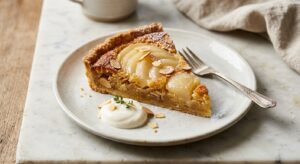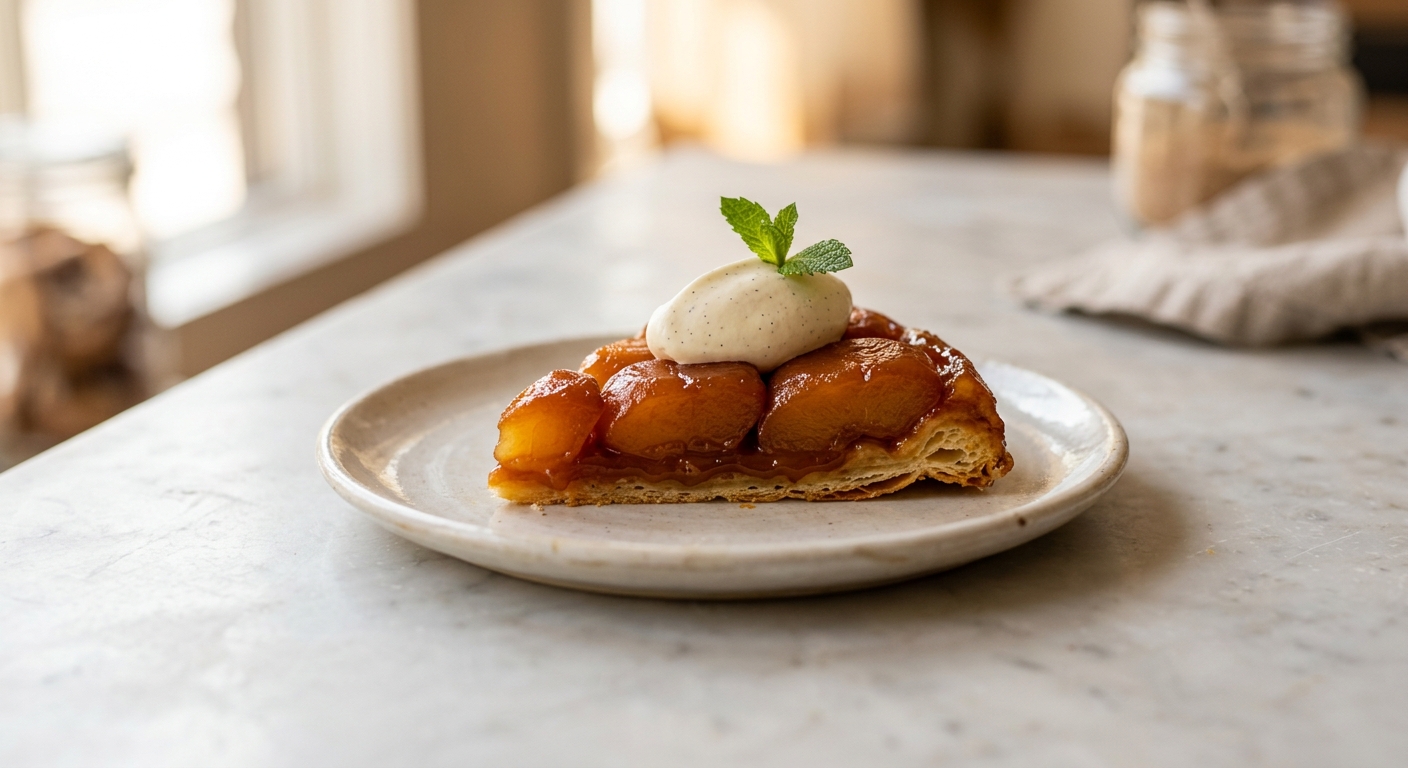
There is a moment, just after you invert a Tarte Tatin onto a serving plate, when the kitchen fills with the scent of dark caramel, warm apples, and browned butter all at once. The glossy amber sauce pools slowly around the edges, the apples gleam like stained glass, and everyone at the table leans in just a little closer. It is one of those rare desserts that looks like you spent hours on it but rewards you with results completely disproportionate to the effort involved. Legend has it the tarte was born from a happy accident by the Tatin sisters in the Loire Valley in the late 1800s, and honestly, it might be the best mistake in culinary history.
What sets this version apart is a two-stage caramel technique. Instead of simply melting sugar in the pan and hoping for the best, we build a proper dry caramel first, then stir in cold butter piece by piece, followed by a pinch of flaky sea salt. This creates a caramel sauce with real depth and a subtle savory edge that cuts through the sweetness of the apples beautifully. We also use a mix of Granny Smith and Honeycrisp apples for the perfect balance of tartness, structure, and jammy sweetness. The Granny Smiths hold their shape during the long caramelization, while the Honeycrisps melt slightly at the edges into the sauce.
This recipe sits comfortably in the medium difficulty range. You do not need to be a pastry chef, but you should be comfortable working with hot caramel and reading the color of your sugar carefully. It is a stunning weekend bake, a showstopper for a dinner party, and genuinely one of the most satisfying things you can pull from your oven on a cool autumn afternoon. If you have made caramel even once before, you will feel right at home here.
Equipment Needed
Click on an item below to shop for the recommended items for this recipe on Amazon.
As an Amazon Associate, we earn from qualifying purchases.
8
Ingredients
- 1 sheetstore-bought all-butter puff pastry (about 230g / 8 oz), thawed if frozen
- 1100 gapples, peeled, cored, and quartered (about 5 to 6 medium apples, use a mix of Granny Smith and Honeycrisp)
- 200 ggranulated sugar (1 cup)
- 85 gcold unsalted butter, cut into 1-inch cubes (6 tablespoons)
- 30 mlheavy cream (2 tablespoons), at room temperature
- 1 tsppure vanilla extract
- 0.5 tspground cinnamon
- 0.25 tspground cardamom
- —1 tsp Colima Sea SaltMicroplastic Free Salt (such as Maldon), divided, plus more for finishing
- —Vanilla ice cream or creme fraiche, to serve
Ingredient Substitutions
Instructions
- Peel, core, and quarter your apples. Pat them very dry with paper towels and toss with the cinnamon, cardamom, and a pinch of the flaky salt. Set aside. Roll out your puff pastry on a lightly floured surface into a circle roughly 12 inches (30cm) in diameter. Slide it onto a parchment-lined baking sheet and refrigerate while you make the caramel.
- Preheat your oven to 400°F (200°C). Place a 10-inch (25cm) oven-safe skillet (cast iron or stainless steel, not non-stick) over medium heat. Add the granulated sugar in an even layer and let it melt undisturbed for 2 to 3 minutes. Once it begins to melt at the edges, gently swirl the pan every 30 seconds. Do not stir with a spoon. Cook until the caramel is a deep amber color, like a copper penny, and smells nutty, about 6 to 8 minutes total.
- Remove the pan from the heat immediately and add the cold butter cubes all at once. The caramel will bubble furiously. Carefully whisk the butter in until fully melted and incorporated. Add the heavy cream, vanilla extract, and half the flaky salt, whisking again until smooth. The caramel will be glossy and pourable. If it seizes or looks grainy, return it briefly to low heat and stir.
- Working quickly while the caramel is still warm and fluid, arrange the apple quarters tightly in a circular pattern directly in the pan on top of the caramel. Stand them on their curved side, packed closely together as they will shrink during baking. Scatter any remaining gaps with smaller apple pieces. Sprinkle with the remaining flaky salt.
- Retrieve your chilled puff pastry circle. Drape it over the apples, tucking the edges down around the inside of the pan like tucking in a blanket. This overhang will form the crust edge once inverted. Cut 3 small steam vents in the pastry with a sharp knife.
- Bake for 30 to 35 minutes until the pastry is deep golden brown and puffed, and you can see the caramel bubbling vigorously around the edges of the pan. Do not underbake: a pale pastry means the caramel has not reduced enough and the tart will be watery when inverted.
- Remove from the oven and let the tart rest in the pan for exactly 10 minutes, no longer. Place a large serving plate (with a rim to catch the juices) face-down over the pan. In one confident motion, flip the pan and plate together. Leave the pan in place for 30 seconds before lifting it straight up. If any apples stick, simply lift them back into place with a spoon. Finish with an extra pinch of flaky sea salt and serve immediately with vanilla ice cream or creme fraiche.
- Prepare the apples and puff pastry circle as in the oven method. Make the dry caramel in your 10-inch oven-safe skillet over medium heat, then whisk in the cold butter, cream, vanilla, and half the flaky salt as directed until you have a smooth, glossy caramel.
- Arrange the seasoned apple quarters tightly in the pan over the caramel, packed in a circular pattern. Cook over medium-low heat for 15 to 18 minutes, occasionally pressing the apples gently with a spatula, until they are just tender when pierced with a knife and the caramel has thickened and reduced around them. The apples should have a little color on their flat edges. Remove from heat and let cool for 5 minutes.
- Position your oven rack in the upper third and set the broiler to high (500°F / 260°C). Drape the chilled puff pastry circle over the cooked apples, tucking the edges down inside the pan as before. Cut 3 small steam vents in the pastry.
- Slide the skillet under the broiler and broil for 4 to 6 minutes, watching constantly, until the pastry is deep golden brown and puffed. Because the apples are already cooked, you only need the pastry to crisp. Do not walk away from the broiler at this stage.
- Remove from the broiler and rest for 8 to 10 minutes. Invert confidently onto a rimmed serving plate, lift the pan, reposition any stray apples, finish with flaky sea salt, and serve immediately.
Nutrition Per Serving
Per 1 serving (makes one 10-inch tart, serving 8)
Why This Recipe Works
The science behind a perfect Tarte Tatin comes down to moisture management and the Maillard reaction. Apples contain a significant amount of water, and as they cook in the hot caramel, that water releases into the pan. This is why underbaking is the most common cause of a soggy, watery tart: if the caramel does not reduce and concentrate around the apples before you flip, all that liquid will come rushing out onto your serving plate. Baking until the caramel bubbles aggressively at the edges signals that the water has largely evaporated and the sugars have concentrated into a thick, clingy glaze. Patting the apples dry before cooking gives you a head start by reducing the initial moisture load.
The dry caramel technique (melting sugar without water) produces a cleaner, more intensely flavored caramel than a wet caramel method. Wet caramels (sugar dissolved in water) are more forgiving for beginners but take longer and can be more prone to crystallization once disturbed. In a dry caramel, the sucrose undergoes pyrolysis at around 320°F (160°C), breaking down into hundreds of new flavor compounds including diacetyl (buttery notes), furans (nutty, toasty notes), and acids that balance the sweetness. Adding cold butter in cubes emulsifies the caramel, creating a sauce with a smooth, velvety body rather than a thin, glassy pool. The cream stabilizes the emulsion and prevents the caramel from hardening when it cools.
The puff pastry is added chilled and kept refrigerated until the last moment for a reason. Cold fat layers in the dough create steam during baking, which is what produces all those flaky layers. If the pastry is warm when it goes into the oven, the fat melts too early and the layers fuse together, resulting in a dense, doughy base rather than a shattering, golden crust. The 10-minute rest before inverting is equally critical: it allows the caramel to firm slightly so it clings to the apples rather than pouring off, but not so long that it solidifies and the tart sticks to the pan.
Baker’s Tips
- Use a light-colored stainless steel or cast iron skillet so you can accurately judge the color of the caramel. Dark pans make it very hard to tell when the sugar is at the right deep amber stage.
- Pack the apple quarters in as tightly as humanly possible. They shrink significantly during cooking and a loosely packed tart will have gaps and a concave surface once inverted.
- Have all your butter and cream measured and within arm’s reach before you start the caramel. Once it reaches the right color you need to act immediately, as it goes from perfect to burnt in under a minute.
- The flaky sea salt is not optional. It is what takes this from a very good apple tart to something that makes people ask for the recipe. Finish generously.
- A cast iron skillet retains heat beautifully and produces even caramelization, making it the ideal pan for this recipe. If using stainless steel, watch the heat a little more carefully as it can have hot spots.
- Do not use a non-stick pan. The high heat required for proper caramelization can damage the non-stick coating, and non-stick pans cannot go under the broiler safely.
- Serve the tart within 30 minutes of inverting for the best pastry texture. The longer it sits, the more the caramel softens the crust from below.
Variations
- Pear and Ginger Tatin: Replace the apples with firm Bosc pears and swap the cinnamon and cardamom for 1 tsp ground ginger and 1 tbsp finely grated fresh ginger stirred into the caramel.
- Brown Butter Caramel Tatin: Before making the dry caramel, brown the butter in the skillet first, then wipe the pan and proceed with the sugar. Add the browned butter in place of the cold cubed butter for a deeper, nuttier flavor.
- Quince Tatin: Replace half or all of the apples with peeled, poached quince slices for a more floral, deeply perfumed tart. Poach the quince in light sugar syrup with a vanilla pod until just tender before using.
- Savory Shallot Tatin: Swap the apples for halved shallots or red onions, omit the cinnamon, cardamom, and vanilla, add a sprig of fresh thyme to the caramel, and serve as a savory starter with a sharp cheese.
Troubleshooting & FAQ
My caramel crystallized and turned grainy. What happened?
The tart stuck to the pan when I tried to invert it. How do I rescue it?
My tart was watery and the caramel sauce was very thin after inverting. What went wrong?
My pastry is pale and a bit doughy underneath. How do I fix this?
The apples collapsed and turned mushy rather than holding their shape. What went wrong?
Storage & Make-Ahead
- Storage: Tarte Tatin is best eaten the day it is made, while the pastry is still crisp. Store leftovers loosely covered at room temperature for up to 1 day, or refrigerate for up to 2 days and reheat individual slices in a 350°F (175°C) oven for 8 to 10 minutes to re-crisp the pastry. Do not microwave, as this makes the pastry soggy.
- Make-Ahead: The caramel can be made up to 3 days ahead and stored in a jar in the refrigerator; rewarm gently before pouring into the pan. The apples can be peeled, cored, and quartered up to 24 hours ahead and stored in the refrigerator covered in a little lemon water to prevent browning. The full assembled tart can be baked up to 4 hours before serving and kept at room temperature, then re-warmed in a 325°F (160°C) oven for 10 minutes before inverting.