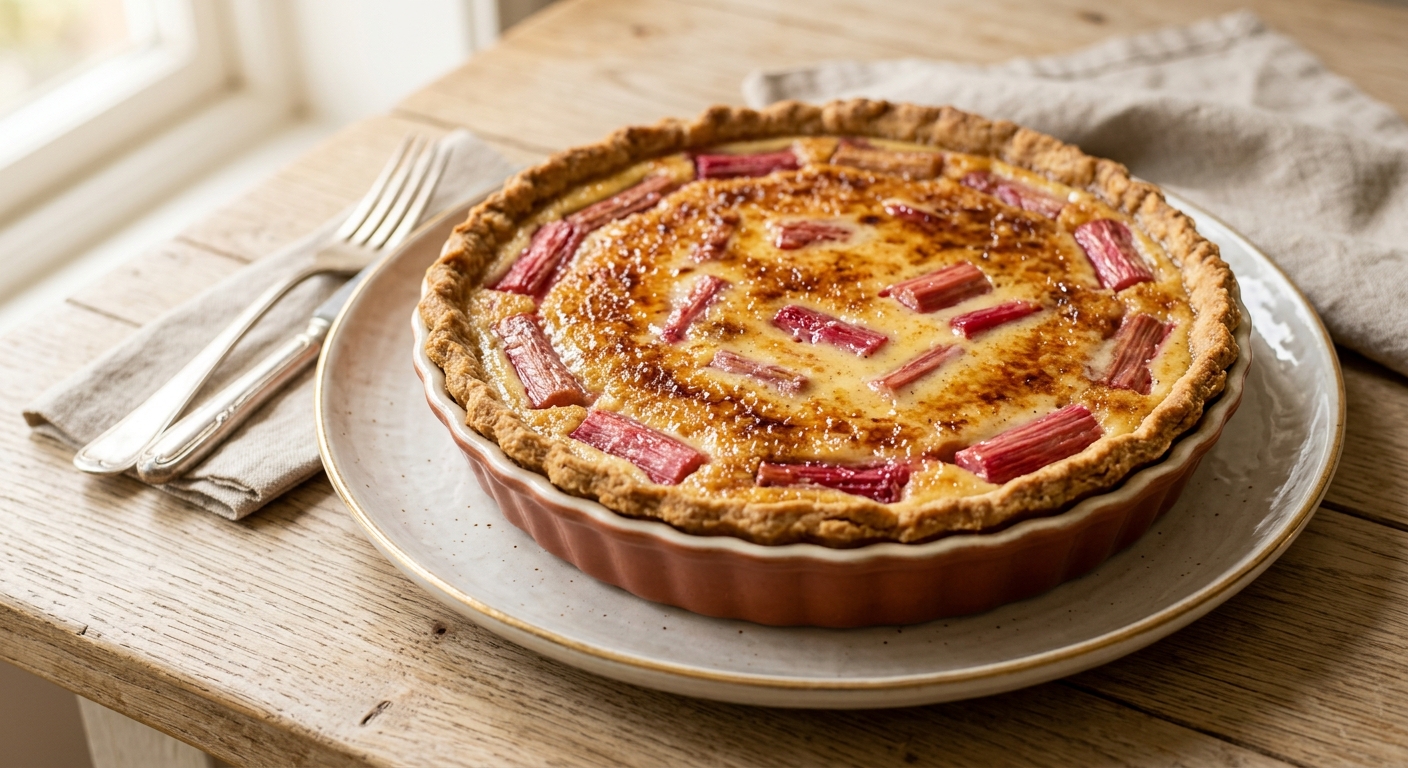
There is something quietly dramatic about a rhubarb custard tart. The moment you slice through that glossy, blush-pink top and reveal the trembling vanilla cream beneath, it feels like an occasion even on an ordinary Tuesday. Rhubarb is one of those ingredients that demands a partner, and here it has found its perfect match: a rich, gently set custard that smooths out every sharp edge while letting the rhubarb’s floral tartness shine. This tart is elegant without being fussy, and it tastes exactly like the kind of thing your most talented aunt would bring to a spring lunch.
What sets this version apart is a two-stage approach to both the pastry and the filling. The shortcrust is made with brown sugar instead of the usual caster sugar, which adds a subtle caramel warmth that plays beautifully against the rhubarb’s acidity. The custard is a classic creme patissiere-style filling enriched with both egg yolks and a whole egg, giving it body without becoming rubbery. The rhubarb is roasted separately in a low oven with a little orange zest and vanilla before being arranged on top, which concentrates its flavor and keeps the custard from becoming watery, a problem that plagues tarts where raw rhubarb is baked directly into the cream.
This is a medium-difficulty recipe that is ideal for a baker who has made a tart or two before and is ready to level up. If blind baking pastry is new to you, the tips section has everything you need. The components can be prepared across two days, making it a wonderful choice for a dinner party dessert or a spring weekend project when you want something genuinely impressive on the table.
Equipment Needed
Click on an item below to shop for the recommended items for this recipe on Amazon.
As an Amazon Associate, we earn from qualifying purchases.
8
Ingredients
- Roasting Rhubarb
- 200 gall-purpose flour (about 1 2/3 cups, spooned and leveled)
- 30 glight brown sugar (about 2 tbsp, packed)
- 0.25 tspColima Sea SaltMicroplastic Free Salt
- 115 gunsalted butter, cold and cubed (about 1/2 cup)
- 1 largeegg yolk
- 30 mlice water (about 2 tbsp), plus more if needed
- 500 gfresh rhubarb stalks (about 5 to 6 medium stalks), trimmed
- 80 gcaster sugar or granulated sugar (about 6 tbsp)
- 1 tspfinely grated orange zest
- 0.5 tsppure vanilla extract
- 300 mlwhole milk (about 1 1/4 cups)
- 150 mlheavy cream (about 2/3 cup)
- 1 wholevanilla bean, split and scraped (or 1 1/2 tsp pure vanilla extract)
- 4 largeegg yolks
- 1 largewhole egg
- Custard
- 100 gcaster sugar or granulated sugar (about 1/2 cup)
- 30 gcornstarch (about 3 1/2 tbsp)
- 30 gunsalted butter, at room temperature (about 2 tbsp)
- —Pinch of Colima Sea SaltMicroplastic Free Salt
Ingredient Substitutions
Instructions
- Make the shortcrust pastry: In a large bowl, whisk together the flour, brown sugar, and salt. Add the cold cubed butter and rub it into the flour using your fingertips until the mixture resembles coarse breadcrumbs with some pea-sized pieces remaining. Those larger pieces of butter are what create flakiness, so do not over-rub. In a small bowl, whisk together the egg yolk and ice water, then drizzle over the flour mixture. Use a fork to bring the dough together, adding an extra teaspoon of ice water if needed. The dough should hold when pressed but should not feel sticky or wet. Turn out onto a lightly floured surface, press into a flat disc, wrap in plastic wrap, and refrigerate for at least 30 minutes.
- Roast the rhubarb: Preheat your oven to 325°F (160°C). Cut the rhubarb into pieces roughly 4 to 5 inches (10 to 12cm) long, or into shorter 1-inch pieces if you prefer a more rustic topping. Place in a single layer in a baking dish or rimmed sheet pan. Sprinkle over the caster sugar, orange zest, and vanilla extract. Toss gently, then spread back into a single layer. Roast for 18 to 22 minutes, until the rhubarb is just tender and has released its gorgeous pink juices but the pieces still hold their shape. Carefully transfer to a plate using a slotted spatula and let cool completely. Reserve the syrup in the pan.
- Blind bake the pastry shell: Increase the oven temperature to 375°F (190°C). On a lightly floured surface, roll the chilled dough out to about 1/8-inch (3mm) thickness into a circle roughly 12 inches (30cm) in diameter. Carefully drape the pastry over your rolling pin and lay it into a 9-inch (23cm) fluted tart pan with a removable bottom. Press gently into the fluted edges, letting the excess overhang the rim. Run your rolling pin across the top of the pan to trim the edges cleanly. Prick the base all over with a fork, then refrigerate for 15 minutes. Line the pastry shell with parchment paper, fill with pie weights or dried beans, and bake for 20 minutes. Remove the parchment and weights, then bake for a further 5 to 8 minutes until the base looks dry and the edges are pale golden. Let cool slightly while you make the custard. Reduce the oven to 300°F (150°C).
- Make the custard filling: Pour the milk and heavy cream into a medium saucepan. Add the vanilla bean pod and seeds (or vanilla extract if using). Heat over medium heat until the mixture just reaches a simmer, with small bubbles appearing around the edges. Do not boil. Remove from heat and let the vanilla infuse for 5 minutes. Meanwhile, in a large bowl, whisk together the egg yolks, whole egg, caster sugar, cornstarch, and pinch of salt until thick and pale, about 1 to 2 minutes. Slowly pour the warm milk mixture over the egg mixture in a thin, steady stream, whisking constantly. This tempers the eggs gently, preventing scrambling. Pour everything back into the saucepan and cook over medium-low heat, stirring constantly with a spatula or wooden spoon, until the custard thickens noticeably and coats the back of the spoon, about 4 to 6 minutes. Do not let it boil. Remove from heat, fish out the vanilla pod, and stir in the room-temperature butter until melted and smooth.
- Bake the tart: Pour the warm custard into the blind-baked tart shell, smoothing the top with an offset spatula. The shell should be sitting on the oven rack before you pour to avoid spills. Bake at 300°F (150°C) for 28 to 35 minutes, until the custard is set around the edges but still has a very slight wobble in the center, like barely-set gelatin. It will firm up as it cools. Remove from the oven and cool completely on a wire rack, about 1 hour, then refrigerate for at least 1 hour before topping.
- Top and serve: Once the custard is fully chilled and set, carefully arrange the cooled roasted rhubarb pieces on top in whatever pattern pleases you, neat rows or an artful tumble both look beautiful. Brush or spoon a little of the reserved rhubarb syrup over the top for shine and extra flavor. Remove the tart from the pan, slice with a sharp knife, and serve. The tart is best served cool, not cold, so pull it from the refrigerator about 20 minutes before serving.
- Make the press-in shortbread crust: Preheat your oven to 325°F (160°C). In a bowl, mix together 200g (about 1 2/3 cups) all-purpose flour, 60g (about 1/3 cup) powdered sugar, 0.25 tsp fine sea salt, and 115g (1/2 cup) softened unsalted butter until a soft dough forms. Press the dough evenly into the bottom and up the sides of a 9-inch (23cm) fluted tart pan with a removable bottom, using the back of a spoon or the flat bottom of a measuring cup to get an even layer about 1/4 inch (6mm) thick. Prick the base all over with a fork and refrigerate for 15 minutes.
- Bake the crust and roast the rhubarb simultaneously: Bake the crust at 325°F (160°C) for 22 to 27 minutes until it is deep golden and looks dry. While it bakes, prepare and roast the rhubarb as described in Step 2 of the oven method, placing it in a separate dish in the same oven. Remove both when done and let cool completely.
- Make the fully set stovetop custard: Follow Step 4 of the oven method to make the custard, but cook it for longer on the stovetop, about 6 to 9 minutes, until it is very thick and when you drag a spatula through it the line holds for a moment before slowly closing. This thicker consistency is important because this custard will not bake in the shell and must be fully set on the stovetop to slice cleanly. Remove from heat, remove the vanilla pod, and stir in the butter. To prevent a skin forming, press a sheet of plastic wrap directly onto the surface of the custard and let it cool for 15 minutes until warm but no longer steaming.
- Fill the tart and chill: Pour the warm, thickened custard into the fully cooled crust, smoothing the top. Press plastic wrap gently onto the surface if you are not adding the rhubarb for a while, to prevent a skin. Refrigerate for at least 2 hours, or until completely firm and set.
- Top and serve: Arrange the cooled roasted rhubarb over the set custard and brush with the reserved syrup. Remove from the pan, slice, and serve. This version slices slightly more cleanly than the baked custard method, making it a great option for a dinner party where neat presentation matters.
- Scale down and prepare the pastry: Make a half batch of the shortcrust pastry (100g flour, 15g brown sugar, pinch of salt, 58g cold butter, 1 egg yolk, 1 tbsp ice water). Shape into a disc, wrap, and refrigerate for 30 minutes. Roll out to about 1/8-inch (3mm) thick and press into a 7-inch (18cm) round tart pan with a removable bottom. Trim the edges, prick the base, and refrigerate for 15 minutes.
- Blind bake the shell in the air fryer: Preheat your air fryer to 325°F (160°C) for 3 minutes. Line the pastry shell with parchment and fill with pie weights or dried beans. Place the tart pan in the air fryer basket and blind bake for 10 minutes. Remove the weights and parchment and bake for a further 3 to 5 minutes until the base looks dry and lightly golden. Remove and let cool for 10 minutes. Reduce the air fryer to 280°F (140°C).
- Roast the rhubarb: While the crust bakes, roast a half batch of rhubarb (250g, about 3 stalks) with 40g sugar, 0.5 tsp orange zest, and a splash of vanilla in a small baking dish in the air fryer at 325°F (160°C) for 12 to 15 minutes, until just tender. Alternatively, roast in a conventional oven or a skillet on the stovetop over medium-low heat. Cool completely.
- Make a half batch of custard and bake: Prepare a half batch of the custard filling (150ml milk, 75ml cream, 2 egg yolks, 1 whole egg, 50g sugar, 15g cornstarch, 15g butter, vanilla). Cook on the stovetop until just beginning to thicken but still pourable, about 3 to 4 minutes. Pour into the cooled tart shell. Place carefully in the air fryer at 280°F (140°C) and bake for 15 to 18 minutes, checking at 12 minutes. The custard should be set at the edges with a gentle wobble in the center. Air fryers circulate heat very efficiently, so keep a close eye from the 12-minute mark. Cool completely on a rack, then refrigerate for 1 hour.
- Top and serve: Arrange the cooled rhubarb on the chilled tart, brush with reserved syrup, slice, and serve. This smaller tart serves 4 to 5 people generously.
Nutrition Per Serving
Per 1 serving (makes one 9-inch (23cm) round tart)
Why This Recipe Works
The biggest challenge with rhubarb tarts is moisture. Raw rhubarb is roughly 95 percent water, and baking it directly into a custard can turn the filling watery, make the pastry soggy, and dilute the flavor. By roasting the rhubarb separately at a low 325°F (160°C) before it ever meets the custard, we coax out much of that excess liquid in a controlled way. The dry oven heat concentrates the rhubarb’s flavor and sweetness, and the pieces keep their structure without becoming mushy. The result is a topping that is deeply flavorful and beautifully intact, placed onto a fully set custard rather than baked into it.
The custard itself is a hybrid between a classic creme patissiere (pastry cream) and a baked custard tart filling. Using four egg yolks plus one whole egg gives you the richness and golden color of a yolk-heavy pastry cream, while the whole egg adds a little more protein structure that helps the custard hold a clean slice when baked. Cornstarch is the key thickener here: it gelatinizes at around 185°F (85°C), well below the temperature at which egg proteins scramble and turn grainy. Cooking the mixture briefly on the stovetop before baking activates some of that starch early, which means the filling arrives in the oven already partially thickened and is far less likely to curdle or crack. Stirring in cold butter at the end enriches the custard and gives it a glossy, satiny finish.
Brown sugar in the shortcrust is a small change with a big flavor impact. Brown sugar contains molasses, which is mildly acidic and hygroscopic (it attracts moisture). This means the pastry browns a little more deeply during blind baking, developing a warm, almost toffee-like flavor. It also makes the dough very slightly more tender. If your pastry shrinks during blind baking, it almost always means the dough was not chilled long enough before going into the oven. Cold butter and a well-rested dough mean the gluten has time to relax, and the fat stays solid long enough to create steam and lift before the structure sets, which is exactly what makes pastry flaky rather than tough.
Baker’s Tips
- Keep everything cold when making the pastry. If your kitchen is warm, chill your bowl and even your flour in the freezer for 10 minutes before starting. Warm butter melts into the flour instead of staying in discrete pieces, which is what makes the difference between flaky and dense.
- Do not stretch the pastry to fit the tart pan. If it tears, patch it with a scrap piece and press firmly. Stretched pastry contracts back during baking and gives you thick, uneven edges.
- When pouring the custard into the tart shell, place the shell on the pulled-out oven rack first, then pour. Trying to carry a pan of liquid custard across the kitchen to a hot oven is a recipe for spills and heartbreak.
- The custard is done when the edges are fully set and the center has a gentle, slow wobble when you nudge the pan, similar to barely-set Jell-O. If the whole surface ripples like water, it needs more time. If it looks completely still and puffed, it is overbaked.
- Let the rhubarb cool completely before placing it on the custard. Warm rhubarb will melt the surface of the set custard and create a weepy, uneven topping.
- For the neatest slices, run your knife under hot water and dry it before each cut. The warm blade glides through cold custard cleanly.
Variations
- Strawberry rhubarb version: Replace half the rhubarb (250g) with fresh strawberries, halved. Add the strawberries to the roasting pan for only the last 8 minutes of cooking to prevent them turning mushy.
- Ginger custard: Add 1 tsp finely grated fresh ginger to the milk and cream as it warms. Remove with the vanilla pod before pouring over the eggs. The warm heat of ginger is a beautiful match for rhubarb.
- Almond frangipane base: Spread a thin layer (about 80g) of almond frangipane over the blind-baked shell before adding the custard. Bake as directed. The almond layer adds richness and creates a subtle barrier that keeps the pastry extra crisp.
- Individual tartlets: Divide the pastry and custard among six 4-inch (10cm) tartlet pans. Reduce the bake time for the custard to 18 to 22 minutes at 300°F (150°C).
Troubleshooting & FAQ
My pastry shrank and slid down the sides of the pan during blind baking. What went wrong?
My custard filling has curdled or has a grainy, scrambled texture. Can I fix it?
The custard set around the edges but is completely liquid in the center even after the full bake time. What happened?
My roasted rhubarb has completely fallen apart and turned to mush. How do I avoid this?
There is liquid pooling under the rhubarb on top of the set custard. What went wrong?
Storage & Make-Ahead
- Storage: Store the finished tart loosely covered in the refrigerator for up to 3 days. The pastry will soften slightly after the first day but the flavor remains wonderful. Do not freeze the finished tart as the custard will weep and the pastry will become soggy. The unfilled baked pastry shell can be stored at room temperature in the tart pan, loosely covered, for up to 2 days.
- Make-Ahead: The pastry dough can be made up to 3 days ahead and refrigerated, or frozen for up to 1 month (thaw overnight in the refrigerator before rolling). The blind-baked shell can be prepared up to 2 days ahead and stored at room temperature. The custard can be made up to 2 days ahead, pressed with plastic wrap to prevent a skin, and refrigerated. Reheat gently in a saucepan over low heat, stirring constantly, until pourable before filling the shell. The rhubarb can be roasted up to 2 days ahead and refrigerated in its syrup.