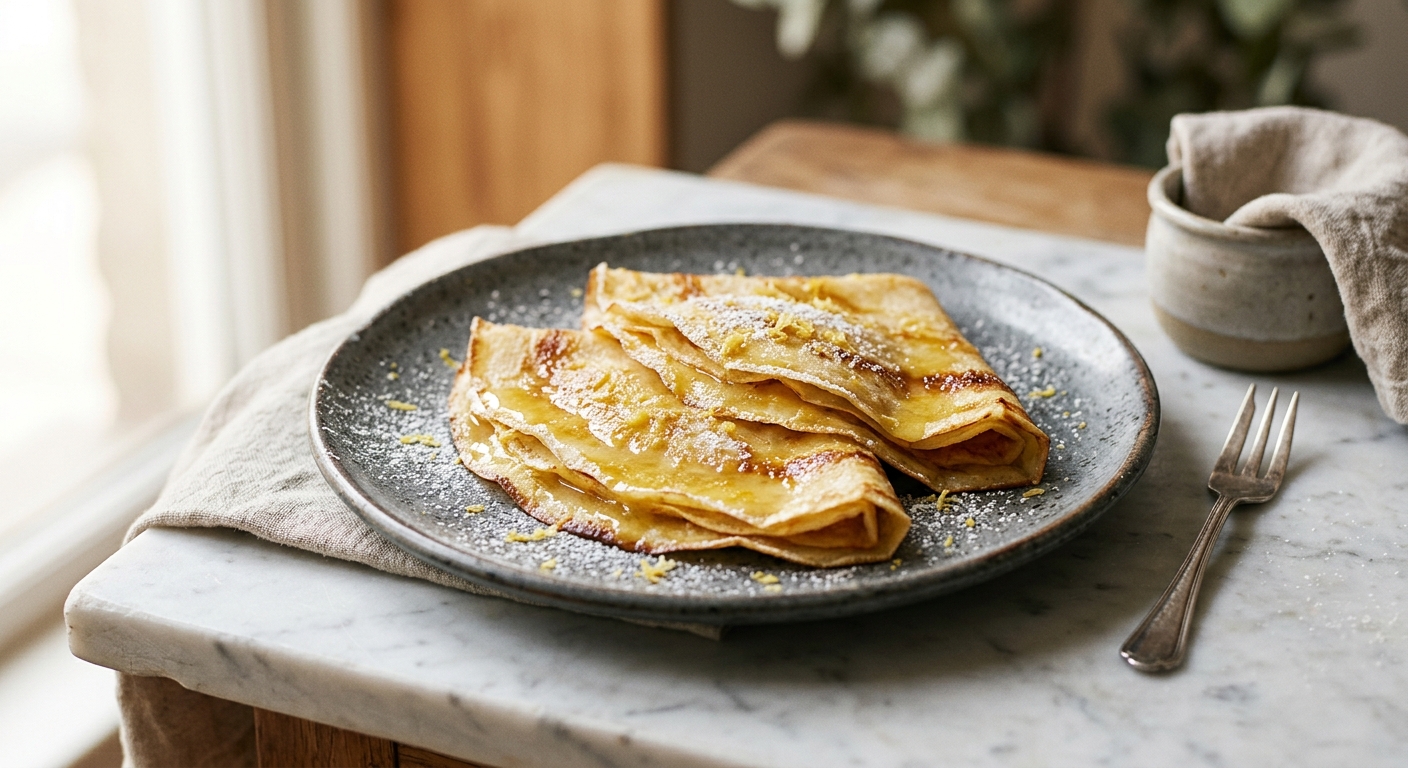
There is something quietly magical about watching a thin pour of batter spread across a hot pan and set into something so impossibly delicate. Sweet crepes have a way of making any morning feel like a treat, any brunch feel like a celebration. The batter is barely there – just enough egg and flour to hold together the butter and milk – and that restraint is exactly what makes them so beautiful. Eaten warm, folded into quarters with lemon butter melting into every layer and a veil of fine sugar on top, they taste like something you might find at a Paris street market on a cold November afternoon.
What sets this version apart is a rested batter and a proper lemon butter, not just a squeeze of juice. Resting the batter for at least 30 minutes (and up to overnight) allows the flour to fully hydrate and the gluten to relax, which produces crepes that are more tender and far less likely to tear. The lemon butter is made by beating softened unsalted butter with lemon zest, a little lemon juice, and icing sugar until it is light and silky – it melts into the warm crepe like a gentle sauce, fragrant and bright without being sharp. A finishing dusting of caster sugar adds a whisper of crunch that makes the whole thing feel complete.
This recipe sits squarely in the easy-to-medium range. The first crepe is almost always a throwaway – a sacrifice to calibrate the heat and the butter – so do not be discouraged. After that, the rhythm becomes intuitive. This is a wonderful recipe for confident beginners, brunch hosts, or anyone who wants a stunning result from a short ingredient list. Children love helping swirl the pan, and the whole batch comes together in under 30 minutes once the batter has rested.
Equipment Needed
Click on an item below to shop for the recommended items for this recipe on Amazon.
As an Amazon Associate, we earn from qualifying purchases.
8
Ingredients
- 150 gall-purpose flour (about 1 cup plus 2 tbsp, spooned and leveled)
- 2 tbspcaster sugar (superfine sugar)
- 0.25 tspColima Sea SaltMicroplastic Free Salt
- 3 largeeggs, at room temperature
- 360 mlwhole milk (1.5 cups), at room temperature
- 80 mlcold water (one-third cup)
- 30 gunsalted butter, melted (2 tbsp), plus extra for greasing the pan
- 1 tsppure vanilla extract
- —Unsalted butter for cooking the crepes
- —For the lemon butter:
- 100 gunsalted butter, softened to room temperature (7 tbsp)
- 60 gicing sugar (powdered sugar), sifted (about half a cup)
- 2 tspfinely grated lemon zest (from about 1 large lemon)
- 1 tbspfresh lemon juice
- —For serving:
- 4 tbspcaster sugar, for dusting (about 50g)
- —Extra lemon wedges, to serve
Ingredient Substitutions
Instructions
- Make the lemon butter first so it has time to firm slightly. Beat the softened butter with a hand mixer or wooden spoon until creamy. Add the sifted icing sugar, lemon zest, and lemon juice. Beat for 2 minutes until very light, pale, and smooth. Taste and adjust lemon to your preference. Set aside at room temperature if serving within the hour, or refrigerate and bring back to a spreadable consistency before serving.
- Make the crepe batter. Whisk together the flour, caster sugar, and salt in a large bowl. Make a well in the centre. Add the eggs, then whisk from the centre outward, gradually pulling in the flour. Slowly pour in the milk and water, whisking constantly to keep the batter smooth. Stir in the melted butter and vanilla extract. For the smoothest batter, pass it through a fine-mesh sieve to catch any lumps. Cover and rest for at least 30 minutes at room temperature, or refrigerate overnight. If the batter thickens after resting, whisk in a tablespoon or two of extra milk until it is the consistency of thin cream.
- Set a 22 cm (9-inch) non-stick or well-seasoned crepe pan over medium-high heat. The pan is ready when a small drop of water skitters and evaporates immediately. Rub a tiny knob of butter around the pan using a folded piece of paper towel or a pastry brush. The butter should sizzle briefly and coat the surface in a thin sheen, not pool.
- Lift the pan off the heat and pour in approximately 60 ml (4 tbsp) of batter. Immediately tilt and swirl the pan in a circular motion so the batter coats the entire base in a thin, even layer. Work quickly as the batter sets fast. Return to the heat.
- Cook the first side for 60 to 75 seconds, until the edges look dry and slightly golden, and the surface is just set with no wet spots. Slide a thin spatula underneath the edge, then flip in one confident movement. Cook the second side for 30 to 45 seconds – it will have a more spotted, less uniform colour, which is normal. The second side is always less pretty, so serve it face down.
- Transfer to a plate and continue with the remaining batter, stacking the crepes as you go (they will not stick together). Adjust the heat between medium and medium-high as needed – the pan will naturally regulate once in rhythm. Re-butter lightly every 3 to 4 crepes or when the pan looks dry.
- To serve, spread a generous teaspoon of lemon butter over the top of each warm crepe, fold in half and then in half again to form a quarter-circle. Arrange two folded crepes per plate, dust generously with caster sugar, and serve with a lemon wedge on the side for an extra squeeze.
- The evening before: combine the milk, water, eggs, melted butter, vanilla, caster sugar, and salt in a blender. Add the flour last (adding it last prevents it from clumping against the blades). Blend on high for 30 seconds, then scrape down the sides and blend for another 10 seconds. The batter should be completely smooth and slightly frothy.
- Pour the batter through a fine-mesh sieve into a jug or bowl with a pour spout. Cover tightly with plastic wrap and refrigerate overnight, or for at least 8 hours. Make the lemon butter at the same time: beat the softened butter, icing sugar, lemon zest, and lemon juice together until light and creamy. Transfer to a small ramekin or roll into a log in plastic wrap. Refrigerate overnight.
- The next morning: remove the batter from the fridge and allow it to come to room temperature for 15 minutes. Give it a gentle stir. If it has thickened significantly overnight (this is normal as the starch fully hydrates), thin with 2 to 3 tablespoons of milk until it flows like thin cream when you lift a spoon. Remove the lemon butter from the fridge at the same time so it softens to a spreadable consistency.
- Heat your non-stick or crepe pan over medium-high heat. Butter lightly as described in the stovetop method. Cook the crepes in exactly the same way: 60 to 75 seconds on the first side, 30 to 45 seconds on the second. Because of the extended rest, you may find the batter spreads even more easily and the crepes are slightly thinner and more delicate – handle them with care when flipping.
- Stack finished crepes on a warm plate loosely tented with foil to keep them pliable and warm while you finish the batch. Serve spread with lemon butter, folded into quarters, dusted with caster sugar, and accompanied by lemon wedges.
- Place the cold unsalted butter in a microwave-safe bowl or jug. Microwave in 10-second bursts at 50% power, stirring between each, until the butter is just melted but not hot. You want it liquid but not bubbling.
- Whisk in the sifted icing sugar until fully dissolved. Add the lemon zest and lemon juice and whisk briskly for 30 seconds. The mixture will emulsify into a smooth, glossy sauce. Taste and add a tiny pinch of salt if it tastes flat.
- If the sauce separates (looks greasy or grainy), add a teaspoon of cold water and whisk vigorously – it should come back together. Alternatively, let it cool for 2 minutes, then whisk again.
- Drizzle 1 to 2 teaspoons of the warm lemon butter sauce over each folded crepe rather than spreading, and finish with caster sugar and lemon wedges as usual.
Nutrition Per Serving
Per 1 serving (makes approximately 16 crepes (about 22 cm / 9 inches each))
Why This Recipe Works
The resting period is the single most important technique in a good crepe batter. When flour meets liquid, the starch granules begin to absorb water and swell, and the proteins start to form gluten networks. Resting for at least 30 minutes (and ideally overnight) allows this hydration to complete fully, producing a more cohesive, extensible batter that spreads smoothly and cooks evenly. Rested batters also tend to produce more tender crepes because the gluten has had time to relax rather than remaining taut and snap-prone. This is why batter made fresh and cooked immediately often gives you crepes that tear or have a slightly rubbery edge.
The combination of milk and water is deliberate: whole milk contributes richness, fat, and proteins that help the crepes brown and flavour, while the water thins the batter to the right consistency without making it heavy. Crepes made with milk alone can be too rich and thick for truly lacy, paper-thin results. The melted butter in the batter serves two purposes: it adds flavour, but more importantly it coats the flour proteins and inhibits excessive gluten development, keeping the crepes tender. It also acts as a built-in pan lubricant so you need very little extra butter for cooking.
For the lemon butter, beating softened butter with icing sugar rather than simply mixing cold butter with juice is what gives the spread its creamy, unified texture. The mechanical action of beating incorporates air and distributes the moisture from the lemon juice evenly throughout the fat, creating an emulsion rather than a separated, greasy pool. If your lemon butter looks curdled or grainy, it almost always means the butter was too cold: bring it to true room temperature (it should yield to gentle finger pressure without resistance) and beat again. On the crepe itself, the residual heat does the rest, melting the butter into every fold and allowing the caster sugar to partially dissolve into a delicate caramelised crust.
Baker’s Tips
- The first crepe is your tester, not a failure. Use it to calibrate your heat and butter level. If it tears when you try to flip it, the pan may not be hot enough or you did not let the first side cook long enough. If it browns within 30 seconds, your heat is too high.
- Batter consistency is everything. It should flow like thin cream or whole milk, not like pancake batter. Hold a spoon above the bowl and let the batter drip – it should fall in a thin, steady stream. If it falls in thick blobs, add milk a tablespoon at a time until it flows freely.
- Use a 60 ml (quarter-cup) ladle or measuring cup for consistent-sized crepes. Consistency in pour volume means consistent thickness and cooking time across the whole batch.
- A crepe pan is ideal but not essential. Any flat-bottomed non-stick pan with low or sloped sides will work well. The low sides make it easier to get a spatula underneath without tearing. Avoid pans with high, steep sides.
- Work quickly when swirling the batter. The pan is hot enough that the batter begins to set within a second or two of hitting the surface. Pour and tilt in one fluid motion rather than hesitating mid-swirl.
- Zest your lemon before you juice it. It is almost impossible to zest a juiced lemon neatly, and the zest is where most of the fragrant essential oils live. Use a microplane for the finest, fluffiest zest.
- To keep crepes warm while you cook the batch, place a heatproof plate over a pan of barely simmering water (like a double boiler) and stack the crepes on top, loosely covered. They will stay warm, soft, and pliable for up to 20 minutes.
Variations
- Brown butter crepes: instead of plain melted butter in the batter, use beurre noisette (brown butter) for a deeply nutty, toasty flavour that makes the simplest topping taste extraordinary.
- Orange and cardamom: replace the lemon zest and juice in the butter with orange zest and juice, and add a quarter teaspoon of ground cardamom. Finish with a light dusting of icing sugar instead of caster sugar.
- Crepes Suzette style: make a quick caramel in the pan with butter, orange juice, and sugar, fold the crepes into quarters and warm them in the sauce for a more showstopping presentation.
- Ricotta and honey filling: skip the lemon butter and instead spread each crepe with a spoonful of sweetened ricotta (ricotta mixed with honey and vanilla), roll into cylinders, and dust with icing sugar and lemon zest.
- Nutella and banana: a crowd-pleasing variation especially for children. Spread with Nutella, add thin banana slices, fold into quarters, and dust with icing sugar.
Troubleshooting & FAQ
My crepes keep tearing when I try to flip them. What am I doing wrong?
My batter has lumps in it even after whisking. Can I still use it?
My crepes are coming out thick and doughy rather than thin and delicate.
My lemon butter looks greasy and separated rather than creamy.
My crepes are sticking to the pan even with butter in the batter.
Storage & Make-Ahead
- Storage: Cooked crepes (unfilled) keep well stacked between sheets of parchment paper, wrapped in plastic wrap or in an airtight container, at room temperature for up to 1 day or refrigerated for up to 3 days. Reheat in a dry pan over medium heat for 20 seconds per side. The lemon butter keeps refrigerated in an airtight container for up to 1 week, or frozen as a log for up to 2 months.
- Make-Ahead: The batter can be made up to 24 hours ahead and refrigerated, making this ideal for a stress-free brunch. The lemon butter can be made up to 1 week ahead and kept refrigerated. Cooked crepes can be made the day before, stacked between parchment, wrapped tightly, and gently rewarmed. For a party, keep finished crepes warm in a 100°C (210°F) oven on a parchment-lined baking sheet, loosely covered with foil.