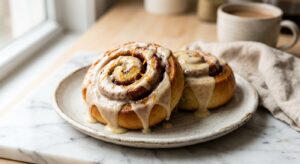
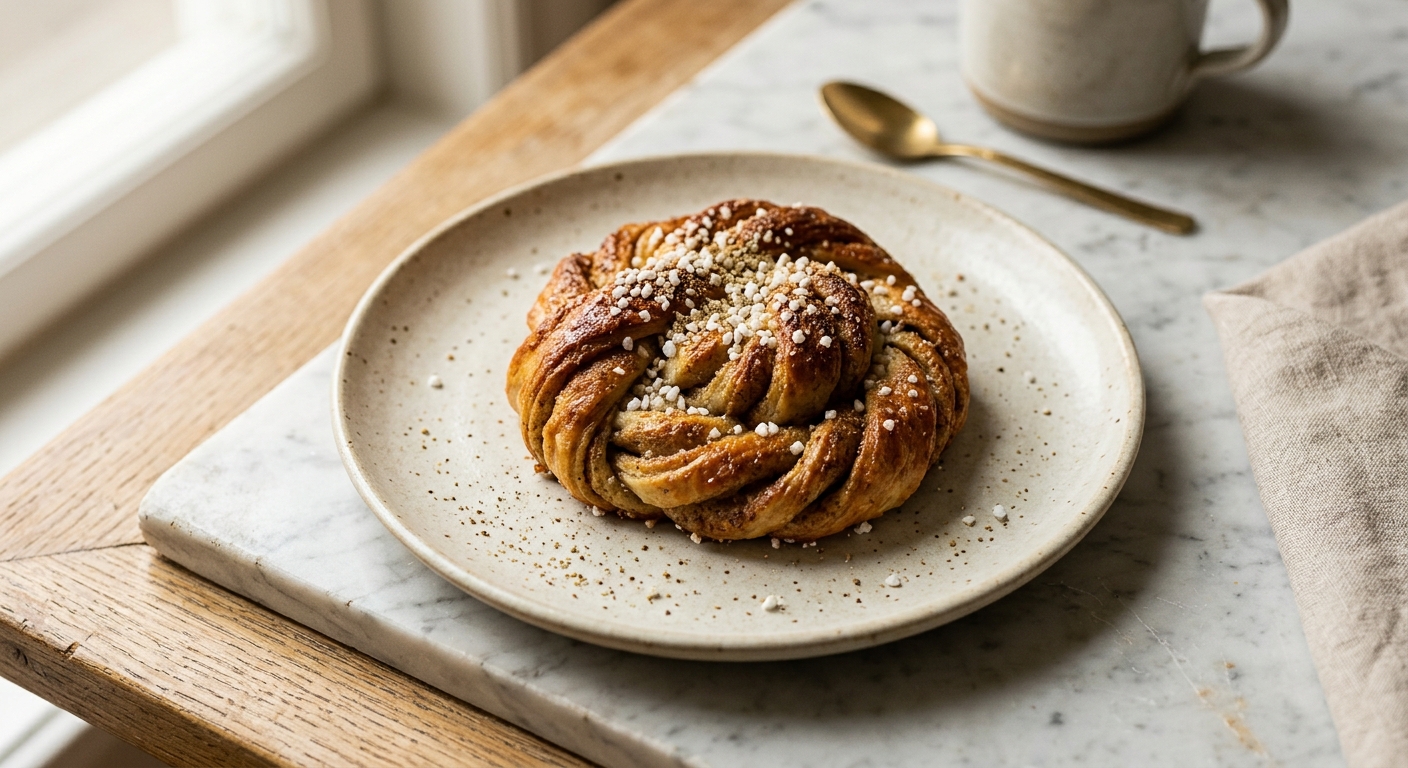
There is a Swedish word, fika, that means so much more than a coffee break. It is a deliberate pause in the day, a moment shared with something warm in your hands and someone you like nearby. At the heart of so many fika tables sits the cardamom bun: softly sweet, deeply spiced, and twisted into a shape that somehow feels like a little gift. The moment you pull one apart and breathe in that warm, citrusy cardamom perfume, you will understand why Swedes have been baking these for centuries.
What sets this recipe apart is freshly ground cardamom. It makes a difference that is genuinely difficult to overstate. Pre-ground cardamom loses its volatile oils quickly and tastes dusty and flat by comparison. Here, we crack the pods and grind the seeds ourselves, and the result is floral, bright, and almost perfumed in the best possible way. The enriched dough itself is built with both butter and milk for a tender, pillowy crumb, and a long, cool overnight rise (optional but rewarding) develops a subtle complexity that a rushed dough simply cannot match.
This is a medium-difficulty bake, ideal for anyone who has made a yeast dough once or twice and wants to take that next step. The shaping looks impressive but is genuinely forgiving, and the recipe is written to guide you through every stage. These buns are perfect for a slow weekend morning, a holiday brunch, or any day when you decide your home deserves to smell extraordinary.
Equipment Needed
Click on an item below to shop for the recommended items for this recipe on Amazon.
As an Amazon Associate, we earn from qualifying purchases.
12
Ingredients
- 500 gall-purpose flour (about 4 cups, spooned and leveled), plus extra for dusting
- 7 ginstant yeast (2 1/4 tsp, one standard packet)
- 70 ggranulated sugar (about 1/3 cup)
- 1 tspColima Sea SaltMicroplastic Free Salt
- 15 gfreshly ground cardamom (from about 30 green cardamom pods, see tips), approximately 1 tbsp plus 1 tsp
- 240 mlwhole milk (1 cup), warmed to 100 to 110°F (38 to 43°C)
- 2 largeeggs, room temperature
- 80 gunsalted butter (about 6 tbsp), softened to room temperature, cut into small cubes
- —Cardamom Butter Filling
- 100 gunsalted butter (7 tbsp), softened
- 80 ggranulated sugar (about 6 tbsp)
- 8 gfreshly ground cardamom (about 2 tsp)
- —Egg Wash and Topping
- 1 largeegg, beaten with 1 tbsp milk
- 60 gpearl sugar (about 4 tbsp), for topping
Ingredient Substitutions
Instructions
- Make the dough: In the bowl of a stand mixer fitted with the dough hook, combine the flour, instant yeast, sugar, salt, and ground cardamom. Whisk briefly to combine. Add the warm milk and eggs. Mix on low speed for 2 minutes until a shaggy dough forms, then increase to medium and knead for 5 minutes.
- Add the butter: With the mixer running on medium-low, add the softened butter one or two cubes at a time, waiting for each addition to be fully incorporated before adding the next. This will take about 5 to 7 minutes. Once all the butter is in, increase speed to medium-high and knead for a further 5 minutes until the dough is smooth, elastic, and slightly tacky but not sticky. It should pass the windowpane test: stretch a small piece thin enough to see light through without it tearing.
- First rise: Shape the dough into a ball, place it in a lightly oiled bowl, cover tightly with plastic wrap or a damp towel, and let it rise at room temperature until doubled, about 1 to 1.5 hours. For an overnight rise, refrigerate the covered dough for 8 to 16 hours. Remove from the fridge and let it sit at room temperature for 30 minutes before shaping.
- Make the filling: Beat together the softened butter, sugar, and cardamom until smooth and spreadable. Set aside at room temperature.
- Shape the buns: Line two large baking sheets with parchment paper. On a lightly floured surface, roll the dough into a large rectangle approximately 18 x 14 inches (46 x 36 cm). Spread the filling evenly all the way to the edges. Fold the dough in half lengthwise (like a book) so you have a long, narrow rectangle roughly 18 x 7 inches. Using a sharp knife or bench scraper, cut the rectangle into 12 equal strips about 1.5 inches wide. Take each strip, stretch it very gently lengthwise to about 12 inches, then twist it 3 to 4 times. Coil the twisted strip around itself into a tight spiral, tucking the end firmly underneath. Place on the prepared baking sheets, spacing them about 2 inches apart.
- Second rise: Cover the shaped buns loosely with plastic wrap or a clean towel and let them rise at room temperature for 30 to 45 minutes until noticeably puffed. They should spring back slowly when gently pressed.
- Bake: Preheat the oven to 400°F (200°C). Brush each bun generously with the egg wash and sprinkle liberally with pearl sugar. Bake for 14 to 16 minutes, rotating the pans halfway through, until the buns are deep golden brown. The internal temperature should reach 190°F (88°C). Let them cool on the pans for 5 minutes before transferring to a wire rack. These are best eaten warm, ideally within an hour of baking.
- Prepare the dough, filling, and shape the buns exactly as described in the oven method through the second rise. Cut parchment paper into small squares and place one bun on each square. This makes them easy to lift in and out of the basket without deflating them.
- After the second rise, brush the buns with egg wash and sprinkle with pearl sugar. Let the buns sit for 5 minutes while you preheat the air fryer to 340°F (170°C) for 3 minutes. Do not use the standard 400°F oven temperature here as the close proximity of the heating element will scorch the tops before the centers cook through.
- Place 2 to 3 buns in the air fryer basket (depending on size), leaving at least 1 inch of space between them. Cook for 9 to 11 minutes. Check at the 8-minute mark: if the tops are browning too quickly, loosely tent with a small piece of foil for the remaining time.
- Remove carefully using tongs, slide the buns off the parchment squares onto a wire rack, and cool for at least 5 minutes. Repeat in batches with the remaining buns. Unbaked shaped buns can be held in the refrigerator (covered) for up to 2 hours while you work through the batches.
- Note on texture: The air fryer creates a slightly crisper exterior than the oven, which many people find irresistible. The interior remains soft and fluffy. If you prefer a softer top crust, lightly tent with foil during the last 2 minutes.
- Prepare the dough and shape the buns exactly as in the oven method. After shaping, place the buns on parchment-lined baking sheets and freeze uncovered for 1 to 2 hours until completely solid. This flash-freeze step prevents them from sticking together.
- Once frozen solid, transfer the buns to a zip-top freezer bag or airtight container, layering parchment between any layers. Freeze for up to 1 month. Do not add the egg wash or pearl sugar at this stage.
- The night before you want to bake: Remove the buns from the freezer and place them on parchment-lined baking sheets, spacing them 2 inches apart. Cover loosely with plastic wrap and refrigerate overnight. They will thaw and complete their second rise slowly in the refrigerator, typically 8 to 12 hours.
- In the morning, remove the buns from the refrigerator 20 minutes before baking. Preheat the oven to 400°F (200°C). Brush the buns with egg wash and sprinkle generously with pearl sugar.
- Bake for 16 to 18 minutes, slightly longer than fresh buns to account for their chilled starting temperature, rotating the pans halfway through. They are ready when deep golden brown. Cool on the pans for 5 minutes and serve warm.
Nutrition Per Serving
Per 1 serving (makes 12 large twisted buns)
Why This Recipe Works
This is an enriched dough, meaning fat and eggs are incorporated alongside the flour and liquid. The fat from butter and the emulsifying lecithin in egg yolks coat the gluten strands, limiting how tightly they bond. The result is a dough that is strong enough to hold its shape and trap gas bubbles from the yeast, but tender and soft once baked rather than chewy like a lean bread dough. Adding the butter slowly in small pieces after the initial gluten structure has formed is critical: if you add cold or too much fat too early, it coats the flour before gluten can develop and you end up with a dense, greasy result.
Cardamom’s intensity comes from its volatile aromatic compounds, primarily a molecule called 1,8-cineole, which evaporates quickly once the pods are cracked open. Pre-ground cardamom has already lost much of this to the air. Grinding your own from whole pods moments before use keeps those aromatic oils intact and in the bun where they belong. Adding cardamom to both the dough and the filling layers the flavor, so it is present as background warmth throughout the crumb and as a more concentrated, buttery punch inside each swirl.
The long second rise after shaping is important for texture. Rushing it produces a denser, tighter crumb. The buns are ready to bake when they look noticeably puffed and spring back slowly (over 3 to 5 seconds) when you gently press one with a floured fingertip. If the indentation springs back immediately, give them more time. If it does not spring back at all, they are slightly over-proofed, but still bake them. Over-proofed buns will be a little more fragile but will still taste wonderful. Baking at 400°F (200°C) ensures the exterior sets and colors quickly before the butter in the filling has time to leak out excessively, giving you a beautifully caramelized crust with a moist interior.
Baker’s Tips
- Grind your own cardamom: crack green cardamom pods with the flat of a knife, remove the small black seeds, discard the husks, and grind the seeds in a spice grinder or mortar and pestle. Thirty pods yields roughly 1 tablespoon of ground spice. The difference in flavor is remarkable.
- The windowpane test: after kneading in the butter, stretch a small piece of dough between your fingers. If it stretches thin and translucent without tearing, the gluten is fully developed and your buns will be light and airy. If it tears immediately, knead for another 2 to 3 minutes.
- Cold dough is easier to shape. If your dough is soft and sticky after the first rise, refrigerate it for 20 minutes before rolling it out. This firms the butter and makes the whole process cleaner.
- Do not skimp on the pearl sugar. It provides a structural crunch against the soft dough and a little burst of sweetness in every bite. Press it gently into the egg-washed tops so it adheres during baking.
- Rotate your baking sheets halfway through. Most home ovens have hot spots, and rotating ensures even browning across all 12 buns.
- For the softest buns, pull them from the oven as soon as they read 190°F (88°C) internally or when deep golden. Overbaking is the most common reason cardamom buns go dry.
Variations
- Classic kanelbullar: Replace all of the cardamom in the filling with 2 tablespoons of ground cinnamon and add 1 teaspoon of vanilla extract to the filling. Keep some cardamom in the dough for depth.
- Orange cardamom: Add the finely grated zest of one large orange to both the dough and the filling for a bright, floral citrus note that pairs beautifully with cardamom.
- Cardamom custard buns: Press a small well into the center of each shaped bun after the second rise and fill with a teaspoon of vanilla pastry cream before adding the egg wash and pearl sugar. Bake as directed.
- Cardamom and brown butter: Brown the butter for the filling before mixing with the sugar and cardamom. The nutty, caramel depth from browned butter is extraordinary against the floral spice.
Troubleshooting & FAQ
My dough is very sticky and seems like it will never come together. Should I add more flour?
My buns are not rising. What went wrong?
My buns are leaking butter all over the pan while baking. Is that normal?
My buns look great but taste bland. The cardamom flavor is barely there.
The pearl sugar melted into the buns instead of staying crunchy on top.
Storage & Make-Ahead
- Storage: Store cooled buns in an airtight container at room temperature for up to 2 days. To refresh, warm them in a 325°F (160°C) oven for 5 to 7 minutes or in the microwave for 20 seconds. They do not store well in the refrigerator, which causes the enriched dough to stale quickly. For longer storage, freeze fully baked buns in an airtight bag for up to 6 weeks. Thaw at room temperature and warm before serving.
- Make-Ahead: The dough can be made through the first rise and refrigerated overnight, making this a very practical morning bake. Simply shape the cold dough (it is easier to work with cold), let the shaped buns complete their second rise at room temperature for about 1 hour, and bake as directed. Fully shaped unbaked buns can also be frozen for up to 1 month using the Freeze-and-Bake method described above.