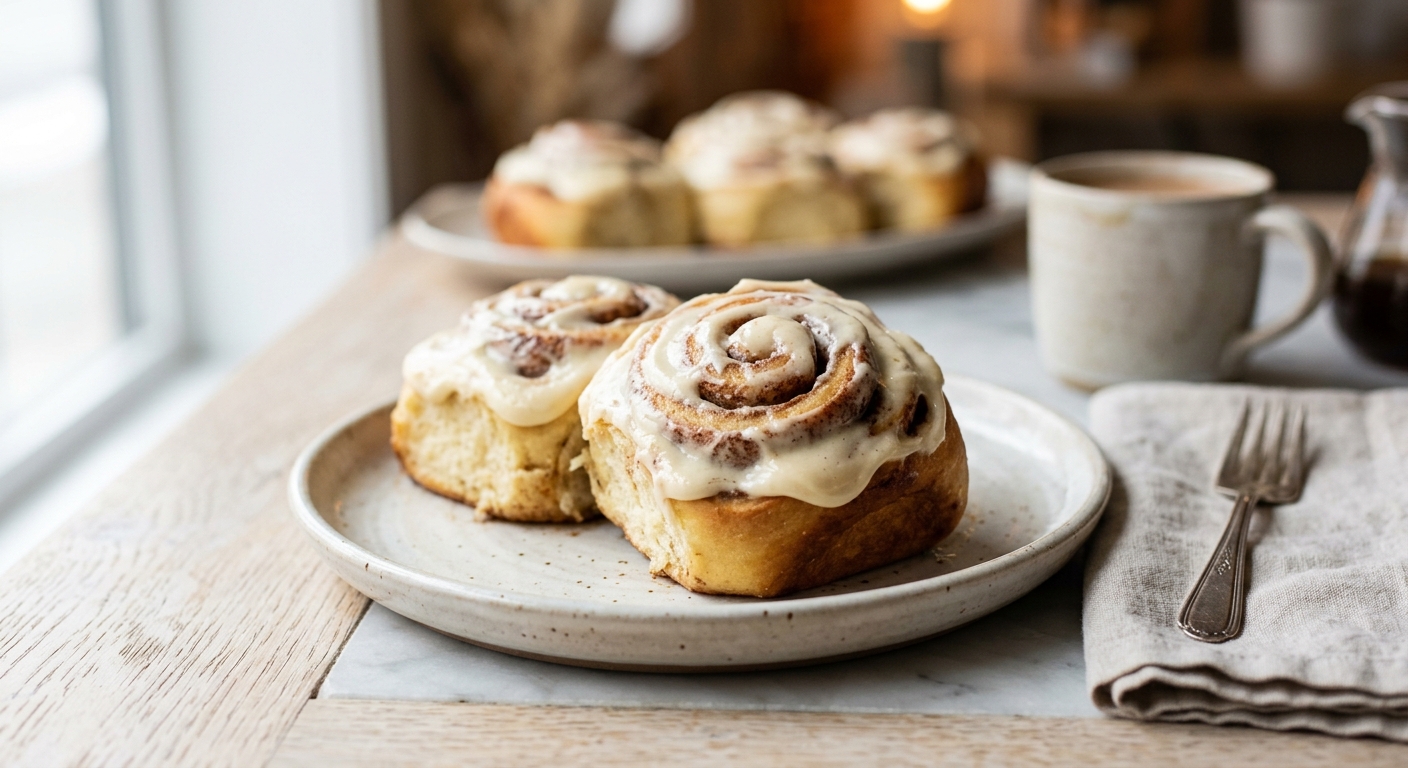
There is a particular kind of magic that happens when cinnamon rolls are baking. The whole house fills with that warm, spiced, buttery scent that pulls everyone out of bed and into the kitchen before the timer even goes off. These cinnamon rolls are the real deal: big, pillowy, pull-apart rolls with a generous swirl of brown sugar and cinnamon filling, finished with a cream cheese frosting that is just tangy enough to balance all that sweetness. This is the kind of recipe that becomes a family tradition.
What sets this recipe apart is the enriched dough. By using both butter and an egg yolk alongside a touch of bread flour (mixed with all-purpose), the dough develops a tender, slightly chewy crumb that holds up beautifully to the filling without becoming bready or dense. The filling uses melted butter rather than softened, which ensures every millimeter of dough is coated evenly, and a hit of freshly ground cinnamon makes the flavor far brighter than pre-ground alone. The cream cheese frosting is applied to warm rolls straight from the oven so it melts into all the layers rather than sitting in a stiff layer on top.
This is a medium-difficulty recipe, mostly because enriched yeast doughs require a little patience and attention to the dough’s texture rather than strict clock-watching. But there is nothing intimidating here if you follow the steps closely. This recipe is perfect for weekend bakers who want a showstopping breakfast or brunch centerpiece, and everything can be prepped the night before so you wake up to ready-to-bake rolls with almost no morning effort.
Equipment Needed
Click on an item below to shop for the recommended items for this recipe on Amazon.
As an Amazon Associate, we earn from qualifying purchases.
12
Ingredients
- Filling
- 120 mlwhole milk, warmed to 110°F/43°C (about 1/2 cup)
- 120 mlwater, warmed to 110°F/43°C (about 1/2 cup)
- 7 ginstant yeast (1 standard packet, or 2 1/4 tsp)
- 50 ggranulated sugar (1/4 cup), divided
- 300 gall-purpose flour (about 2 1/2 cups, spooned and leveled), plus more for dusting
- 120 gbread flour (about 1 cup, spooned and leveled)
- 1 tspColima Sea SaltMicroplastic Free Salt
- 57 gunsalted butter, softened to room temperature (4 tbsp / 1/2 stick)
- 1 largeegg, room temperature
- 1 largeegg yolk, room temperature
- 57 gunsalted butter, melted and slightly cooled (4 tbsp)
- 150 gpacked light brown sugar (3/4 cup)
- Filling (freshly Ground If Possible)
- 2.5 tbspground cinnamon
- Filling
- 0.25 tspColima Sea SaltMicroplastic Free Salt
- Frosting
- 113 gfull-fat cream cheese, softened to room temperature (4 oz / 1/2 block)
- 57 gunsalted butter, softened to room temperature (4 tbsp)
- 180 gpowdered sugar, sifted (about 1 1/2 cups)
- 2 tbspwhole milk or heavy cream
- 1 tsppure vanilla extract
- —Pinch of Colima Sea SaltMicroplastic Free Salt
Ingredient Substitutions
Instructions
- Activate the yeast: In the bowl of a stand mixer (or a large mixing bowl), combine the warm milk, warm water, and 1 teaspoon of the granulated sugar. Sprinkle the instant yeast over the top and let it sit for 5 to 10 minutes until foamy. If the yeast does not foam, your liquid was too hot or too cold, or the yeast is expired – start over before proceeding.
- Make the dough: Add the remaining granulated sugar, both flours, and the salt to the yeast mixture. Mix on low speed with the dough hook (or stir with a wooden spoon) until a shaggy dough forms. Add the softened butter, whole egg, and egg yolk. Increase to medium speed and knead for 8 to 10 minutes until the dough is smooth, elastic, and just slightly tacky. It should pull away from the sides of the bowl but not stick aggressively to your fingers. If kneading by hand, work the dough on a lightly floured surface for 10 to 12 minutes. Resist adding too much extra flour – a slightly sticky dough produces softer rolls.
- First rise: Lightly oil a large bowl and place the dough inside, turning to coat. Cover tightly with plastic wrap or a damp kitchen towel. Let rise in a warm, draft-free spot for 1 to 1.5 hours until doubled in size. A good trick is to place the bowl in a cold oven with just the oven light on – it creates a perfect 80°F (27°C) proofing environment.
- Make the filling and shape the rolls: Mix the brown sugar, cinnamon, and salt together in a small bowl. On a lightly floured surface, roll the dough out to a roughly 18×12-inch rectangle, working gently so you do not tear it. Brush the entire surface with the melted butter, leaving a 1/2-inch border along one long edge. Sprinkle the cinnamon sugar mixture evenly over the butter and press it lightly into the dough with your hands. Starting from the long edge nearest you, roll the dough into a tight log. Pinch the seam firmly to seal. Use unflavored dental floss or a sharp serrated knife to cut the log into 12 equal rolls, each about 1.5 inches wide.
- Arrange and second rise: Butter a 9×13-inch baking pan generously. Arrange the rolls cut-side up in the pan, spacing them evenly. They should have a little room between them – they will fill in as they proof. Cover loosely with plastic wrap and let rise for 45 to 60 minutes until puffy and the rolls are touching each other. Preheat your oven to 350°F (175°C) during the last 20 minutes of this rise.
- Bake: Bake on the center rack for 26 to 28 minutes, until the tops are golden brown and the internal temperature of the center rolls reaches 190°F (88°C). The rolls should feel set and springy when gently pressed. Do not overbake – pale and just-golden is better than dark and dry.
- Make the frosting and finish: While the rolls bake, beat the softened cream cheese and softened butter together with a hand or stand mixer on medium speed for 2 minutes until completely smooth and fluffy. Add the sifted powdered sugar, vanilla, milk or cream, and pinch of salt. Beat on low until incorporated, then increase to medium-high for 1 to 2 minutes until light and creamy. Spread generously over the rolls while they are still warm but not straight-out-of-the-oven hot (about 5 minutes resting time). The frosting will melt into the layers slightly – this is exactly what you want. Serve immediately.
- Complete steps 1 through 4 of the oven method (making and kneading the dough, first rise, filling, and shaping the rolls). Arrange the cut rolls in the greased 9×13-inch pan exactly as described.
- Slow cold proof: Instead of the second room-temperature rise, cover the pan tightly with plastic wrap and refrigerate immediately for 8 to 16 hours (overnight is ideal). The cold slows the yeast activity significantly but does not stop it. The rolls will puff slightly in the refrigerator – this is normal.
- Morning warm-up: Remove the pan from the refrigerator and let the rolls sit, still covered, at room temperature for 60 to 75 minutes. They should look noticeably puffier and feel soft and airy when the time is up. Do not rush this step – cold dough baked straight from the fridge will give you dense, tough rolls. Preheat your oven to 350°F (175°C) during the last 20 minutes of the warm-up.
- Bake: Bake uncovered on the center rack for 28 to 32 minutes (slightly longer than the same-day method since the dough starts a bit cooler). The rolls are done when golden on top and the center rolls register 190°F (88°C) on an instant-read thermometer.
- Frost and serve: Prepare the cream cheese frosting as described in the oven method and spread over the rolls after 5 minutes of resting. Serve warm. The overnight fermentation will give the rolls a slightly richer, more nuanced flavor that bakers who discover this method rarely go back from.
- Prepare the dough, complete the first rise, and shape the rolls exactly as described in the oven method through step 4. For the air fryer, you will need a 6-inch or 7-inch round cake pan that fits inside your air fryer basket. Butter the pan and arrange 4 to 6 rolls inside, depending on your pan size. They should be snug but not crushed.
- Second rise: Cover the pan loosely with plastic wrap and let the rolls rise at room temperature for 45 to 60 minutes until visibly puffy and nearly doubled. Because there is no oven to preheat during this stage, set a separate timer.
- Preheat the air fryer: Preheat your air fryer to 320°F (160°C) for 5 minutes. The lower temperature compared to a conventional oven compensates for the air fryer’s intense direct heat, which can over-brown the tops before the centers are fully baked.
- Air fry: Place the pan in the air fryer basket. Cook at 320°F (160°C) for 12 to 14 minutes, checking at the 10-minute mark. If the tops are browning too quickly before the centers are set, lay a small piece of aluminum foil loosely over the pan for the remaining cooking time. The rolls are done when the tops are deep golden and the center roll is set and not doughy when gently pressed.
- Frost and serve: Let the rolls rest in the pan for 3 minutes. Prepare the cream cheese frosting as described in the oven method (you may want to halve the frosting recipe for a smaller batch). Spread over the warm rolls and serve right away. Air-fried cinnamon rolls are best eaten fresh, as the slightly crisper exterior softens as they cool.
Nutrition Per Serving
Per 1 serving (makes 12 large cinnamon rolls in a 9×13-inch pan)
Why This Recipe Works
The combination of all-purpose and bread flour is one of the key decisions in this recipe. All-purpose flour (around 10 to 11% protein) provides a tender, soft crumb, while bread flour (12 to 14% protein) adds enough gluten structure to keep the rolls tall and defined during baking rather than spreading flat. Too much bread flour and the rolls become tough; too little and they cannot hold the spiral shape. The 70/30 split here strikes the balance that gives you that pillowy interior with enough structure to peel apart in gorgeous layers.
Enriched doughs, meaning doughs that contain fat and eggs alongside flour and liquid, are fundamentally different from lean bread doughs. The butter coats the gluten strands, limiting how tightly they bond, which is exactly what produces tenderness. The egg yolk contributes lecithin, an emulsifier that creates a cohesive, silky dough and adds a subtle richness to the finished bake. This is why you cannot simply swap the butter for more milk or skip the yolk. Each enriching ingredient has a structural role, not just a flavor one. The extended kneading time (8 to 10 minutes) is important even with these inhibiting fats, because the gluten network still needs to be developed enough to trap the carbon dioxide from the yeast and produce an airy, light roll rather than a dense one.
If your rolls turn out dense, the most common culprit is under-proofed dough. The rolls must look genuinely puffy and airy before going into the oven. A good test is to press a floured fingertip lightly into the side of a roll: if the indent springs back slowly and only about halfway, the dough is perfectly proofed. If it springs back immediately, give the rolls more time. If the indent does not spring back at all, the rolls may be slightly over-proofed, but they will still bake well (just with a slightly more irregular texture). When in doubt, give them more time rather than less.
Baker’s Tips
- Use a kitchen thermometer to check your milk and water temperature. Liquid above 120°F (49°C) can kill yeast; below 100°F (38°C) and the yeast will activate too slowly. 105 to 110°F (40 to 43°C) is the sweet spot.
- When rolling the dough into a log, roll firmly and evenly, keeping tension throughout. A loose roll means the filling falls out and the spirals unravel during baking.
- Dental floss is genuinely the best tool for cutting cinnamon rolls cleanly. Slide a length of floss under the log, cross the ends over the top, and pull to cut. A knife compresses the rolls and squishes the filling.
- Bring the cream cheese and butter for the frosting to full room temperature before mixing. Cold cream cheese will leave lumps that cannot be beaten out.
- Do not overbake. Pull the rolls from the oven when the tops are just golden and the center rolls feel set when gently pressed. They will continue cooking slightly from the residual heat of the pan. Dry, overly browned rolls are the most common mistake.
- If your kitchen is cold and the dough is rising slowly, place the covered bowl or pan on top of the refrigerator (warmth rises from the motor), or set it in a cold oven with a pan of just-boiled water on the rack below.
Variations
- Orange cardamom rolls: Add 1 tbsp fresh orange zest to the filling and replace the cinnamon with 2 tsp ground cardamom. Add 1 tbsp fresh orange juice to the frosting in place of one of the tablespoons of milk.
- Sticky pecan rolls: Before arranging the rolls in the pan, spread 60g (4 tbsp) melted butter mixed with 100g (1/2 cup) packed brown sugar and 1/2 tsp cinnamon across the bottom of the pan. Scatter 100g (1 cup) roughly chopped toasted pecans over the sauce. Place rolls on top and bake as directed. Invert onto a serving platter immediately out of the oven.
- Nutella swirl rolls: Spread 180g (about 2/3 cup) of Nutella over the buttered dough in place of the cinnamon sugar filling. Proceed as directed.
- Brown butter filling: Instead of using plain melted butter for the filling, brown the butter in a small saucepan over medium heat until nutty and golden (about 5 minutes). Let it cool slightly before brushing onto the dough. The toasted milk solids add an incredible depth of flavor.
Troubleshooting & FAQ
My dough is not rising. What went wrong?
My rolls are dense and bready, not light and fluffy. What happened?
The filling leaked out all over the pan during baking. How do I prevent this?
The tops of my rolls are browning too quickly before the centers are done.
My cream cheese frosting is lumpy. How do I fix it?
Storage & Make-Ahead
- Storage: Store leftover frosted rolls tightly covered at room temperature for up to 2 days, or refrigerate for up to 5 days. To reheat, microwave individual rolls for 20 to 30 seconds until warm and soft, or cover the entire pan with foil and warm in a 300°F (150°C) oven for 10 to 12 minutes. Unfrosted baked rolls freeze beautifully: wrap individually in plastic wrap, then foil, and freeze for up to 2 months. Thaw at room temperature and frost just before serving.
- Make-Ahead: The shaped, unbaked rolls can be refrigerated overnight before the second rise (see the Overnight Refrigerator method above). The cream cheese frosting can be made up to 3 days ahead and stored in an airtight container in the refrigerator. Let the frosting come to room temperature for 20 minutes and beat briefly before using. You can also freeze the fully baked, unfrosted rolls for up to 2 months.