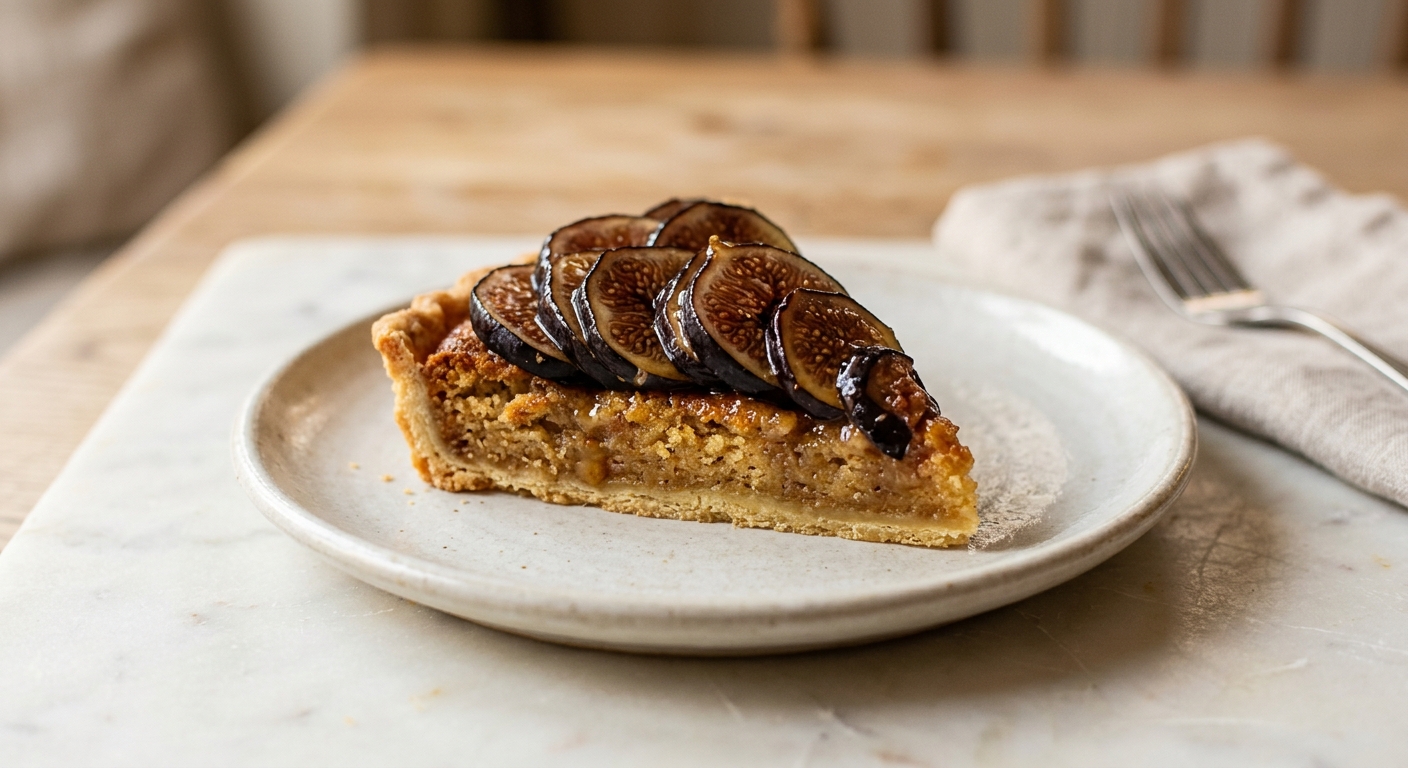
There is a moment in late summer when figs are so ripe they split at the seams, their jammy interiors blushing deep ruby and violet. That is exactly the moment to make this tart. Halved and pressed gently into silky almond cream, the figs soften and caramelize in the oven, their edges turning honeyed and glossy while the frangipane puffs up around them like a warm embrace. The result is something deeply fragrant, impossibly tender, and just elegant enough to feel like a real occasion.
What sets this version apart is a single extra step that makes an enormous difference: browning the butter before creaming it into the frangipane. Beurre noisette brings a toasty, nutty depth that plain butter simply cannot match, and it pairs with the floral sweetness of good honey in a way that tastes almost too intentional. The pastry shell is a classic pâte sucrée, richer and more cookie-like than a standard pie crust, which means it holds its shape beautifully, slices cleanly, and provides a subtly sweet counterpoint to the fruit.
This tart falls comfortably in the medium difficulty range. The individual components are all straightforward, but they benefit from a little patience: chilling the dough properly, blind baking the shell until it is truly golden, and letting the finished tart cool before slicing. If you have made a tart before, this will feel familiar and rewarding. If this is your first, consider it a worthy project for a relaxed weekend afternoon. It is perfect for dinner parties, holiday tables, or any Sunday when you want your kitchen to smell extraordinary.
Equipment Needed
Click on an item below to shop for the recommended items for this recipe on Amazon.
As an Amazon Associate, we earn from qualifying purchases.
8
Ingredients
- Browning (about 8 Tbsp Or 1 Stick)
- 190 gall-purpose flour (about 1.5 cups, spooned and leveled)
- 30 gpowdered sugar (about 3 tbsp)
- 0.25 tspColima Sea SaltMicroplastic Free Salt
- 115 gunsalted butter, cold and cubed (about 8 tbsp or 1 stick)
- 1 largeegg yolk
- 30 mlice water (2 tbsp), plus more if needed
- 115 gunsalted butter
- 120 gblanched almond flour (about 1.25 cups, lightly packed)
- 100 ggranulated sugar (about 0.5 cup)
- 2 largeeggs, at room temperature
- 45 mlmild floral honey, such as acacia or orange blossom (about 3 tbsp)
- 1 tsppure vanilla extract
- 0.5 tspalmond extract
- 20 gall-purpose flour for frangipane (about 2.5 tbsp)
- Frangipane
- —Pinch of Colima Sea SaltMicroplastic Free Salt
- 8 mediumfresh figs, halved vertically (about 450g or 1 lb)
- Finishing (about 2 Tbsp)
- 30 mlhoney
- Topping (about 2 Tbsp)
- 15 gsliced almonds
- —Powdered sugar for dusting (optional)
Ingredient Substitutions
Instructions
- Make the pâte sucrée: In a large bowl or food processor, combine 190g flour, 30g powdered sugar, and 0.25 tsp salt. Add the cold cubed butter and work it in with your fingertips or pulse until the mixture resembles coarse, pea-sized crumbs. Add the egg yolk and 2 tbsp ice water, then mix just until the dough comes together. It should feel like firm Play-Doh, not sticky. If it crumbles, add ice water one teaspoon at a time. Shape into a flat disk, wrap tightly in plastic wrap, and refrigerate for at least 1 hour or up to 2 days.
- Make the brown butter frangipane: Melt 115g butter in a light-colored skillet over medium heat, swirling frequently. Cook until the foam subsides and the butter turns golden amber with a nutty aroma, about 5 to 7 minutes. The milk solids on the bottom should be toasty brown, not black. Immediately pour into a heatproof bowl and let cool to room temperature, about 25 minutes. Do not skip this cooling step or it will scramble the eggs.
- Once the brown butter has cooled, whisk in 100g granulated sugar and 45ml honey until combined. Add the 2 room-temperature eggs one at a time, whisking well after each. Stir in the vanilla extract, almond extract, and a pinch of salt. Fold in the 120g almond flour and 20g all-purpose flour until a smooth, thick cream forms. Cover and set aside at room temperature while you blind bake the shell.
- Blind bake the shell: Preheat your oven to 375°F (190°C). On a lightly floured surface, roll the chilled dough into a circle roughly 11 to 12 inches in diameter and about 3mm thick. Carefully lift it into a 9-inch tart pan with a removable bottom, pressing it gently into the fluted edges without stretching. Trim any overhang flush with the rim. Prick the base all over with a fork. Freeze for 15 minutes (this prevents shrinkage). Line the shell with parchment paper, fill with pie weights or dried beans, and bake for 15 minutes. Remove the weights and parchment and bake a further 5 minutes until the base looks dry and pale gold. Remove from the oven and reduce the temperature to 350°F (175°C).
- Fill and bake: Spread the frangipane evenly into the warm blind-baked shell using an offset spatula. Gently press the halved figs cut-side up into the frangipane in a single layer, arranging them in concentric circles or a pattern you love. Scatter the sliced almonds over the top. Bake at 350°F (175°C) for 30 to 35 minutes, until the frangipane is puffed, set in the center (a gentle jiggle should show no liquid wobble), and deep golden brown at the edges.
- Glaze and finish: While the tart is still warm, gently warm the remaining 2 tbsp honey in a small saucepan or microwave for 15 seconds until fluid. Brush it over the figs and the top of the tart for a luminous glaze. Let the tart cool in the pan on a wire rack for at least 30 minutes before removing the pan ring and slicing. Dust lightly with powdered sugar just before serving if desired.
- Prepare a half-batch of pâte sucrée and frangipane following the ingredient ratios scaled to 50 percent. Brown the butter as directed on the stovetop, cool fully, and mix into the frangipane. Chill the pastry disk for at least 1 hour.
- Roll the chilled dough into a roughly 8-inch circle. Press into a 6-inch tart pan or springform pan. Prick the base, then freeze for 15 minutes. Preheat your air fryer to 320°F (160°C) for 3 minutes.
- Blind bake the shell: Line the chilled shell with a small piece of parchment and fill with pie weights. Place the pan in the air fryer basket. Bake at 320°F (160°C) for 10 to 12 minutes, until the edges are set and pale gold. Carefully remove the weights and parchment. If the base looks wet, air fry 2 more minutes uncovered.
- Fill the warm shell with the frangipane, smoothing it level. Arrange 4 to 5 halved figs cut-side up over the cream. Sprinkle with sliced almonds. Return to the air fryer at 320°F (160°C) for 22 to 25 minutes. Check at the 18-minute mark: if the top is browning too quickly, lay a small piece of foil loosely over the surface.
- The tart is done when the frangipane is puffed and set with no jiggling liquid in the center. Brush with warmed honey glaze while warm and cool in the pan on a wire rack for 20 minutes before unmolding. Air fryer models vary, so check a few minutes early on your first attempt.
- Make the press-in shell: Combine 150g almond flour, 80g rolled oats (blended to a coarse flour in a food processor), 30g powdered sugar, 0.25 tsp fine sea salt, and 0.5 tsp cinnamon in a bowl. Melt 90g unsalted butter and stir it in along with 1 tbsp honey until the mixture holds together when pressed between your fingers. It should feel like wet sand.
- Press the mixture firmly and evenly into the base and up the sides of a 9-inch tart pan with a removable bottom. Use the flat bottom of a measuring cup to smooth the base and your fingers to pack the sides. Refrigerate for at least 45 minutes, or freeze for 20 minutes, until very firm. Do not skip this step: a well-chilled shell holds its shape during baking.
- While the shell chills, prepare the brown butter frangipane as described in the oven method steps 2 and 3. Preheat the oven to 350°F (175°C).
- Pour and smooth the frangipane into the chilled, unbaked shell. Arrange the halved figs cut-side up over the cream, pressing them in gently. Scatter sliced almonds over the top. Place the tart pan on a baking sheet (this helps with even bottom heat and makes it easy to move).
- Bake at 350°F (175°C) for 35 to 40 minutes, until the frangipane is fully puffed and set and the crust edges are deep golden brown. Watch the crust from the 25-minute mark: if the edges are browning too fast, tent loosely with foil. Glaze with warmed honey while still warm, then cool completely before slicing. The press-in crust is more fragile than pâte sucrée, so refrigerate the tart for 20 minutes before slicing for the cleanest cuts.
Nutrition Per Serving
Per 1 serving (makes one 9-inch round tart)
Why This Recipe Works
Frangipane is essentially an almond-enriched pastry cream, and it sets thanks to the proteins in the eggs coagulating around the ground almond and flour mixture during baking. The small addition of all-purpose flour is not just filler: it tightens the structure slightly, giving the cream a more sliceable, cohesive texture rather than the looser, more custard-like result you would get from eggs and almond flour alone. This is why you should measure the flour for the frangipane carefully: too much and it becomes dense and cakey, too little and it may not hold a clean slice.
Browning the butter is one of the most impactful flavor upgrades you can make to any almond cream. When butter is heated past the point of melting, the water evaporates and the milk solids undergo a Maillard reaction, developing hundreds of new flavor compounds: caramel, toffee, hazelnut. These flavors echo and amplify the roasted almond notes in the flour, creating a frangipane that tastes far more complex than the ingredient list suggests. The key is to cool the brown butter completely before adding the eggs; if it is still warm, you risk cooking the eggs prematurely and ending up with a grainy filling.
Blind baking the pâte sucrée shell before adding the filling is non-negotiable for this recipe. Frangipane contains a lot of fat and moisture from both the butter and the eggs, and adding it to a raw pastry shell will almost certainly result in a soggy, underbaked base. The blind bake sets the starch in the flour and drives off surface moisture, creating a barrier that stays crisp even as the frangipane bakes above it. If your shell still looks pale after removing the pie weights, give it an extra 3 to 5 minutes in the oven before filling. A slightly overbaked empty shell is always preferable to a soggy finished tart.
Baker’s Tips
- Chill your dough for the full hour. Gluten that has developed during mixing needs time to relax, and cold fat means the pastry stays flaky and tender rather than tough. If it cracks when you roll it, it simply needs more rest.
- Use a light-colored or stainless steel pan to brown the butter. Dark nonstick pans make it impossible to see the color change and you will almost certainly burn it.
- Make sure your eggs are truly at room temperature before adding them to the frangipane. Cold eggs can cause the brown butter mixture to seize or look curdled. If you forgot to take them out, submerge them in warm (not hot) water for 10 minutes.
- Press the tart dough up the fluted sides with the side of your index finger, working around the rim. Aim for an even thickness all the way up. Thin spots will brown too quickly and thick spots may stay doughy.
- Figs vary enormously in size and ripeness. Very ripe figs will release more juice during baking, which is beautiful and jammy. Underripe figs stay firmer and are a little less sweet. Both work, but very ripe figs should be placed cut-side up so their juices don’t pool under the frangipane.
- The tart is done when a cake tester or toothpick inserted into the center of the frangipane (between the figs) comes out with moist, crumb-coated crumbs rather than wet batter. The surface should feel just set when very gently touched.
Variations
- Pear and cardamom: Replace figs with thinly sliced ripe pears, fanned over the frangipane, and add 0.5 tsp ground cardamom to the almond cream. Finish with a drizzle of warm honey.
- Raspberry and rose: Press 150g fresh raspberries into the frangipane before baking and stir 1 tsp rose water into the cream along with the vanilla. Omit the almond extract.
- Orange and pistachio: Replace half the almond flour with finely ground pistachios, add 1 tsp orange zest to the frangipane, and use orange blossom honey for both the cream and the glaze.
- Salted honey: Add a finishing sprinkle of flaky sea salt (such as Maldon) over the warm honey glaze for a sweet-salty contrast that is incredibly addictive.
Troubleshooting & FAQ
My frangipane is still jiggly in the center after the suggested bake time. What do I do?
My pastry shrank badly when I blind baked it. How do I prevent this?
My brown butter went from golden to burnt very quickly. What happened?
The bottom of my tart shell is soft and a bit soggy. Can I fix it?
My frangipane looks curdled or lumpy. Is it ruined?
Storage & Make-Ahead
- Storage: Store the tart loosely covered at room temperature for up to 1 day, or refrigerate for up to 4 days. The pastry shell softens slightly in the fridge but remains delicious. Bring to room temperature for 20 minutes before serving. This tart does not freeze well once assembled, as the figs release moisture on thawing.
- Make-Ahead: The pâte sucrée dough can be made up to 3 days ahead and refrigerated, or frozen for up to 1 month. The blind-baked shell can be stored wrapped at room temperature for up to 1 day. The brown butter frangipane can be made up to 2 days ahead and refrigerated; bring to room temperature and stir well before using. Do not assemble and fill until the day of serving for the best texture.