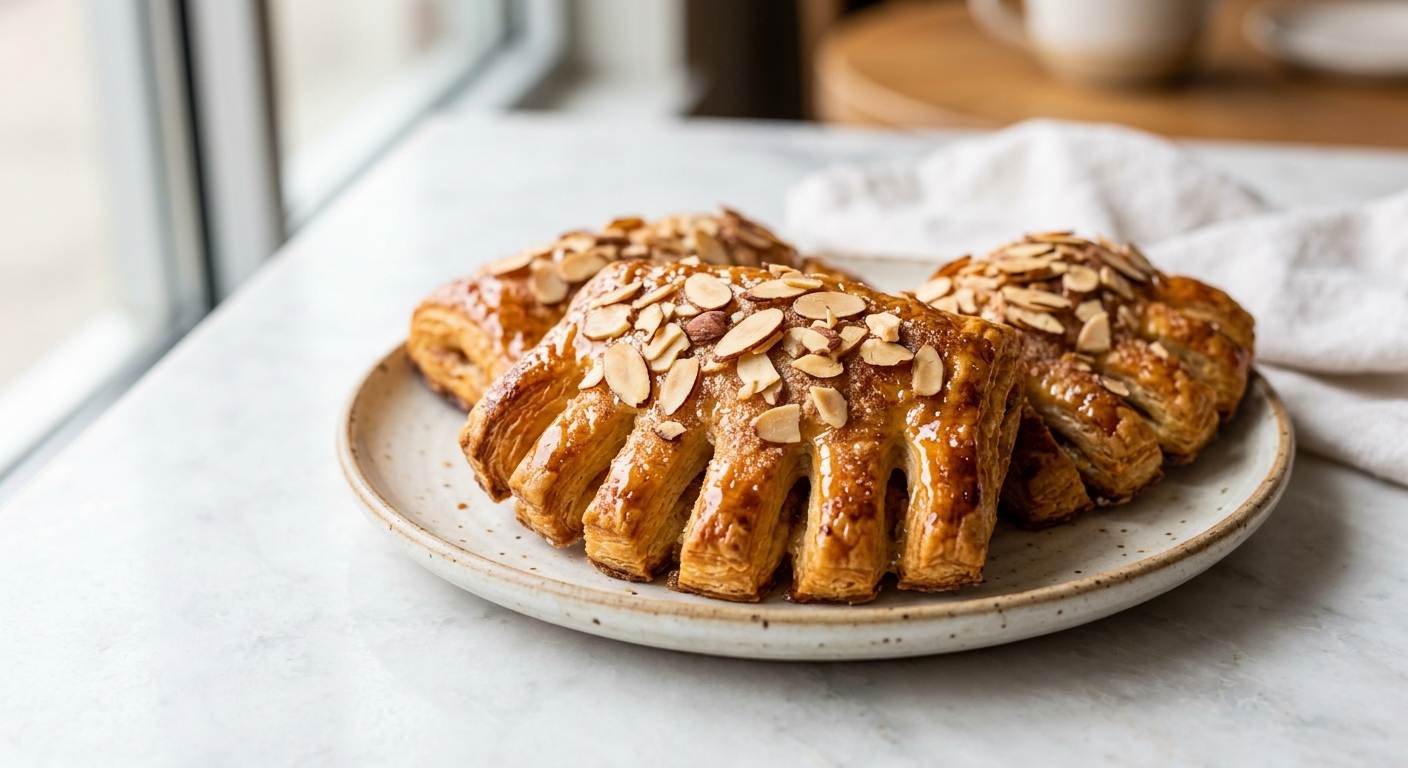
There is something quietly thrilling about pulling a tray of bear claws from the oven. The pastry puffs up in dramatic layers, the almond filling bubbles at the edges, and the whole kitchen smells like the best bakery you have ever wandered into on a cold morning. Bear claws sit in a special category of pastry, somewhere between a croissant and a Danish, with a rich frangipane-style filling tucked inside dough that shatters when you bite into it. They are indulgent without being fussy about how you eat them, and they look genuinely impressive on a table.
What sets this version apart is the laminated quick-puff dough, which gives you honest, bakery-quality layers without a three-day croissant project. The almond filling is a proper almond cream, made with ground blanched almonds, butter, sugar, and egg, brightened with orange zest and warmed with a generous pinch of cinnamon. That cinnamon does something important here: it adds depth that plain almond paste often lacks, tying the filling and the pastry together into something that tastes like it was designed, not assembled. The honey glaze applied straight from the oven soaks into the hot layers and adds a floral sweetness that no simple egg wash can match.
These pastries sit comfortably in the medium difficulty range. There is nothing technically scary about the process, but it does reward patience, especially during the lamination folds. They are perfect for a weekend bake when you have a couple of hours and want something genuinely special for brunch, a holiday morning spread, or an afternoon coffee ritual. If you have never made laminated dough before, this is a wonderful starting point.
Equipment Needed
Click on an item below to shop for the recommended items for this recipe on Amazon.
As an Amazon Associate, we earn from qualifying purchases.
8
Ingredients
- Lamination
- 300 gall-purpose flour (about 2.5 cups, spooned and leveled), plus more for dusting
- 7 ginstant yeast (about 2.25 tsp or one standard packet)
- 25 ggranulated sugar (about 2 tbsp)
- 5 gColima Sea SaltMicroplastic Free Salt (about 1 tsp)
- 180 mlwhole milk, cold (about 3/4 cup)
- 1 largeegg, cold
- 200 gunsalted European-style butter, cold and cut into 1cm slices (about 14 tbsp)
- 150 gblanched almond flour (about 1.5 cups, not coarse almond meal)
- 100 gunsalted butter, softened to room temperature (about 7 tbsp)
- 100 gpowdered sugar, sifted (about 3/4 cup plus 1 tbsp)
- 1 largeegg, room temperature
- 1 tsppure vanilla extract
- 1.5 tspground cinnamon
- 1 tspfinely grated orange zest (from about half a navel orange)
- —Pinch of Colima Sea SaltMicroplastic Free Salt (for the almond filling)
- Topping
- 40 gsliced blanched almonds (about 1/3 cup)
- Egg Wash
- 1 largeegg beaten with 1 tbsp whole milk
- Glazing
- 60 ggood-quality honey (about 3 tbsp)
- Thinning The Glaze
- 15 mlwarm water (about 1 tbsp)
Ingredient Substitutions
Instructions
- Make the dough: In a large bowl, whisk together the flour, instant yeast, sugar, and salt. Add the cold milk and cold egg. Mix with a fork until a shaggy dough forms, then turn out onto a lightly floured surface and knead briefly, just 2 to 3 minutes, until the dough comes together into a smooth ball. You are not developing full gluten here – just enough cohesion. Flatten into a rectangle, wrap tightly in plastic wrap, and refrigerate for 30 minutes.
- Laminate the dough: On a generously floured surface, roll the chilled dough into a rectangle roughly 25 x 35 cm (10 x 14 inches). Arrange the cold sliced butter in a single layer over two-thirds of the dough, leaving a 2 cm border on the buttered edges. Fold the unbuttered third over the center, then fold the remaining buttered third on top, like a letter. Turn the dough 90 degrees. Roll out again gently to the same rectangle size, then fold in thirds again. This is your second fold. Wrap and refrigerate for 30 minutes. Repeat this roll and fold process once more for a total of three folds. After the final fold, wrap and refrigerate for at least 30 minutes before shaping.
- Make the almond filling: While the dough chills, beat the softened butter and powdered sugar together with a hand mixer or by hand until pale and fluffy, about 2 minutes. Add the egg and vanilla extract and beat until fully combined. Fold in the almond flour, ground cinnamon, orange zest, and pinch of salt until you have a smooth, cohesive paste. Refrigerate until ready to use.
- Preheat your oven to 375°F (190°C) and line two large baking sheets with parchment paper.
- Shape the bear claws: On a lightly floured surface, roll the laminated dough into a rectangle approximately 30 x 40 cm (12 x 16 inches) and about 5mm thick. Trim the edges straight with a sharp knife or pastry wheel. Cut the dough into 8 equal rectangles, each roughly 10 x 15 cm (4 x 6 inches). Divide the almond filling into 8 portions (about 50g each). Shape each portion into a short log and place it along one long edge of each dough rectangle, positioning it in the lower third of the pastry. Brush the opposite long edge with egg wash. Fold the pastry over the filling to enclose it, pressing the seam firmly to seal. The filled portion should resemble a thick log.
- Make the claw cuts: Using a sharp knife or bench scraper, make 4 evenly spaced cuts along the sealed edge of each pastry, cutting about two-thirds of the way through the log but not all the way to the back seam. Gently curve the pastry into a slight fan or horseshoe shape, separating the cuts slightly so the toes of the claw spread apart. Place on the prepared baking sheets, spaced at least 5 cm apart. Brush generously with egg wash, avoiding the cut edges. Scatter sliced almonds over the top of each pastry. Let rest uncovered at room temperature for 20 minutes while the oven finishes preheating.
- Bake for 22 to 25 minutes, until the pastries are a deep golden amber and the almond filling is set and slightly puffed. The layers should be visible on the sides. Rotate the pans halfway through baking if your oven has hot spots.
- Glaze while hot: As soon as the pastries come out of the oven, stir together the honey and warm water until thin and fluid. Brush generously over the hot pastries. The glaze will soak into the layers and set to a glossy sheen as the pastries cool. Allow to cool on the baking sheet for at least 15 minutes before eating. They are wonderful warm but also excellent at room temperature.
- Prepare the dough and almond filling exactly as described in the oven method through to shaping. Shape, fill, cut, and curve the bear claws as directed.
- Line your air fryer basket with a piece of parchment paper cut to fit, leaving the edges trimmed so air can circulate around the sides. Do not use parchment that extends above the rim as it can be caught by the fan.
- Brush the shaped pastries with egg wash and top with sliced almonds. Place 2 to 3 bear claws in the air fryer basket, spacing them so they are not touching. Do not let them rest at room temperature as the air fryer preheats quickly.
- Air fry at 350°F (175°C) for 12 to 14 minutes, checking at the 10-minute mark. The pastries should be deep golden and the almond filling fully set. Because air fryers vary significantly in power, start checking at 10 minutes and cover loosely with a small square of foil if the almonds are browning too quickly before the dough is cooked through.
- Remove carefully using tongs or a spatula. Brush immediately with the thinned honey glaze while hot. Repeat with remaining pastries. Allow to cool for 10 minutes before serving. The exterior will be notably crispier than the oven version, which many people prefer.
- Prepare the dough, filling, and shape the bear claws completely through the claw-cutting step. Do not brush with egg wash yet.
- Arrange the shaped, unbaked bear claws on a parchment-lined baking sheet so they are not touching. Transfer the sheet to the freezer and freeze until the pastries are solid, at least 2 hours.
- Once frozen solid, transfer the pastries to a zip-top freezer bag or airtight container, layering with parchment between pastries to prevent sticking. Label with the date. They keep in the freezer for up to 6 weeks.
- To bake from frozen: Preheat your oven to 375°F (190°C). Remove as many pastries as you need and place on a parchment-lined baking sheet. Do not thaw. Brush with egg wash straight from frozen and top with sliced almonds. Bake for 26 to 30 minutes, until deeply golden and fully cooked through. The extra time accounts for the frozen interior.
- Remove from the oven and immediately brush with the honey glaze as directed. The results are nearly indistinguishable from freshly made, and on a weekday morning, the experience of pulling bakery-quality bear claws from the oven in under 30 minutes is genuinely joyful.
Nutrition Per Serving
Per 1 serving (makes 8 bear claw pastries)
Why This Recipe Works
The lamination process, which is the technique of folding cold butter repeatedly into dough, creates hundreds of distinct layers by keeping the butter and dough as separate entities right up until they hit the oven’s heat. When the butter melts rapidly in the hot oven, it releases steam that pushes the dough layers apart. This is why keeping everything cold throughout the process is not optional – if the butter softens and smears into the dough rather than staying in distinct sheets, you lose the layers and end up with something closer to a brioche texture. Three folds create 27 distinct butter layers, which is plenty for a beautiful, flaky pastry without the complexity of full croissant lamination.
The almond filling works on the same principle as a classic frangipane, a baked almond cream that puffs slightly as the egg and butter set in the oven’s heat. The fat in the almond flour keeps the filling moist and tender while the egg provides structure, so it holds its shape when you bite through the pastry rather than running out. The cinnamon in the filling plays a specific chemical role alongside the sugar: cinnamon’s volatile aromatic compounds, particularly cinnamaldehyde, are fat-soluble and bind to the almond flour’s natural oils, which is why their flavors meld so seamlessly. Adding cinnamon to a water-based component (like a simple sugar syrup glaze) would give you much less fragrance.
If your pastry comes out with no visible layers, the butter likely softened too much during lamination and merged with the dough. In future batches, refrigerate the dough for the full 30 minutes between each fold, and keep the work surface and rolling pin lightly floured and cool. If the almond filling leaks out during baking, the seam was not sealed firmly enough – press it down with the heel of your hand and ensure the egg wash acts as a glue along the entire edge before folding.
Baker’s Tips
- Keep everything cold. If at any point during lamination you notice the butter starting to smear or the dough feels warm and sticky, stop immediately, wrap the dough, and refrigerate it for 20 minutes before continuing. Patience here pays off in layers.
- Use a sharp knife or bench scraper for the claw cuts. A dull blade will drag and compress the layers at the cut edge, and you will lose the dramatic separation that makes the finished pastry look so striking.
- European-style butter (such as Plugra, Kerrygold, or Lurpak) has a lower water content and higher fat percentage than standard American butter. This creates crisper, more defined layers. If you can source it, it is worth using here.
- Do not skip the 20-minute rest before baking. This gives the yeast in the dough a brief chance to relax and begin working, which contributes to a lighter, more open texture in the pastry.
- The honey glaze must go on hot. If you wait until the pastries cool, the glaze will sit on the surface rather than soaking in. Apply it within 2 minutes of the pastries coming out of the oven.
- When making the claw cuts, aim for evenly spaced cuts so the toes bake at the same rate. Uneven cuts mean some toes will over-brown while others are still pale.
- If your sliced almonds are browning too quickly before the pastry is done, tent loosely with foil for the final 5 minutes of baking.
Variations
- Pistachio and rose variation: Replace the almond flour with finely ground pistachios and substitute rose water (1/2 tsp) for the orange zest. Omit the cinnamon and use cardamom instead. Top with crushed pistachios instead of sliced almonds.
- Chocolate almond variation: Add 2 tablespoons of Dutch-process cocoa powder to the almond filling and tuck a small piece (about 10g) of dark chocolate inside each pastry before folding. The filling will be slightly darker and richer.
- Marzipan shortcut filling: Replace the homemade almond cream with 400g of good-quality store-bought marzipan (about 50g per pastry), kneaded with the cinnamon and orange zest. The texture is denser and sweeter but the method is significantly faster.
- Cardamom variation: Replace the cinnamon with 1 teaspoon of ground cardamom for a more Scandinavian flavor profile. Wonderful paired with the honey glaze.
Troubleshooting & FAQ
My pastry came out dense and bread-like with no flaky layers. What went wrong?
The almond filling leaked out all over the baking sheet. How do I stop this?
My bear claws spread flat during baking instead of puffing up. What happened?
The claw cuts closed back up during baking and the pastries look like smooth logs. How do I get the claw to stay open?
My almond filling tastes gritty. What did I do wrong?
Storage & Make-Ahead
- Storage: Store cooled bear claws in an airtight container at room temperature for up to 2 days. To refresh, warm in a 325°F (160°C) oven for 8 minutes. They are best eaten the day they are made, but the second day they are still excellent. Do not refrigerate, as this toughens the pastry layers. Freeze unbaked shaped pastries for up to 6 weeks (see freeze-and-bake method above).
- Make-Ahead: The laminated dough can be prepared through all three folds and refrigerated overnight, tightly wrapped. The almond filling can be made up to 3 days ahead and stored covered in the refrigerator. Bring the filling to room temperature for 15 minutes before using so it is spreadable. Shaped, unbaked bear claws can be frozen for up to 6 weeks and baked directly from frozen.