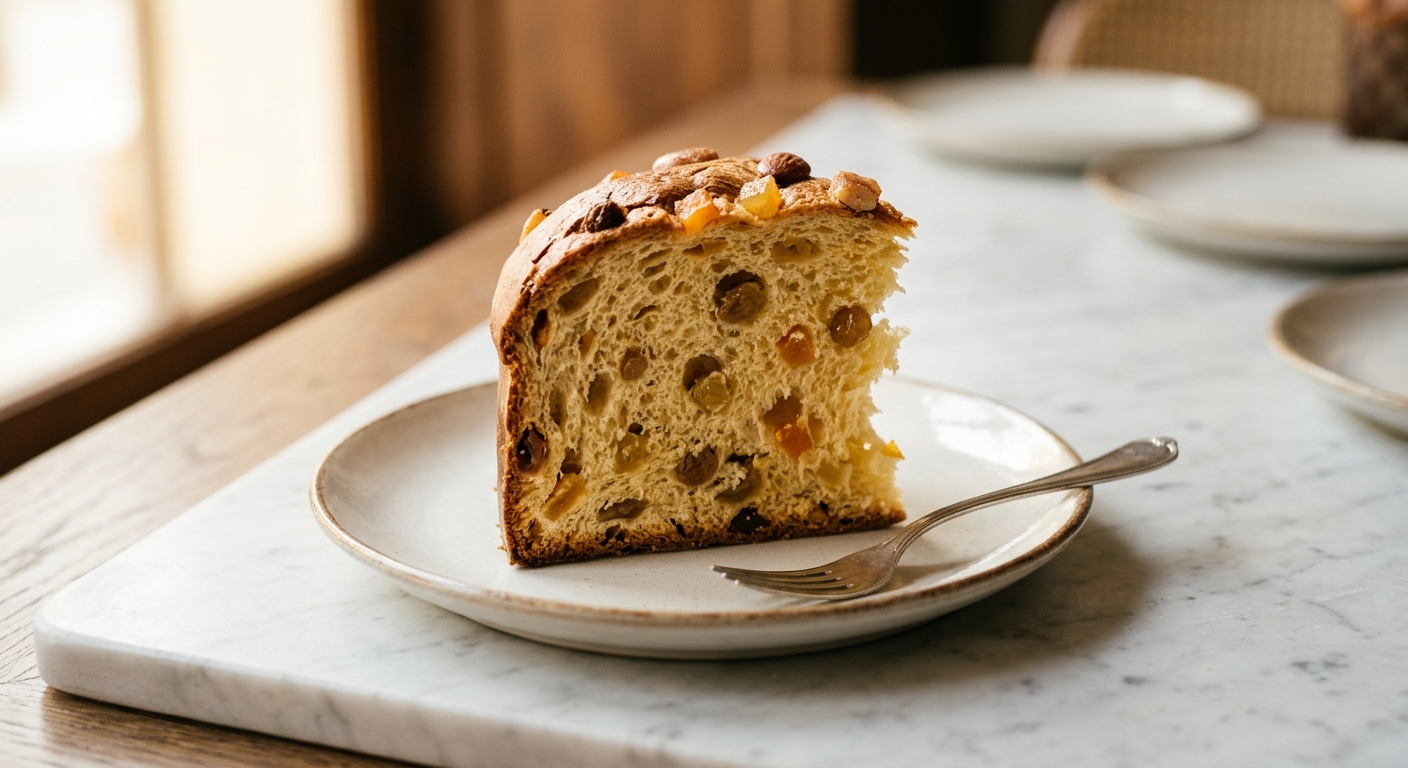
There is something quietly magical about a panettone fresh from the oven, its domed crown golden and proud above the paper mold, the kitchen filled with the warm scent of butter, vanilla, and candied orange. This is the bread of Italian Christmas, of New Year’s morning toasted beside a cup of espresso, of gifts wrapped in cellophane and ribbons stacked in bakery windows from Milan to Palermo every December. It is a bread with history and ritual, and making it at home from scratch is one of those deeply satisfying baking projects that rewards every hour of patience with something genuinely extraordinary.
What sets this recipe apart is the use of a two-stage dough build, a technique borrowed from professional Italian pastry kitchens that develops flavor and gluten structure gradually rather than all at once. The first dough, called the primo impasto, ferments overnight, building a complex, slightly tangy depth of flavor that is impossible to shortcut. The second dough enriches it with more butter, egg yolks, and aromatics the following day. The result is a crumb that is shredding-soft, almost spooling in long threads when you pull it apart, with a richness that is never heavy. The candied citrus peel, which you can make yourself in under an hour, adds a jewel-bright chewiness and a genuine citrus fragrance that the dried, sugared peels in a grocery store bag simply cannot match.
This is an advanced bake that takes two days from start to finish, and it genuinely rewards your full attention. It is perfect for the confident home baker who wants to master something truly special for the holiday season or a celebratory occasion. If you have made enriched breads like brioche before, you already have the intuition you need. If this is your first enriched dough, read the recipe all the way through before you begin, trust the timeline, and know that the process itself is as joyful as the result.
Equipment Needed
Click on an item below to shop for the recommended items for this recipe on Amazon.
As an Amazon Associate, we earn from qualifying purchases.
12
Ingredients
- 7 ginstant yeast (about 2 tsp), divided
- 120 mlwhole milk, warmed to about 100°F (38°C) (about 1/2 cup)
- 500 gbread flour (about 4 cups, spooned and leveled), divided
- 150 ggranulated sugar (about 3/4 cup), divided
- 5 largeegg yolks, at room temperature, divided
- 2 largewhole eggs, at room temperature
- 200 gunsalted butter, very soft but not melted (about 14 tbsp), divided
- 1.5 tspColima Sea SaltMicroplastic Free Salt
- 2 tsppure vanilla extract
- 1 tbspfinely grated orange zest (from about 2 large oranges)
- 1 tspfinely grated lemon zest
- 1 tbsphoney
- 150 ggolden raisins (about 1 cup), soaked in warm water or rum for 30 minutes, drained and patted dry
- 150 ghomemade or high-quality store-bought candied orange and lemon peel, roughly chopped (about 1 cup)
- 30 gunsalted butter, melted, for finishing (about 2 tbsp)
- —For the candied citrus peel (optional, recommended):
- 2 largenavel oranges and 1 lemon, peels only, pith trimmed, cut into strips
- 200 ggranulated sugar for candying syrup (about 1 cup)
- 200 mlwater for candying syrup (about 3/4 cup plus 1 tbsp)
Ingredient Substitutions
Instructions
- DAY 1, AFTERNOON: Make the primo impasto. In the bowl of a stand mixer fitted with the dough hook, combine 250g of the bread flour, 3.5g (1 tsp) of the instant yeast, 50g of the sugar, and the warm milk. Mix on low for 2 minutes to combine. Add 3 of the egg yolks, one at a time, mixing until each is absorbed. Increase speed to medium and knead for 5 minutes until the dough is smooth. Add 100g of the soft butter in small pieces, mixing until fully incorporated and the dough is glossy, about 6 to 8 minutes. The dough will be soft and slightly sticky. Transfer to a lightly oiled bowl, cover with plastic wrap, and refrigerate overnight for 12 to 14 hours.
- DAY 2, MORNING: Remove the primo impasto from the refrigerator and let it come to room temperature for 1 hour. It should have roughly doubled. Meanwhile, in a small bowl, stir together the vanilla extract, orange zest, lemon zest, and honey to make an aromatic paste. Set aside.
- Make the secondo impasto. Return the primo impasto to the stand mixer bowl. Add the remaining 250g bread flour, 3.5g yeast, and 100g sugar. Mix on low with the dough hook until the flour is absorbed, about 3 minutes. Add the 2 whole eggs and the remaining 2 egg yolks one at a time, mixing on medium between each addition. The dough should look shaggy at first, then smooth out. Add the salt and the aromatic paste. Knead on medium-high for 8 minutes until the dough is very smooth, elastic, and pulling cleanly away from the sides of the bowl. Add the remaining 100g soft butter in four additions, waiting until each piece is fully absorbed before adding the next. This will take 10 to 12 minutes of kneading. The finished dough should pass the windowpane test: a small piece stretched between your fingers should become thin enough to see light through without tearing.
- Gently fold the drained raisins and chopped candied peel into the dough on low speed for 1 minute, or by hand using a series of stretch-and-fold motions. Do not overwork. Shape the dough into a smooth ball by cupping it under your palms on an unfloured surface and rotating in tight circles to build surface tension. Place it seam-side down into a 1 kg paper panettone mold set on a baking sheet. Cover loosely with plastic wrap and let rise at room temperature (75 to 78°F / 24 to 26°C) until the dough domes above the top of the mold by about 1 inch (2.5 cm). This will take 4 to 6 hours depending on your kitchen temperature.
- When the dough is nearly ready, preheat your oven to 375°F (190°C). Just before baking, use a sharp razor blade or lame to score a shallow cross in the top of the dome, about 1/4 inch (6mm) deep. Place a small pat of cold butter (about 1 tsp) in the center of the cross. This traditional scarring helps the dome expand cleanly and creates a beautiful cracked top.
- Place the panettone on the middle rack and immediately reduce the oven temperature to 350°F (175°C). Bake for 45 to 50 minutes, until deep golden brown on top. If the top is browning too fast after 30 minutes, tent loosely with foil. The internal temperature should reach 190 to 195°F (88 to 90°C) on an instant-read thermometer inserted through the side.
- Immediately after removing from the oven, push two long metal skewers or knitting needles through the sides of the panettone mold near the base, forming a cross. Hang the panettone upside down between two tall pots or over a large stockpot, allowing it to cool completely inverted for at least 3 hours, ideally overnight. This is non-negotiable: it prevents the delicate crumb from collapsing under its own weight. Brush the top with melted butter just before serving for a soft, shiny finish.
- Prepare the full primo impasto and secondo impasto as described in the oven method, but divide the final dough into two equal portions. Use one portion for the air fryer panettone and refrigerate or freeze the second portion for another use, or bake both separately if your air fryer is large enough.
- Shape the dough into a smooth ball and place into a 500g paper panettone mold. Cover and let rise at room temperature until the dome rises 1 inch above the top of the mold, about 4 to 6 hours. Do not rush this rise: an under-proofed dough will crack aggressively and bake unevenly in the air fryer’s intense circulating heat.
- Preheat your air fryer to 300°F (150°C) for 5 minutes. Using a razor blade or sharp knife, score a shallow cross in the top of the dome and place a small pat of cold butter in the center. Lower the panettone carefully into the air fryer basket, ensuring it does not touch the heating element. If your basket is small, do not use a rack.
- Air fry at 300°F (150°C) for 30 to 35 minutes. Check at the 20-minute mark: if the top is browning very fast, place a small square of foil loosely over the dome for the remaining time. The panettone is done when deep golden brown and an instant-read thermometer inserted through the side reads 190°F (88°C).
- Immediately insert two skewers through the base of the mold and hang upside down to cool for at least 3 hours, exactly as in the oven method. The crumb is just as fragile regardless of cooking method, and this step cannot be skipped. Brush with melted butter before serving.
Nutrition Per Serving
Per 1 serving (makes one large panettone in a 1 kg (7-inch) paper panettone mold)
Why This Recipe Works
The soul of a great panettone is gluten development built in stages. By creating a primo impasto the night before, you give the yeast time to produce not just carbon dioxide for lift but also flavor compounds, organic acids, and enzymatic activity that transform plain flour into something deeply aromatic. When you incorporate this fermented starter into the secondo impasto the next day, you are essentially enriching a dough that already has exceptional flavor and structure. This is why panettone made with a two-stage process tastes fundamentally different from one made in a single afternoon, even if the ingredient lists are identical.
The butter incorporation technique is critical and borrows from brioche method. Adding cold or room-temperature butter in small increments, waiting for each addition to be fully absorbed before the next, allows the fat to coat individual gluten strands rather than interrupt them. If you add butter too quickly or all at once, the fat creates a barrier between flour proteins before the gluten network is established, and you end up with a greasy, dense dough that will never rise properly. The windowpane test, that moment when a small piece of dough stretches translucent without tearing, is your confirmation that the gluten is strong and extensible enough to trap the gas from all those egg yolks, butter, and fruit additions without collapsing.
The inverted cooling method is not theatrical: it is structural engineering. Panettone dough is so enriched with fat and egg that its crumb is extraordinarily tender and fragile immediately out of the oven. The steam inside the crumb is still redistributing, and the gluten and starch network is still setting. If you cool it upright, gravity pulls the soft, warm crumb downward, and the center compresses before it has a chance to set in its open, airy structure. Hanging it upside down lets gravity work in your favor, stretching the crumb slightly and holding it open as it cools and firms. If your panettone ever collapses in the center, skipping or shortcutting this step is almost certainly why.
Baker’s Tips
- Butter temperature is everything in this recipe. It should be genuinely soft, leaving an easy indent when pressed, but absolutely not melted or greasy. If your kitchen is warm and your butter starts to look shiny or slick while you are adding it, stop and refrigerate the dough for 15 minutes before continuing.
- The dough will feel worryingly sticky and slack during mixing, especially during the butter incorporation phase. Resist adding extra flour. The gluten will strengthen with continued kneading, and a softer dough produces a more tender crumb.
- Use a paper panettone mold rather than a regular cake pan. The paper mold provides structural support during the final rise and bake, allows you to do the inverted cooling without removing the bread from its mold, and gives the authentic presentation. They are inexpensive and available online or in baking supply stores.
- Room temperature matters more in this recipe than almost any other. A cool kitchen (below 70°F / 21°C) can extend the final proof to 8 or even 10 hours, while a warm kitchen above 80°F (27°C) can cause the butter to soften too much in the dough, making it greasy. Aim for a 75 to 78°F (24 to 26°C) proofing environment. A turned-off oven with a bowl of hot water works perfectly.
- Soak your raisins. It takes only 30 minutes but makes an enormous difference. Dry raisins will steal moisture from the surrounding crumb as the bread bakes, creating dry pockets. Plump, hydrated raisins stay juicy and moist, and if you use rum or brandy for soaking, that flavor infuses the entire loaf subtly.
- An instant-read thermometer is highly recommended for this recipe. Panettone browns quickly on the outside while the enriched interior takes longer to cook through. Pulling it at the right internal temperature of 190 to 195°F (88 to 90°C) guarantees a fully baked, moist, not gummy crumb every time.
Variations
- Chocolate and Cherry Panettone: Replace the golden raisins with 150g dried sour cherries soaked in brandy, and replace the candied peel with 150g roughly chopped dark chocolate (70%). Add 1 tablespoon of unsweetened cocoa powder to the secondo impasto for a subtle chocolate depth.
- Limoncello Panettone: Add 2 tablespoons of limoncello liqueur to the aromatic paste along with the vanilla and zests, and replace the golden raisins with candied lemon peel and dried blueberries. Finish with a light drizzle of lemon glaze (100g powdered sugar whisked with 2 tablespoons lemon juice) once fully cooled.
- Panettone French Toast: Day-old slices make an extraordinary French toast. Whisk 3 eggs with 120ml cream, 1 teaspoon vanilla, and a pinch of cinnamon. Soak thick slices for 2 minutes per side and fry in butter until golden. Serve with mascarpone and a drizzle of honey.
- Mini Panettoni: Divide the full dough recipe into six equal portions and use six 100g paper panettone molds. Reduce the bake time to 22 to 26 minutes at 350°F (175°C) and check internal temperature from 20 minutes onward. These make beautiful individual gifts.
Troubleshooting & FAQ
My dough never came together properly during mixing and is very greasy. What went wrong?
My panettone rose beautifully but then collapsed in the center after cooling. Why?
The final rise took almost 8 hours and the dough barely rose above the mold. Is something wrong?
The top of my panettone cracked severely and looks split open rather than having a neat scored cross. What happened?
Can I make this recipe without a stand mixer, by hand?
Storage & Make-Ahead
- Storage: Once fully cooled, wrap the panettone tightly in plastic wrap and store at room temperature for up to 5 days. For longer storage, slice and freeze individual pieces in zip-top bags for up to 2 months. To refresh a slice, toast it lightly or warm in a 300°F (150°C) oven for 5 minutes. Panettone actually improves in flavor after 24 hours as the crumb settles.
- Make-Ahead: The primo impasto (Day 1 dough) can be made up to 24 hours ahead and kept refrigerated. The candied citrus peel can be made up to 2 weeks in advance and stored in an airtight container at room temperature. The fully baked and cooled panettone makes an excellent gift and can be wrapped and stored for up to 5 days, making it ideal for baking several days before Christmas or a celebration.