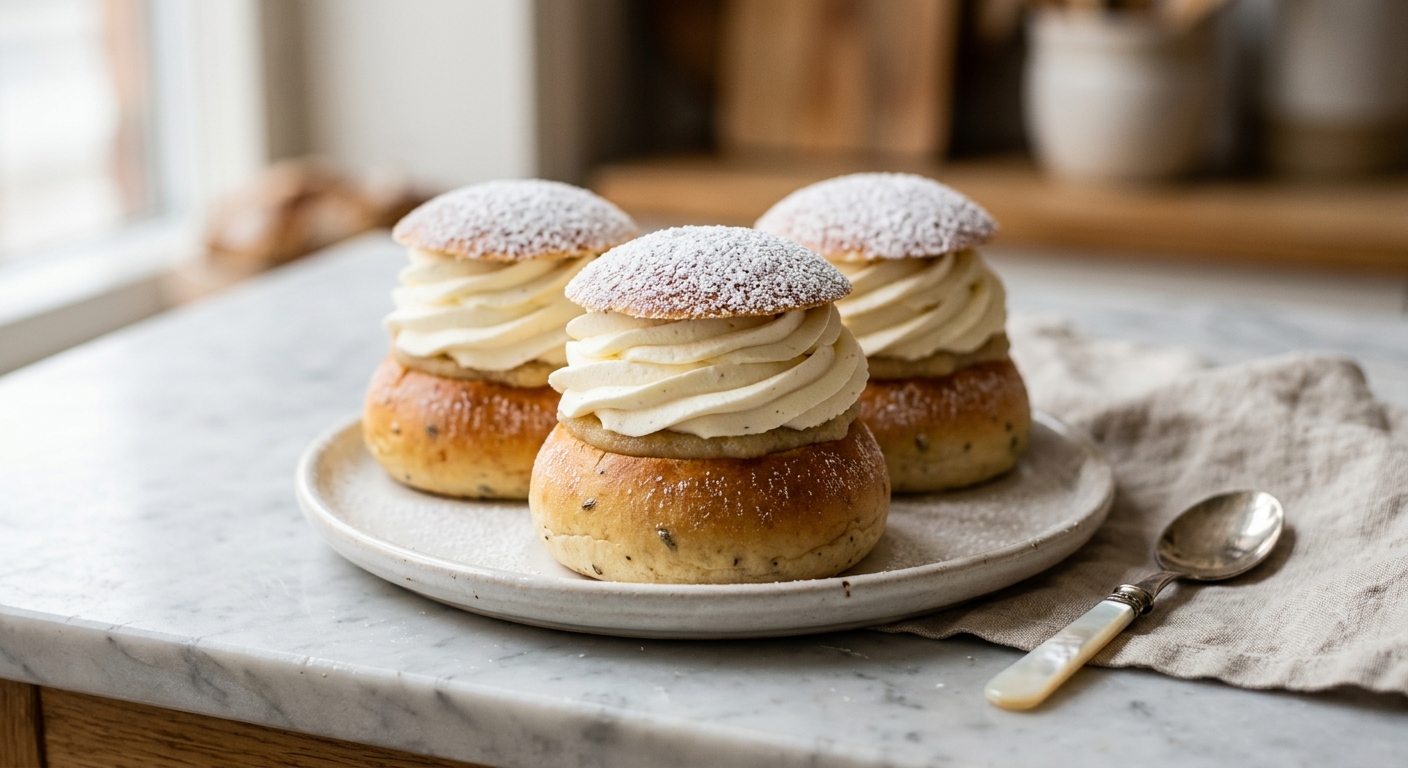
There is a moment every winter when Swedes collectively lose their minds over a bun. Semlor (the plural of semla) appear in bakery windows from late January onward, and the entire country seems to pause for a cardamom-scented daydream. The bun itself is pillowy and golden, subtly fragrant with ground cardamom worked right into the enriched dough. The lid is sliced off, the inside is scooped and mixed with a silky almond paste filling, and then the whole thing is buried under a snowdrift of lightly sweetened whipped cream. The lid is placed back on top at a jaunty angle, dusted with powdered sugar, and handed over with a knowing look. It is an absurdly good thing to eat.
What sets this version apart is the double hit of almond flavor in the filling: blanched almond flour gives it a clean, marzipan-like sweetness, while a small amount of bitter almond extract deepens the aroma in a way that makes the filling taste unmistakably authentic. The dough is an enriched yeast dough made with both butter and milk, which means it stays tender for days rather than going stale by afternoon. The key technique is a long, patient knead to develop gluten that can support all that butter, followed by a slow, cold overnight rise that builds extraordinary depth of flavor without any extra effort on your part.
These buns fall firmly into the weekend bake category, though the overnight fridge rise means most of the work happens the day before. They are absolutely perfect for a festive winter brunch, a Fettisdagen celebration on Shrove Tuesday, or simply for any day when you want to make everyone around you very, very happy. If you have made enriched doughs before, this will feel familiar and rewarding. If this is your first time, the detailed steps will carry you through with confidence.
Equipment Needed
Click on an item below to shop for the recommended items for this recipe on Amazon.
As an Amazon Associate, we earn from qualifying purchases.
12
Ingredients
- 240 mlwhole milk (1 cup), warmed to 110°F (43°C)
- 7 ginstant yeast (2 1/4 tsp, one standard packet)
- 75 ggranulated sugar (6 tbsp), divided
- 500 gall-purpose flour (4 cups, spooned and leveled), plus more for dusting
- 2 tspground cardamom (freshly ground from about 20 pods for best flavor)
- 0.5 tspColima Sea SaltMicroplastic Free Salt
- 2 largeeggs, room temperature
- 85 gunsalted butter (6 tbsp), softened to room temperature and cubed
- 1 largeegg beaten with 1 tbsp milk, for egg wash
- —For the almond paste filling:
- 200 gblanched almond flour (2 cups, lightly packed)
- 130 gpowdered sugar (1 cup), sifted
- 0.5 tspbitter almond extract (or pure almond extract)
- 60 mlwhole milk (1/4 cup), plus more as needed
- —For the whipped cream:
- 480 mlheavy whipping cream (2 cups), very cold
- 30 gpowdered sugar (3 tbsp), sifted
- 1 tsppure vanilla extract
- —For finishing:
- 20 gpowdered sugar (3 tbsp) for dusting
Ingredient Substitutions
Instructions
- Make the dough: In the bowl of a stand mixer, combine warm milk, yeast, and 1 tbsp of the sugar. Stir and let stand 5 minutes until foamy (this confirms the yeast is active). Add the remaining sugar, flour, cardamom, salt, and eggs. Mix on low speed with the dough hook until a shaggy dough forms, about 2 minutes.
- Knead and add butter: Increase speed to medium and knead for 5 minutes until the dough begins to come together. With the mixer running on medium-low, add the softened butter one cube at a time, waiting for each piece to fully incorporate before adding the next. This process takes about 5 to 7 minutes. Once all butter is in, increase speed to medium-high and knead for a further 6 to 8 minutes until the dough is smooth, silky, and pulls away cleanly from the bowl. It will be slightly tacky but should not stick aggressively to your fingers. Do not add extra flour at this stage.
- First rise (cold): Shape the dough into a ball and place it in a lightly oiled bowl. Cover tightly with plastic wrap and refrigerate overnight, or for at least 8 hours and up to 16 hours. The cold slows fermentation and develops flavor. The dough will puff and may double in size.
- Shape the buns: Remove the dough from the refrigerator and let it sit at room temperature for 20 minutes. Turn it out onto a lightly floured surface and divide it into 12 equal pieces (about 85g each for precision). Roll each piece into a tight, smooth ball by cupping your hand over the dough and rolling it in a circular motion on the counter, creating surface tension. Place on two parchment-lined baking sheets, spacing them about 3 inches apart.
- Second rise: Cover loosely with a clean kitchen towel and let rise at room temperature until puffy and roughly 1.5 times their original size, about 60 to 90 minutes depending on how cold your kitchen is. They should look visibly plump and spring back slowly when poked gently.
- Bake: Preheat your oven to 375°F (190°C). Brush each bun gently with egg wash, using a light hand to avoid deflating them. Bake for 13 to 15 minutes until deep golden brown on top. They should sound hollow when tapped on the bottom. Transfer to a wire rack and cool completely before filling, at least 45 minutes. Filling warm buns will collapse the cream.
- Make the almond paste filling: Combine almond flour, sifted powdered sugar, almond extract, and milk in a bowl. Stir until a smooth, thick paste forms. It should be spreadable but hold its shape. Add milk one teaspoon at a time if it seems too stiff. Set aside.
- Make the whipped cream: Using a stand mixer or hand mixer with a chilled bowl, whip the cold heavy cream, powdered sugar, and vanilla on medium-high speed until it holds firm peaks. It should be billowy but stable. Do not overwhip.
- Fill the buns: Using a serrated knife, cut a small lid from the top of each bun at a slight angle, about one-quarter of the way down. Hollow out a small cavity from the interior of the bottom portion, setting the crumbs aside. Mix those crumbs with the almond paste filling to extend it and add texture, then spoon a generous amount of filling back into each cavity. Fit a large piping bag with a large open-star tip and pipe a generous swirl of whipped cream over the filling, mounding it up generously. Rest the lid on top at an angle. Dust liberally with powdered sugar and serve within 2 hours.
- Follow steps 1 through 5 of the oven method exactly to make, rise, and shape the dough. The dough preparation and overnight cold rise are identical.
- Preheat your air fryer to 340°F (170°C) for 5 minutes. Line the basket with a small piece of parchment paper cut to fit, leaving gaps around the edges for airflow. Do not use a full sheet that blocks circulation.
- Working in batches of 3 to 4 buns depending on your basket size, brush each bun lightly with egg wash. Place in the basket with at least 1.5 inches of space between each bun, as they spread and puff during baking.
- Air fry for 10 to 11 minutes until deep golden brown. Check at 9 minutes: if the tops are browning too quickly, loosely tent with a small piece of foil. The buns are done when they reach an internal temperature of 190°F (88°C) and sound hollow when tapped. Transfer to a wire rack. Repeat with remaining buns, allowing the basket to reheat for 2 minutes between batches.
- Cool completely on a wire rack for at least 40 minutes. Make the almond paste filling and whipped cream as described in steps 7 and 8 of the oven method, then fill and assemble exactly as described in step 9.
- Make the dough as described in steps 1 and 2 of the oven method, but increase the yeast to 9g (3 tsp) to compensate for the shorter fermentation time. Mix and knead until smooth and silky.
- First rise at room temperature: place the dough in a lightly oiled bowl, cover with plastic wrap, and let rise in a warm spot (75 to 80°F, such as an oven with just the light on) for 1 to 1.5 hours until doubled in size. To test, press two floured fingers about half an inch into the dough. If the indentation springs back slowly and partially, the dough is ready. If it springs back immediately, give it more time.
- Divide and shape into 12 balls as described in step 4 of the oven method. Place on parchment-lined baking sheets. Cover loosely and let rise a second time at room temperature for 45 to 60 minutes until noticeably puffy.
- Preheat your oven to 375°F (190°C). Brush buns with egg wash and bake for 13 to 15 minutes until deep golden brown and hollow-sounding when tapped. Cool completely on a wire rack, at least 45 minutes.
- Prepare the almond paste filling, make the whipped cream, and fill the buns exactly as described in steps 7, 8, and 9 of the oven method. Serve promptly.
Nutrition Per Serving
Per 1 serving (makes 12 individual semla buns)
Why This Recipe Works
The enriched dough in this recipe works on the same principle as brioche: fat from both butter and eggs coats the gluten strands after they are formed, creating a tender, plush crumb rather than a chewy one. This is why the butter is added after the initial kneading rather than at the start. If you added fat too early, it would coat the flour proteins before they had a chance to link into gluten networks, and your dough would never develop the strength needed to trap the carbon dioxide produced by the yeast. Adding it gradually, cube by cube, allows the gluten to be built first and then lubricated, giving you buns that are simultaneously strong enough to hold their shape and tender enough to pull apart in soft layers.
Cardamom is the soul of a semla, and grinding it fresh makes a significant difference. Pre-ground cardamom loses its volatile aromatic compounds quickly after opening, and within a few months it tastes flat and papery. When you crack the pods and grind the seeds yourself, you release a complex mix of compounds including terpinene, cineole, and linalool, which give cardamom its distinctive floral, citrusy, slightly menthol warmth. Even if you cannot grind your own, buying ground cardamom in small quantities and using it within two months of opening will produce noticeably better buns.
The cold overnight fermentation does two things simultaneously. It slows yeast activity to a crawl, which means fermentation produces flavor compounds, including alcohols and organic acids, over a long period rather than rushing through quickly as it does at room temperature. It also firms the butter in the dough, making the shaped buns much easier to handle and roll into tight balls without tearing. If your dough feels very stiff coming out of the refrigerator, do not panic: give it 20 minutes at room temperature and it will become pliable and workable. If the shaped buns seem to be taking longer than 90 minutes on their second rise, simply be patient. A slow, steady rise produces a more evenly structured crumb than a fast one.
Baker’s Tips
- Weigh your dough pieces for 12 perfectly even buns. Even a small difference in weight means some buns will be over- or underbaked at the same time in the oven.
- Freshly ground cardamom is one of the biggest upgrades you can make to this recipe. Crack about 20 green cardamom pods, remove the small black seeds, and grind them in a spice grinder or mortar and pestle. The aroma difference is remarkable.
- The dough should feel slightly tacky after kneading, not smooth and dry like bread dough. Resist adding extra flour or you will end up with dense buns. Trust the process and the overnight rest will tighten everything up.
- Chill your mixing bowl and whisk attachment in the freezer for 10 minutes before whipping the cream. Cold equipment keeps the cream cold throughout whipping, which means it reaches firm peaks faster and holds them longer.
- When hollowing out the buns, do not excavate too deeply. Leave a wall of about 1 cm around the inside. Mixing the scooped crumbs into the almond paste is a traditional step that stretches the filling and creates a more cohesive, moist texture.
- If you do not have a piping bag, a large zip-top bag with one corner snipped off works perfectly for swirling the cream. Use a generous swirl: semlor are not shy about their cream.
Variations
- Rose and pistachio filling: replace the almond flour with finely ground pistachios and add 1 tsp rose water to the filling. Top the cream with crushed pistachios and dried rose petals for a stunning Persian-inspired semla.
- Chocolate semla: add 20g of Dutch-process cocoa powder to the dough along with the flour, and stir 30g of very finely chopped dark chocolate into the almond paste filling. Dust with a mix of powdered sugar and cocoa.
- Citrus cardamom buns: add the finely grated zest of one orange and one lemon to the dough along with the eggs. The citrus brightens the cardamom and makes the buns feel lighter and more spring-like.
- Mini semlor: divide the dough into 24 pieces (about 43g each) and bake for 10 to 11 minutes. Perfect for parties where guests want just a taste without committing to a full bun.
Troubleshooting & FAQ
My dough feels greasy and keeps sliding around during kneading rather than coming together. What is happening?
My buns came out quite dense and did not rise much. Where did I go wrong?
The cream collapsed after I assembled the buns. How do I keep it from going soft?
My almond paste filling is grainy and dry rather than smooth. How do I fix it?
The buns browned on the outside but the interior still felt doughy when I cut them open. What went wrong?
Storage & Make-Ahead
- Storage: Filled semlor are best eaten within 2 hours of assembly, as the cream softens the bun over time. Unfilled baked buns can be stored in an airtight container at room temperature for up to 2 days, or frozen (tightly wrapped) for up to 1 month. Thaw at room temperature and refresh in a 300°F oven for 5 minutes before filling. Do not store filled buns overnight.
- Make-Ahead: The dough is designed for an overnight cold rise, so it is already built for make-ahead baking. Baked, unfilled buns can be made 1 day ahead and stored airtight at room temperature. The almond paste filling can be made up to 3 days ahead and refrigerated in a covered container. Whip the cream fresh on the day of serving for the best texture and volume.