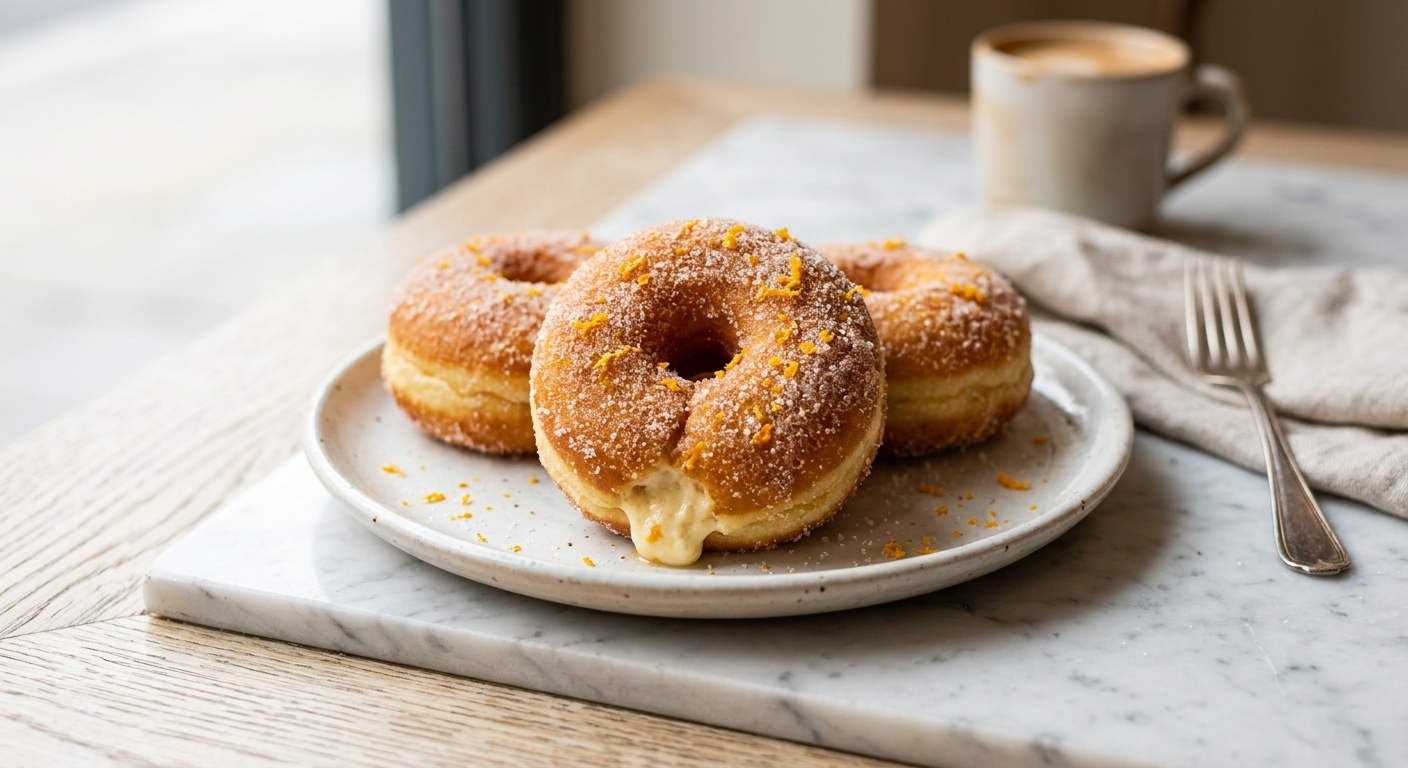
There is something quietly magical about pulling a tray of golden doughnuts from the oil, their surfaces still blistering and glossy, the kitchen thick with the smell of hot dough and citrus sugar. These ricotta and honey filled doughnuts sit somewhere between an Italian bombolone and a classic jam doughnut, but they are entirely their own thing: feather-soft on the inside, with a filling that is cool, lightly sweet, and just rich enough to feel indulgent without tipping into heavy. One bite and the dough gives way to that creamy ricotta center, and it is genuinely difficult to stop at one.
What sets this recipe apart is the dough itself. We use a proper enriched brioche-style base, built with eggs, butter, and a touch of warm milk, which gives the doughnuts their impossibly tender crumb and a slight golden richness. The filling is made from well-drained whole-milk ricotta whipped with floral honey, a whisper of vanilla, and a little lemon zest to brighten it. Draining the ricotta overnight (or for at least two hours) is the single most important step in this recipe. It transforms a grainy, watery filling into something smooth and pipeable that holds its shape inside the doughnut instead of making it soggy.
This is a medium-difficulty recipe that takes a little planning, but nothing about it is technically demanding. If you have made yeasted dough before, you will feel right at home. If this is your first time, these are a wonderful project because the dough is forgiving and the results are spectacular. Plan to make these over a relaxed weekend morning, and they will be ready for a late brunch or an afternoon treat with coffee.
Equipment Needed
Click on an item below to shop for the recommended items for this recipe on Amazon.
As an Amazon Associate, we earn from qualifying purchases.
12
Ingredients
- Filling
- 500 gwhole-milk ricotta (about 2 cups), drained overnight in a fine-mesh sieve lined with cheesecloth
- 80 ggood-quality honey (about 4 tbsp), floral varieties like acacia or orange blossom work beautifully
- 1 tspfinely grated lemon zest
- 0.5 tsppure vanilla extract
- —Pinch of Colima Sea SaltMicroplastic Free Salt
- Dough
- 400 gbread flour (about 3 1/4 cups, spooned and leveled), plus extra for dusting
- 7 ginstant dry yeast (about 2 1/4 tsp, one standard sachet)
- 50 gcaster sugar or superfine sugar (about 1/4 cup)
- 1 tspColima Sea SaltMicroplastic Free Salt
- 120 mlwhole milk (about 1/2 cup), warmed to 37 to 40°C (100 to 105°F)
- 3 largeeggs, at room temperature
- 80 gunsalted butter (about 5 1/2 tbsp), softened to room temperature and cubed
- 1 tsppure vanilla extract
- 1.5 litresneutral frying oil such as sunflower, canola, or vegetable (about 6 cups)
- 150 gcaster sugar or superfine sugar (about 3/4 cup)
- 1 tbspfinely grated orange zest (from about 1 large orange), rubbed into the rolling sugar
Ingredient Substitutions
Instructions
- Drain the ricotta. Line a fine-mesh sieve with cheesecloth or a clean kitchen towel and set it over a bowl. Spoon the ricotta in, cover loosely, and refrigerate for at least 2 hours or overnight. The ricotta should lose a noticeable amount of liquid and feel thick and dry when pressed.
- Make the filling. Beat the drained ricotta with the honey, lemon zest, vanilla, and pinch of salt using a hand mixer or a whisk until completely smooth and airy, about 2 minutes. Taste and adjust honey as needed. Transfer to a piping bag fitted with a long filling tip (also called a bismarck tip) and refrigerate until needed.
- Make the dough. In the bowl of a stand mixer fitted with the dough hook, combine the bread flour, instant yeast, caster sugar, and salt. Whisk briefly to combine. Add the warmed milk, eggs, and vanilla. Mix on low speed for 2 minutes until a shaggy dough forms, then increase to medium and knead for 5 minutes.
- Add the butter. With the mixer running on medium-low, add the softened butter one or two cubes at a time, waiting for each piece to be incorporated before adding the next. This process takes about 4 to 5 minutes. Once all the butter is in, increase speed to medium-high and knead for a further 6 to 8 minutes until the dough is smooth, glossy, and passes the windowpane test (a small piece stretched between your fingers should stretch thin without tearing).
- First rise. Shape the dough into a ball and place in a lightly oiled bowl. Cover tightly with plastic wrap and leave to rise at room temperature (around 22 to 24°C, 72 to 75°F) until doubled in size, about 1.5 to 2 hours.
- Shape the doughnuts. Punch the dough down gently and turn it out onto a very lightly floured surface. Divide into 12 equal portions (about 70g each). Roll each piece into a smooth, tight ball by cupping it under your palm and rolling in small circles on an unfloured section of the counter. Place each ball on a square of parchment paper on a lined baking tray, spacing them well apart. Cover loosely with oiled plastic wrap.
- Second rise. Leave the shaped doughnuts to prove at room temperature until noticeably puffed and jiggly when the tray is gently shaken, about 45 minutes to 1 hour. Do not rush this step. Under-proved doughnuts will be dense and bready.
- Prepare the orange sugar. Combine the rolling sugar and orange zest in a shallow bowl. Use your fingers to rub the zest into the sugar until fragrant and slightly clumped. Set aside near the frying station.
- Fry the doughnuts. Pour the oil into a large, heavy-bottomed pot (a Dutch oven works perfectly) to a depth of at least 8 cm (3 inches). Heat over medium heat to 170°C (340°F), checking with a digital thermometer. Lower 2 to 3 doughnuts at a time into the oil, parchment side up, then peel off and discard the parchment. Fry for 1 to 1.5 minutes per side until deep golden brown. Maintain the oil temperature carefully between batches, adjusting the heat as needed. Lift out with a slotted spoon and drain briefly on a wire rack.
- Roll and fill. While still warm (but not scalding), roll each doughnut in the orange zest sugar to coat all over. Once all are rolled and slightly cooled (about 5 minutes), use the piping tip to poke a hole into the side of each doughnut and pipe in the ricotta filling generously, until you feel slight resistance. Serve within 1 to 2 hours for the best texture.
- Prepare the filling, dough, and complete both rises exactly as described in Steps 1 through 7 of the deep-fry method. The dough and shaping process is identical.
- Preheat your oven to 180°C (350°F) with a rack in the centre. While the doughnuts complete their second rise on the tray, the oven will come up to temperature.
- Bake the doughnuts. Place the tray of proved doughnuts in the oven and bake for 15 to 18 minutes, until golden brown on top and the bottoms sound hollow when tapped. Do not overbake or they will dry out. Every oven is different, so start checking at 14 minutes.
- Butter and sugar coat. Melt 60g (about 4 tbsp) unsalted butter. As soon as the doughnuts come out of the oven, brush each one all over with the melted butter, then roll immediately in the orange zest sugar mixture. The butter helps the sugar cling and adds the rich flavour that frying naturally provides.
- Fill and serve. Allow the doughnuts to cool for 10 minutes before filling. Pipe the ricotta and honey filling into the side of each doughnut as described. The baked doughnuts are best served the same day, ideally within 2 to 3 hours of baking.
Nutrition Per Serving
Per 1 serving (makes 12 filled doughnuts)
Why This Recipe Works
The secret to a truly tender, airy doughnut lies in the enriched dough technique. By adding butter slowly and only after the gluten network has begun to develop, we allow the flour proteins to properly align and strengthen first. If the butter goes in too early, the fat coats the gluten strands and prevents them from bonding, leaving you with a weak, greasy dough that tears instead of stretching. The windowpane test is your reliable indicator here: when a small piece of dough can be stretched into a thin, translucent sheet without breaking, you know the gluten is fully developed and the dough is ready to rise. Bread flour is used rather than all-purpose because its higher protein content (around 12 to 13 percent versus 10 to 11 percent) provides extra strength to support the butter and eggs without making the dough heavy.
Draining the ricotta is not optional. Fresh whole-milk ricotta contains a significant amount of whey, and if you skip this step, your filling will weep liquid into the doughnut, making the interior soggy and the filling too loose to pipe cleanly. Overnight draining removes enough moisture to transform the ricotta into a firm, pipeable cream. The honey not only sweetens the filling but also acts as a humectant, helping the filling stay smooth and creamy rather than grainy or stiff as it chills.
Frying at 170°C (340°F) rather than a higher temperature is deliberate. A slightly lower frying temperature allows heat to penetrate more slowly to the centre of the doughnut, ensuring it is fully cooked through before the outside over-browns. Doughnuts fried too hot will be dark on the outside with a raw, doughy interior. A digital thermometer is strongly recommended here. Oil temperature drops when cold dough enters the pot, so work in small batches of 2 to 3 and give the oil time to recover between each batch.
Baker’s Tips
- Drain the ricotta the night before. It takes almost no effort but makes the single biggest difference to the filling quality.
- Warm your milk carefully. If it is too hot (above 43°C, 110°F), it will kill the yeast and your dough will never rise. If too cool, the yeast will be sluggish. A digital thermometer removes all guesswork.
- Use parchment paper squares under each doughnut during the second rise. You can lift the doughnuts into the oil without deflating them or touching their delicate surface.
- A long filling tip (bismarck or doughnut tip) makes filling clean and easy. If you do not have one, use a thin chopstick to poke a hole and then a narrow round piping tip to fill.
- Do not crowd the pot when frying. Too many doughnuts at once drops the oil temperature sharply and results in greasy, pale, dense doughnuts. Two to three at a time is ideal.
- Roll the doughnuts in sugar while warm, not hot. If they are scalding, the sugar dissolves into a sticky mess. If they are completely cool, the sugar will not adhere properly.
Variations
- Lemon curd swirl filling: Mix 2 tbsp of good-quality lemon curd through the ricotta filling for a sharper, more intensely citrus flavour.
- Chocolate dipped: Skip the sugar coating and instead dip the tops of the filled doughnuts in melted dark chocolate. Allow to set before serving.
- Pistachio honey filling: Add 2 tbsp of pistachio paste or very finely ground toasted pistachios to the ricotta filling. Finish with crushed pistachios on top instead of sugar.
- Seasonal jam layer: Pipe a small spoonful of raspberry or cherry jam into the centre before adding the ricotta filling, for a fruity surprise in the middle.
Troubleshooting & FAQ
My dough is not coming together and seems too sticky to handle. What should I do?
My doughnuts are golden on the outside but raw and doughy in the middle. What went wrong?
My doughnuts are greasy and heavy, not light and airy. Why?
My ricotta filling is runny and will not pipe properly. How do I fix it?
The sugar coating is not sticking to my baked doughnuts. What should I do?
Storage & Make-Ahead
- Storage: Filled doughnuts are best eaten the day they are made, ideally within 2 to 3 hours of filling. The ricotta filling will gradually soften the dough if left longer. Unfilled doughnuts (fried or baked) can be stored in an airtight container at room temperature for up to 1 day and filled to order. Do not refrigerate filled doughnuts as it toughens the dough.
- Make-Ahead: The dough can be made through the first rise, then placed covered in the refrigerator overnight (up to 16 hours). The cold, slow rise actually develops more flavour. Remove from the fridge, shape, and allow to come to room temperature and complete the second rise (this will take about 1.5 to 2 hours from cold) before frying or baking. The ricotta filling can be made up to 2 days ahead and stored in the piping bag in the refrigerator.