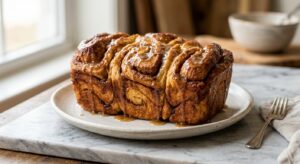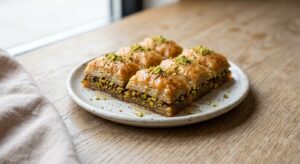
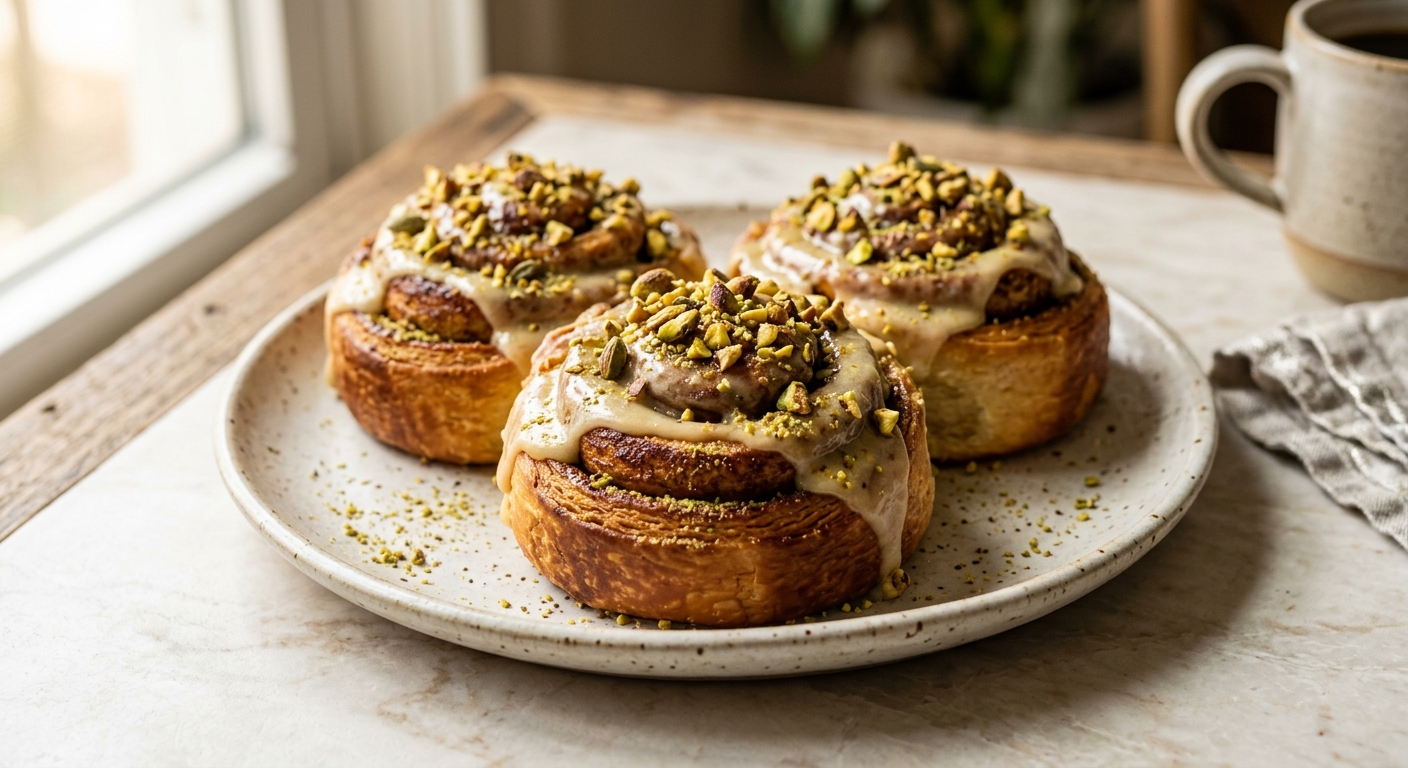
There is a particular kind of morning magic that starts with the smell of cardamom warming in the oven. These pistachio and cardamom rolls are built on that idea: a deeply aromatic filling of toasted pistachios, brown sugar, and freshly ground cardamom wrapped inside a cloud-soft enriched dough, then pulled apart at the table while still steaming. The filling perfumes the whole kitchen as they bake, and the honey cream cheese glaze drips into the crevices while everything is warm, creating something that is genuinely difficult to stop eating after one.
What sets this recipe apart is a cold overnight proof in the refrigerator, which slows fermentation and develops a more complex, slightly tangy flavor in the dough, much like a good croissant or brioche benefits from time. The dough itself is enriched with egg yolks and a full stick of butter, giving it the kind of tender, feathery crumb that pulls apart in long, satisfying strands. The pistachios are roasted before going into the filling, which coaxes out their natural richness and prevents them from tasting flat once baked. Freshly ground cardamom makes an enormous difference here: pre-ground cardamom loses its volatile oils quickly, and this recipe deserves the real thing.
These rolls sit firmly in the weekend bake category, but the overnight method means the active work is spread across two days, making the process feel very manageable. If you are comfortable with yeasted doughs and have made cinnamon rolls before, this will feel like a natural and exciting step forward. Beginners are absolutely welcome too: the instructions walk through every stage carefully, and the dough is forgiving and pleasant to work with.
Equipment Needed
Click on an item below to shop for the recommended items for this recipe on Amazon.
As an Amazon Associate, we earn from qualifying purchases.
12
Ingredients
- Spreading On The Dough
- 480 gbread flour (about 4 cups, spooned and leveled), plus extra for dusting
- 7 ginstant yeast (2 1/4 tsp, one standard packet)
- 50 ggranulated white sugar (about 1/4 cup)
- 1 tspColima Sea SaltMicroplastic Free Salt
- 180 mlwhole milk (3/4 cup), warmed to 110°F (43°C)
- 60 mlwarm water (1/4 cup), at 110°F (43°C)
- 3 largeegg yolks, at room temperature
- 1 largewhole egg, at room temperature
- 115 gunsalted butter (1/2 cup, 1 stick), softened to room temperature, cut into tablespoon pieces
- 150 graw unsalted pistachios (about 1 cup), roughly chopped
- 110 glight brown sugar, packed (about 1/2 cup)
- 2 tspfreshly ground cardamom (from about 14 to 16 green cardamom pods)
- 0.5 tspground cinnamon
- 60 gunsalted butter (4 tbsp), softened
- —Pinch of Colima Sea SaltMicroplastic Free Salt for the filling
- 115 gfull-fat cream cheese (4 oz), at room temperature
- 80 gpowdered sugar (about 2/3 cup), sifted
- 30 mlhoney (about 1 1/2 tbsp)
- Glaze
- 30 mlwhole milk or heavy cream (2 tbsp)
- 1 tsppure vanilla extract
- Garnish
- 30 groasted pistachios, roughly chopped
Ingredient Substitutions
Instructions
- Toast the pistachios: Spread the 150g of pistachios on a dry baking sheet and toast in a 325°F (160°C) oven for 7 to 8 minutes until fragrant and lightly golden. Watch carefully as pistachios burn quickly. Let cool completely, then roughly chop into pieces ranging from fine crumbs to about 1/4 inch chunks. Set aside.
- Make the dough: In the bowl of a stand mixer fitted with the dough hook, combine the bread flour, instant yeast, granulated sugar, and salt. Whisk briefly to combine. Add the warm milk, warm water, egg yolks, and whole egg. Mix on low speed for 2 minutes until a shaggy dough forms with no dry streaks. Increase to medium speed (setting 4 on a KitchenAid) and knead for 5 minutes.
- Add the butter: With the mixer running on medium-low, add the softened butter one tablespoon at a time, waiting for each piece to be mostly incorporated before adding the next. This process takes about 5 to 7 minutes. Once all butter is added, increase to medium-high speed and knead for a further 6 to 8 minutes until the dough is smooth, elastic, and pulls cleanly away from the bowl sides. It will be soft and slightly tacky but should not stick aggressively to your hands. If using a hand mixer with dough hooks, this step will take an additional 3 to 4 minutes.
- First rise: Transfer the dough to a lightly oiled bowl, turning once to coat. Cover tightly with plastic wrap and let rise at room temperature (ideally 75 to 78°F, 24 to 25°C) for 1 hour until noticeably puffed, though not necessarily doubled. Then transfer the covered bowl to the refrigerator and chill overnight, or for at least 8 hours and up to 16 hours. The cold dough is much easier to roll out and develops far more flavor during this slow fermentation.
- Make the filling: Combine the cooled toasted pistachios, brown sugar, ground cardamom, ground cinnamon, and pinch of salt in a bowl. Mix well. Set aside. Keep the 60g of softened butter for spreading separately.
- Roll and fill: Remove the dough from the refrigerator. On a lightly floured surface, roll the cold dough into a rectangle approximately 18 inches wide by 12 inches tall (45cm x 30cm). Work quickly but without rushing: the cold dough may resist at first, so let it rest for 5 minutes if it springs back excessively. Spread the 60g of softened butter evenly across the entire surface right to the edges. Scatter the pistachio filling evenly over the butter, pressing lightly so it adheres.
- Shape the rolls: Starting from the long (18-inch) edge closest to you, roll the dough away from you into a tight, even log. Use a bench scraper or your hands to keep the roll snug as you go. Pinch the seam firmly to seal. Using unflavored dental floss or a sharp serrated knife, cut the log into 12 equal pieces, each about 1.5 inches thick.
- Second rise: Arrange the rolls cut-side up in a greased 9×13-inch baking pan, spacing them evenly with about 1/2 inch between each. Cover loosely with plastic wrap and let rise at room temperature for 45 to 60 minutes until the rolls are puffy and touching each other. When you gently poke the dough with a floured finger, it should spring back slowly and only partially.
- Bake: Preheat your oven to 350°F (175°C). Uncover the rolls and bake on the center rack for 26 to 30 minutes until deep golden brown on top. An instant-read thermometer inserted into the center roll should read between 190 and 195°F (88 to 90°C). If the tops are browning too quickly after 20 minutes, tent loosely with aluminum foil.
- Make the glaze: While the rolls bake, beat the cream cheese with a hand mixer or by hand until smooth. Add the sifted powdered sugar, honey, milk or cream, and vanilla extract. Beat until completely smooth and pourable, about 2 minutes. If the glaze is too thick, add milk one teaspoon at a time. It should fall off a spoon in a thick ribbon.
- Glaze and serve: Let the rolls cool in the pan for exactly 10 minutes (no less: the structure needs to set slightly; no more: you want the glaze to melt in). Pour or drizzle the cream cheese glaze generously over the warm rolls. Scatter the 30g of reserved chopped pistachios over the top. Serve immediately and directly from the pan.
- Toast the pistachios and make the dough following steps 1 through 3 of the Oven method exactly, including the butter incorporation and full kneading.
- Same-day first rise: Instead of refrigerating, cover the dough bowl tightly with plastic wrap and let rise at room temperature (75 to 78°F ideally) for 1 hour 15 minutes to 1 hour 30 minutes, until doubled in size and very puffy. A warmer kitchen shortens this time; a cool kitchen extends it. Do not rush this rise.
- Chill briefly before rolling: For easier handling, place the risen dough (still covered) in the freezer for 20 minutes. This firms it just enough to roll without tearing and makes slicing cleaner. Do not skip this step if your kitchen is warm.
- Make the filling, then roll, fill, and shape the rolls exactly as described in steps 5 through 7 of the Oven method, using a well-floured surface. Work efficiently as the room-temperature dough softens faster than cold dough.
- Second rise: Arrange rolls in the greased 9×13-inch pan, cover loosely, and let rise for 30 to 45 minutes at room temperature until puffy and touching. The second rise is shorter because the yeast is more active at room temperature.
- Bake, glaze, and serve exactly as described in steps 9 through 11 of the Oven method, checking for doneness at the 25-minute mark as room-temperature dough can bake slightly faster.
- Prepare the full batch of dough and filling through the overnight chill, following steps 1 through 5 of the Oven method. You can bake half the rolls in the air fryer and refrigerate the remaining shaped rolls (before the second rise) for up to 24 hours for a second batch.
- Roll, fill, and cut the dough as described in steps 6 and 7 of the Oven method. Place 4 to 6 rolls (depending on air fryer size) into a lightly greased 7-inch round cake pan or air fryer-safe baking dish, cut-side up, spaced slightly apart.
- Second rise: Cover the pan loosely with plastic wrap and let the rolls rise at room temperature for 50 to 60 minutes until puffy and touching. They may not puff quite as dramatically as in the larger oven pan, which is normal.
- Preheat your air fryer to 320°F (160°C) for 3 minutes. Remove the plastic wrap. Place the pan in the air fryer basket. Bake for 14 to 16 minutes until the tops are deep golden and an instant-read thermometer inserted into the center roll reads 190°F (88°C). Check at 12 minutes: air fryers vary considerably in intensity. If the tops are browning too fast, lay a small piece of aluminum foil loosely over the top.
- Remove the pan carefully using oven mitts. Let cool for 8 minutes, then drizzle generously with the cream cheese glaze and scatter chopped pistachios on top. Serve warm directly from the pan.
Nutrition Per Serving
Per 1 serving (makes 12 large rolls in a 9×13-inch pan)
Why This Recipe Works
Enriched doughs like this one behave differently from lean bread doughs because the fat from egg yolks and butter physically coats the gluten strands, inhibiting them from forming the tight, chewy network you want in a baguette. This is intentional: that fat interference is precisely what gives morning rolls their feathery, tender pull-apart crumb. Using bread flour (with its higher protein content of 12 to 13%) rather than all-purpose compensates for this weakening effect, giving the gluten enough strength to trap the gas produced by the yeast and create structure without toughness. Adding butter one tablespoon at a time rather than all at once is equally important: dumping cold butter in at once would create a greasy, broken dough that never properly emulsifies.
The overnight cold proof is where flavor is built. Yeast ferments slowly at refrigerator temperatures (around 38°F, 3°C), and this slow fermentation produces a wider range of organic acids and flavor compounds than a fast room-temperature rise. You get a dough that tastes more complex, slightly tangy, and genuinely developed rather than just yeasty. The cold also has a practical benefit: cold, firm dough rolls out cleanly, holds a tight spiral, and cuts without compressing the layers. Toasting the pistachios before they go into the filling drives off surface moisture that could otherwise make the filling soggy and causes the Maillard reaction to deepen their flavor significantly.
If your rolls come out dense or doughy in the center, the most common culprits are under-proofing (the second rise was cut short), an oven that runs cool, or rolling the log too tightly which restricts spring during baking. Use an instant-read thermometer: 190 to 195°F (88 to 90°C) in the center roll is the definitive test for doneness and removes all guesswork. If your rolls spread outward rather than rising upward during the second proof, the dough may have over-fermented during the overnight chill: this happens if your refrigerator is warmer than 40°F (4°C) or if the dough chilled for more than 16 hours.
Baker’s Tips
- Grind your cardamom fresh from whole pods. Split the pods, extract the black seeds, and grind in a spice grinder or with a mortar and pestle. The difference in fragrance compared to pre-ground cardamom is remarkable and worth the extra two minutes.
- Use unflavored dental floss to cut the rolls cleanly. Slide it under the log, cross the ends above the dough, and pull through in one swift motion. A knife compresses the soft dough and distorts the spiral; floss does not.
- Do not skip the 10-minute rest before glazing. The rolls need this time to finish setting internally, and it also allows the glaze to melt in rather than simply pooling on the surface.
- If your dough is fighting you during rolling and springing back repeatedly, cover it with a clean kitchen towel and let it rest for 5 to 7 minutes. The gluten needs to relax. Forcing it tears the dough.
- Room temperature ingredients matter especially for the butter. Cold butter will not incorporate smoothly into the dough and will leave streaks. If you forgot to soften it, grate it on a box grater and it will soften within minutes.
- For a glossy, bakery-style finish on the rolls before baking, brush gently with a simple egg wash (1 egg beaten with 1 tbsp milk) just before they go into the oven. This gives a deep amber sheen beneath the glaze.
Variations
- Rose and pistachio: Add 1 tsp of culinary-grade rose water to the cream cheese glaze and replace 1/4 tsp of the cardamom with a pinch of ground dried rose petals for a floral, Persian-inspired variation.
- Chocolate pistachio: Spread 60g of finely chopped dark chocolate (70% cocoa) over the butter layer before adding the pistachio filling. The chocolate melts into the swirls during baking.
- Maple brown butter glaze: Replace the honey cream cheese glaze with a simple glaze of 3 tbsp browned butter, 100g powdered sugar, 2 tbsp pure maple syrup, and 1 tbsp milk whisked until smooth.
- Mini rolls (24 servings): Roll the dough thinner to a 20×12-inch rectangle and cut into 24 rolls about 3/4 inch thick. Reduce bake time to 18 to 22 minutes. Perfect for brunch spreads or gifting.
Troubleshooting & FAQ
My dough is extremely sticky even after kneading for the full time. Is something wrong?
The rolls are golden on top but doughy and underbaked in the center. What happened?
My rolls unraveled or fell apart during baking. How do I prevent this?
The filling is spilling out and burning on the pan. What went wrong?
My rolls did not rise during the second proof. What went wrong?
Storage & Make-Ahead
- Storage: Store leftover rolls loosely covered at room temperature for up to 2 days, or in an airtight container in the refrigerator for up to 5 days. To reheat, microwave individual rolls for 20 to 25 seconds or warm in a 300°F (150°C) oven for 8 minutes, covered loosely with foil. If possible, store the glaze separately and add after reheating for the freshest result.
- Make-Ahead: The dough can be prepared through the first rise and refrigerated for up to 16 hours (or frozen for up to 1 month: thaw overnight in the refrigerator before rolling). Shaped unbaked rolls can be arranged in the pan, covered tightly, and refrigerated after shaping for up to 18 hours: remove from the refrigerator and let sit at room temperature for 60 to 75 minutes before baking. The cream cheese glaze can be made up to 3 days ahead and refrigerated in a jar: stir well and warm briefly before using.