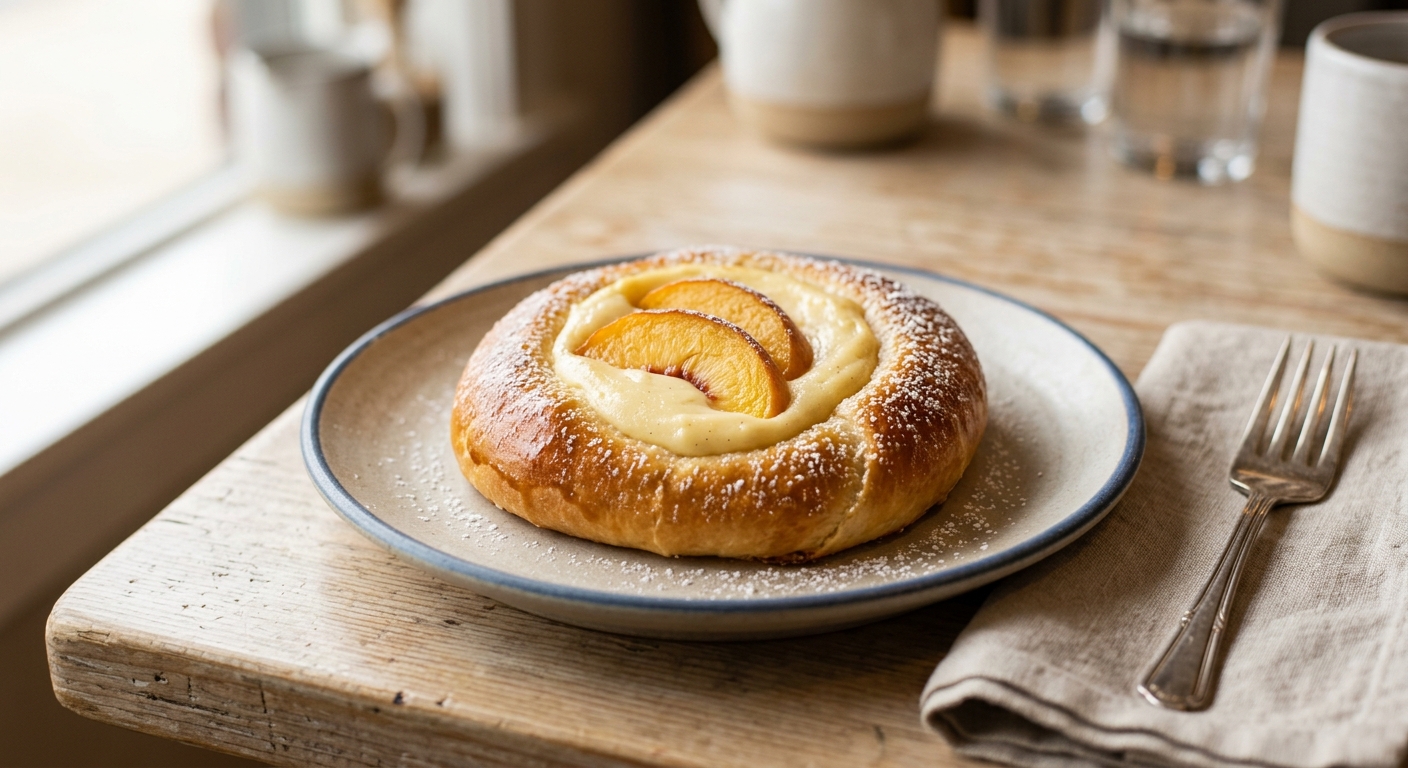
There is a particular kind of magic that happens in Czech and Texas bakeries early in the morning, when trays of kolache emerge from the ovens still steaming, their edges golden and their centers plump with fruit and cream. The peach kolache is a summer staple in these places, a soft, slightly sweet yeasted roll cradling ripe peaches and a cloud of sweetened cream cheese that somehow manages to be both indulgent and comforting at the same time. One bite and you understand exactly why people drive out of their way to find a good kolache bakery.
What sets this version apart is the enriched dough, which relies on both butter and egg yolks for a brioche-like tenderness that holds its shape around the filling without becoming bready or dense. The cream cheese filling is lightly flavored with real vanilla and just enough lemon zest to brighten it against the sweetness of the peach topping. Rather than using canned filling, this recipe calls for fresh or thawed frozen peaches tossed with a little sugar and cornstarch, which means you get jammy, concentrated fruit flavor with a slight caramelized edge from the oven heat.
This is a medium-difficulty bake, mostly because of the yeasted dough, but every step is clearly laid out and forgiving for bakers who are comfortable with basic bread making. If you have never worked with enriched dough before, this is a wonderful place to start. These kolache are ideal for weekend brunches, holiday mornings, or any occasion that calls for something homemade and genuinely special.
Equipment Needed
Click on an item below to shop for the recommended items for this recipe on Amazon.
As an Amazon Associate, we earn from qualifying purchases.
12
Ingredients
- Filling
- 480 gall-purpose flour (about 4 cups, spooned and leveled), plus more for dusting
- 7 ginstant yeast (1 packet or 2.25 tsp)
- 50 ggranulated sugar (about 1/4 cup)
- 1 tspColima Sea SaltMicroplastic Free Salt
- 180 mlwhole milk, warmed to 110°F (43°C) (about 3/4 cup)
- 3 largeegg yolks, at room temperature
- 113 gunsalted butter, softened to room temperature (1/2 cup or 1 stick)
- 1 tsppure vanilla extract
- 226 gfull-fat cream cheese, softened to room temperature (8 oz or 1 block)
- 60 gpowdered sugar, sifted (about 1/2 cup)
- 1 tsppure vanilla extract
- Egg Wash
- 0.5 tspfinely grated lemon zest
- 1 largeegg
- 2 tbspwhole milk
- Peach Topping)
- 400 gfresh or thawed frozen peach slices, patted dry (about 3 medium peaches or 2.5 cups)
- 50 ggranulated sugar (about 1/4 cup
- 1.5 tbspcornstarch
- 0.5 tspground cinnamon
- —Pinch of ground nutmeg
- 1 tspfresh lemon juice
Ingredient Substitutions
Instructions
- Make the dough: In the bowl of a stand mixer fitted with the dough hook, combine the flour, instant yeast, sugar, and salt. Whisk briefly to combine. Add the warm milk, egg yolks, and vanilla extract. Mix on low speed for 2 minutes until a shaggy dough forms.
- Add the butter one tablespoon at a time with the mixer running on medium-low speed, waiting about 20 to 30 seconds between each addition. Once all the butter is incorporated, increase speed to medium and knead for 6 to 8 minutes until the dough is smooth, slightly tacky, and pulls cleanly from the sides of the bowl. It should pass the windowpane test: stretch a small piece between your fingers and it should stretch thin without tearing.
- Shape the dough into a ball and place in a lightly greased bowl. Cover with plastic wrap or a damp kitchen towel and let rise at room temperature until doubled in size, about 1 hour to 1 hour 30 minutes depending on the warmth of your kitchen.
- While the dough rises, make the cream cheese filling: Beat the softened cream cheese with the powdered sugar, vanilla extract, and lemon zest using a hand mixer or stand mixer until completely smooth and fluffy, about 2 minutes. Set aside. Prepare the peach topping by tossing the peach slices with the sugar, cornstarch, cinnamon, nutmeg, and lemon juice in a bowl until well coated. Set aside.
- Once the dough has doubled, punch it down gently and turn it out onto a lightly floured surface. Divide the dough into 12 equal pieces, about 75g each. Roll each piece into a smooth ball by cupping your hand over it and rolling it in tight circles on an unfloured surface. Place the balls 2 inches apart on two parchment-lined baking sheets.
- Cover loosely and let the shaped rolls proof for 30 to 45 minutes until puffy and noticeably larger. They will not quite double, but should feel soft and airy when gently pressed. Preheat your oven to 350°F (175°C) during this time.
- Whisk together the egg and 2 tablespoons of milk for the egg wash. Brush each roll gently with egg wash. Using your fingers or the bottom of a small round measuring cup (about 2 inches wide), press a deep well into the center of each roll, pressing almost but not all the way to the bottom. Try not to deflate the surrounding dough.
- Spoon about 1 generous tablespoon of cream cheese filling into each well. Top with 3 to 4 peach slices, pressing them lightly into the cream cheese. Bake for 18 to 22 minutes, rotating the pans halfway through, until the edges are deep golden brown and the peaches are softened and beginning to caramelize at the edges. The cream cheese filling will puff slightly and set. Cool on the baking sheets for at least 10 minutes before serving.
- Prepare the dough, cream cheese filling, and peach topping exactly as described in the oven method steps 1 through 4. The dough, filling, and topping are identical regardless of cooking method.
- After the first rise, divide and shape the dough into 12 smooth balls. Place 3 to 4 balls in the air fryer basket lined with a round of parchment paper cut to fit, leaving at least 1.5 inches between each ball. Cover loosely with a clean towel and let proof directly in the basket for 25 to 30 minutes. The confined space holds warmth well and the proof may be slightly faster.
- Preheat the air fryer to 325°F (165°C) for 3 minutes. Brush the proofed rolls with egg wash. Press a well into the center of each roll and fill with cream cheese filling and peach slices as described in the oven method steps 7 and 8. Work quickly so the rolls do not deflate.
- Air fry for 10 to 12 minutes, checking at the 9-minute mark. The kolache are done when the edges are a deep golden brown and the peaches look jammy and slightly caramelized. The tops will brown faster than in a conventional oven, so check early. If the tops are browning too quickly before the base is cooked, lay a small piece of foil loosely over the basket for the last 2 minutes.
- Remove carefully and cool on a wire rack for at least 8 minutes before eating. Repeat with remaining rolls, giving the basket a quick wipe between batches if any filling has bubbled over.
Nutrition Per Serving
Per 1 serving (makes 12 individual kolache)
Why This Recipe Works
The enriched dough in this recipe behaves very differently from a lean bread dough, and understanding why helps you bake it with confidence. The combination of butter and egg yolks coats the gluten strands with fat, which tenderizes the crumb and creates that characteristic soft, almost pillowy pull that defines a great kolache. Adding the butter gradually, a tablespoon at a time, is not just fussiness: it allows the gluten network to fully develop first so the fat can be absorbed without breaking the structure of the dough. If you add all the butter at once, the dough becomes greasy and difficult to work with. The windowpane test is your best guide to knowing the gluten is strong enough to support the filling without the walls of the well collapsing.
Pressing the wells into the rolls after proofing rather than before is also a deliberate choice. It preserves the open, airy crumb structure that developed during proofing and gives the walls of the kolache more strength to hold the filling as it bakes. Using cornstarch in the peach topping is key to preventing a soggy center: cornstarch binds the fruit juices as they release during baking, turning them into a glossy, set jammy layer rather than a watery puddle that would soak into the dough.
If your kolache come out dense or tight-crumbed, the most likely cause is under-proofing: the rolls need to feel genuinely puffy and airy before going into the oven, even if they have not quite doubled. A cold kitchen can slow the yeast significantly, so if your space is chilly, try proofing inside your oven with just the light on, or set a pan of hot water on the rack below to create a warm, humid environment. If your wells sink into the rolls during baking rather than holding their shape, the filling was likely too warm or too liquid: both the cream cheese and the peach topping should be at room temperature, not warm, when assembled.
Baker’s Tips
- Bring all refrigerated ingredients (butter, eggs, cream cheese) to room temperature before starting. Cold butter will not incorporate smoothly into the dough, and cold cream cheese will leave lumps in the filling.
- Do not skip the windowpane test. Stretch a small piece of dough between your fingers; if it stretches thin and translucent without tearing, your gluten is developed. If it tears immediately, knead for another 2 minutes and test again.
- Pat the peach slices as dry as possible before tossing with the cornstarch mixture. Excess moisture from the fruit is the number one cause of soggy bottoms on fruit-filled kolache.
- When pressing the wells into the proofed rolls, flour the bottom of your measuring cup or press with the flat of your fingers, not just one fingertip. A wider, flatter well holds more filling and looks more like the beautiful bakery versions.
- Rotate your pans halfway through baking. The oven is rarely perfectly even, and rotating ensures all your kolache brown evenly without some burning while others are underdone.
- Let the kolache cool for at least 10 minutes before eating. The cream cheese filling sets as it cools, and cutting into them too soon will cause the filling to run.
Variations
- Strawberry and cream: Replace the peach topping with 300g hulled and halved fresh strawberries tossed with 40g sugar and 1 tbsp cornstarch, and add a teaspoon of balsamic vinegar to the fruit for depth.
- Blueberry lemon: Use 300g fresh blueberries with 40g sugar, 1 tbsp cornstarch, and the zest of one lemon in place of the peaches. Add an extra teaspoon of lemon zest to the cream cheese filling.
- Poppyseed and peach: Add 2 tablespoons of sweetened poppyseed filling (store-bought or homemade) beneath the cream cheese layer for a traditional Czech touch.
- Brown sugar cinnamon streusel topping: Mix 40g cold butter, 60g flour, 50g brown sugar, and 1 tsp cinnamon into crumbs and sprinkle over the peaches before baking for a crumbly, bakery-style finish.
Troubleshooting & FAQ
My dough is very sticky and soft. Did I do something wrong?
The filling sank through the bottom of the roll. What happened?
My kolache did not rise much and came out dense. Why?
The peach topping is watery and made the center of my kolache soggy.
The edges of my kolache are browning too fast while the centers look underdone.
Storage & Make-Ahead
- Storage: Store kolache in an airtight container at room temperature for up to 2 days. For longer storage, refrigerate for up to 5 days, noting that the dough will firm up when cold. Reheat refrigerated kolache in a 300°F (150°C) oven for 8 to 10 minutes or in the air fryer at 300°F for 4 to 5 minutes to restore their softness. Freeze fully baked and cooled kolache in a single layer, then transfer to a freezer bag for up to 2 months. Reheat from frozen at 325°F (165°C) for 12 to 15 minutes.
- Make-Ahead: The dough can be made through the first rise, then punched down, covered tightly, and refrigerated overnight (up to 16 hours). The cold fermentation actually improves flavor. Remove from the refrigerator 30 minutes before shaping and proceed with the recipe. The cream cheese filling can be made up to 3 days ahead and stored in an airtight container in the refrigerator. The peach topping is best made fresh on the day of baking.