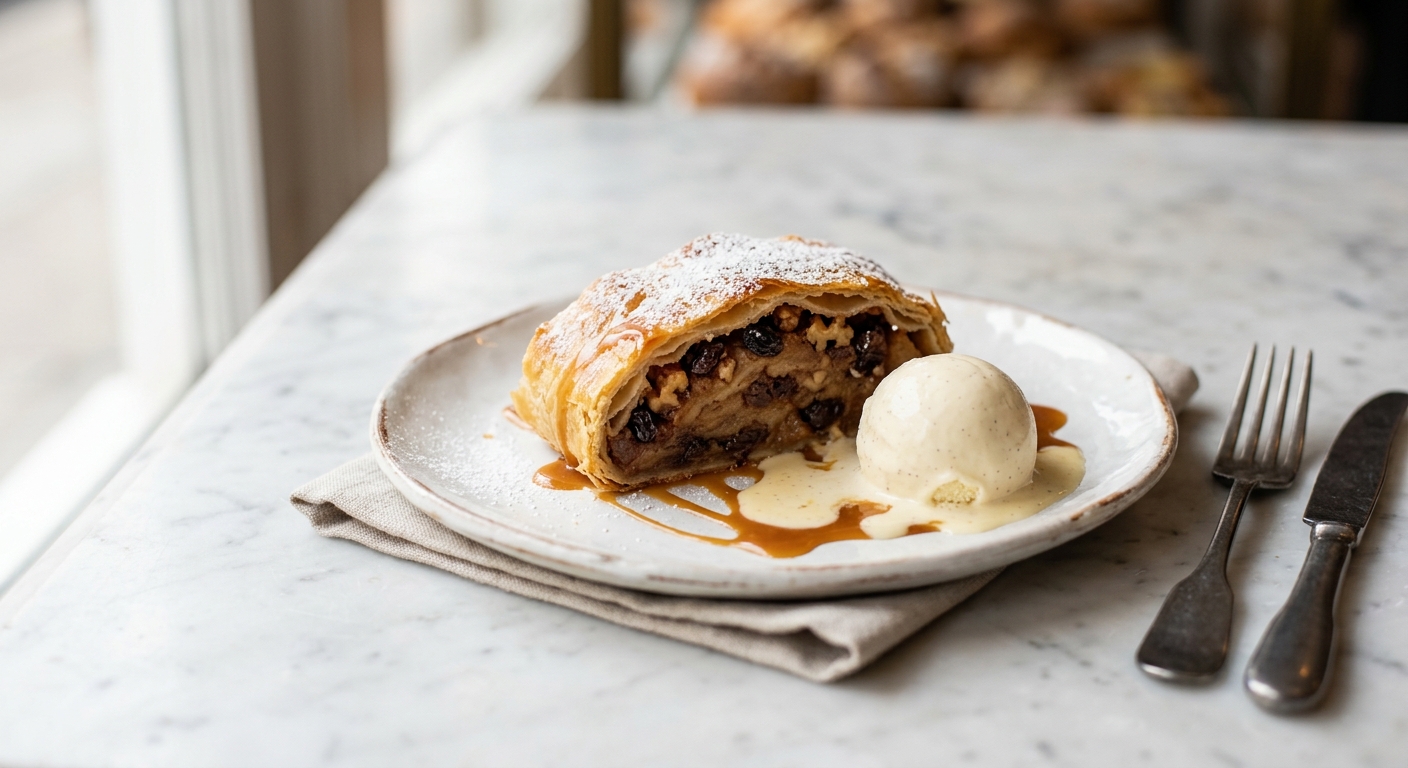
There is something almost theatrical about pulling a baked apple strudel from the oven. The pastry shatters at the gentlest press of a fork, releasing a curl of steam and the scent of cinnamon, brown butter, and caramelized apple. It is the kind of dessert that makes a kitchen feel like a Viennese coffeehouse on a grey afternoon, and every single bite delivers that perfect contrast of crisp, flaky crust against the soft, jammy fruit beneath.
What sets this version apart is the hand-stretched strudel dough. Yes, you can use store-bought phyllo in a pinch, and there is an alternative method below for exactly that, but the homemade dough has a supple elasticity that phyllo simply cannot match. Made with a small amount of oil and a rest period that lets the gluten relax completely, it stretches to an almost translucent sheet over a tablecloth without tearing. The filling is kept deliberately balanced: tart Granny Smith apples tossed with demerara sugar, plump rum-soaked raisins, toasted walnuts for crunch, and a scattering of lightly toasted breadcrumbs that absorb the apple juices and keep the pastry gloriously crisp rather than soggy.
This recipe sits firmly in the medium difficulty range. The dough itself is forgiving once you understand what you are aiming for, and the rolling and stretching is a genuinely enjoyable tactile process. It is ideal for a confident home baker who wants to try something truly traditional, for a cozy weekend afternoon project, or for impressing guests at a dinner party with something far more personal than a shop-bought pastry.
Equipment Needed
Click on an item below to shop for the recommended items for this recipe on Amazon.
As an Amazon Associate, we earn from qualifying purchases.
8
Ingredients
- Brushing
- 200 gall-purpose flour (about 1 2/3 cups, spooned and leveled), plus more for dusting
- 1 tspColima Sea SaltMicroplastic Free Salt
- 120 mlwarm water (about 1/2 cup), between 100 and 110°F (38 to 43°C)
- 40 mlAvocado Oil100% Pure Avocado Oil (about 3 tbsp)
- 1 tspwhite wine vinegar or apple cider vinegar (helps relax the gluten)
- 80 gunsalted butter (about 6 tbsp), melted and cooled
- 60 gfine dry breadcrumbs (about 1/2 cup)
- 900 gGranny Smith apples (about 4 to 5 medium), peeled, cored, and sliced 3 to 4mm thin
- 120 graisins (about 3/4 cup)
- Soaking Raisins
- 60 mldark rum or apple juice (about 1/4 cup)
- 100 gwalnuts (about 1 cup), roughly chopped and lightly toasted
- 100 gdemerara or light brown sugar (about 1/2 cup packed)
- 2 tspground cinnamon
- 0.5 tspground nutmeg
- 1 tspfinely grated lemon zest (from about half a lemon)
- 1 tbspfresh lemon juice
- Dusting To Serve
- —Powdered (icing) sugar
Ingredient Substitutions
Instructions
- Soak the raisins: Place raisins in a small bowl, pour the rum or apple juice over them, and let them soak for at least 30 minutes while you make the dough. Drain well before using.
- Make the dough: Whisk together the flour and salt in a large bowl. Make a well in the center and add the warm water, oil, and vinegar. Mix with a fork until a shaggy dough forms, then turn out onto an unfloured surface and knead firmly for 8 to 10 minutes until the dough is completely smooth, silky, and slightly tacky but not sticky. Shape into a ball, brush lightly with oil, wrap in plastic wrap, and rest at room temperature for 30 minutes. Do not skip this rest – it is what allows the dough to stretch without tearing.
- Toast the breadcrumbs: Melt 1 tablespoon of the measured melted butter in a skillet over medium heat. Add the breadcrumbs and stir constantly for 3 to 4 minutes until golden and fragrant. Spread on a plate to cool completely.
- Prepare the filling: Toss the sliced apples with the demerara sugar, cinnamon, nutmeg, lemon zest, and lemon juice in a large bowl. Fold in the drained raisins, toasted walnuts, and cooled toasted breadcrumbs. The breadcrumbs will absorb excess apple juice during baking and keep the pastry crisp.
- Preheat your oven to 375°F (190°C). Line a large baking sheet (at least 13×18 inches) with parchment paper.
- Stretch the dough: Cover a large table or countertop with a clean cotton tablecloth or large piece of muslin and dust it generously with flour. Place the rested dough in the center and roll it out as thin as you can with a rolling pin. Then, working with both hands palms-down under the dough, use the backs of your hands to gently stretch it from the center outward, walking around the table and letting gravity help. Continue stretching until the dough is roughly 20×24 inches and nearly translucent – you should be able to see the pattern of the cloth underneath. Trim any thick edges with scissors.
- Assemble the strudel: Brush the stretched dough generously all over with melted butter. Scatter the filling in an even strip about 4 inches wide along one long edge of the dough, leaving a 2-inch border on the sides and a 3-inch border at the far end. Fold the 2-inch side borders in over the filling, then use the tablecloth to help roll the strudel away from you into a tight log, tucking as you go. Transfer seam-side down onto the prepared baking sheet. Gently curve the ends under to seal if needed. Brush the entire surface generously with melted butter.
- Bake for 35 to 40 minutes until the pastry is deeply golden and crisp all over. Brush with remaining melted butter once more halfway through baking for extra crunch and colour. Let the strudel cool on the pan for at least 15 minutes before slicing, as the filling is very hot and needs time to settle. Dust generously with powdered sugar and serve warm.
- Soak the raisins: Place raisins in a small bowl with the rum or apple juice and soak for at least 20 minutes. Drain well.
- Toast the breadcrumbs: Melt 1 tablespoon of butter in a skillet over medium heat. Add breadcrumbs and stir for 3 to 4 minutes until golden. Cool completely on a plate.
- Prepare the filling: Toss sliced apples with sugar, cinnamon, nutmeg, lemon zest, and lemon juice. Fold in drained raisins, walnuts, and cooled toasted breadcrumbs. Set aside.
- Preheat your oven to 375°F (190°C). Line a large baking sheet with parchment paper. Thaw phyllo sheets according to package instructions and keep them covered with a barely damp kitchen towel as you work to prevent drying out.
- Build the base: Lay one phyllo sheet flat on the parchment-lined baking sheet and brush all over with melted butter. Lay a second sheet directly on top and brush again with butter. Repeat with 8 to 10 sheets total, buttering every single layer. The layers are what create the flaky structure.
- Add the filling: Spoon the apple filling in a strip about 4 inches wide along one long edge of the layered phyllo, leaving a 2-inch border on the sides and a 3-inch border at the opposite long edge. Fold the short sides in, then roll the strudel snugly away from you into a log. Place seam-side down. Brush the outside generously with the remaining melted butter.
- Bake for 30 to 35 minutes until the pastry is deeply golden and crisp. The phyllo bakes quickly, so start checking at 25 minutes. Cool for 15 minutes, dust with powdered sugar, and serve warm.
Nutrition Per Serving
Per 1 serving (makes one large strudel, approximately 12 inches long)
Why This Recipe Works
The secret to strudel dough that stretches paper-thin without tearing lies in two things: high gluten development and complete gluten relaxation. Kneading the dough vigorously for 8 to 10 minutes builds strong, elastic gluten networks. But it is the 30-minute rest, wrapped and at room temperature, that is equally critical. Gluten that has been worked becomes tight and resistant, much like a rubber band that has been stretched. Resting allows those networks to relax and loosen, so when you begin stretching, the dough yields willingly instead of snapping back. The addition of a small amount of oil lubricates the gluten strands, helping them slide past each other during stretching, and the vinegar slightly acidifies the dough, which further tenderizes the gluten for easier handling.
The toasted breadcrumb layer serves a precise structural purpose. As the apples heat in the oven they release a significant amount of liquid. Without a buffer, this moisture would steam the base of the pastry from the inside and leave you with a soggy, collapsed bottom. The dry toasted breadcrumbs act like a sponge, absorbing those juices before they can saturate the pastry, and they also add a subtle nutty flavour that complements the filling beautifully. This is why the breadcrumbs must be toasted rather than raw – raw breadcrumbs can become gummy when they absorb liquid, while toasted crumbs stay relatively open and absorbent.
Brushing the stretched dough generously with melted butter before rolling, and again partway through baking, does two things. First, the fat coats the thin dough layers and inhibits gluten from becoming chewy in the heat, keeping the pastry tender and short. Second, the butter conducts heat into each layer and promotes the Maillard browning reaction, which gives the strudel its gorgeous deep golden colour and that rich, toasty flavour. If your strudel is pale after the suggested bake time, your oven may run cool. Increase to 400°F (200°C) and give it an additional 5 to 8 minutes.
Baker’s Tips
- Use a tablecloth that you do not mind getting a little floury. A plain white or light-coloured cloth lets you see the dough’s translucency clearly as you stretch it.
- Keep the melted butter warm throughout the assembly process. Butter that has cooled and solidified will tear the delicate stretched dough when you try to brush it on. A small heatproof bowl set over hot water works perfectly.
- Slice the apples uniformly at 3 to 4mm. Slices that are too thick will not soften fully during the bake time; slices that are too thin will turn to mush. A mandoline makes this easy.
- Do not overfill. It is tempting to pile in extra filling, but an overstuffed strudel will burst at the seams and the filling may not heat through evenly. Stick to the quantities given for a clean, manageable roll.
- When transferring the rolled strudel to the baking sheet, use the tablecloth to tip and guide it rather than lifting it directly. The roll is fragile at this stage and direct handling can cause it to tear.
- Let the strudel rest for at least 15 minutes before cutting. The filling is volcanic directly from the oven, and the apple mixture needs a few minutes to thicken and settle so it does not pour out when you slice.
- Serve with lightly sweetened whipped cream or a small scoop of vanilla ice cream. The contrast of cold cream against warm, spiced strudel is exactly the point.
Variations
- Cherry and almond strudel: Replace the apples with 700g pitted fresh or frozen cherries (thawed and drained well) and swap walnuts for slivered almonds. Add 1/4 tsp almond extract to the filling.
- Pear and cardamom strudel: Replace apples with 900g firm Bosc or Anjou pears, swap cinnamon for 1 tsp ground cardamom, and use pistachios instead of walnuts.
- Cheese strudel (Topfenstrudel): Omit the apple filling entirely and fill with 500g full-fat ricotta or quark blended with 1 egg, 60g sugar, 1 tsp vanilla, and 60g raisins for a classic Austrian alternative.
- Caramel apple version: Toss the apple slices in 2 tablespoons of salted caramel sauce along with the sugar and spices. Slightly reduce the sugar to 70g to account for the extra sweetness.
Troubleshooting & FAQ
My dough keeps tearing when I try to stretch it. What am I doing wrong?
My pastry was soggy on the bottom after baking. What went wrong?
The pastry looks pale and blond rather than deep golden after baking. How do I fix it?
My strudel burst open at the seam during baking. How do I prevent this?
Can I make the dough by hand if I have never done it before, or do I need a machine?
Storage & Make-Ahead
- Storage: Store leftover strudel loosely covered at room temperature for up to 2 days. To re-crisp, place slices on a baking sheet in a 325°F (165°C) oven for 8 to 10 minutes. Refrigeration is not recommended as it makes the pastry go soft and limp. Strudel does not freeze well once baked, but the assembled unbaked roll can be frozen on a tray, then transferred to a freezer bag for up to 1 month. Bake straight from frozen at 375°F (190°C) for 50 to 55 minutes.
- Make-Ahead: The strudel dough can be made, wrapped in oiled plastic wrap, and refrigerated for up to 24 hours. Bring it back to room temperature for 20 minutes before stretching. The apple filling can be prepared up to 4 hours ahead and kept at room temperature. The fully assembled but unbaked strudel can be refrigerated for up to 4 hours before baking, loosely covered with plastic wrap.