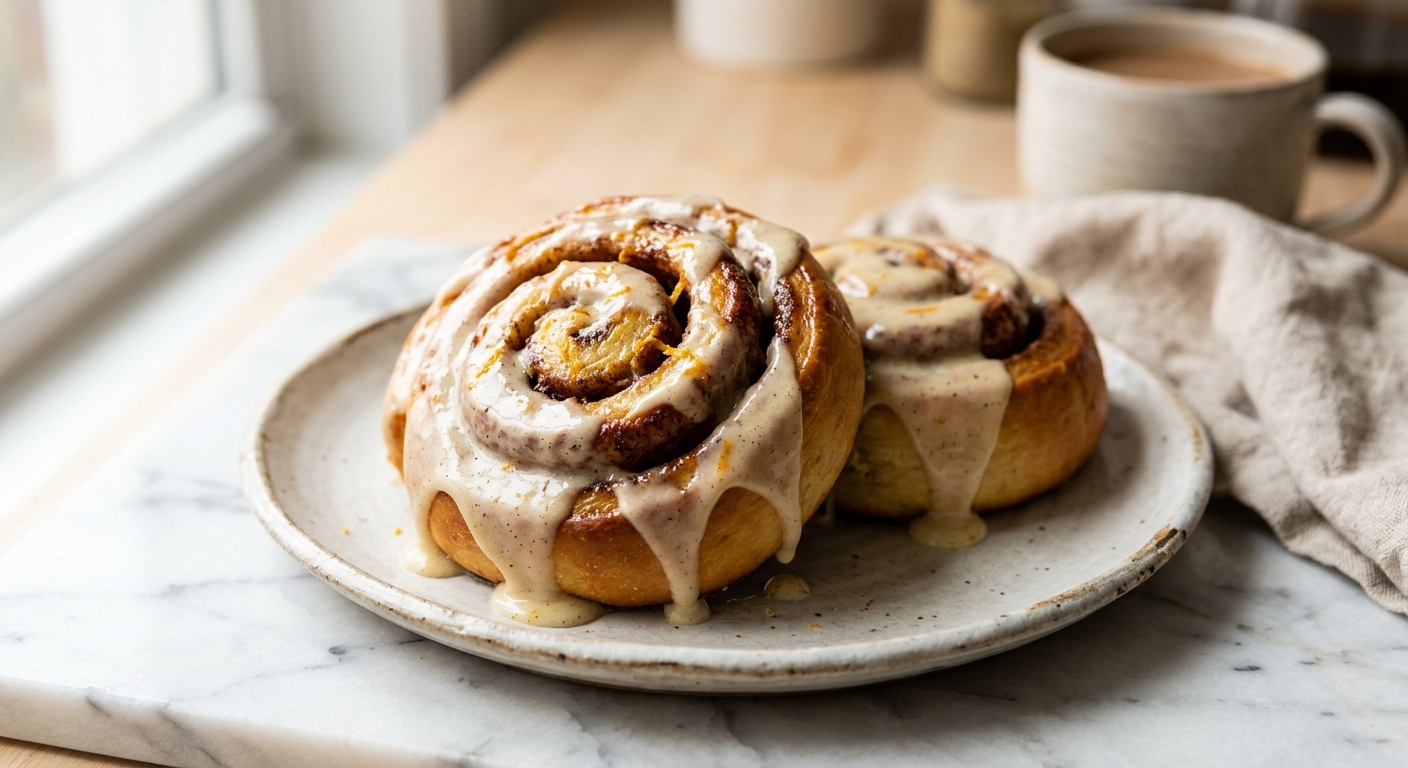
There is something almost magical about pulling a pan of sweet rolls from the oven, their edges pressed together in a golden huddle, steam curling upward carrying the scent of warm spice and citrus. These Orange and Cardamom Sweet Rolls hit differently from the classic cinnamon roll – the cardamom brings a floral, almost perfumed warmth, and the fresh orange zest cuts right through the richness with a brightness that makes every bite feel alive. When the vanilla cream glaze goes on while they are still warm, it soaks into the spirals and creates pockets of sweetness throughout the dough that are genuinely hard to resist.
What sets this recipe apart is the enriched dough made with both whole milk and sour cream. The sour cream adds a gentle tang that balances the sweetness and, crucially, it adds extra fat and acidity that tenderizes the gluten strands, giving you a roll that stays soft for days rather than going stiff by afternoon. The filling uses freshly grated orange zest worked directly into the brown sugar before spreading, which releases the citrus oils and perfumes the entire filling. Freshly ground cardamom, if you can manage it, is transformative here – the difference between pre-ground and freshly cracked pods is like the difference between fresh and dried herbs.
This is a medium-difficulty bake that requires two rises and some patience, but none of the individual steps are technically difficult. If you have made bread or enriched dough before, you will feel right at home. If this is your first time working with yeast dough, these rolls are a wonderful place to start, because the dough is forgiving and the reward is enormous. They are perfect for a slow weekend morning, a holiday brunch, or any occasion that deserves something genuinely special on the table.
Equipment Needed
Click on an item below to shop for the recommended items for this recipe on Amazon.
As an Amazon Associate, we earn from qualifying purchases.
12
Ingredients
- 120 mlwhole milk, warmed to 110°F (43°C) (about 1/2 cup)
- 7 ginstant yeast (2 1/4 tsp, one standard packet)
- 50 ggranulated sugar (1/4 cup), divided
- 480 gall-purpose flour (about 4 cups, spooned and leveled), plus more for dusting
- 1 tspColima Sea SaltMicroplastic Free Salt
- 2 tspground cardamom (freshly ground from pods is highly recommended)
- 115 gfull-fat sour cream, at room temperature (1/2 cup)
- 2 largeeggs, at room temperature
- 60 gunsalted butter, melted and slightly cooled (4 tbsp)
- 1 tbspfinely grated orange zest (from 1 large orange)
- 1 tsppure vanilla extract
- —FILLING
- 115 gunsalted butter, softened to room temperature (8 tbsp, 1 stick)
- 150 glight brown sugar, packed (3/4 cup)
- 2 tspground cardamom
- 2 tbspfinely grated orange zest (from 1 to 2 large oranges)
- —VANILLA CREAM GLAZE
- 200 gpowdered sugar, sifted (about 1 3/4 cups)
- 115 gfull-fat cream cheese, softened (4 oz)
- 60 mlheavy cream, plus more to thin (1/4 cup)
- 1 tsppure vanilla extract
- —Pinch of Colima Sea SaltMicroplastic Free Salt
Ingredient Substitutions
Instructions
- Make the dough: Warm the milk to 110°F (43°C) – it should feel warm but not hot on your wrist. Whisk in the instant yeast and 1 tablespoon of the granulated sugar. Let it sit for 5 minutes. Instant yeast does not need to foam the way active dry does, but you may see some light bubbling, which is a good sign.
- In the bowl of a stand mixer fitted with the dough hook, combine the flour, remaining granulated sugar, salt, and cardamom. Whisk briefly to combine. Add the milk and yeast mixture, sour cream, eggs, melted butter, orange zest, and vanilla extract. Mix on low speed for 2 minutes until a shaggy dough forms, then increase to medium speed and knead for 7 to 8 minutes until the dough is smooth, slightly tacky, and pulls away cleanly from the sides of the bowl. If kneading by hand, turn out onto a lightly floured surface and knead for 10 to 12 minutes. The dough should be soft and a little sticky, but not wet. Resist adding too much flour.
- First rise: Lightly oil a large bowl and place the dough inside, turning to coat. Cover with plastic wrap or a damp kitchen towel and let rise in a warm spot for 60 to 75 minutes, until doubled in size. A good warm spot is inside your oven with just the oven light on, or near a warm burner.
- Make the filling: While the dough rises, combine the brown sugar, cardamom, and orange zest in a small bowl. Use your fingertips to rub the zest into the sugar for about 30 seconds until the mixture feels damp and fragrant – this releases the citrus oils into the filling. Set aside. Keep the softened butter separate.
- Shape the rolls: Lightly flour a large work surface. Punch down the risen dough and turn it out. Roll into a rectangle approximately 18×12 inches, with the long edge facing you. Spread the softened butter evenly all the way to the edges using an offset spatula or the back of a spoon, leaving a 1/2-inch border along the far long edge. Scatter the orange-cardamom sugar mixture evenly over the butter and press it in gently. Starting from the long edge closest to you, roll the dough tightly into a log. Pinch the seam firmly to seal.
- Cut the rolls: Using a sharp knife or unflavored dental floss (the floss method prevents squashing), cut the log into 12 equal rolls, each about 1.5 inches wide. Arrange them cut-side up in a greased 9×13-inch baking pan, spacing them just slightly apart so they will touch as they rise.
- Second rise: Cover the pan loosely with plastic wrap and let the rolls rise in a warm spot for 45 to 55 minutes, until they are puffed, touching each other, and have grown noticeably in height. Do not rush this rise. Preheat your oven to 350°F (175°C) during the last 20 minutes of this rise.
- Bake: Bake for 22 to 25 minutes, until the tops are golden and the internal temperature of the center rolls reads 190 to 195°F (88 to 91°C). The edges will be more golden than the center rolls – that is normal. Do not overbake or the rolls will dry out.
- Make the glaze and finish: While the rolls bake, beat the softened cream cheese with a hand mixer or whisk until smooth. Add the sifted powdered sugar, heavy cream, vanilla, and salt, and beat until silky and pourable. Add more cream a teaspoon at a time to reach your preferred consistency. Pour or spread the glaze over the rolls while they are still warm in the pan. Serve immediately, or within the hour for the best texture.
- Prepare the dough and filling exactly as described in steps 1 through 5 of the oven method. The dough, rising process, and filling are identical.
- Shape and cut the rolls as described in step 6. Line the insert of a 6-quart oval slow cooker with parchment paper, leaving an overhang on the sides to help lift the rolls out. Grease the parchment lightly. Arrange the 12 cut rolls in the slow cooker insert in a single layer – you may need to pack them in slightly closer together depending on the shape of your slow cooker.
- Second rise in the slow cooker: Place the lid on the slow cooker but leave it slightly ajar by propping it open with the handle of a wooden spoon. This allows steam to escape and prevents condensation from dripping onto the rolls. Let the rolls rise in this covered environment for 40 to 50 minutes at room temperature – the slight warmth from the cooker even when off can help. They should look puffed and touching.
- Cook on High: Set the slow cooker to High with the lid ajar (wooden spoon propped) and cook for 2 to 2.5 hours. Begin checking at the 2-hour mark. The rolls are done when they are set through, the tops look dry and matte rather than shiny and raw, and an instant-read thermometer inserted into the center of a middle roll reads 190°F (88°C). They will remain pale on top and will not brown.
- Optional finishing broil: If you want a little color on top, carefully lift the rolls out using the parchment overhang and place the parchment on a baking sheet. Broil 6 inches from the broiler element for 2 to 3 minutes, watching constantly, until the tops are lightly golden. This step is optional but adds visual appeal.
- Glaze and serve: Make the vanilla cream glaze as described in the oven method. Pour over the warm rolls and serve immediately. The slow-cooker rolls are best eaten on the day they are made.
- Prepare the dough through the first rise exactly as in steps 1 through 3 of the oven method. Complete the first rise at room temperature as normal.
- Make the filling and shape the rolls exactly as in steps 4 through 6 of the oven method. Arrange the cut rolls in a greased 9×13-inch baking pan.
- Refrigerate overnight: Cover the pan tightly with plastic wrap and refrigerate for 8 to 16 hours. The cold slows the yeast activity dramatically, allowing a long, slow second rise in the fridge. The rolls will grow slowly overnight and may be partially or fully risen by morning depending on your refrigerator temperature and how long they have been in.
- Morning prep: Remove the pan from the refrigerator and let it sit at room temperature, still covered, for 45 to 60 minutes. This takes the chill off the dough and allows the yeast to become active again. The rolls should look noticeably puffed and touching. If they do not seem to have risen much in the fridge, allow up to 90 minutes at room temperature. Preheat your oven to 350°F (175°C) during this time.
- Bake and glaze: Bake as directed in the oven method, 22 to 25 minutes at 350°F (175°C), until golden and cooked through to 190 to 195°F (88 to 91°C) internally. Make the glaze, pour over the warm rolls, and serve fresh.
Nutrition Per Serving
Per 1 serving (makes 12 large sweet rolls in one 9×13-inch pan)
Why This Recipe Works
The combination of sour cream and whole milk in this enriched dough is doing heavy lifting. Sour cream introduces extra fat and lactic acid, and that acidity partially weakens the gluten network, resulting in a more tender crumb than a dough made with milk alone. The fat from the sour cream also coats some of the flour proteins before they can fully hydrate and form gluten, which further contributes to softness. This is the same principle behind using oil or buttermilk in quick breads, applied to a yeast dough. The rolls stay soft for longer because the extra fat helps retain moisture as the rolls cool.
Working the orange zest directly into the brown sugar before adding it to the filling is a technique borrowed from professional pastry kitchens. Rubbing zest into sugar ruptures the oil sacs in the zest and forces the volatile aromatic compounds into the sugar crystals, distributing citrus flavor far more effectively than simply scattering zest over the butter. This is the difference between a roll that tastes vaguely orange and one where the citrus sings. The same logic applies to cardamom – grinding it fresh releases far more of its terpene compounds, particularly terpinyl acetate, which gives cardamom its signature floral-spice quality, before those volatile compounds have a chance to evaporate from pre-ground powder sitting in a jar.
Baking at 350°F (175°C) rather than a higher temperature is deliberate. Sweet rolls contain a high amount of sugar and dairy, both of which brown quickly. A moderate oven temperature lets the dough cook all the way through, particularly in those dense center rolls, before the tops over-brown. The target internal temperature of 190 to 195°F (88 to 91°C) ensures the starch in the dough is fully gelatinized and the crumb is set, preventing gummy or doughy centers. If your rolls are browning too quickly, tent the pan loosely with foil for the last 8 to 10 minutes of baking.
Baker’s Tips
- Bring your eggs, sour cream, and butter to room temperature before starting. Cold ingredients can shock the yeast and slow fermentation, leading to an uneven or sluggish rise.
- Do not add extra flour unless the dough is genuinely unworkable. A slightly sticky dough produces softer rolls. If the dough is sticking to your hands, lightly oil your hands rather than adding more flour to the dough.
- Use unflavored dental floss to cut the rolls cleanly without squashing them. Slide a piece under the log, cross the ends over the top, and pull. You get perfect, even cuts every time.
- For the most even rolls, use a ruler when rolling the dough out. A true 18×12-inch rectangle gives you 12 rolls at a consistent 1.5 inches each.
- Pour the glaze on while the rolls are still warm, not hot. Steaming hot rolls will melt the cream cheese glaze into a liquid puddle. Wait 5 to 8 minutes after pulling from the oven before glazing.
- If your kitchen is cold and the dough is struggling to rise, heat a mug of water in the microwave for 2 minutes, then place it in the microwave alongside your covered bowl of dough with the door closed. The trapped warmth and steam create a perfect proofing environment without turning on the oven.
Variations
- Lemon and Rose Cardamom: Replace the orange zest in both the dough and filling with lemon zest, and add 1 teaspoon of food-grade rose water to the glaze for a floral, fragrant variation.
- Chocolate Orange: Add 2 tablespoons of Dutch-process cocoa powder to the filling sugar mixture and scatter 60g of finely chopped dark chocolate over the butter layer before adding the sugar for a rich orange-chocolate swirl.
- Cream Cheese Filled: Before rolling up the dough, spread a thin layer of sweetened cream cheese (115g cream cheese beaten with 2 tbsp powdered sugar and 1 tsp vanilla) directly on the dough before the butter and sugar filling for an extra-indulgent result.
- Mini Rolls: Divide the log into 24 smaller rolls, about 3/4 inch wide, and bake in two 9×13-inch pans or use a muffin tin. Reduce the bake time to 15 to 18 minutes.
Troubleshooting & FAQ
My dough is not rising. What went wrong?
My rolls are golden on the outside but doughy in the middle. How do I fix this?
The filling leaked out all over the pan during baking. Did I do something wrong?
My glaze is too thick and is not spreading into the rolls. How do I thin it?
Can I use active dry yeast instead of instant yeast, and how do I adjust?
Storage & Make-Ahead
- Storage: Store leftover rolls in an airtight container or tightly covered pan at room temperature for up to 2 days, or refrigerate for up to 4 days. To reheat, microwave individual rolls for 20 to 30 seconds or place the covered pan in a 300°F (150°C) oven for 10 minutes. Freeze unglazed baked rolls tightly wrapped for up to 2 months – glaze after reheating.
- Make-Ahead: The shaped, unrisen rolls can be refrigerated overnight (up to 16 hours) before baking, as detailed in the Overnight Refrigerator Rise method above. The dough can also be made through the first rise, then refrigerated (punched down, covered tightly) for up to 24 hours before shaping. The cream glaze can be made up to 3 days ahead and refrigerated, then stirred well and brought to room temperature before using.