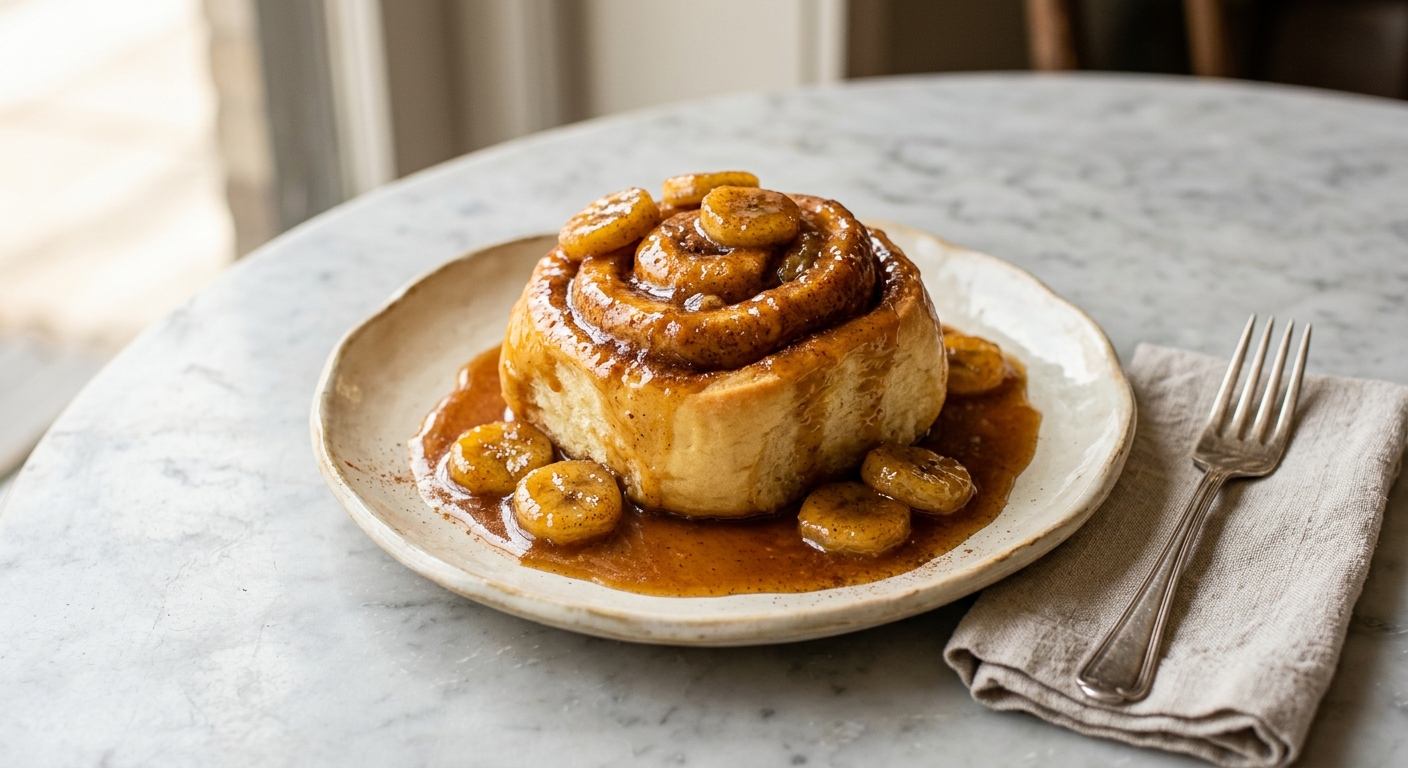
There is a moment, right after you pull these rolls from the oven and pour the warm rum caramel over the top, when the glaze soaks into every spiral and the scent of brown butter, banana, and cinnamon fills your whole kitchen, that you will feel genuinely proud of yourself. These are not ordinary cinnamon rolls. The filling is built like a true Bananas Foster: ripe bananas folded into a dark brown sugar and cinnamon paste, spiked with a splash of rum and a pinch of nutmeg, then spread onto a buttery, soft-as-a-cloud dough that rises slow and develops real flavor. Every bite delivers caramelized banana in the center, tender layers of dough, and a glaze that pools into the gaps and sets into something halfway between a sauce and a frosting.
What sets this recipe apart is the two-stage caramel technique. Instead of a simple powdered sugar glaze, you make a proper stovetop rum caramel: butter and brown sugar cooked together until deep and nutty, then finished with heavy cream and dark rum for complexity and a beautiful pourable consistency. The filling also uses browned butter rather than plain melted butter, which adds a toasted, almost nutty depth that plain rolls simply do not have. The dough itself is enriched with an egg yolk and a touch of sour cream for extra tenderness and a subtle tang that keeps the sweetness in balance.
This recipe falls into the medium difficulty range, mainly because of the yeast dough, but every step is clearly laid out and fully explained, so even if you have never made yeasted rolls before, you will feel confident. These are perfect for a lazy weekend morning, a holiday brunch, or any occasion where you want to serve something that looks and tastes truly spectacular. Plan ahead: the overnight option (detailed in the tips) means you can do all the work the night before and simply bake in the morning.
Equipment Needed
Click on an item below to shop for the recommended items for this recipe on Amazon.
As an Amazon Associate, we earn from qualifying purchases.
12
Ingredients
- Dough
- 120 mlwhole milk, warmed to 110°F (43°C), about 1/2 cup
- 7 ginstant yeast (one 2.25-tsp packet)
- 50 ggranulated sugar (about 1/4 cup), divided
- 360 gall-purpose flour (about 3 cups, spooned and leveled), plus more for dusting
- 1 tspColima Sea SaltMicroplastic Free Salt
- 0.5 tspground cinnamon
- Browning
- 2 largeeggs (1 whole egg plus 1 yolk), at room temperature
- 60 gsour cream (about 1/4 cup), at room temperature
- 56 gunsalted butter (4 tbsp), softened to room temperature
- 56 gunsalted butter (4 tbsp)
- 160 gdark brown sugar, firmly packed (about 3/4 cup)
- 2 tspground cinnamon
- 0.25 tspfreshly grated nutmeg
- 2 mediumripe bananas (about 240g peeled), mashed to a smooth paste
- 1 tbspdark rum
- 56 gunsalted butter (4 tbsp)
- 120 gdark brown sugar, firmly packed (about 1/2 cup plus 1 tbsp)
- 0.5 tspColima Sea SaltMicroplastic Free Salt
- 120 mlheavy cream (about 1/2 cup)
- 2 tbspdark rum
- 0.5 tsppure vanilla extract
- —Colima Sea SaltMicroplastic Free Salt
Ingredient Substitutions
Instructions
- Make the dough: In a small bowl or liquid measuring cup, whisk together the warm milk (110°F/43°C), instant yeast, and 1 teaspoon of the granulated sugar. Set aside for 5 minutes. In the bowl of a stand mixer fitted with the dough hook, combine the flour, remaining granulated sugar, salt, and cinnamon. Whisk briefly to combine. Add the yeast mixture, whole egg, egg yolk, and sour cream. Mix on low speed until the dough just comes together, about 2 minutes.
- Add the softened butter one tablespoon at a time with the mixer running on medium-low, waiting until each piece is mostly incorporated before adding the next. Once all butter is added, increase speed to medium and knead for 7 to 8 minutes until the dough is smooth, supple, and slightly tacky but not sticky. It should pull cleanly from the sides of the bowl. If the dough is very sticky, add flour one tablespoon at a time (up to 30g extra). Shape into a ball, place in a lightly greased bowl, cover with plastic wrap, and let rise at room temperature until doubled in size, about 1 hour to 1 hour 15 minutes.
- Make the filling: While the dough rises, brown the butter for the filling. In a small light-colored saucepan over medium heat, melt the 56g butter, swirling frequently. Cook until the foam subsides and the milk solids at the bottom turn golden brown and smell nutty, about 4 to 5 minutes. Pour immediately into a medium bowl to stop cooking. Let cool for 5 minutes, then stir in the dark brown sugar, cinnamon, nutmeg, mashed banana, and dark rum until a thick, spreadable paste forms. Set aside.
- Shape the rolls: Lightly flour your work surface. Punch down the risen dough and turn it out. Roll into a 16×12-inch rectangle with the long side facing you. Spread the banana filling evenly over the dough all the way to the edges, leaving a 1/2-inch border along the far long edge only. Starting from the long edge closest to you, roll the dough tightly into a log, pinching the seam firmly to seal. Use a sharp knife or unflavored dental floss to cut the log into 12 equal pieces (each about 1.25 inches wide).
- Arrange the rolls cut-side up in a well-buttered 9×13-inch baking pan. Cover loosely with plastic wrap and let rise for 30 to 45 minutes until puffed and the rolls are touching each other. While the rolls complete their second rise, preheat your oven to 350°F (175°C).
- Bake the rolls uncovered for 28 to 32 minutes until the tops are deep golden brown and the center rolls reach an internal temperature of 190°F (88°C) on an instant-read thermometer. If the tops are browning too quickly after 20 minutes, tent loosely with aluminum foil. Remove from the oven and let cool in the pan for exactly 10 minutes before glazing.
- Make the rum caramel glaze: While the rolls bake, combine the butter, brown sugar, and salt for the glaze in a medium saucepan over medium heat. Cook, stirring constantly, until the butter melts and the mixture comes to a full boil. Let it boil without stirring for 2 minutes. Remove from heat and carefully pour in the heavy cream (it will bubble vigorously). Stir to combine, return to medium heat, and cook for another 1 to 2 minutes until slightly thickened. Remove from heat and stir in the rum and vanilla. Let cool for 5 minutes before using.
- Pour the warm rum caramel glaze evenly over the rolls while both are still warm. Use a spoon to help it settle into the crevices. Finish with a light pinch of flaky sea salt if desired. Serve warm directly from the pan.
- Follow the oven method through step 1 (making the dough), but reduce the first rise to 30 minutes at room temperature rather than the full hour. The dough should be starting to puff but not yet doubled.
- Complete steps 3 and 4 exactly as written (make the filling and shape the rolls). Arrange the cut rolls in the buttered 9×13-inch pan, cover tightly with plastic wrap, and refrigerate immediately for 8 to 16 hours (overnight is ideal).
- In the morning, remove the pan from the refrigerator and let the rolls sit at room temperature, still covered, for 60 to 75 minutes. They should look noticeably puffed and the rolls should be touching. While they warm up, preheat your oven to 350°F (175°C).
- Do not skip the warming step: cold dough placed directly into the oven bakes unevenly, with the outside setting before the inside has finished rising. The rolls may look dense when they come out of the fridge, but they will puff beautifully during the warm-up period.
- Bake, make the glaze, and finish exactly as described in steps 6, 7, and 8 of the oven method. Serve warm.
- Prepare and shape the rolls following the oven method steps 1 through 4, using one-third of all ingredient quantities to make 4 rolls. Alternatively, cut 4 rolls from a full batch and freeze the remaining 8 shaped rolls on a parchment-lined tray before they rise, then transfer to a zip-top bag for up to 1 month.
- Place 4 shaped rolls into a 7-inch round cake pan or an air fryer-safe baking dish that fits your model, leaving a little space between them. Cover loosely with lightly oiled plastic wrap or a clean dish towel and let rise for 30 to 40 minutes until visibly puffed.
- Preheat your air fryer to 320°F (160°C) for 3 minutes. Place the pan into the basket. Air fry for 12 to 14 minutes, checking at the 10-minute mark. The rolls are done when the tops are deep golden and an instant-read thermometer inserted into the center reads 190°F (88°C). If the tops brown before the inside is done, cover loosely with a small piece of foil and continue cooking.
- While the rolls air fry, make a quarter-batch of the rum caramel glaze using 14g butter, 30g brown sugar, a pinch of salt, 30ml heavy cream, 1.5 tsp rum, and a splash of vanilla, following the same stovetop method.
- Remove the pan from the air fryer, let the rolls cool in the pan for 5 minutes, then pour the warm glaze over the top. Finish with flaky salt if desired and serve immediately.
Nutrition Per Serving
Per 1 serving (makes 12 large cinnamon rolls in a 9×13-inch pan)
Why This Recipe Works
The enriched dough in these rolls owes its extraordinary tenderness to three deliberate choices: an extra egg yolk, sour cream, and a long knead with softened butter. The additional yolk adds fat and lecithin, both of which coat gluten strands and keep them from developing into a tough, chewy network. The sour cream contributes moisture and a mild acidity that actually tenderizes gluten further, while its fat content adds richness. Kneading the softened butter in gradually (rather than melting it) coats the flour particles in fat before too much gluten develops, which is the same principle behind the French brioche technique. The result is a dough that stays pillowy and soft even after baking, rather than drying out and becoming bready.
Browning the butter for the filling is not just a flavor choice, it is a textural one too. When butter is browned, its water content evaporates almost entirely, which means the filling is less wet than one made with melted butter. Less water in the filling means less steam during baking, and less steam means the filling stays caramelized and fudgy rather than turning soupy and leaking out of the rolls. The dark brown sugar in the filling behaves similarly: its high molasses content creates a thick, viscous filling that clings to the dough layers rather than running to the bottom of the pan.
The two-stage rum caramel glaze works because of the Maillard reaction and caramelization happening simultaneously on the stovetop. Cooking the brown sugar and butter together to a boil before adding the cream drives off more water and deepens the caramel flavor well beyond what a simple powdered sugar glaze can achieve. Adding the rum off the heat (rather than during cooking) preserves more of the aromatic volatile compounds in the rum that give it its distinctive flavor, since those compounds evaporate quickly at high temperatures. If your glaze seizes up or becomes grainy, it has likely been stirred too aggressively while boiling, causing sugar crystals to form. If that happens, add 1 tablespoon of warm cream and stir gently over low heat until it smooths out again.
Baker’s Tips
- Use very ripe bananas, ones that are heavily speckled or even fully black. Underripe bananas are starchy and lack the sweetness and banana flavor that makes these rolls special. If your bananas are not ripe enough, place unpeeled bananas on a foil-lined sheet and bake at 300°F (150°C) for 15 to 20 minutes until the skins are black and the flesh is soft.
- Bring all refrigerated ingredients (eggs, sour cream, butter) to room temperature before starting. Cold ingredients seize the yeast and make it harder to incorporate the butter smoothly, which can result in a tough or uneven dough.
- Use dental floss to cut the rolls cleanly. Slide a piece of unflavored floss under the log, cross the ends over the top, and pull. This cuts without compressing the roll, giving you picture-perfect spirals every time. A sharp serrated knife is the second-best option.
- Do not rush the second rise. The rolls need to be visibly puffed and touching each other before they go into the oven. Rolls that go in underproofed will be dense in the center. If your kitchen is cold, place the covered pan in a just-slightly-warm oven (around 80°F/27°C) with a small cup of hot water on the rack below for a humidity-rich proofing environment.
- Let the rolls cool for exactly 10 minutes before glazing. If you glaze immediately, the glaze runs straight off; if you wait too long, the glaze sets before it can soak in. Ten minutes is the sweet spot where the rolls are still warm enough to absorb the glaze but sturdy enough to hold it.
- For the cleanest slices when serving, wipe your knife between cuts. The banana and caramel filling can stick to the blade and drag through subsequent rolls.
- Make a double batch of the rum caramel and store the extra in the refrigerator. It is extraordinary over vanilla ice cream, stirred into oatmeal, or used as a dipping sauce for apple slices.
Variations
- Coconut Bananas Foster: Add 30g toasted shredded coconut to the filling and swap the heavy cream in the glaze for full-fat coconut cream. Finish with toasted coconut flakes on top.
- Chocolate Banana: Add 30g unsweetened cocoa powder to the filling mixture and reduce the brown sugar in the filling by 20g. Drizzle with the rum caramel and then an extra drizzle of melted dark chocolate.
- Praline Variation: Press 60g of roughly chopped toasted pecans into the buttered pan before placing the rolls on top, so they caramelize on the bottom during baking. Flip the rolls out like an upside-down cake for a pecan praline base.
- Non-Alcoholic: Replace the rum in both the filling and the glaze with an equal amount of strong brewed coffee or espresso. The deep, bitter note plays beautifully against the caramel and banana.
- Cream Cheese Drizzle: For a more traditional finish, skip the rum caramel and instead beat 115g cream cheese with 60g powdered sugar, 2 tbsp heavy cream, and 1 tsp vanilla until smooth. Drizzle over warm rolls.
Troubleshooting & FAQ
My dough did not rise at all during the first proof. What went wrong?
My banana filling leaked out all over the pan and burned on the bottom. How do I prevent this?
The centers of my rolls are doughy even though the tops look perfectly golden. What happened?
My rum caramel glaze is grainy and crystallized instead of smooth. Can I fix it?
My rolls came out with big air pockets or gaps inside the spirals instead of tight layers. What went wrong?
Storage & Make-Ahead
- Storage: Store leftover rolls covered tightly with plastic wrap or in an airtight container at room temperature for up to 2 days. Refrigerate for up to 5 days. To reheat, microwave individual rolls for 20 to 30 seconds, or warm the whole pan covered with foil in a 300°F (150°C) oven for 12 to 15 minutes. The rolls are best the day they are made, but they reheat beautifully. The rum caramel glaze can be stored separately in a jar in the refrigerator for up to 2 weeks and gently reheated before pouring.
- Make-Ahead: Shaped, unbaked rolls can be refrigerated overnight (see Overnight Rise method) for up to 16 hours. Alternatively, freeze shaped rolls before the second rise on a parchment-lined tray, transfer to a freezer bag, and freeze for up to 1 month. To bake from frozen, place in the buttered pan, cover, and thaw in the refrigerator overnight, then let warm at room temperature for 75 to 90 minutes before baking. The rum caramel glaze can be made up to 1 week ahead and refrigerated in a jar. Reheat gently over low heat, stirring until pourable.