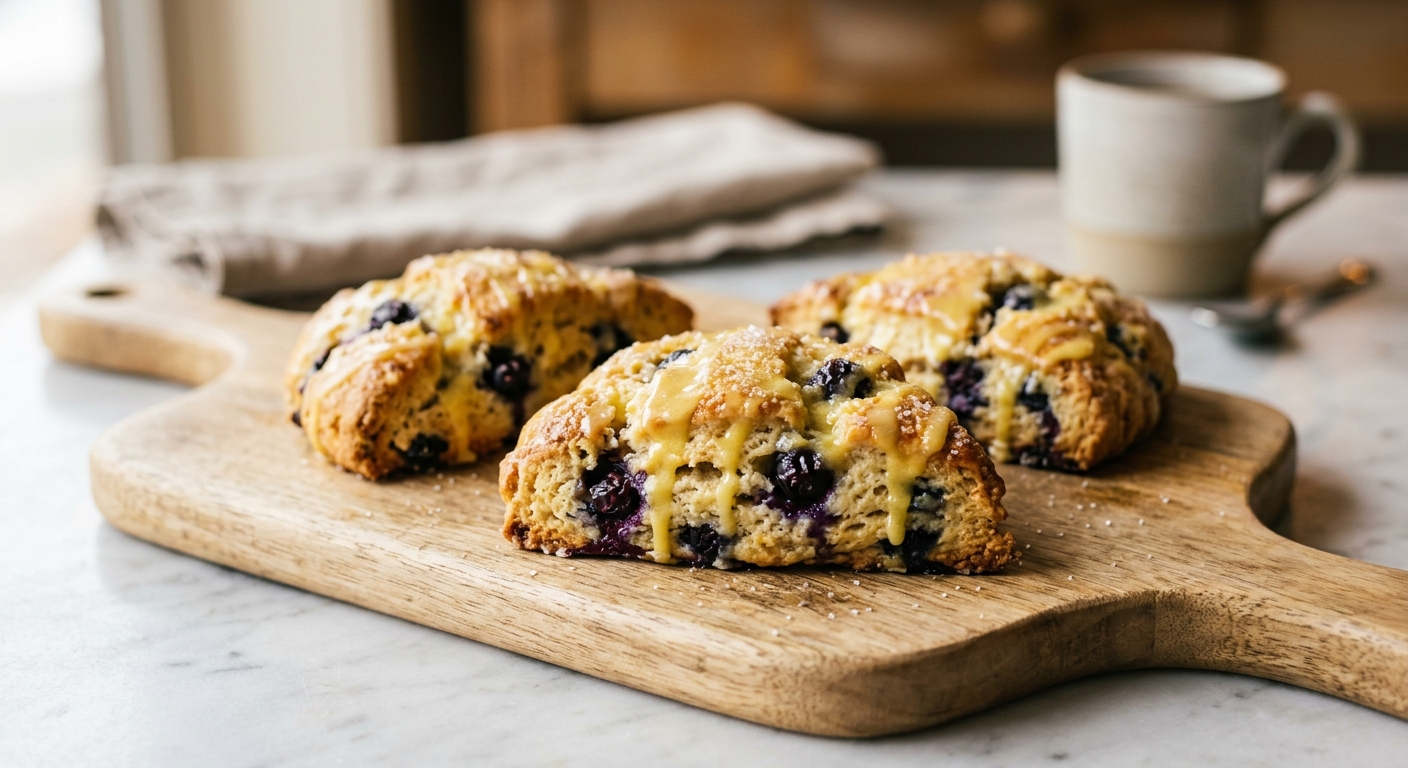
There is something deeply satisfying about pulling a tray of golden scones from the oven, their edges crisped to a pale amber, a handful of blueberries having burst and pooled into little violet pockets throughout the crumb. These Blueberry Lemon Scones smell like a bakery and taste even better: tender and buttery at the center, with a slight crunch at the crust and a lemon drizzle that sets into a delicate, sugary glaze. Slice one open while it is still warm and you will find a soft, layered interior that is nothing like the dry, dense scones you may have encountered at a coffee shop.
What sets this recipe apart is the technique of grating frozen butter directly into the flour. Cold fat is the non-negotiable secret to flaky scones. When those tiny shards of butter hit the heat of the oven, they release steam and create the distinct layers that make a great scone worth eating. We also use both lemon zest in the dough and fresh lemon juice in the drizzle, so the citrus flavor comes through at every stage rather than fading into the background. A brief rest in the freezer before baking firms the butter back up after handling, guaranteeing lift and flakiness even if your kitchen runs warm.
This recipe sits comfortably at a medium difficulty level. If you have made biscuits or pastry before, you will feel right at home. If you are newer to pastry work, the instructions walk you through every detail so nothing is left to guesswork. These scones are ideal for a weekend breakfast or brunch, an afternoon tea, or anytime you want to offer someone a homemade bake that looks and tastes like it came from a proper patisserie.
Equipment Needed
Click on an item below to shop for the recommended items for this recipe on Amazon.
As an Amazon Associate, we earn from qualifying purchases.
8
Ingredients
- Sprinkling On Top
- 300 gall-purpose flour (about 2 1/2 cups, spooned and leveled), plus extra for dusting
- 50 ggranulated sugar (about 1/4 cup)
- 12 gbaking powder (1 tablespoon)
- 3 gColima Sea SaltMicroplastic Free Salt (1/2 teaspoon)
- 115 gunsalted butter, frozen solid (1/2 cup or 1 stick)
- 180 mlcold heavy cream (3/4 cup), plus 2 tablespoons for brushing
- 1 largeegg, cold
- 15 mlfresh lemon juice (1 tablespoon)
- 12 glemon zest (zest of 2 large lemons)
- 1 tsppure vanilla extract
- 170 gfresh or frozen blueberries (about 1 1/4 cups; do not thaw if frozen)
- —1 tablespoon coarse or turbinado sugar
- Drizzle
- 120 gpowdered sugar, sifted (about 1 cup)
- 30 mlfresh lemon juice (2 tablespoons)
- 4 glemon zest (zest of 1 lemon)
Ingredient Substitutions
Instructions
- Preheat your oven to 400°F (205°C) and line a large baking sheet with parchment paper. Place the sheet in the fridge or freezer while you prepare the dough to keep it cold.
- In a large bowl, whisk together the flour, granulated sugar, baking powder, and salt. Working quickly over the bowl, use the large holes of a box grater to grate the frozen butter directly into the flour. Toss the butter shreds gently with your fingers to coat them in flour. You want visible butter pieces throughout, not a sandy mix.
- In a small jug or bowl, whisk together the cold heavy cream, egg, 1 tablespoon lemon juice, lemon zest, and vanilla extract. Pour this mixture over the flour and butter. Using a rubber spatula or fork, stir and fold until the dough just begins to come together. It will look shaggy and slightly dry at this stage, which is correct.
- Add the blueberries to the bowl. Use your hands to gently press and fold the dough 6 to 8 times until it holds together in a rough mass. Do not overwork it. If using frozen blueberries, work especially quickly so they do not thaw and bleed.
- Turn the dough out onto a lightly floured surface and pat it into a circle about 7 inches (18 cm) wide and 1 inch (2.5 cm) thick. Use a sharp knife or bench scraper to cut the circle into 8 equal wedges, like a pizza. Transfer the wedges to the cold baking sheet, spacing them about 2 inches apart.
- Place the baking sheet in the freezer for 10 minutes. This firms the butter back up and helps the scones hold their shape and rise tall. While they chill, brush the tops with the extra 2 tablespoons of heavy cream and sprinkle generously with coarse sugar.
- Bake for 20 to 22 minutes, until the tops are a deep golden brown and the edges look set and cooked through. A scone that is too pale on top is likely underbaked in the center. Let them cool on the pan for 5 minutes, then transfer to a wire rack.
- While the scones cool, whisk together the sifted powdered sugar, 2 tablespoons lemon juice, and lemon zest for the drizzle until smooth. Add a teaspoon more juice if you want a thinner glaze. Once the scones are just barely warm (not hot), drizzle the glaze over the tops and let it set for 5 to 10 minutes before serving.
- Prepare the scone dough exactly as described in steps 1 through 5 of the oven method, shaping into 8 wedges. Line the air fryer basket with a cut piece of parchment paper, leaving the edges trimmed so air can circulate. Do not use a full sheet that blocks airflow.
- After cutting the dough into wedges, place 3 to 4 scones in the air fryer basket, leaving at least 1 inch of space between each one. They will expand. Brush the tops with heavy cream and sprinkle with coarse sugar. There is no need for a freezer rest with this method as the circulating hot air sets the exterior quickly.
- Air fry at 350°F (175°C) for 12 to 14 minutes, checking at the 10-minute mark. The tops should be deep golden and the sides should look dry and cooked through. Because air fryer models vary, start checking early. If the tops brown too fast, lay a small square of foil loosely over them for the final 2 to 3 minutes.
- Transfer the cooked scones to a wire rack and repeat with the remaining dough. Keep finished scones loosely tented with foil while the second batch cooks to retain warmth.
- Prepare and drizzle the lemon glaze as described in the final step of the oven method, once the scones have cooled slightly.
Nutrition Per Serving
Per 1 serving (makes 8 large wedge scones)
Why This Recipe Works
The foundation of a flaky, tender scone is cold fat and minimal gluten development. When frozen butter is grated into the flour, those discrete shards remain intact and coated in flour rather than being worked into a uniform paste. In the oven, the water inside each butter shard converts to steam and pushes the layers apart, creating lift and flakiness. The brief freezer rest before baking re-solidifies any butter that may have softened during mixing, making sure every scone goes into a hot oven with the fat still in its ideal state. This is the same science behind good pie crust and laminated pastry, just achieved much more quickly.
The combination of heavy cream and egg in the liquid component serves a dual purpose. The fat in the cream keeps the crumb tender and rich, while the egg contributes structure through protein coagulation during baking, which helps the scones hold their shape and rise upright rather than spreading flat. A tablespoon of lemon juice in the dough subtly activates the baking powder, which contains baking soda as a component, giving an initial lift as soon as the liquid hits the leavener. The coarse sugar on top does more than sparkle: its larger crystals take longer to melt than the finer sugar in the dough, which means they remain partially intact through baking and create a lightly crunchy, caramelized crust.
If your scones spread too much, the most likely culprit is butter that was too warm going into the oven, dough that was overworked and developed too much gluten, or a baking sheet that was too warm. Always start with frozen butter and a cold pan. If your scones turn out dry or crumbly, the dough may have been over-floured or too much liquid evaporated during baking. Measure your flour by spooning it into the cup and leveling, never scooping directly from the bag, which packs the flour and can add up to 20 percent extra by weight.
Baker’s Tips
- Freeze your butter for at least 30 minutes before starting. Grating it frozen is much faster than cutting it in with a pastry cutter and produces even, flour-coated shards that melt evenly in the oven.
- Do not skip the freezer rest before baking. Even 10 minutes makes a visible difference in how tall and defined the scones come out of the oven.
- Use a sharp knife or bench scraper to cut the wedges cleanly. A sawing or dragging motion compresses the layers at the edges and prevents a good rise.
- If using fresh blueberries, toss them briefly in 1 teaspoon of flour before adding them to the dough. This helps prevent them from sinking and reduces streaking.
- The dough should feel slightly sticky and shaggy, not smooth and pliable like bread dough. Resist the urge to add more flour or keep kneading. Over-mixing develops gluten and turns scones tough.
- Let scones cool at least 10 minutes before drizzling. Glazing while they are too hot causes the icing to slide off rather than setting into that lovely crackled finish.
- For the neatest wedges, use a ruler or score the circle lightly before cutting all the way through.
Variations
- Lemon Poppy Seed: Omit the blueberries and add 2 tablespoons of poppy seeds to the dry ingredients. Increase the lemon zest to the zest of 3 lemons for an even brighter citrus punch.
- Blueberry Orange: Swap all the lemon zest and juice for orange zest and juice for a warmer, slightly sweeter flavor. Use blood orange in winter for a stunning pink drizzle.
- Cream Cheese Filled: Before shaping, press the dough into a rectangle, spread 60g of softened cream cheese mixed with 1 tablespoon powdered sugar over half, then fold the dough over and press gently before cutting into wedges. Rich and bakery-worthy.
- Lavender Blueberry: Add 1 teaspoon of culinary-grade dried lavender to the dry ingredients. It pairs beautifully with both the blueberry and lemon and gives the scones a subtle floral note.
Troubleshooting & FAQ
My scones spread out flat instead of rising tall. What went wrong?
The insides of my scones are doughy even though the tops are golden. How do I fix this?
My blueberries turned the dough purple and streaky. How do I prevent this?
My lemon drizzle is too thick and clumps instead of drizzling smoothly. How do I fix it?
My scones came out dry and crumbly rather than tender. Where did things go wrong?
Storage & Make-Ahead
- Storage: Store cooled scones in an airtight container at room temperature for up to 2 days. For longer storage, refrigerate for up to 4 days and warm briefly in a 300°F (150°C) oven for 5 to 8 minutes before serving. The glaze will soften in the fridge but will not affect the flavor.
- Make-Ahead: The dry ingredients and grated butter can be mixed together and refrigerated in an airtight container for up to 2 days. The unbaked, shaped scone wedges can be frozen solid on a baking sheet, then transferred to a freezer bag and stored for up to 2 months. Bake directly from frozen at 400°F (205°C), adding 4 to 6 extra minutes to the bake time. Do not prepare the drizzle until just before serving.