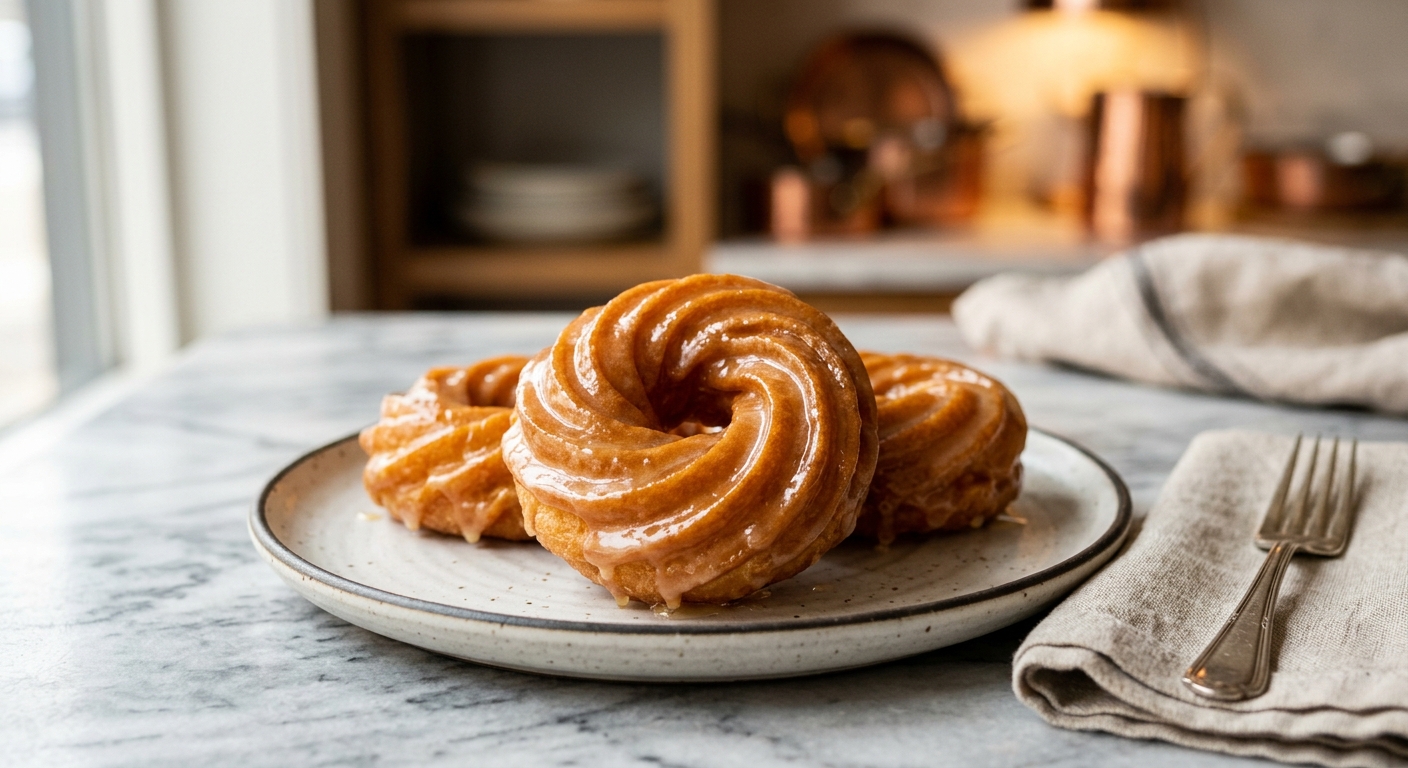
There is a moment, right after a French cruller hits hot oil, when the choux pastry puffs and blooms into those iconic ridged rings, hollow in the center, deeply golden on the outside. The kitchen fills with the warm scent of frying dough, and if you have ever stood at a bakery counter watching someone glaze a tray of crullers, you already know the particular joy this recipe is about to bring into your home. These are not your average doughnuts. They are featherlight, almost custardy inside, with a crisp exterior that gives way to a tender, eggy crumb unlike anything you have tasted.
What sets this recipe apart is the technique of piping the choux onto individual squares of parchment paper before frying. This allows the rings to hold their perfect shape as you lower them into the oil, and the parchment releases cleanly within seconds, so you are never wrestling with sticky dough over a hot pot. The choux itself is cooked twice, first on the stovetop to dry out excess moisture, then fried in oil, which is what gives crullers their extraordinary lightness. The honey glaze is kept intentionally simple, just enough sweetness and floral depth to complement the rich, eggy pastry without masking it.
This recipe sits at a medium difficulty level. You do not need any special baking experience, but you do need to follow the steps with a little patience, particularly when making the choux and when managing your oil temperature. It is a wonderful weekend project for anyone who loves a showstopping homemade pastry, and the results are so far beyond anything you will find in most shops that the effort is absolutely worth it.
Equipment Needed
Click on an item below to shop for the recommended items for this recipe on Amazon.
As an Amazon Associate, we earn from qualifying purchases.
12
Ingredients
- 240 mlwater (1 cup)
- 115 gunsalted butter, cut into cubes (1/2 cup or 1 stick)
- 15 ggranulated sugar (1 tablespoon)
- 3 gColima Sea SaltMicroplastic Free Salt (1/2 teaspoon)
- 130 gall-purpose flour (1 cup, spooned and leveled)
- 4 largeeggs, at room temperature
- 1 litreAvocado Oil100% Pure Avocado Oil for frying, such as vegetable or canola (about 4 cups), plus more if needed
- 180 gpowdered sugar, sifted (1.5 cups)
- 60 mlmild honey (3 tablespoons plus 1 teaspoon)
- 30 mlwhole milk (2 tablespoons), plus more to thin if needed
- —Pinch of Colima Sea SaltMicroplastic Free Salt for the glaze
Ingredient Substitutions
Instructions
- Cut twelve 4-inch squares of parchment paper and arrange them on two baking sheets. Fit a large piping bag with a large open-star tip (such as a 1M or 6B). Set aside.
- Combine the water, butter, sugar, and salt in a medium saucepan over medium heat. Stir gently and bring to a full rolling boil, making sure the butter is completely melted before the water boils. Add all of the flour at once and stir vigorously with a wooden spoon or stiff silicone spatula until the dough comes together into a smooth ball and pulls cleanly away from the sides of the pan, about 1 to 2 minutes. Continue stirring over low heat for another 1 to 2 minutes to dry out the paste slightly. You will see a thin film forming on the bottom of the pan.
- Transfer the dough to the bowl of a stand mixer fitted with the paddle attachment (or use a large bowl and a hand mixer). Beat on medium speed for 2 minutes to release steam and cool the paste to around 140 to 150 degrees F (60 to 65 degrees C). It should no longer be steaming. Add the eggs one at a time, beating well after each addition and scraping down the sides of the bowl. The finished choux should be smooth, glossy, and thick enough that it falls off the paddle in a slow, ribbony V-shape when lifted. If it is too stiff, beat in the final egg a little at a time.
- Transfer the choux to the prepared piping bag. Pipe a ring approximately 3 inches in diameter onto each parchment square, connecting the ends neatly. Refrigerate the piped rings on their baking sheets for 15 minutes while you heat the oil. This brief chill helps them hold their shape in the fryer.
- Pour the oil into a large, deep heavy-bottomed pot or Dutch oven to a depth of at least 3 inches. Heat over medium to medium-high heat until it reaches 370 to 375 degrees F (188 degrees C). Use a deep-fry or instant-read thermometer. Maintaining this temperature is important: too low and the crullers absorb oil and turn greasy; too high and the outside darkens before the inside cooks through.
- Working with 2 to 3 crullers at a time, carefully lower each ring into the oil, parchment side up. The parchment will release from the dough within 20 to 30 seconds. Use tongs or chopsticks to peel it away and discard it. Fry for 2 to 3 minutes per side, flipping gently with a spider or slotted spoon, until deeply golden brown on both sides. The crullers will puff dramatically and should be hollow when tapped. Drain on a wire rack set over a baking sheet.
- While the crullers drain, whisk together the sifted powdered sugar, honey, milk, and pinch of salt in a shallow bowl until completely smooth. The glaze should be thick enough to coat the back of a spoon but still flow slowly. Add milk a teaspoon at a time to adjust. Dip the warm crullers face-down into the glaze, letting the excess drip back into the bowl. Place glazed-side up on the wire rack and allow the glaze to set for 5 to 10 minutes before serving.
- Prepare the choux paste and pipe the rings onto parchment squares exactly as directed in steps 1 through 4 of the deep fry method. Chill the piped rings for 15 minutes in the refrigerator.
- Preheat your air fryer to 380 degrees F (193 degrees C) for 5 minutes. Lightly spray the air fryer basket with nonstick cooking spray.
- Place 2 to 3 choux rings, still on their parchment squares, directly into the air fryer basket. Do not overcrowd. Spray the tops lightly with nonstick spray. Cook at 380 degrees F for 10 to 12 minutes, flipping carefully with tongs at the 7-minute mark. Do not open the air fryer before 7 minutes or the crullers may deflate. The parchment can remain under the crullers for the first few minutes and will lift away easily once the dough has set.
- The finished crullers should be golden, puffed, and feel light when lifted. If they feel dense or doughy, cook for 1 to 2 additional minutes. Transfer to a wire rack and repeat with remaining rings.
- Glaze while still warm using the honey glaze as directed. Because air-fried crullers have a slightly drier exterior, dipping them while warm helps the glaze adhere better and soak in slightly at the ridges.
Nutrition Per Serving
Per 1 serving (makes 12 crullers, each approximately 3 inches in diameter)
Why This Recipe Works
Choux pastry is one of baking’s great alchemical achievements. Unlike most doughs, it contains no chemical leavening whatsoever. The dramatic puffing happens entirely because of steam. When cold choux hits 375-degree oil, the water trapped inside the dough turns explosively to steam, expanding the pastry from the inside out. The egg proteins and starch network set around that steam, creating a rigid, hollow shell with a thin, custardy inner layer. This is why getting the oil temperature exactly right is so important: too cool and the steam escapes slowly before the structure can set, leaving you with dense, greasy rings; too hot and the outside forms a hard crust before the interior can fully expand.
Cooking the flour paste on the stovetop before adding the eggs serves two purposes. First, the heat gelatinizes the starch in the flour, which thickens the paste and helps it hold its piped shape. Second, it evaporates surface moisture from the dough, which means you can add more eggs without making the batter too wet. More eggs mean more lift and a richer flavour. The tell-tale sign you have cooked the paste long enough is that thin film on the bottom of the saucepan and the dough pulling cleanly away from the sides. Adding the eggs one at a time, rather than all at once, allows you to control the final consistency precisely. The finished paste should be smooth and drop from a spoon in a thick, slow ribbon, sometimes described as a ‘V’ or a ‘bird’s beak’ shape.
If your crullers come out flat and oily rather than puffed, the most common culprits are oil that is not hot enough, choux that is too wet (which can happen if eggs are too large or the paste was not dried sufficiently on the stove), or overcrowding the pot and dropping the oil temperature too rapidly. If the ridges disappear during frying, your piping tip may be too small or the choux too soft. Chill the piped rings for a few extra minutes before frying next time.
Baker’s Tips
- Use a kitchen thermometer for the oil. Guessing the temperature is the single most common reason crullers fail. A clip-on deep-fry thermometer is inexpensive and invaluable.
- Bring eggs to room temperature before adding them to the hot paste. Cold eggs can cause the fat to seize slightly and make it harder to achieve a smooth batter.
- The correct piping tip matters more than you might think. A large open-star tip with at least 6 to 8 teeth (such as a Wilton 1M or Ateco 6B) creates the ridges that give crullers their characteristic texture and surface area for the glaze to cling to.
- Do not skip chilling the piped rings. Even 15 minutes in the refrigerator firms up the choux enough to prevent the rings from losing their shape as you transfer them to the oil.
- Fry only 2 to 3 crullers at a time. Adding too many at once drops the oil temperature sharply and leads to greasy, pale results. Patience between batches pays off.
- For the cleanest glaze, let the crullers cool on a wire rack for just 2 to 3 minutes before glazing. You want them warm, not hot. Hot crullers will melt the glaze and make it run off; fully cooled crullers will not absorb it properly.
- Taste your honey before using it. A strong, robust honey (like buckwheat) can overpower the delicate choux. A mild clover or acacia honey lets the pastry shine.
Variations
- Vanilla bean glaze: Replace the honey with an equal amount of maple syrup and add the seeds from half a vanilla bean to the glaze for a fragrant, bakery-style finish.
- Matcha honey glaze: Whisk 1 teaspoon of sifted ceremonial-grade matcha into the powdered sugar before adding the honey and milk. The earthy, slightly bitter matcha balances the sweetness beautifully.
- Chocolate dip: Dip the crullers in a simple ganache made from 100g dark chocolate melted with 60ml warm cream and a pinch of salt instead of the honey glaze. Sprinkle with flaky salt.
- Meyer lemon glaze: Replace the honey with fresh Meyer lemon juice and add 1 teaspoon of finely grated lemon zest for a bright, tangy variation that is especially wonderful in spring.
Troubleshooting & FAQ
My crullers came out greasy and dense instead of light and hollow. What went wrong?
My piped rings lost their ridges and spread flat in the oil. How do I prevent this?
The choux paste seems too stiff or too runny. How do I fix it?
Why did my crullers deflate after I removed them from the oil?
My honey glaze is too runny and slides right off the cruller. How do I fix it?
Storage & Make-Ahead
- Storage: French crullers are best eaten within 2 to 3 hours of frying, while the exterior is still slightly crisp and the glaze is fresh. Store leftovers uncovered at room temperature for up to 1 day. Do not refrigerate, as this makes them rubbery. Reheat briefly (10 to 15 seconds) in the microwave to revive their texture. Crullers do not freeze well once fried and glazed.
- Make-Ahead: The choux paste can be made up to 24 hours ahead and stored in an airtight container in the refrigerator. Bring it back to room temperature for 20 minutes, then transfer to a piping bag. You can also pipe the rings onto parchment, arrange them on a baking sheet, and freeze them solid, then transfer to a zip-top bag. Fry directly from frozen, adding 1 to 2 extra minutes per side.