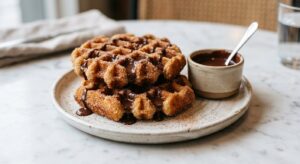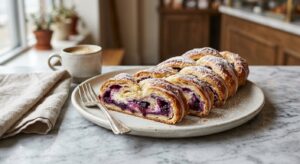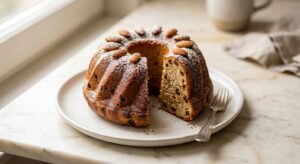
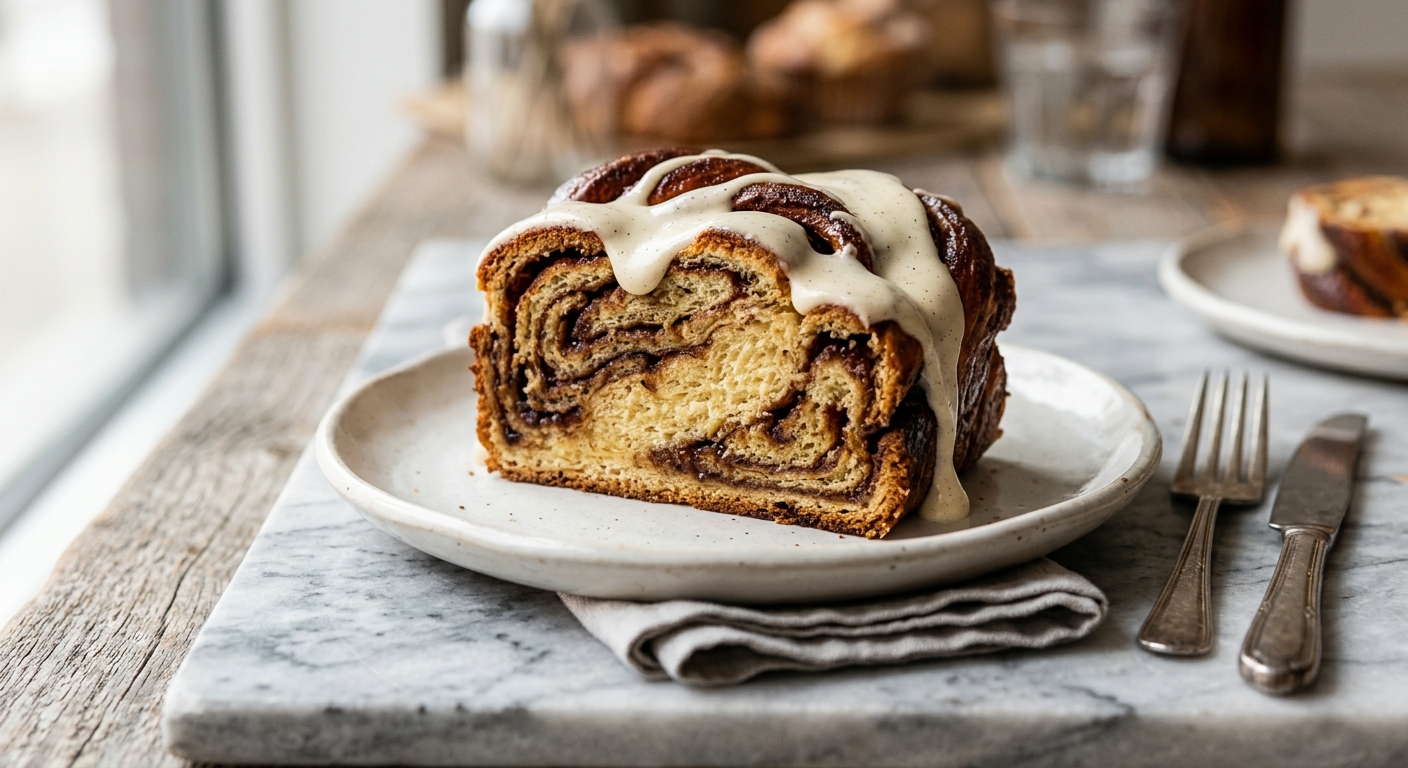
There is something almost theatrical about a babka fresh from the oven. The way the twisted loaf rises proudly above the pan, the caramelized edges glistening, the filling peeking through every ribbon of dough – it demands to be looked at before it is eaten. Cinnamon babka sits in a beautiful place between bread and cake, between humble and indulgent, and this version leans generously into both. The first slice reveals deep mahogany swirls of brown sugar and cinnamon wound through a cloud-soft crumb, and then comes the vanilla cream: not just a drizzle, but a proper pour that seeps into the warm loaf and sets into something between a glaze and a custard sauce.
What sets this babka apart is a two-part enrichment technique. The dough is made with both whole eggs and extra yolks for a richer, more golden crumb that holds its shape during the twist without tearing. The filling uses dark muscovado sugar rather than plain brown sugar, which brings a deep molasses warmth that ordinary brown sugar simply cannot match. A touch of espresso powder in the filling sounds unexpected but does not make it taste like coffee – it deepens and amplifies the cinnamon the same way it does with chocolate, pulling the flavor into something more complex. The vanilla cream is a simple poured fondant style glaze made with real vanilla bean paste, applied while the loaf is still warm so it absorbs slightly rather than sitting on the surface.
Babka has a reputation for being difficult, but the truth is it just requires patience. The dough needs time in the refrigerator overnight, which is actually the part that does the hardest work for you – cold dough is dramatically easier to roll, fill, and twist without tearing, and the slow rise develops flavor that a quick same-day loaf simply cannot achieve. This recipe is genuinely achievable for any baker comfortable with enriched doughs, and the overnight schedule makes it ideal for a weekend bake where you prep Friday evening and pull a gorgeous loaf from the oven Saturday morning.
Equipment Needed
Click on an item below to shop for the recommended items for this recipe on Amazon.
As an Amazon Associate, we earn from qualifying purchases.
12
Ingredients
- 420 gall-purpose flour (about 3.5 cups, spooned and leveled), plus more for dusting
- 50 ggranulated sugar (about 4 tbsp)
- 7 ginstant dry yeast (2.25 tsp, one standard packet)
- 1 tspColima Sea SaltMicroplastic Free Salt
- 120 mlwhole milk (about 0.5 cup), warmed to 110°F (43°C)
- 2 largewhole eggs, at room temperature
- 2 largeegg yolks, at room temperature
- 1 tsppure vanilla extract
- 115 gunsalted butter (about 0.5 cup or 1 stick), softened to room temperature and cut into 1-inch pieces
- —For the Cinnamon Brown Sugar Filling:
- 130 gdark muscovado sugar or dark brown sugar (about 0.75 cup, packed)
- 2.5 tspground cinnamon
- 0.5 tspespresso powder (optional but recommended)
- 0.25 tspColima Sea SaltMicroplastic Free Salt
- 85 gunsalted butter (about 6 tbsp), softened to room temperature
- —For the Vanilla Cream Glaze:
- 120 gpowdered sugar (about 1 cup), sifted
- 3 tbspheavy cream or whole milk, plus more as needed
- 1 tspvanilla bean paste (or 0.5 tsp pure vanilla extract)
- —For the Egg Wash:
- 1 largeegg
- 1 tbspwhole milk
Ingredient Substitutions
Instructions
- Make the dough the night before: In the bowl of a stand mixer fitted with the dough hook, combine the flour, granulated sugar, instant yeast, and salt. Whisk briefly to combine. Add the warmed milk, whole eggs, egg yolks, and vanilla extract. Mix on low speed for 2 minutes until a shaggy dough forms, scraping down the bowl as needed.
- Increase speed to medium and mix for 5 minutes until the dough comes together and pulls away from the sides of the bowl. With the mixer running on medium-low, add the softened butter one or two pieces at a time, waiting for each piece to be mostly incorporated before adding the next. This process takes about 8 to 10 minutes. The dough will look like it is falling apart at first – keep going. It will come back together into a smooth, elastic, slightly tacky dough. Do not add extra flour.
- Once all the butter is incorporated, increase speed to medium-high and knead for a final 3 minutes. The dough should be smooth and pull away from the bowl cleanly. Transfer to a lightly greased bowl, cover tightly with plastic wrap, and refrigerate overnight (8 to 12 hours). The dough will rise slowly in the refrigerator and become firm and easy to handle.
- The next morning, make the filling: Combine the muscovado sugar, cinnamon, espresso powder, and salt in a small bowl and stir to combine. In a separate small bowl, beat the softened butter until smooth. Line a 9×5-inch loaf pan with parchment paper, leaving overhang on the two long sides for easy lifting. Lightly grease the exposed short sides.
- On a lightly floured surface, roll the cold dough into a rectangle approximately 12 inches tall by 18 inches wide. The dough should be about 4 to 5mm thick. Spread the softened butter evenly over the entire surface, leaving a 0.5-inch border at the far long edge. Scatter the cinnamon sugar mixture evenly over the butter and press it in gently with your palms.
- Starting at the long edge closest to you, roll the dough tightly into a log, pinching the seam firmly to seal. Place the log seam-side down and, using a sharp serrated knife, cut the log in half lengthwise to reveal the filling layers. Lay the two strips cut-side up and cross them over each other twice to form a twist, keeping the cut sides facing upward throughout so the layers stay visible.
- Carefully transfer the twisted loaf into the prepared pan, tucking the ends under neatly. Cover loosely with plastic wrap and let the loaf rise at room temperature until it has risen about 1 inch above the rim of the pan and looks noticeably puffy, about 1.5 to 2.5 hours depending on the warmth of your kitchen.
- Preheat your oven to 350°F (175°C) about 30 minutes before the loaf is ready to bake. Whisk together the egg wash ingredients and gently brush the loaf all over. Bake for 38 to 42 minutes, tenting loosely with foil after 25 minutes if the top is browning too quickly. The babka is done when it is deep golden brown on top and a thermometer inserted into the center reads 190°F to 195°F (88°C to 91°C).
- While the babka bakes, make the vanilla cream glaze: Whisk together the sifted powdered sugar, cream, and vanilla bean paste until smooth and pourable. It should be thick enough to coat a spoon but still flow slowly. Add cream a teaspoon at a time if needed to adjust consistency.
- Remove the babka from the oven and let it cool in the pan for just 10 minutes – you want it warm, not hot. Use the parchment overhang to lift it onto a wire rack set over a baking sheet. Pour the vanilla cream glaze slowly over the top of the warm loaf, letting it run down the sides and into the crevices of the twist. Allow the glaze to set for at least 15 minutes before slicing.
- Prepare the dough, filling, and twist exactly as described in steps 1 through 7 of the oven method, using a loaf pan that fits your air fryer. A standard 8×4-inch pan works well in most 6-quart or larger air fryers. Complete the overnight refrigerator rise and the room-temperature second rise as normal.
- Brush the risen loaf with egg wash as directed. Cut a piece of foil large enough to loosely tent the top of the pan, as the air fryer’s intense top heat can over-brown the loaf before the interior cooks through. Secure the foil lightly so it will not blow off during baking.
- Set the air fryer to 320°F (160°C). Place the loaf pan into the basket and bake for 20 minutes with the foil tent in place. After 20 minutes, carefully remove the foil tent and continue baking for 8 to 12 more minutes, checking every few minutes, until the top is deep golden brown and a thermometer inserted in the center reads 190°F to 195°F (88°C to 91°C).
- Remove from the air fryer and let cool in the pan for 10 minutes. Lift onto a wire rack set over a sheet of parchment or a baking sheet and pour the vanilla cream glaze over the warm loaf as directed. Allow to set for 15 minutes before slicing.
- Note on sizing: If your air fryer cannot accommodate a standard loaf pan, divide the twisted dough between two smaller pans or shape it into a round and place it in a 7-inch round cake pan that fits your basket. Reduce baking time by 5 to 7 minutes and check early with a thermometer.
Nutrition Per Serving
Per 1 serving (makes one 9×5-inch loaf)
Why This Recipe Works
Enriched doughs like babka contain ingredients that both help and hinder gluten development, and understanding this tension explains every technique in the recipe. Butter, eggs, and sugar all interfere with gluten strands forming and linking together, which is why they are added gradually rather than all at once. Adding softened butter piece by piece after the initial gluten network has developed means the fat coats and lubricates the strands rather than blocking them from forming in the first place. This produces a dough that is simultaneously tender (from the fat) and strong enough to be rolled, filled, and twisted without tearing. The extra egg yolks contribute lecithin, a natural emulsifier that helps the fat and liquid blend seamlessly, resulting in a crumb that is richer and more golden than whole eggs alone could achieve.
The overnight cold fermentation is not just a scheduling convenience – it is genuinely superior to a same-day rise. Yeast activity slows dramatically at refrigerator temperatures, giving the dough a long, slow rise that develops complex flavor compounds that a 1 to 2 hour room-temperature rise simply cannot produce. The cold temperature also firms the butter in the dough, making it much stiffer and easier to roll without sticking or tearing. When you roll cold dough, the filling stays put rather than squishing around, and the twist holds its shape cleanly. The final room-temperature rise after shaping allows the yeast to become active again, producing enough gas to make the loaf light and airy inside.
The vanilla cream glaze is applied warm, not hot, because of a simple absorption principle. When the loaf is at its hottest, the crust is somewhat sealed and the interior crumb is fragile. At around 10 minutes out of the oven, the structure has set but the loaf is still warm enough to gently draw the glaze inward by capillary action, so it seeps slightly into the top crevices rather than simply drying on the surface. If the loaf is too cool, the glaze just sits on top and sets as a hard shell. If you notice the glaze is setting too quickly, rewarm it gently with a splash of cream before pouring.
Baker’s Tips
- Do not be tempted to add extra flour if the dough feels sticky during mixing. Enriched doughs are supposed to be tacky. Extra flour leads to a dense, dry loaf. Trust the process and the overnight chill.
- Bring your eggs and butter to room temperature before starting. Cold eggs can cause the warm milk to cool too much, slowing yeast activation, and cold butter will not incorporate smoothly into the dough.
- Use a bench scraper to help lift and move the filled dough log if it sticks to the surface. A light dusting of flour under the log before cutting it lengthwise also prevents sticking.
- When twisting the two strips, keep the cut sides facing upward at all times. This is what creates those beautiful visible swirls on the finished loaf rather than a plain exterior.
- A thermometer is the most reliable way to know if your babka is done. The exterior can look deeply golden while the interior is still doughy. Target an internal temperature of 190°F to 195°F (88°C to 91°C) for a fully set crumb.
- If your kitchen is cold and the dough is rising very slowly during the second rise, place the loaf pan in your unheated oven with just the oven light on. The gentle warmth from the light bulb creates a perfect proofing environment.
- Sift the powdered sugar for the glaze even if it looks smooth in the bag. Lumps in the powdered sugar will not dissolve in the small amount of cream and will leave a lumpy glaze.
Variations
- Cardamom Orange variation: Replace half the cinnamon with 1 tsp ground cardamom and add 2 tsp fresh orange zest to the filling. Add 1 tsp orange zest to the glaze for a fragrant, Scandinavian-inspired loaf.
- Chocolate Cinnamon Babka: Add 60g (about 0.5 cup) of finely chopped dark chocolate or mini chocolate chips scattered over the cinnamon sugar filling before rolling. The chocolate melts into the filling during baking and creates a rich fudgy ribbon through the crumb.
- Cream Cheese Swirl: Spread a thin layer of softened cream cheese (about 115g or 4oz, beaten smooth with 2 tbsp sugar and 0.5 tsp vanilla) directly over the dough before the butter and cinnamon sugar layer for a tangy, cheesecake-like richness.
- Mini Babka Rolls: Instead of placing the twist in a loaf pan, slice the twisted log into 12 equal rounds and bake in a greased muffin tin at 350°F for 22 to 26 minutes. Ideal for sharing or portioning for a brunch spread.
Troubleshooting & FAQ
My dough did not rise much overnight in the refrigerator. Is it ruined?
The filling leaked out of the sides and burned on the bottom of my pan. What went wrong?
The top of my babka is browning too fast but the inside is not done yet. What should I do?
My babka is dense and bready rather than light and fluffy. Where did I go wrong?
My glaze set hard and cracked rather than staying soft. How do I fix it?
Storage & Make-Ahead
- Storage: Store the babka loosely wrapped in plastic wrap or in an airtight container at room temperature for up to 3 days. For longer storage, slice the cooled loaf and freeze individual slices in an airtight bag for up to 2 months. Reheat frozen slices in a toaster oven at 325°F for 6 to 8 minutes or in a microwave for 30 to 40 seconds.
- Make-Ahead: The dough is specifically designed for an overnight refrigerator rise, making it ideal for advance preparation. The unbaked twisted loaf can be assembled, placed in the pan, covered tightly, and refrigerated for a second time (before the room-temperature rise) for up to 24 hours – simply let it come to room temperature and rise for 2 to 3 hours before baking. The fully baked and cooled loaf (without glaze) can be wrapped tightly and frozen for up to 2 months. Thaw overnight at room temperature and apply fresh glaze before serving.