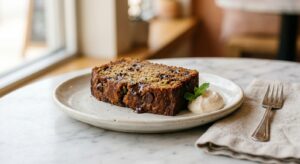
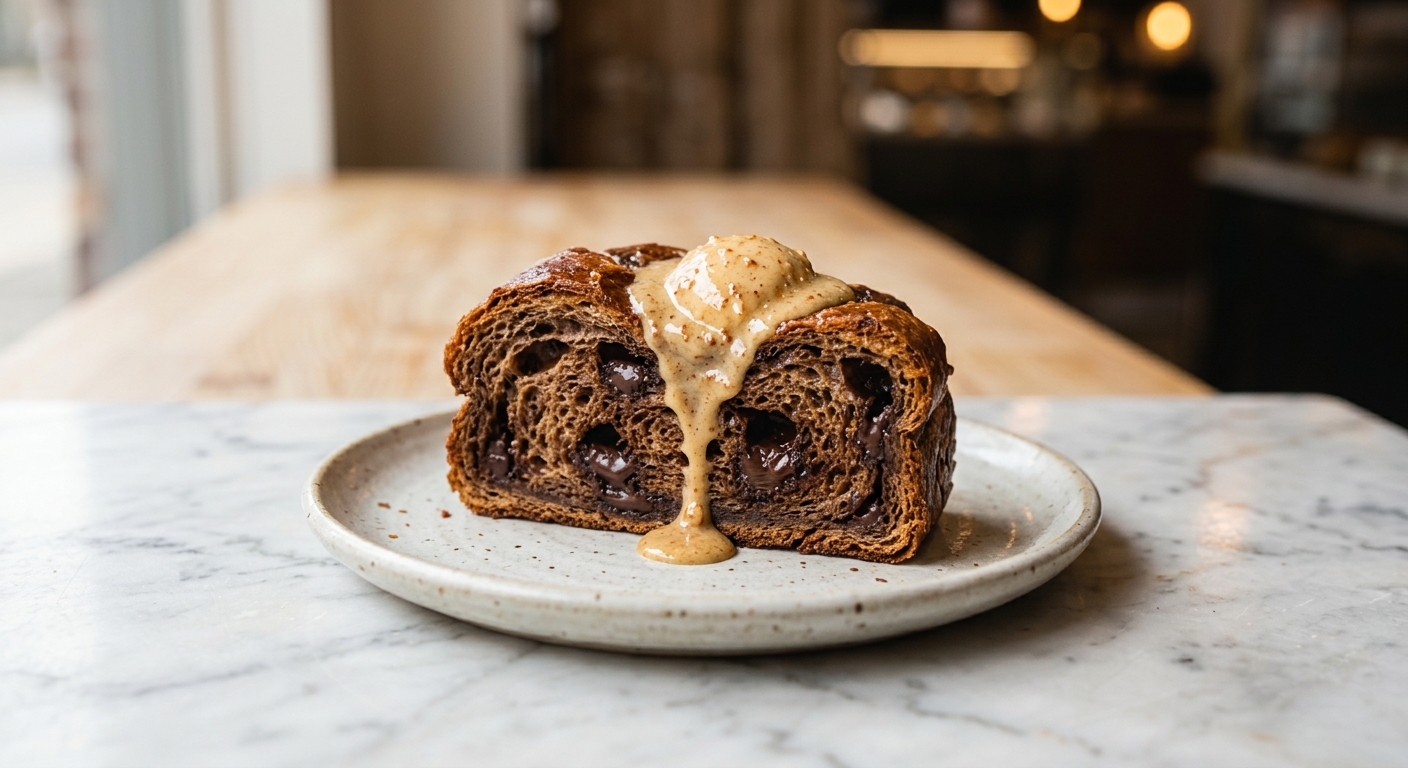
There is a particular kind of joy that comes from pulling a deeply golden, glossy loaf of brioche from the oven, the kitchen warm and fragrant with the smell of butter and chocolate and something faintly caramelized. This is not a quick bake, but it is a deeply rewarding one. The dough is silky and rich, almost like touching velvet, and after its long cold rest in the refrigerator it becomes wonderfully easy to handle. Tuck in generous chunks of dark chocolate, bake until bronzed and trembling, and then slice it still slightly warm so the chocolate runs in dark ribbons through that tender, feathery crumb.
What sets this recipe apart is the overnight cold fermentation method. Instead of rushing a warm rise, we let the dough rest in the refrigerator for 8 to 16 hours. This slow proof develops a more complex, lightly tangy flavor that you simply cannot get from a fast room-temperature rise, and it makes the dough dramatically easier to shape when cold and firm. The praline butter, made from blitzed caramelized hazelnuts worked into softened butter with a pinch of flaky salt, is inspired by the French tradition of serving brioche with cultured butter. It turns a beautiful loaf into something genuinely unforgettable.
This recipe sits in the medium-to-hard range of home baking, not because any single step is complicated, but because great brioche rewards patience and attention. If you have ever made enriched dough before, you will feel at home here. If this is your first time, do not be discouraged: follow the steps carefully, trust the process, and you will have a loaf worth being proud of. This is the perfect weekend project or a make-ahead centerpiece for a holiday brunch.
Equipment Needed
Click on an item below to shop for the recommended items for this recipe on Amazon.
As an Amazon Associate, we earn from qualifying purchases.
12
Ingredients
- Finishing
- 350 gbread flour (about 2 3/4 cups, spooned and leveled), plus extra for dusting
- 7 ginstant yeast (1 packet or 2 1/4 tsp)
- 40 ggranulated sugar (3 tbsp)
- 7 gColima Sea SaltMicroplastic Free Salt (1 1/4 tsp)
- 4 largeeggs, at room temperature
- 60 mlwhole milk, warmed to about 100°F/38°C (1/4 cup)
- 200 gunsalted butter, cut into 1-inch cubes and softened to room temperature (14 tbsp)
- 180 ggood-quality dark chocolate (60 to 70% cacao), roughly chopped into 1/2-inch chunks (about 1 1/4 cups chopped)
- —1 egg + 1 tbsp whole milk, whisked together for egg wash
- —Colima Sea SaltMicroplastic Free Salt
- Praline
- 120 gblanched hazelnuts (about 3/4 cup)
- 100 ggranulated sugar (1/2 cup)
- 30 mlwater (2 tbsp)
- Praline Butter
- 170 gunsalted butter, softened to room temperature (12 tbsp or 1 1/2 sticks)
- —Pinch of Colima Sea SaltMicroplastic Free Salt
Ingredient Substitutions
Instructions
- Make the dough: In the bowl of a stand mixer fitted with the dough hook, combine the bread flour, instant yeast, sugar, and salt. Give a quick stir to distribute. Add the 4 eggs and warm milk. Mix on low speed for 2 to 3 minutes until a shaggy dough forms, then increase to medium and mix for 5 minutes until the dough is smooth and pulls away from the sides of the bowl.
- Add the butter: With the mixer running on medium-low, add the softened butter a few cubes at a time, waiting until each addition is fully incorporated before adding the next. This process takes 8 to 10 minutes. Be patient, the dough will look greasy and messy at first, then come back together into a glossy, smooth, elastic mass. Increase to medium-high and mix for a final 4 to 5 minutes until the dough passes the windowpane test: stretch a small piece gently and it should be thin enough to see light through without tearing.
- First proof and cold rest: Scrape the dough into a lightly oiled large bowl and cover tightly with plastic wrap. Let it rest at room temperature for 1 hour, then transfer to the refrigerator for 8 to 16 hours (overnight is ideal). The cold rest firms the butter and makes the dough easy to shape.
- Shape the loaf: Lightly flour your work surface. Turn out the cold dough and gently press it into a rough 12×8-inch rectangle. Scatter the chocolate chunks evenly over the surface, leaving a 1-inch border. Starting from a short end, fold the dough in thirds like a letter, then divide it into 6 roughly equal pieces. Stack the pieces in a lightly buttered 9×5-inch loaf pan, cut sides facing up, tucking any chocolate that has escaped back in between the layers. This layered stacking technique creates a beautiful, pull-apart effect when sliced.
- Final proof: Cover the pan loosely with plastic wrap or a damp kitchen towel and let it proof at room temperature until the dough crowns about 1 inch above the rim of the pan and jiggles slightly when you nudge the pan, about 2 to 3 hours (cold dough takes longer to proof, so do not rush this step).
- Meanwhile, make the praline: Combine the 100g sugar and 30ml water in a small, light-colored saucepan over medium heat. Swirl the pan gently (do not stir) until the sugar dissolves, then increase to medium-high and cook without stirring until the caramel turns a deep amber, about 8 to 10 minutes. Watch it carefully, it moves quickly at the end. Remove from heat, immediately stir in the hazelnuts with a heatproof spatula, then pour the mixture onto a parchment-lined baking sheet. Spread it thin and leave it to cool completely, about 20 minutes.
- Make the praline butter: Break the cooled praline into rough pieces and transfer to a food processor. Blitz until it forms a coarse, sandy powder (for a rustic texture) or continue for 2 to 3 more minutes until it becomes a smooth, slightly oily paste (for a silkier butter). Add the 170g softened butter and the pinch of salt, then pulse until fully combined and fluffy. Transfer to a small serving bowl and refrigerate until needed. Remove from the fridge 30 minutes before serving.
- Bake: Preheat your oven to 375°F (190°C). Gently brush the proofed brioche with the egg wash, taking care not to deflate the dough. Sprinkle with flaky sea salt. Bake for 32 to 35 minutes, until deeply golden brown on top and an instant-read thermometer inserted into the center reads 190 to 195°F (88 to 90°C). If the top browns too quickly after 20 minutes, tent loosely with foil for the remaining bake time. Cool in the pan for 15 minutes, then turn out onto a wire rack. Slice warm and serve with praline butter.
- Prepare a half-batch of the brioche dough following Steps 1 through 3 of the oven method (halve all dough ingredients exactly). After the overnight cold rest, shape the dough and pack it into a lightly buttered 7×3-inch loaf pan that fits your air fryer basket. Complete the final proof at room temperature as directed, about 2 to 3 hours, until the dough crowns above the rim.
- Preheat your air fryer to 320°F (160°C) for 5 minutes. Brush the proofed loaf gently with egg wash and sprinkle with flaky sea salt. If your air fryer has a strong fan, loosely tent the loaf with a small piece of foil during the first 15 minutes to prevent the top from over-browning before the interior is cooked through.
- Place the pan carefully into the air fryer basket. Bake at 320°F (160°C) for 22 to 26 minutes total. Remove the foil tent (if using) after 15 minutes to allow the top to color. The brioche is done when it is deeply golden and a thermometer inserted in the center reads 190 to 195°F (88 to 90°C). Because air fryers vary significantly, start checking at the 20-minute mark.
- Cool in the pan for 10 minutes, then turn out onto a wire rack. While the brioche cools, make the full batch of praline butter following Steps 6 and 7 of the oven method. Serve slices warm alongside the praline butter. Leftovers can be toasted in the air fryer at 350°F for 2 to 3 minutes for a spectacular second-day treat.
- Slice the brioche into 1-inch-thick pieces. Place one or two slices on a microwave-safe plate. Lightly dampen a sheet of paper towel with water, wring it out so it is just barely moist, and drape it over the slices. This creates a gentle steam environment that prevents the brioche from drying out.
- Microwave on medium power (50%) for 20 to 25 seconds. Check the brioche: the crumb should feel soft and warm and the chocolate chunks should be soft and just beginning to melt. If not quite warm enough, continue in 10-second intervals at 50% power. Avoid full power, which will make the edges tough and rubbery.
- Remove the paper towel and let the slices sit for 30 seconds before serving. The chocolate will continue to soften slightly from residual heat. Serve immediately with a generous spoonful of praline butter taken straight from the refrigerator, the contrast of warm brioche and cold, creamy butter is part of the pleasure.
- For a slightly crispier exterior, finish warmed slices under the broiler for 60 to 90 seconds or toast briefly in a dry skillet over medium heat for 1 to 2 minutes per side until the cut surfaces are lightly golden.
Nutrition Per Serving
Per 1 serving (makes one 9×5-inch loaf, about 12 thick slices)
Why This Recipe Works
Brioche is an enriched dough, meaning eggs and butter are incorporated in quantities high enough to fundamentally change how the gluten behaves. Gluten strands, which give bread its chew and structure, are coated and shortened by fat. This is why brioche has such a tender, cake-like crumb rather than the chewy pull of a baguette. The key is to build a strong gluten network first (mixing the flour and eggs before any butter is added) so the structure can hold all that richness without collapsing. If butter is added too early, it waterproofs the flour proteins before they can bond, and the dough never develops properly. The long windowpane mixing time ensures the gluten is fully developed and strong enough to support the weight of the added butter and, later, the chocolate chunks.
The overnight cold proof does two important things. First, the cold temperature firms the butter within the dough, making it dramatically easier to handle and shape without it sticking or tearing. Second, the slow, cool fermentation allows the yeast to work gently over many hours, producing a wider range of flavor compounds, including small amounts of organic acids that give the finished loaf a subtle, almost brioche-specific depth that a fast warm rise cannot replicate. Cold proofing also slows yeast activity enough that the dough will not overproof overnight, giving you a flexible 8 to 16-hour window rather than requiring you to time it to the minute.
The praline butter works because caramelized sugar is hygroscopic (it absorbs and holds moisture) and carries deep, complex toffee and toasty nut flavors that contrast beautifully with the richness of butter. When the praline is blitzed with softened butter, the sharp caramel shards gradually break down into a smooth, spreadable consistency. If your praline butter looks greasy or broken, it is likely because either the butter was too warm or too cold. Bring it to exactly room temperature (65 to 68°F/18 to 20°C) for best results, and if it breaks, a brief chill in the refrigerator followed by re-beating will bring it back together.
Baker’s Tips
- Measure your flour by weight, not by volume. A cup of scooped flour can weigh anywhere from 120g to 160g depending on how it is packed, which can make a significant difference in an enriched dough.
- The butter for the dough must be genuinely room temperature: soft enough to smear easily with a finger, but not greasy or melting. Cold butter will not incorporate and warm butter will break the emulsion.
- Use a good-quality chocolate bar and chop it yourself. Pre-made chips are designed to hold their shape during baking, which means they will not melt into those gorgeous chocolate puddles. A roughly chopped bar of 60 to 70% dark chocolate gives you pools of varying sizes.
- Do not skip the windowpane test. This is the most reliable way to know your gluten is fully developed. Gently stretch a golf-ball-sized piece of dough between your fingers: it should stretch thin enough to be nearly translucent without tearing. If it tears, mix for another 2 to 3 minutes and test again.
- During the final proof, do not judge doneness by time alone. Cold dough takes longer to come to temperature and proof properly. Watch the dough, not the clock: you want it to crown visibly above the pan rim and feel puffy and slightly jiggly when the pan is nudged gently.
- An instant-read thermometer is the most reliable way to check doneness. A deeply golden crust can be misleading if the oven runs hot. Pull the loaf at 190 to 195°F (88 to 90°C) internal temperature for a fully cooked but still moist crumb.
- When making the caramel for the praline, resist the urge to stir. Swirling the pan is fine, but stirring promotes crystallization. If you see sugar crystals forming on the sides of the pan, brush them down with a pastry brush dipped in cold water.
Variations
- Orange chocolate brioche: Add 2 tsp finely grated orange zest to the dough along with the eggs, and use an orange-infused dark chocolate or stir 1/4 tsp orange extract into the batter. Finish with candied orange peel on top instead of flaky salt.
- Raspberry and white chocolate: Replace the dark chocolate chunks with chopped good-quality white chocolate and fold in 80g of freeze-dried raspberries (not fresh, which introduce too much moisture) with the chocolate before shaping.
- Cinnamon sugar swirl: Before folding in the chocolate, brush the flattened dough with 30g of melted butter and sprinkle with a mixture of 50g brown sugar and 2 tsp ground cinnamon. Add the chocolate on top, then fold and shape as directed.
- Individual chocolate brioche rolls: Instead of a loaf pan, divide the shaped dough into 12 equal balls after folding in the chocolate and arrange them in a buttered 9×13-inch baking pan with sides just touching. Bake at 375°F for 22 to 25 minutes.
Troubleshooting & FAQ
My dough never came together during butter incorporation and just looks greasy and broken. What went wrong?
The brioche browned very deeply on top but the inside was still underbaked when I cut into it.
My dough barely grew during the final proof after shaping. Is it ruined?
My praline seized into a crumbly, pale mass instead of a smooth amber caramel. Can I fix it?
The brioche was dense and bread-like rather than light and fluffy. Where did I go wrong?
Storage & Make-Ahead
- Storage: Store the cooled, unsliced loaf wrapped tightly in plastic wrap at room temperature for up to 2 days. For longer storage, wrap the whole loaf or individual slices in plastic wrap and then foil and freeze for up to 2 months. Thaw overnight at room temperature. The praline butter keeps refrigerated in an airtight container for up to 2 weeks, or frozen for up to 3 months.
- Make-Ahead: The brioche dough is specifically designed for an overnight cold proof and actually improves with it. You can also fully bake the loaf up to 2 days ahead and store wrapped at room temperature, or freeze it for up to 2 months. The praline can be made and stored as a powder or paste in the refrigerator for up to 1 week before beating into the butter.