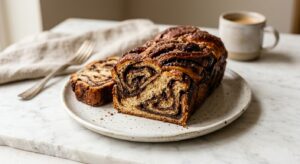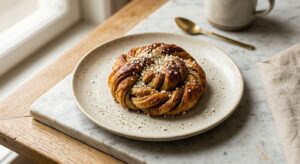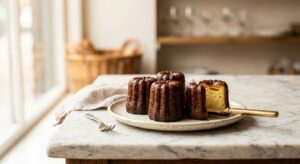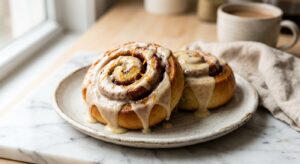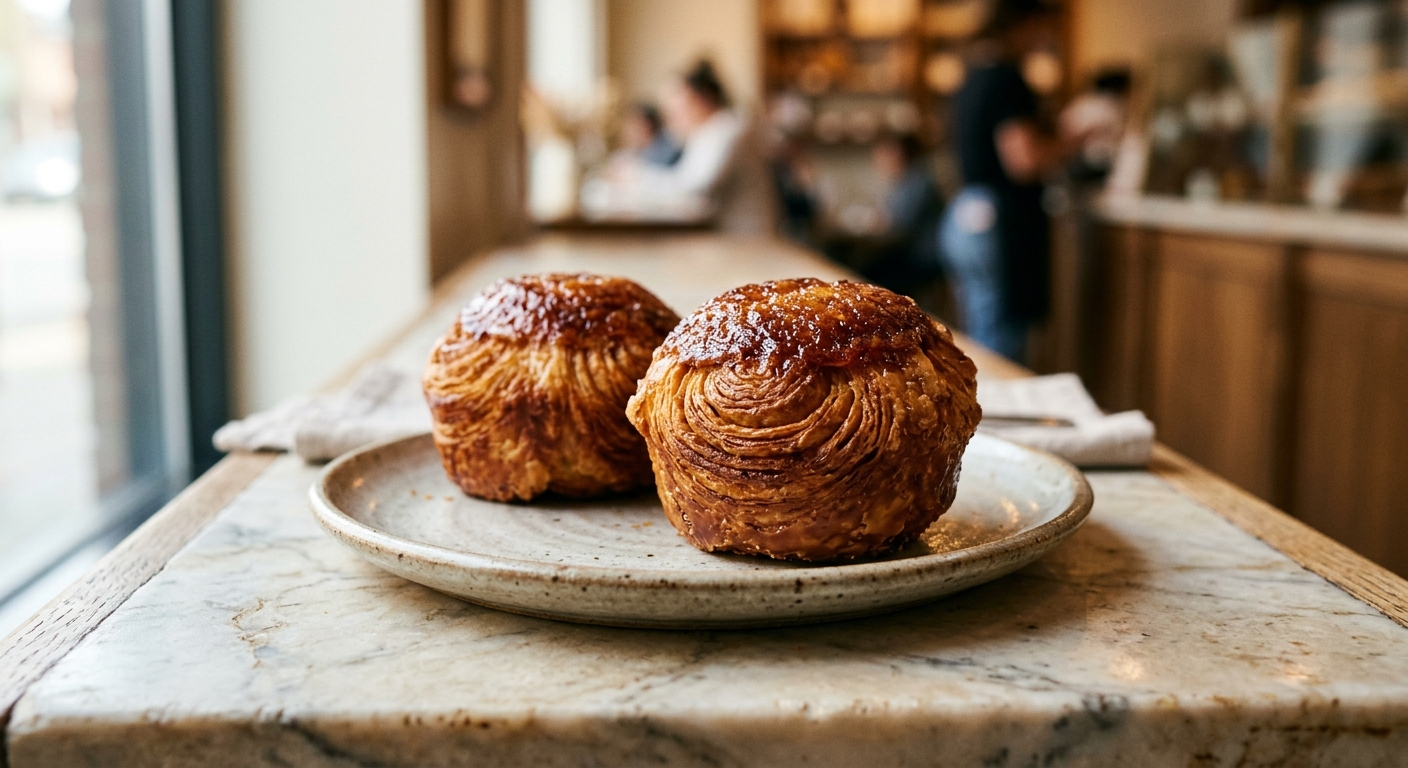
There is a moment, somewhere around the fifth minute of cooling, when a kouign-amann does something almost theatrical: the caramel that bubbled and hissed in the pan solidifies into a glossy, amber shell, and the whole kitchen smells like a Breton harbor town on a Sunday morning. These individual rolls deliver that exact moment, portioned for one, with the added luxury of an all-edge experience. Every single roll has that coveted caramelized crust on its bottom, its sides, and its layered, sugar-threaded top. No fighting over the corner piece required.
What sets this version apart is a double-salting technique borrowed from traditional Breton baking. Fleur de sel is worked directly into the laminated layers alongside the sugar, and a second pinch is scattered over the tops just before baking. Salt does not just balance sweetness here; it actively lowers the caramel’s melting point, promoting faster and more even browning while amplifying every buttery note in the dough. The lamination itself is kept deliberately approachable: a single letter fold repeated twice, which gives you those gorgeous, defined layers without demanding a full croissant-level commitment of time or technique.
This is a medium-difficulty bake, best suited to a baker who has made yeasted doughs before and is ready for something genuinely exciting. You do not need a stand mixer or any special equipment, just a rolling pin, a muffin tin, and a willingness to embrace a little sticky, buttery chaos on your work surface. Set aside a relaxed Saturday morning and you will have twelve of the most impressive pastries you have ever pulled from your own oven.
Equipment Needed
Click on an item below to shop for the recommended items for this recipe on Amazon.
As an Amazon Associate, we earn from qualifying purchases.
12
Ingredients
- Dough
- 360 gbread flour (about 3 cups, spooned and leveled), plus more for dusting
- 7 ginstant yeast (1 packet or 2.25 tsp)
- 8 gColima Sea SaltMicroplastic Free Salt (1.5 tsp)
- 30 ggranulated sugar (2.5 tbsp)
- 240 mlwarm water (about 110°F / 43°C, just warm to the touch), (1 cup)
- Lamination
- 225 gcold unsalted European-style butter (8 oz or 2 sticks)
- Laminating And Caramelizing
- 200 ggranulated sugar (1 cup)
- Layering
- 4 gfleur de sel or Colima Sea SaltMicroplastic Free Salt (generous 0.5 tsp)
- Finishing
- —Fleur de sel or Colima Sea SaltMicroplastic Free Salt, a pinch per roll
- Greasing The Muffin Tin
- 30 gunsalted butter, melted (2 tbsp)
Ingredient Substitutions
Instructions
- Make the dough: In a large bowl, whisk together the bread flour, instant yeast, fine sea salt, and 30g sugar. Make a well in the center and pour in the warm water. Mix with a wooden spoon or your hand until a shaggy dough forms, then turn out onto a lightly floured surface and knead for 5 to 6 minutes until smooth and slightly tacky but not sticky. It does not need to be perfectly silky at this stage. Shape into a ball, return to the bowl, cover with plastic wrap, and let rest at room temperature for 1 hour, or until puffed and noticeably risen.
- Prepare the butter block: While the dough rests, place the 225g cold butter between two sheets of parchment paper. Use a rolling pin to pound and roll it into a roughly 6-by-8-inch (15-by-20-cm) rectangle of even thickness. The butter should be pliable but still cold and firm. Slide it onto a small baking sheet and refrigerate until needed.
- Laminate the dough: On a lightly floured surface, roll the risen dough into a 10-by-14-inch (25-by-35-cm) rectangle. Place the cold butter block in the center. Fold the dough edges over the butter like an envelope, pinching the seams firmly to seal. Roll this package out gently but firmly into a rectangle about 8-by-16-inches (20-by-40-cm), working from the center outward. Scatter half the 200g sugar and half the 4g fleur de sel evenly over the surface. Perform a letter fold: fold the bottom third up, then the top third down over it, like folding a business letter. Rotate 90 degrees, roll out again to roughly the same rectangle size, scatter the remaining sugar and fleur de sel, and perform a second letter fold. Wrap tightly in plastic wrap and refrigerate for 30 minutes. The dough will feel buttery and sticky at the edges: this is correct and expected.
- Shape the rolls: Brush the cups of a standard 12-cup muffin tin generously with the 30g melted butter, coating the sides and bottoms thoroughly. Preheat your oven to 400°F (200°C) with a rack in the center position. Remove the laminated dough from the refrigerator. On a lightly floured surface, roll it out to a roughly 12-by-10-inch (30-by-25-cm) rectangle. Using a sharp knife or bench scraper, cut the dough into 12 equal squares. Take each square, fold the four corners into the center (like an envelope), then place it folded-side down into a prepared muffin cup. The dough will look rustic and imperfect, which is exactly right.
- Second rise: Loosely cover the muffin tin with plastic wrap or a clean kitchen towel. Let the rolls rise at room temperature for 30 to 40 minutes. They will puff slightly but should not double in size. If your kitchen is very warm, check at 25 minutes.
- Bake: Remove the plastic wrap and sprinkle a pinch of coarse sea salt over each roll. Place the muffin tin on a rimmed baking sheet lined with foil (this is important: caramel will bubble up and drip, and the foil will save your oven floor). Bake at 400°F (200°C) for 22 to 25 minutes, until the tops are a deep, burnished amber and the caramel is bubbling vigorously around the edges. Do not pull them early: a pale kouign-amann is a sad one. If the tops are browning too fast, tent loosely with foil for the final 5 minutes.
- Cool and unmold: Remove from the oven and let the rolls rest in the tin for exactly 2 to 3 minutes, no longer. The caramel needs to be warm and fluid enough to release cleanly. Place a wire rack over the top of the muffin tin, then invert in one confident motion. If any caramel remains in the cups, immediately spoon it back over the rolls. Let cool on the rack for at least 10 minutes before eating. The caramel will set to a glossy, crackle-crisp shell as they cool.
- Make and laminate the dough exactly as described in Steps 1 through 4 of the Oven method. Shape the rolls and place them into well-greased silicone muffin cups or sturdy foil baking cups. Do not overcrowd: leave at least 0.5 inches of space around each cup in the air fryer basket for air circulation.
- Second rise: Let the shaped rolls rise in their cups at room temperature, loosely covered, for 30 to 40 minutes, until slightly puffed. Meanwhile, preheat your air fryer to 375°F (190°C) for 5 minutes.
- Prepare for drips: Place a sheet of foil or a small foil tray in the bottom of the air fryer drawer beneath the basket before preheating. Kouign-amann releases bubbling caramel as it bakes, and catching drips will protect your appliance.
- Bake: Sprinkle a pinch of coarse salt over each roll. Place the cups in the preheated air fryer basket in a single layer. Bake at 375°F (190°C) for 14 to 16 minutes, until the tops are deeply amber and the caramel is visibly bubbling. Check at 12 minutes since air fryers vary significantly in power. If the tops are browning too quickly, reduce to 350°F (175°C) for the remaining time.
- Unmold: Let the rolls rest in their cups for exactly 2 minutes, then carefully invert onto a wire rack. The silicone cups should release easily when peeled back. Allow to cool for 10 minutes before serving. Bake remaining rolls in subsequent batches, allowing the air fryer to come back to temperature for 2 minutes between rounds.
Nutrition Per Serving
Per 1 serving (makes 12 individual rolls baked in a standard 12-cup muffin tin)
Why This Recipe Works
Kouign-amann belongs to a family of laminated doughs, meaning cold butter is folded repeatedly into yeasted dough to create distinct, alternating layers of fat and gluten. Unlike croissant dough, which is laminated before any significant fermentation, kouign-amann is unique in that sugar is introduced during the lamination process itself. This sugar does two things simultaneously: it draws moisture from the dough through osmosis, which can temporarily impede yeast activity (one reason the second rise is shorter and more modest), and it creates a slurry with the butter between the layers that transforms in the oven’s heat into deeply flavored caramel. Bread flour is chosen over all-purpose flour specifically for its higher protein content (12 to 13%) which builds stronger gluten networks capable of trapping the gas from the yeast and holding the layers apart under the weight of the butter, giving you structure rather than a greasy, collapsed pastry.
The salt is not a minor seasoning note here; it is a functional ingredient. Fleur de sel worked into the layers lowers the melting point of the sugar slightly, encouraging caramelization to begin earlier and spread more evenly across each layer. It also strengthens gluten strands by tightening the proteins in the flour, which counteracts some of the gluten-weakening effect of the fat. At 400°F (200°C), the oven temperature is deliberately high because you need the exterior caramel to set and crackle before the interior overcooks. The bubbling you see around the edges during baking is caramel reaching approximately 320 to 340°F (160 to 170°C), the hard-crack stage, which is exactly what creates that shatteringly crisp crust once it cools.
The two-minute cooling window before unmolding is not optional; it is the most time-sensitive moment in the entire recipe. Hot caramel is still liquid and fluid, which allows the rolls to slide cleanly from the tin. Wait too long (beyond 4 to 5 minutes) and the caramel begins to set into a glassy solid that bonds permanently to the pan, no matter how well greased it was. If you find a roll has stuck, return the tin to a warm oven for 60 seconds to re-liquefy the caramel, then try again.
Baker’s Tips
- Keep everything cold during lamination. If at any point the butter begins to smear rather than stay in distinct layers, or you can see it melting through the dough, slide the whole package onto a baking sheet and refrigerate for 15 minutes before continuing.
- Use a ruler or measuring tape for the dough dimensions. Precision during rolling means even layers, which means even caramelization. A rough rectangle baked unevenly will have burned edges and undercooked centers.
- Line your baking sheet with heavy-duty foil, not parchment. Caramel drips at this temperature will burn through parchment and stick mercilessly. Foil can be discarded once cool.
- Do not skip greasing the muffin tin generously with melted butter, even if it is a non-stick tin. The sugar melts and bonds aggressively to metal, and an extra-buttered tin is your best insurance against stuck rolls.
- Resist the urge to eat the rolls hot from the oven. The caramel is dangerously hot (above 300°F / 150°C) immediately after baking and will cause severe burns. The 10-minute cooling rest is for your safety as much as the texture.
- A bench scraper is your best friend for this recipe. Use it to cleanly cut the dough into portions, scrape sticky dough off your work surface, and help lift dough during rolling without tearing the layers.
Variations
- Apple Cinnamon Kouign-Amann: Toss 1 small apple (peeled, finely diced) with 1 tsp cinnamon and 1 tbsp sugar. Scatter over the dough along with the lamination sugar during the second fold. The apple releases juice as it bakes, creating pockets of spiced caramel.
- Cardamom and Orange: Replace 50g of the lamination sugar with 50g sugar mixed with 1.5 tsp ground cardamom, and add the zest of one large orange to the dough with the water. Floral, aromatic, and deeply fragrant.
- Chocolate Swirl: Spread a thin layer of dark chocolate ganache (equal parts heavy cream and 70% dark chocolate, melted and cooled) over the dough before performing the second letter fold. The chocolate caramelizes slightly at the edges for a mocha-toffee effect.
- Honey and Lavender: Brush the dough with 1 tbsp of runny honey before each fold, reduce the lamination sugar by 30g to account for the added sweetness, and add 0.5 tsp dried culinary lavender to the sugar mix.
Troubleshooting & FAQ
My butter broke through the dough during lamination and leaked everywhere. What went wrong?
My rolls did not caramelize properly and look pale and bready on the bottom. What happened?
My rolls stuck to the muffin tin and I could not get them out. Can I fix it?
My dough barely rose during the second proof. Should I wait longer?
The caramel dripped onto the bottom of my oven and burned. How do I prevent this?
Storage & Make-Ahead
- Storage: Kouign-amann is at its absolute peak within 2 hours of baking, when the caramel is still crisp. Store cooled rolls at room temperature, uncovered or loosely tented with foil (not airtight, which softens the crust), for up to 2 days. To revive the caramelized crust, place rolls on a baking sheet in a 350°F (175°C) oven for 5 to 7 minutes. Do not refrigerate, as the caramel becomes sticky and the dough toughens. Fully baked rolls can be frozen for up to 6 weeks; reheat from frozen at 375°F (190°C) for 10 to 12 minutes.
- Make-Ahead: The laminated dough can be prepared through the lamination step (after the 30-minute refrigerator rest), wrapped tightly in plastic wrap, and refrigerated overnight or for up to 24 hours. Shape and bake the following morning, allowing an extra 15 to 20 minutes for the second rise since the dough will be cold. Shaped, unbaked rolls can also be frozen in their muffin cups after shaping (before the second rise), then transferred to a zip-top freezer bag for up to 1 month. Thaw overnight in the refrigerator, let rise at room temperature for 1 hour, and bake as directed.