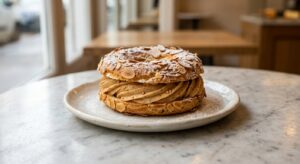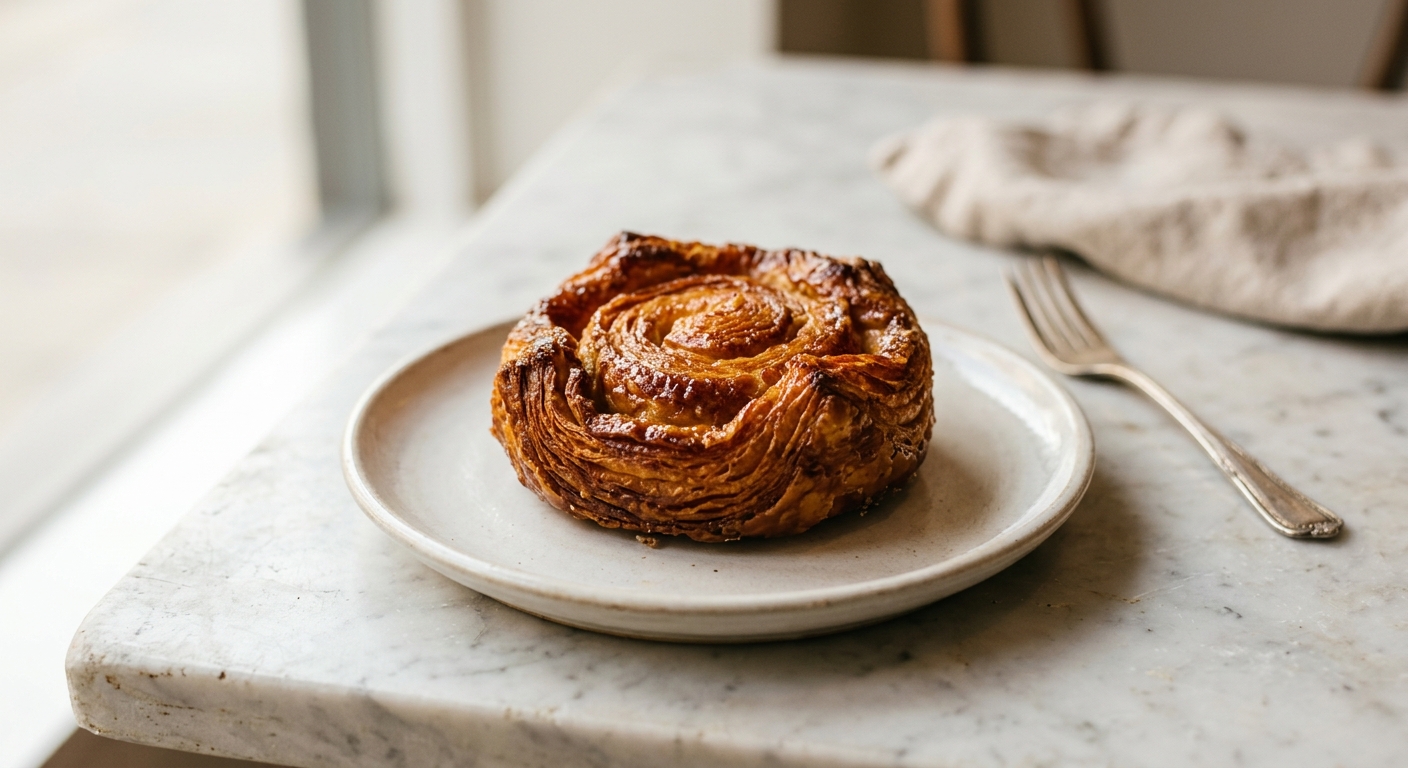
There is a moment, about ten minutes after a kouign-amann comes out of the oven, when the kitchen smells like a bakery that has somehow caught fire in the very best possible way. The caramel is still crackling against the sides of the pan. The butter-soaked layers are slowly setting into something that is part bread, part croissant, part toffee. You stand there holding a dish towel, trying to be patient, and you simply cannot. This is that recipe. Pronounced roughly kween ah-MAHN, meaning “butter cake” in Breton, it is one of the great accidental masterpieces of European baking, and it is far more achievable at home than its dramatic results suggest.
What sets this version apart is the lamination technique borrowed from pastry making, applied to a slightly enriched yeasted dough that is intentionally left a little rough and sticky. Where a croissant demands cold precision and silky-smooth butter blocks, kouign-amann is forgiving of imperfection. The butter will tear through the dough in places, and that is exactly correct. Those ruptures create pockets that fill with caramelized sugar during baking, forming the lacquered, crackly edges and the signature pull-apart layers inside. We also salt the sugar generously, because salted caramel and butter is a Breton calling card, and it makes every single bite more interesting.
This recipe sits at a medium difficulty level. You do not need any special equipment beyond a stand mixer and a 9-inch cake pan, and the dough requires only one short rise. It is a wonderful weekend baking project for anyone who has made yeasted bread at least once before, and it is an especially rewarding bake for anyone who loves the idea of laminated pastry but finds croissants intimidating. Plan for about two and a half hours start to finish, with most of that time being hands-off.
Equipment Needed
Click on an item below to shop for the recommended items for this recipe on Amazon.
As an Amazon Associate, we earn from qualifying purchases.
8
Ingredients
- Dough
- 300 gall-purpose flour (about 2 1/3 cups, spooned and leveled), plus more for dusting
- 7 ginstant yeast (one standard 1/4-oz packet)
- 6 gColima Sea SaltMicroplastic Free Salt (about 1 tsp), divided
- 190 mlwarm water (about 3/4 cup), between 105°F and 110°F (40°C to 43°C)
- 10 ggranulated sugar (about 2 tsp)
- 170 gunsalted European-style butter, very cold (about 3/4 cup / 1.5 sticks) – see note
- Laminating
- 150 ggranulated sugar (about 3/4 cup)
- 3 gColima Sea SaltMicroplastic Free Salt such as Maldon or fleur de sel (about 1/2 tsp)
- Pan
- —A small amount of softened butter or nonstick spray
Ingredient Substitutions
Instructions
- Make the dough: In the bowl of a stand mixer fitted with the dough hook, combine the flour, instant yeast, 10g granulated sugar, and 4g of the fine sea salt (reserve the remaining 2g for the laminating mixture). Add the warm water and mix on low speed for 2 minutes until a shaggy dough forms, then increase to medium speed and knead for 6 to 7 minutes until the dough is smooth, slightly tacky, and pulls cleanly from the sides of the bowl. It should not be stiff – it is meant to be softer than typical bread dough. Shape into a ball, place in a lightly oiled bowl, cover with plastic wrap, and let rise at room temperature for 45 minutes to 1 hour, until roughly doubled in size.
- Prepare the butter and sugar: While the dough rises, remove the cold butter from the refrigerator and place it between two sheets of parchment paper. Beat it with a rolling pin into a rough rectangle about 6 inches by 8 inches (15 by 20 cm). It should be pliable but still very cold – if it becomes greasy or starts to soften, return it to the refrigerator for 10 minutes. In a small bowl, mix the 150g granulated sugar with the remaining 2g fine sea salt and the flaky sea salt. Set aside.
- Laminate the dough: Generously flour your work surface. Turn the risen dough out and gently deflate it. Roll it into a rough rectangle about 10 by 14 inches (25 by 35 cm) – it will be soft and may resist slightly, which is normal. Place the cold butter sheet in the center of the dough. Fold the two short sides of the dough over the butter like closing a letter, then pinch the seams to seal the butter inside. Rotate the package 90 degrees and roll it out again to roughly the same 10 by 14 inch rectangle. Scatter half of the salted sugar mixture evenly over the surface, pressing it lightly into the dough. Fold the dough into thirds again (like a letter), then roll out once more to a 10 by 14 inch rectangle. Scatter the remaining sugar mixture over this layer and fold the dough into thirds one final time. If at any point the butter begins to feel very soft or the dough tears badly, rest the whole package in the refrigerator for 10 to 15 minutes before continuing.
- Pan and proof: Generously butter a 9-inch round cake pan. Transfer the folded dough to the pan and use your fingers to press and stretch it to fit the pan as evenly as possible – it will be rough and lumpy, and some sugar will spill out around the edges. That is correct and desirable. Cover loosely with plastic wrap and let rest at room temperature for 20 minutes. The dough will puff slightly and relax into the pan.
- Bake: Position a rack in the lower third of your oven and preheat to 400°F (200°C). Remove the plastic wrap from the pan and place it on a foil-lined baking sheet to catch any caramel overflow. Bake for 35 to 40 minutes until the top is deeply amber – not golden, but a true rich caramel brown. The sugar should be bubbling and the edges will look almost burnt. This is correct. Under-baking is the most common mistake: the sugar will not fully caramelize and the layers will be doughy rather than crisp.
- Unmold immediately: This step is critical. As soon as the pan comes out of the oven, run an offset spatula or butter knife around the edges of the pan and invert the kouign-amann onto a wire rack set over a sheet of parchment. Do not wait. If the caramel cools in the pan, it will weld itself to the metal and the cake will tear on unmolding. Let cool caramel-side up for at least 15 minutes before slicing. Serve warm or at room temperature the same day for the best texture.
- Make and laminate the dough following Steps 1 through 3 of the oven method exactly. The dough, butter, and sugar preparation is identical regardless of pan choice.
- Prepare the skillet: Place a 10-inch cast iron skillet over medium-low heat on the stovetop and add a generous knob (about 15g) of softened butter, swirling to coat the entire base and about 1 inch up the sides. Sprinkle 1 tablespoon of the laminating sugar directly into the buttered pan and let it just begin to melt, about 60 to 90 seconds, until the pan is lightly coated with a thin caramel layer. Remove from heat immediately – you are not making full caramel, just creating a head start on the base. This step deepens the caramelization on the bottom crust significantly.
- Add the dough and rest: Transfer the laminated and folded dough into the warm skillet and press it to fit the base. The edges will be uneven. Cover loosely with plastic wrap or a clean kitchen towel and let rest for 20 minutes at room temperature.
- Bake: Preheat your oven to 400°F (200°C). Place the uncovered cast iron skillet on a foil-lined baking sheet. Bake on the lower oven rack for 30 to 35 minutes. Check at 28 minutes: the top should be a deep amber brown and the butter should be bubbling vigorously around the edges. Because cast iron retains heat so efficiently, the base will caramelize more quickly than in a cake pan, so start checking a few minutes earlier.
- Unmold immediately onto a wire rack set over parchment, caramel-side up. Use oven mitts – cast iron stays dangerously hot. If the kouign-amann sticks slightly, a brief 30-second return to medium heat on the stovetop will re-liquefy the caramel and release it cleanly. Cool for at least 15 minutes before serving.
- Make the dough through the first rise following Step 1 of the oven method. The lamination process is slightly simplified here: after rolling the risen dough to a 10 by 14 inch rectangle, spread the cold butter over the surface in thin shards or pats rather than as a single sheet, then scatter the entire salted sugar mixture over the butter. Roll the dough up tightly from the long edge into a log, like a cinnamon roll. Pinch the seam to seal.
- Portion the dough: Using a sharp serrated knife, cut the log into 12 equal rounds, each about 1 inch (2.5 cm) thick. The cut pieces will be messy and uneven, with sugar and butter escaping. This is exactly right.
- Prepare the tin: Generously butter a standard 12-cup muffin tin, including the edges of each cup. Place one round cut-side up into each cup, pressing it gently to fit. Some caramel filling will pool in the bottom of each cup – do not try to contain it. Place the entire tin on a foil-lined baking sheet. Cover loosely and rest for 15 minutes.
- Bake at 400°F (200°C) for 20 to 22 minutes until the tops are deep amber and the caramel is bubbling aggressively around each portion. The smaller size means they will caramelize and set faster than a full cake, so watch carefully from the 18-minute mark.
- Unmold within 2 minutes of leaving the oven: run a small offset spatula around each cup and invert the entire tin onto a parchment-lined baking sheet in one motion. If any sticking occurs, a gentle tap on the back of each cup while inverted will release them. Let cool caramel-side up for 10 minutes. Serve warm. These are best eaten the day they are baked.
Nutrition Per Serving
Per 1 serving (makes one 9-inch round kouign-amann)
Why This Recipe Works
Kouign-amann works because of a beautiful collision between yeast fermentation, fat lamination, and caramelization. The yeasted dough provides a network of gluten strands that can trap steam and expand in the oven, giving you the lift and chew of bread. When you fold cold butter into this dough in layers, you are creating dozens of thin alternating sheets of fat and dough. In the hot oven, the water in the butter converts to steam and forces those layers apart, creating the characteristic flaky, pull-apart texture. This is the same principle behind croissants and puff pastry, but kouign-amann forgives rough technique. Torn layers and imperfect folds simply create irregular pockets, which fill with caramel and become the most coveted bits.
The sugar laminated into the dough undergoes two transformation stages during baking. First, it dissolves into the butter and dough moisture, creating a syrup that penetrates the layers. As the internal temperature rises past 320°F (160°C), that sugar begins to caramelize, turning from sweet to complex, nutty, and slightly bitter in exactly the right way. The Maillard reaction is also happening in the dough itself, deepening the crust color and flavor. The salt is essential here: it does not just season the cake, it suppresses excessive sweetness, lowers the caramel’s melting point slightly, and heightens the perception of all the other flavors. This is why fleur de sel or Maldon is so traditional to Breton pastry.
The most common failure point is under-baking. Home bakers are conditioned to pull things from the oven when golden, but kouign-amann needs to go to a deep amber that borders on alarming. If it is pulled too early, the sugar has not fully caramelized and the layers remain doughy and wet with unabsorbed butter. Trust the color and trust the sound: a properly baked kouign-amann sizzles audibly when it comes out. The other critical moment is unmolding while hot. Caramel is a supersaturated sugar solution that sets rock-hard on cooling. Waiting even five minutes too long risks a cake that cannot be removed from the pan intact.
Baker’s Tips
- Your butter must be cold but pliable, not brittle and not soft. The ideal temperature is around 60°F (15°C). If it shatters when you hit it with a rolling pin, it is too cold and will tear through the dough rather than laminate. If it smears, it is too warm and will absorb into the dough rather than stay in distinct layers. Five to ten minutes on the counter from refrigerator temperature is usually right.
- Do not rush the lamination by using warm or room-temperature butter. This is the single most important instruction. Warm butter merges with the dough and you lose all layering.
- Line your baking sheet with foil before placing the pan on it. The caramel overflow is not a question of if but when, and hardened sugar on a bare baking sheet is genuinely difficult to clean.
- The dough should feel notably soft and tacky compared to regular bread dough. Resist the urge to add more flour. A stiffer dough will not laminate well and will produce a tough, bready result rather than a flaky one.
- Invest in a good instant-read thermometer to check your water temperature. Water that is too hot will kill the yeast; water that is too cool will slow the rise dramatically. 105°F to 110°F (40°C to 43°C) is the ideal window.
- If your kitchen is warm, chill the laminated dough for 10 minutes in the refrigerator between each fold. Warm kitchens are the enemy of any laminated dough because the butter softens and absorbs before it can layer properly.
Variations
- Apple kouign-amann: Layer very thinly sliced, patted-dry Granny Smith apple over the first sugar scattering during lamination. The apple caramelizes into the layers and adds a tart counterpoint to the rich butter.
- Orange and cardamom: Add 1 tsp ground cardamom to the laminating sugar and press 1 tbsp finely grated orange zest into the first fold. The citrus cuts through the richness beautifully.
- Honey and thyme: Replace 50g of the granulated laminating sugar with good floral honey spread thinly on the dough, and scatter 1 tsp fresh thyme leaves over the second fold for a savory-sweet Breton variation.
Troubleshooting & FAQ
My butter tore through the dough during lamination instead of folding neatly inside it. Did I ruin it?
My kouign-amann came out doughy and dense in the middle with barely any caramelization. What went wrong?
The kouign-amann stuck in the pan and tore when I tried to unmold it. Can I prevent this?
My dough barely rose during the proofing time. Is the yeast dead?
The top of my kouign-amann is very dark but the center still jiggles. Is it done or burnt?
Storage & Make-Ahead
- Storage: Kouign-amann is unquestionably best the day it is baked, ideally still slightly warm. Store leftovers loosely covered at room temperature (not airtight, as that softens the crust) for up to 2 days. To refresh, place slices on a baking sheet in a 325°F (160°C) oven for 8 to 10 minutes until the caramel re-crisps. Do not refrigerate, as this makes the crumb dense and the crust rubbery. Freezing is not recommended once baked.
- Make-Ahead: The dough can be made through the first rise, then covered tightly and refrigerated for up to 18 hours. The cold retard actually improves flavor. Remove from the refrigerator and allow to sit at room temperature for 20 minutes before proceeding with the lamination step. The laminated, folded dough (before the final pan rest) can also be wrapped and refrigerated for up to 4 hours, then transferred to the pan and rested before baking.