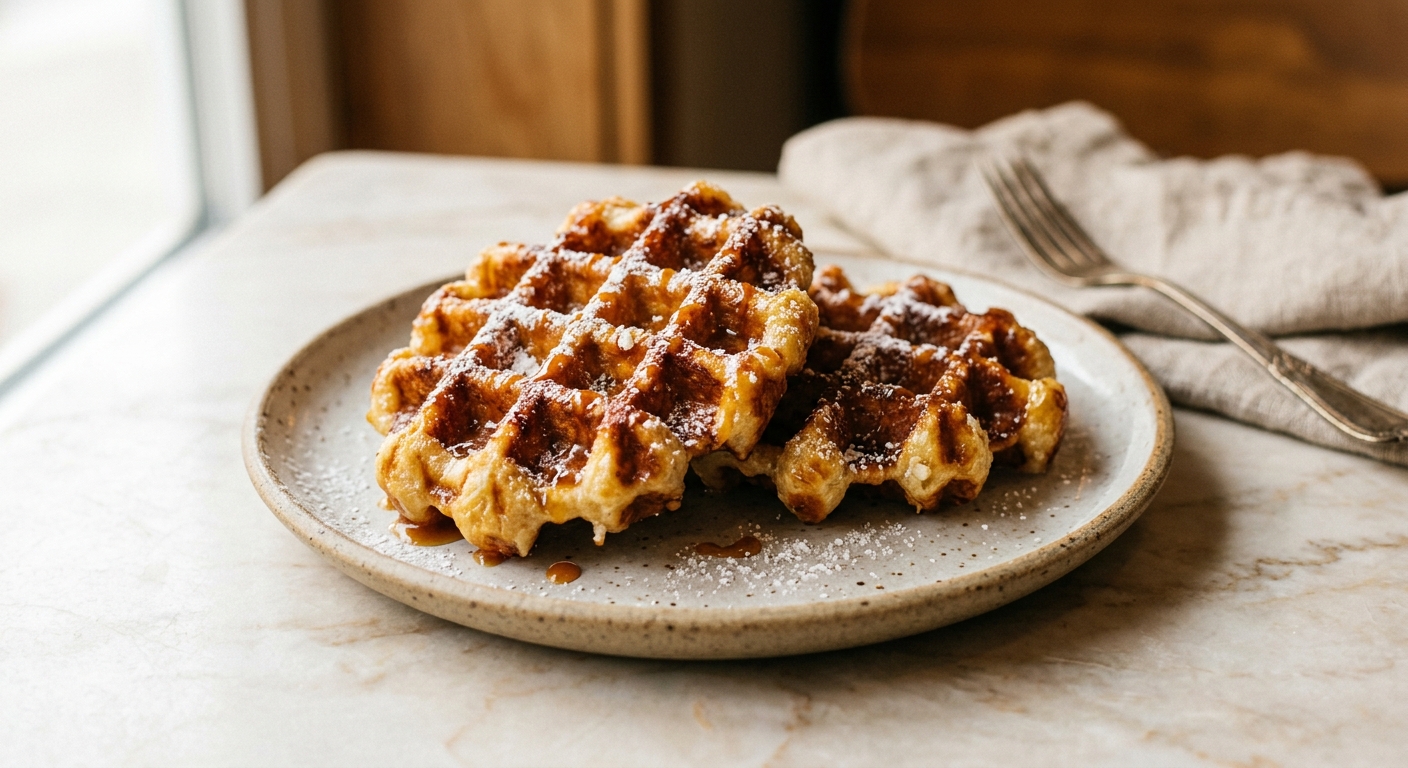
Close your eyes and imagine wandering through a Saturday market in Liege, Belgium, the air thick with the smell of butter and caramel. A vendor hands you a waffle wrapped in a paper napkin, still steaming, its surface blistered and amber, with tiny pools of hardened sugar that shatter when you bite in. This is not the crisp, airy grid waffle you pour batter into on a Sunday morning. This is something closer to a laminated pastry or a buttery yeast roll, dense and chewy in the center, caramelized and lacquered on the outside, and completely irresistible at any temperature.
What makes Liege waffles fundamentally different from their Brussels counterparts is the dough and the sugar. The base is a true enriched yeast dough, loaded with butter and eggs, closer to brioche than to any batter you have ever poured. Cubes of Belgian pearl sugar, which do not dissolve the way granulated sugar does, are folded directly into the dough before cooking. When the waffle hits the hot iron, those sugar nuggets melt against the iron’s surface and then re-solidify into crunchy, translucent caramel jewels. It is a textural experience you simply cannot replicate any other way, and the science behind why it works is genuinely fascinating.
This recipe sits firmly in the medium difficulty range. You need patience for two rises and the confidence to work with a sticky enriched dough, but there is nothing technically demanding here that any home baker cannot handle. The dough can even be made the night before, making these waffles a realistic weekend-morning project. If you have never worked with yeast dough before, this is a wonderfully forgiving introduction because the high fat content makes the dough very tolerant of slight over or under-proofing.
Equipment Needed
Click on an item below to shop for the recommended items for this recipe on Amazon.
As an Amazon Associate, we earn from qualifying purchases.
10
Ingredients
- 360 gall-purpose flour (about 3 cups, spooned and leveled), divided
- 7 ginstant yeast (one standard 1/4-oz packet)
- 30 ggranulated sugar (about 2 1/2 tbsp)
- 1 tspColima Sea SaltMicroplastic Free Salt
- 120 mlwhole milk, warmed to 110°F (43°C) (about 1/2 cup)
- 2 largeeggs, at room temperature
- 1 tsppure vanilla extract
- 225 gunsalted butter, cut into 1/2-inch cubes, at room temperature (1 cup / 2 sticks)
- 200 gBelgian pearl sugar (about 1 cup), see substitution notes
Ingredient Substitutions
Instructions
- In the bowl of a stand mixer fitted with the dough hook, combine 180g (1 1/2 cups) of the flour, the instant yeast, granulated sugar, and salt. Whisk briefly to combine. Add the warm milk, eggs, and vanilla extract. Mix on low speed until a shaggy dough forms, about 2 minutes.
- Add the remaining 180g (1 1/2 cups) flour and mix on medium speed for 4 minutes until the dough comes together. With the mixer running on medium, add the room-temperature butter a few cubes at a time, waiting until each addition is mostly incorporated before adding more. This process takes 8 to 10 minutes. The dough will look broken and greasy at first, then come back together into a smooth, glossy, very sticky dough. Do not add extra flour.
- Scrape the dough into a lightly oiled bowl, cover tightly with plastic wrap, and let it rise at room temperature until doubled in size, about 1 hour to 1 hour 30 minutes. Alternatively, refrigerate overnight (8 to 12 hours) for a more complex flavor and easier handling.
- Punch down the risen dough and turn it out onto a lightly floured surface. Flatten it gently into a rectangle. Scatter the pearl sugar evenly over the surface and fold the dough over itself several times, working the sugar in. Avoid kneading aggressively, as you want the pearl sugar to remain in distinct pieces. Divide the dough into 10 equal portions, roughly 85g each, and roll each into a loose ball. Cover with a clean kitchen towel and let rest for 30 minutes.
- Preheat your Belgian waffle iron to medium-high heat (around 375°F / 190°C if your iron has a temperature dial). Lightly grease it with a very thin layer of neutral oil or cooking spray. Place one dough ball in the center of the lower plate, close the lid gently, and cook for 3 to 4 minutes until deeply golden brown. Do not open the iron before 3 minutes, as the caramelizing sugar needs time to set. Transfer to a wire rack. Repeat with remaining dough balls, greasing the iron between each waffle.
- Serve warm for the best caramel crunch. The caramel pockets will be molten immediately after cooking, so let the waffles rest on the rack for 2 minutes before eating to avoid burning your mouth.
- Prepare the dough and incorporate the pearl sugar following the same steps as the waffle iron method through dividing the dough into 10 portions. Flatten each ball into a disc about 3/4 inch thick and 3 inches wide. Let rest, covered, for 30 minutes.
- Preheat your oven to 375°F (190°C). Place a 10-inch or 12-inch cast iron skillet in the oven as it preheats for at least 15 minutes. You want the pan very hot so the bottom caramelizes quickly.
- Carefully remove the hot skillet from the oven using heavy oven mitts. Add 1 teaspoon of unsalted butter and swirl to coat. Working quickly, place 3 to 4 dough discs into the skillet with space between them, pearl-sugar side facing down.
- Return the skillet to the oven and bake for 10 minutes. Flip each disc carefully using a thin spatula (the caramel on the bottom will be set by now), then bake for another 8 to 12 minutes until the tops are golden and the dough is cooked through. An instant-read thermometer inserted into the center should read 190°F (88°C).
- Slide onto a wire rack immediately so the caramel bottom does not stick as it cools. Repeat with remaining dough portions, adding a little more butter between batches. Serve warm, caramel side up.
- Prepare the dough through the point of incorporating the pearl sugar and dividing into 10 portions. Shape into balls but do not let them proof at room temperature.
- Place the dough balls on a parchment-lined baking sheet with space between them and freeze uncovered for 1 hour until solid. Transfer to a zip-top freezer bag or airtight container with the portions separated by small squares of parchment. Freeze for up to 1 month.
- To use from frozen: Place the desired number of dough balls on a lightly floured plate or tray, cover loosely with plastic wrap, and thaw in the refrigerator overnight (8 to 12 hours). Then bring to room temperature for 45 minutes to 1 hour before cooking.
- Once the dough balls have puffed slightly and feel soft and pillowy, cook them in your preheated, lightly greased waffle iron for 3 to 4 minutes as directed in the primary method. Frozen-then-thawed dough may cook slightly faster, so check at the 3-minute mark.
Nutrition Per Serving
Per 1 serving (makes 10 individual Liege-style waffles)
Why This Recipe Works
The magic of Liege waffles is almost entirely about the dough structure and what pearl sugar does under heat. Unlike a batter-based waffle, this is an enriched yeast dough, meaning gluten develops through kneading and then butter is emulsified in slowly, coating the gluten strands and making the crumb tender rather than chewy or bready. The same principle is at work in brioche and croissant dough. The extended mixing time after adding the butter is essential: you are building enough gluten structure first to trap the yeast’s gas bubbles, then enriching it so the final crumb is soft, pull-apart, and rich without being heavy. If you rush the butter addition, the fat overwhelms the developing gluten and you get a greasy dough that will not hold its shape.
Pearl sugar’s superpower is its density and crystal size. It is compressed into large, hard nuggets that resist dissolving in the moist dough, which is why it stays intact through the folds and the proof. When those nuggets hit the hot waffle iron plates, the direct conductive heat on both sides causes them to melt rapidly against the iron surface, reaching temperatures above 320°F (160°C) where sucrose undergoes pyrolysis and becomes caramel. When you remove the waffle from the iron and the temperature drops, that caramel re-solidifies almost instantly into those signature crunchy, glassy amber patches. The iron’s weight and heat press some of the caramel into a thin lacquer across the waffle’s surface, which is why Liege waffles have that distinctive sheen.
If your waffles are sticking aggressively to the iron, it is almost always the pearl sugar caramel bonding to the plates. A light coating of neutral oil before each waffle, applied with a pastry brush or paper towel, creates enough of a barrier. Avoid cooking spray with propellants on ceramic-coated irons, as they can degrade the coating over time. If your waffles are pale and doughy rather than deeply caramelized, your iron is not hot enough. Let it preheat for at least 5 minutes at medium-high before cooking the first waffle.
Baker’s Tips
- Do not add extra flour when the dough feels sticky after the butter is incorporated. An enriched dough this high in fat will always feel tacky compared to a lean bread dough. Resist the urge, and trust the process.
- The butter must be genuinely at room temperature, not cold and not melted. Cold butter breaks the dough into greasy chunks. Melted butter cannot be properly emulsified into the dough structure. If you forget to soften it, cut it into small cubes and microwave in 5-second bursts until pliable but not shiny.
- Weigh your dough portions on a kitchen scale for even waffles. Each ball should be about 85g. Uneven portions mean some waffles cook faster than others.
- Let your waffle iron fully preheat before cooking the first waffle. That first waffle is often a test. If it comes out pale, give the iron another 2 minutes.
- Cook the waffles a shade darker than you think looks right. The caramel on the edges and surface should be a deep amber, not golden. Undercooked Liege waffles taste doughy and the pearl sugar will not have fully caramelized.
- Clean your waffle iron while it is still warm, not scorching hot and not cold. Hardened caramel on a cold iron is very difficult to remove. A damp cloth on a warm iron lifts it easily.
- For overnight cold-proof dough, the first rise happens in the refrigerator. The dough will not double visually as dramatically as at room temperature, but it is active and will produce a more complex, slightly tangy flavor.
Variations
- Cardamom and orange zest: Add 1 tsp ground cardamom and the finely grated zest of one orange to the dough with the dry ingredients. Pairs beautifully with the caramel notes.
- Dark chocolate chip version: Fold 80g finely chopped dark chocolate (70% cacao) into the dough alongside the pearl sugar. The chocolate melts and mingles with the caramel for an indulgent variation.
- Brown butter base: Replace the regular softened butter with browned butter that has been chilled back to room temperature. This adds a nutty, toffee depth to the dough that complements the pearl sugar perfectly.
- Cinnamon sugar swirl: Dust the dough rectangle with 1 tsp ground cinnamon mixed with 1 tbsp granulated sugar before folding in the pearl sugar for a subtle spiced warmth throughout.
Troubleshooting & FAQ
My dough looks broken and greasy after adding the butter. Did I ruin it?
The pearl sugar is dissolving into the dough instead of staying in pieces. What went wrong?
My waffles are sticking badly to the iron and tearing when I open it.
My waffles are doughy and pale with no caramelized crunch. What happened?
My dough did not rise at all. What should I check?
Storage & Make-Ahead
- Storage: Liege waffles are best eaten within 2 hours of cooking while the caramel is still crisp. Store cooled leftovers in an airtight container at room temperature for up to 2 days. Reheat in a toaster oven at 325°F (160°C) for 5 to 6 minutes to revive the caramel crunch. Do not microwave, as it softens the caramel completely and makes the texture gummy. Freeze fully cooked waffles for up to 6 weeks and reheat directly from frozen in a toaster oven.
- Make-Ahead: The dough can be made through the first rise and refrigerated overnight for up to 12 hours, which actually improves the flavor. Bring it out 30 minutes before you plan to fold in the pearl sugar and shape. Alternatively, freeze shaped dough balls as described in the freezer method above.