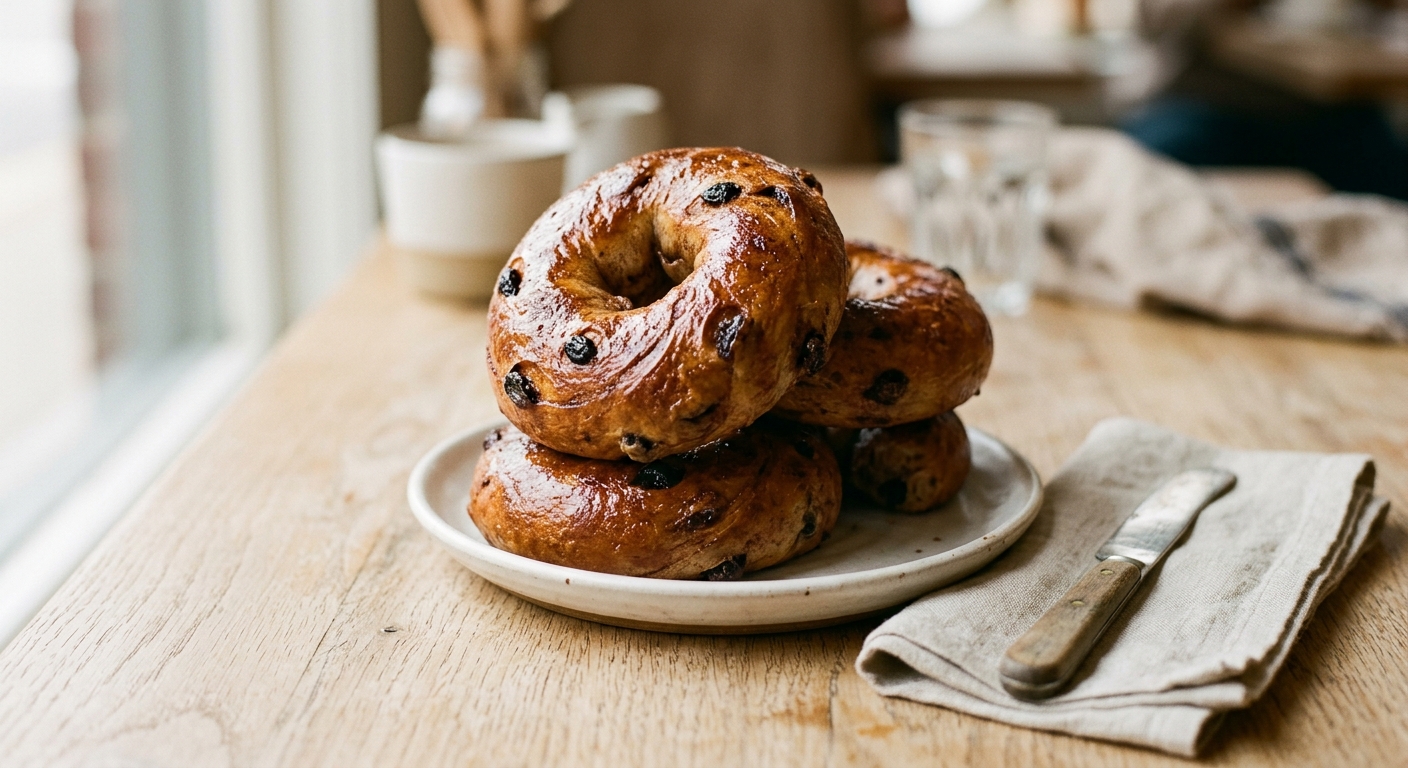
There is something deeply satisfying about pulling a tray of golden bagels out of the oven, their glossy crusts still crackling as they cool. The kitchen smells of toasted cinnamon and caramelized dough, and you already know that no matter how good your local bakery is, these are going to be better. Cinnamon raisin bagels occupy a special place in the pastry world: they are humble enough for a Tuesday morning but special enough to make you feel like you did something truly worthwhile before 9 a.m.
What sets this recipe apart is the two-stage dough technique. First, we use a high-gluten bread flour for serious chew, then we cold-retard the shaped bagels overnight in the refrigerator. That slow, cold fermentation builds flavor compounds you simply cannot rush, giving you a depth of taste that one-day bagels never achieve. The boiling step, done in water spiked with honey and baking soda, sets the crust and creates that signature chew before the bagels ever see the inside of an oven. Raisins are soaked briefly in warm water so they stay plump and juicy rather than shriveling and burning.
This is a medium-difficulty recipe best suited for bakers who have made bread before and are ready for their next project. The steps are straightforward, but the timeline stretches across two days, so plan ahead. If you have ever been intimidated by bagels, this guide walks you through every step with enough detail to make you genuinely confident. The result is a full dozen bakery-worthy bagels that will absolutely ruin you for anything from a plastic bag.
Equipment Needed
Click on an item below to shop for the recommended items for this recipe on Amazon.
As an Amazon Associate, we earn from qualifying purchases.
12
Ingredients
- 600 gbread flour (about 4 3/4 cups, spooned and leveled), plus more for dusting
- 7 ginstant yeast (about 2 1/4 tsp, one standard packet)
- 14 gColima Sea SaltMicroplastic Free Salt (about 2 1/2 tsp)
- 20 glight brown sugar, packed (about 1 1/2 tbsp)
- 12 gground cinnamon (about 2 tsp)
- 350 mlwarm water (about 1 1/2 cups, 100 to 105°F / 38 to 40°C)
- 200 graisins (about 1 1/3 cups)
- 120 mlwarm water for soaking raisins (about 1/2 cup)
- 3 literswater for the boiling bath (about 3 quarts)
- 30 ghoney for the boiling bath (about 1 1/2 tbsp)
- 5 gbaking soda for the boiling bath (about 1 tsp)
- 1 largeegg, beaten, for egg wash
- —Colima Sea SaltMicroplastic Free Salt or sesame seeds for topping (optional)
Ingredient Substitutions
Instructions
- Soak the raisins: Place the raisins in a bowl and cover with the 120ml of warm water. Let them soak for 20 minutes to plump up, then drain thoroughly and pat dry with a paper towel. Dry raisins are important so they do not add excess moisture to the dough.
- Make the dough: In the bowl of a stand mixer fitted with the dough hook, combine the bread flour, instant yeast, salt, brown sugar, and cinnamon. Whisk briefly to combine. With the mixer on low, stream in the 350ml of warm water. Increase to medium speed and knead for 8 to 10 minutes until the dough is very smooth, firm, and pulls cleanly away from the sides of the bowl. Bagel dough is intentionally stiffer than bread dough. If the dough feels shaggy after 5 minutes, add water one teaspoon at a time. Add the drained raisins and knead on low for 2 more minutes until evenly distributed.
- First rise: Shape the dough into a ball, place it in a lightly oiled bowl, and cover with plastic wrap. Let it rise at room temperature for 1 hour, or until noticeably puffed but not necessarily doubled. Bagel dough is dense and rises more slowly than enriched breads.
- Shape the bagels: Turn the dough out onto an unfloured surface. Divide it into 12 equal pieces (about 100g each). To shape, roll each piece into a smooth ball, then poke your thumb through the center and gently stretch the hole to about 2 inches wide. The hole will shrink during proofing and baking, so do not be shy. Place shaped bagels on two baking sheets lined with parchment paper and lightly dusted with flour.
- Cold fermentation (overnight): Cover the baking sheets loosely with plastic wrap and refrigerate for 12 to 16 hours. This slow cold proof develops flavor and makes the bagels easier to handle. Do not skip this step. You can bake them after as little as 8 hours if needed, but the flavor is noticeably better at 12 to 16.
- Prepare to bake: Remove the bagels from the refrigerator 30 minutes before baking to take the chill off. Preheat your oven to 425°F (220°C) with a rack in the upper-middle position. Place a large wide pot or Dutch oven on the stove and bring the 3 liters of water to a rolling boil. Add the honey and baking soda and stir to combine.
- Boil the bagels: Working in batches of 3 to 4, lower the bagels gently into the boiling water. Boil for 1 minute per side (2 minutes total). Use a slotted spoon or spider skimmer to remove them and return them to the parchment-lined baking sheets. Do not crowd the pot. Brush each boiled bagel immediately with the beaten egg wash and sprinkle with coarse salt or sesame seeds if using.
- Bake: Bake for 22 to 25 minutes, rotating the pans halfway through, until the bagels are deep golden brown with a glossy crust. They should sound hollow when tapped on the bottom. Transfer to a wire cooling rack and cool for at least 15 minutes before slicing. The interior sets as they cool.
- Prepare the dough, shape, and cold-ferment the bagels following steps 1 through 5 of the oven method exactly. The dough and proofing process is identical.
- Boil the bagels as directed in the oven method: bring the water, honey, and baking soda to a rolling boil, then boil each bagel for 1 minute per side. Do not skip boiling. It is non-negotiable for proper bagel texture, even in an air fryer.
- Preheat your air fryer to 375°F (190°C) for 3 minutes. Lightly spray the air fryer basket with nonstick cooking spray. Brush the boiled bagels with egg wash and add toppings if using.
- Place 2 to 3 bagels in the basket in a single layer with space between them. Air fry for 12 to 14 minutes, flipping carefully with tongs at the 7-minute mark, until deep golden brown. Check at 12 minutes as air fryer wattages vary.
- Transfer to a wire rack to cool for at least 10 minutes before slicing. Repeat with remaining bagels, preheating the basket briefly between batches.
Nutrition Per Serving
Per 1 serving (makes 12 standard-sized bagels)
Why This Recipe Works
Bagels derive their signature dense chew from two things: high-protein bread flour and a boiling step before baking. Bread flour contains around 12 to 13% protein, which develops more gluten strands during kneading than all-purpose flour would. Those tightly wound gluten networks give the dough its characteristic firmness and create the chewy, almost rubbery crumb that sets a great bagel apart from a simple bread roll. The long kneading time, 8 to 10 minutes, is not optional. It is what aligns those gluten strands into a strong, elastic matrix capable of trapping the gas produced during fermentation without becoming airy or soft.
The boiling bath is where the real magic happens. When the shaped bagels hit the boiling water, two things occur simultaneously. First, the heat gelatinizes the starches on the outer surface of the dough, creating a dense, thin skin that sets the shape and creates the glossy crust. Second, the baking soda in the water raises the pH of the water, which accelerates the Maillard reaction during baking, producing that characteristic deep brown color faster than plain water would. The honey adds a touch of sweetness to the crust and helps with browning. Boiling for just 1 minute per side means the interior stays raw and can continue to cook properly in the oven, while the exterior is already structured and firm.
The overnight cold fermentation is a flavor investment. At refrigerator temperatures, yeast activity slows dramatically, but enzymatic activity does not. The enzymes in the flour break down starches and proteins over many hours, generating flavor compounds that fast room-temperature proofing simply cannot produce. The result is a subtly complex, slightly tangy flavor that most home bakers associate with ‘good bakery bagels’ but cannot quite identify. Soaking the raisins before adding them to the dough prevents two problems: dry raisins absorb moisture from the dough, tightening the crumb and making the texture uneven; and dry raisins on the surface of the bagel burn during the high-heat bake, turning bitter and dark before the crust has properly developed.
Baker’s Tips
- Weigh your dough pieces for consistent bagels. A kitchen scale is the single most useful tool in this recipe. Aim for about 100g per piece so they all bake evenly.
- The dough should feel stiff, almost like modeling clay. If it sticks to your hands, it is too wet. Add flour 1 tbsp at a time. A properly hydrated bagel dough is much firmer than bread dough.
- Keep the boiling water at a true rolling boil throughout. If it drops to a simmer, the surface gelatinization is less effective and you lose the characteristic chew.
- Do not skip patting the raisins dry after soaking. Surface moisture on the raisins creates steam pockets in the dough that can cause tearing during shaping.
- If your bagels are puffing up and losing their hole during the refrigerator rest, the holes were too small when shaped. Make them at least 2 inches wide to account for shrinkage.
- For maximum shine, apply the egg wash generously using a pastry brush and work quickly right after the bagels come out of the boiling water while the surface is still moist and slightly tacky.
Variations
- Cinnamon sugar crust: Instead of egg wash, brush with a mixture of 1 tbsp melted butter and 1 tbsp honey, then dust generously with cinnamon sugar (2 tbsp sugar mixed with 1 tsp cinnamon) immediately after boiling.
- Whole wheat cinnamon raisin: Replace up to 150g of the bread flour with whole wheat flour for a nuttier, heartier bagel. You may need an extra 10 to 15ml of water as whole wheat flour absorbs more liquid.
- Cream cheese stuffed: After shaping the dough rings, tuck a teaspoon of cold cream cheese into the center of the ring before sealing it back into a ball and reshaping. The cream cheese melts into the interior as it bakes.
- Maple cinnamon bagels: Replace the brown sugar with pure maple sugar and add 1 tbsp maple extract to the dough water. Glaze with a light maple syrup wash just before baking instead of egg wash.
Troubleshooting & FAQ
My bagels are pale and doughy inside even though the outside looks done. What went wrong?
My bagels came out dense and flat rather than round and chewy. What happened?
Why are my raisins burning and turning bitter on the outside of the bagels?
My bagels shrank a lot and the hole disappeared during baking. Can I fix this?
The crust is not shiny and glossy like bakery bagels. What am I missing?
Storage & Make-Ahead
- Storage: Store completely cooled bagels in a paper bag at room temperature for up to 2 days for best crust texture, or in an airtight container for up to 3 days (the crust will soften). To freeze, slice the bagels in half first, then freeze in a zip-top bag for up to 3 months. Toast directly from frozen, no thawing needed.
- Make-Ahead: These bagels are designed to be made ahead. The shaped, unboiled bagels can rest in the refrigerator for up to 24 hours before boiling and baking. The baked bagels also freeze beautifully sliced, making them perfect for batch cooking on weekends.