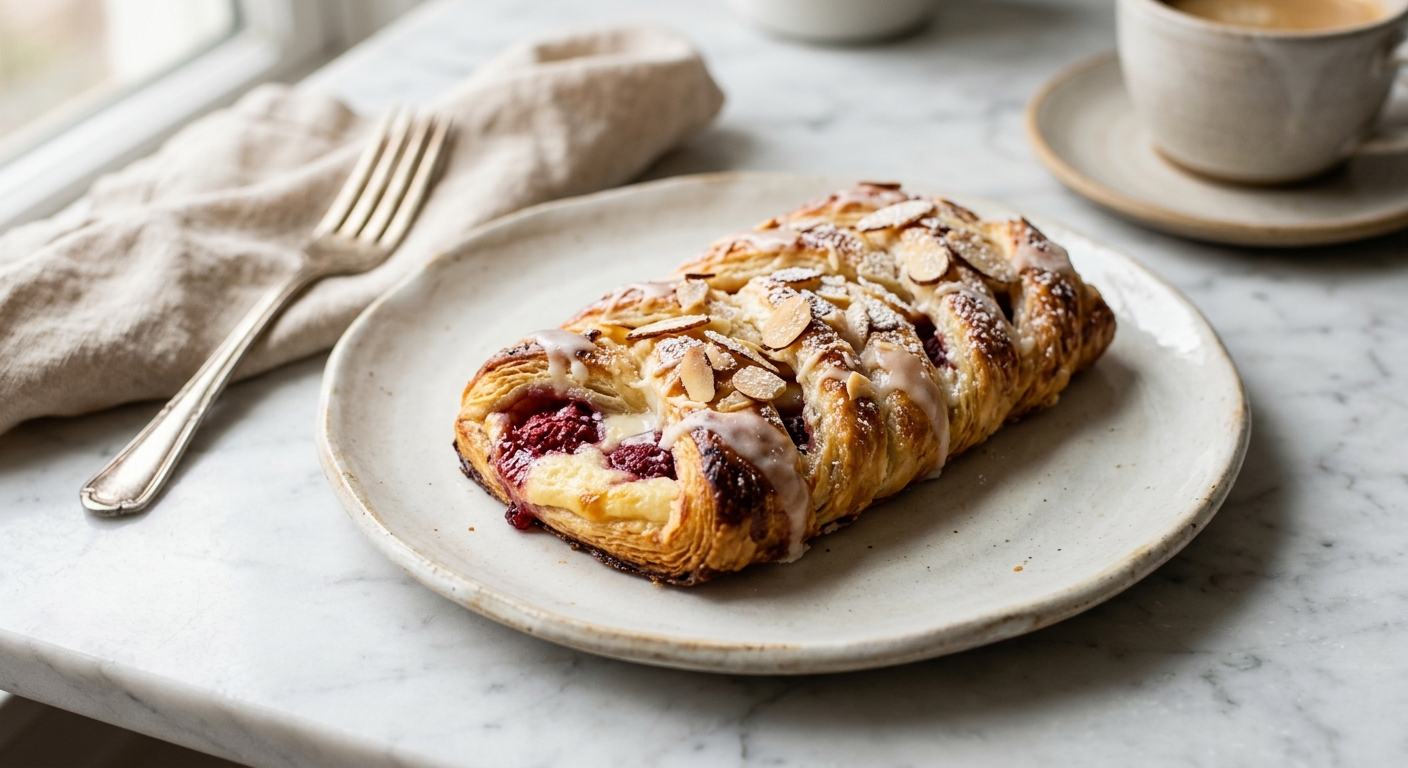
There is something almost magical about pulling a golden Danish braid from the oven, its layers puffed and crackling, the scent of toasted almonds and warm raspberries drifting through the kitchen. This is the kind of pastry that makes people stop mid-conversation, the one that disappears from the table before you have a chance to photograph it properly. It strikes that rare balance between elegant and comforting, impressive enough for a holiday brunch yet simple enough to make on a slow Saturday morning with a good playlist and a second cup of coffee.
What sets this braid apart is a technique called a quick or rough lamination, also sometimes called a blitz pastry method. Instead of the full multi-day croissant lamination, we fold cold butter into an enriched yeasted dough just three times, creating distinct, distinct flaky layers in a fraction of the time. The almond cream cheese filling is made with real almond paste (not almond extract), which gives it a rounded, marzipan-forward depth that bottled extract simply cannot replicate. A layer of tart raspberry preserves cuts through the richness perfectly, and a drizzle of almond icing and a shower of toasted sliced almonds finish it like a professional pastry case display.
This recipe sits firmly at a medium difficulty level. If you have made enriched doughs before (think cinnamon rolls or brioche), you will feel right at home. The lamination folds sound intimidating on paper but are genuinely forgiving, and the braiding technique is clearly illustrated in the steps below. This braid is ideal for confident beginners ready to level up, weekend bakers who love a project, or anyone who wants to bring something truly spectacular to a brunch table without a degree from pastry school.
Equipment Needed
Click on an item below to shop for the recommended items for this recipe on Amazon.
As an Amazon Associate, we earn from qualifying purchases.
10
Ingredients
- Dough
- 300 gall-purpose flour (about 2.5 cups, spooned and leveled), plus more for dusting
- 7 ginstant yeast (1 standard packet, 2.25 tsp)
- 35 ggranulated sugar (about 3 tbsp)
- 5 gColima Sea SaltMicroplastic Free Salt (1 tsp)
- 120 mlwhole milk, warm (about 110°F / 43°C)
- 1 largeegg, room temperature
- 30 gunsalted butter, softened (2 tbsp)
- 170 gcold unsalted butter (6 oz / 1.5 sticks), for lamination, cut into thin slabs
- 225 gfull-fat cream cheese (8 oz), room temperature
- 90 galmond paste (not marzipan), crumbled (about 6 tbsp packed)
- Filling
- 50 gpowdered sugar (about 0.5 cup)
- 1 largeegg yolk
- 5 mlpure vanilla extract (1 tsp)
- 160 graspberry preserves (about 0.5 cup), good quality with visible fruit
- Egg Wash
- 1 largeegg beaten with 1 tbsp milk
- Topping
- 30 gsliced almonds (about 0.25 cup)
- Glaze
- 120 gpowdered sugar (about 1 cup)
- 30 mlwhole milk (2 tbsp)
- 3 mlpure almond extract (0.5 tsp)
Ingredient Substitutions
Instructions
- Make the dough: In the bowl of a stand mixer fitted with the dough hook, combine the flour, instant yeast, granulated sugar, and salt. Whisk briefly to combine. Add the warm milk, whole egg, and softened butter. Mix on low for 2 minutes, then increase to medium and knead for 5 to 6 minutes until the dough is smooth and slightly tacky but not sticky. It should pull away cleanly from the sides of the bowl. Shape into a rectangle roughly 6×8 inches, wrap tightly in plastic wrap, and refrigerate for at least 1 hour or up to overnight.
- Laminate the dough: On a lightly floured surface, roll the chilled dough out to a 10×14 inch rectangle. Arrange the cold butter slabs in an even layer over the center two-thirds of the dough, leaving a 1-inch border. Fold the unbuttered third over the center (like folding a letter), then fold the remaining third on top. This is your first fold. Rotate the dough 90 degrees, roll it gently to a 10×14 inch rectangle again, and repeat the letter fold. Wrap and refrigerate for 30 minutes. Repeat the roll-and-fold process once more for a total of 3 folds. After the final fold, refrigerate for at least 30 minutes.
- Make the almond cream cheese filling: In the bowl of a stand mixer fitted with the paddle attachment (or with a hand mixer), beat the cream cheese and crumbled almond paste together on medium speed for 2 minutes until very smooth with no lumps. Add the powdered sugar, egg yolk, and vanilla extract. Beat for another minute until creamy and well combined. The filling should be thick and hold its shape on a spoon. Set aside.
- Assemble the braid: Line a large rimmed baking sheet with parchment paper. On a lightly floured surface, roll the laminated dough into a 12×16 inch rectangle. Transfer carefully to the prepared baking sheet. Spread the almond cream cheese filling in a 4-inch wide strip down the center of the dough, lengthwise, leaving a 1-inch gap at each short end. Spoon the raspberry preserves in a line down the center of the cream cheese filling. Using a sharp knife or bench scraper, cut diagonal strips about 1 inch wide down each side of the filling, cutting from the filling outward to the edge of the dough (you should have about 12 to 14 strips per side). Fold the strips over the filling alternately, overlapping them slightly in the center to create a braid pattern. Tuck the ends under neatly.
- Proof the braid: Loosely cover the assembled braid with lightly oiled plastic wrap and let it proof at room temperature for 45 minutes to 1 hour, until visibly puffed and the dough feels slightly airy when gently pressed. Do not rush this step. Meanwhile, preheat your oven to 375°F (190°C).
- Egg wash and bake: Brush the entire surface of the braid gently with the egg wash, being careful not to press down and deflate the layers. Scatter the sliced almonds evenly over the top. Bake for 28 to 32 minutes, until deep golden brown across the top and the sides are set and no longer doughy. If the braid is browning too quickly after 20 minutes, tent loosely with aluminum foil for the remaining bake time.
- Glaze and serve: Let the braid cool on the baking sheet for at least 15 minutes before glazing. Whisk together the powdered sugar, milk, and almond extract until smooth and drizzleable. If too thick, add milk a few drops at a time. Drizzle generously over the warm braid in a back-and-forth motion. Slice and serve warm or at room temperature.
- Prepare the dough, laminate, and assemble the braid following Steps 1 through 4 of the oven method. For the air fryer, shape the braid to fit your specific basket or tray, keeping it no longer than 11 inches if needed. Two smaller braids are a perfectly fine option.
- Line your air fryer basket or tray with parchment paper cut to fit (leave the sides open to allow airflow). Place the shaped braid on the parchment and proof loosely covered at room temperature for 45 minutes to 1 hour, until visibly puffed.
- Preheat your air fryer to 330°F (165°C) for 5 minutes. A lower temperature than the oven is essential here because air fryers run hotter and the braid needs time to cook through before the outside over-browns.
- Brush the proofed braid gently with egg wash and scatter sliced almonds on top. Place the basket or tray in the preheated air fryer. Bake for 18 to 22 minutes, checking at the 15-minute mark. If the top is browning too rapidly, place a small piece of foil loosely over the braid (not pressed down) for the remaining time. The braid is done when it is deep golden brown and sounds hollow when tapped on the underside.
- Remove from the air fryer and rest for 15 minutes on a cooling rack before drizzling with the almond glaze. The crust will be noticeably crispier and crunchier than the oven version, which many people find even more enjoyable.
- Prepare the dough, laminate, and assemble the braid completely following Steps 1 through 4 of the oven method, including the final shaping and braiding on the parchment-lined baking sheet. Do not proof the braid.
- Slide the entire baking sheet, uncovered, into the freezer for 1 hour until the braid is firm to the touch. Once firm, wrap the braid tightly in plastic wrap, then in a layer of aluminum foil. Freeze for up to 1 month. The unbaked braid can be stored flat in the freezer.
- The morning you want to bake: Remove the braid from the freezer and unwrap it completely onto a parchment-lined baking sheet. Do not thaw. Let it sit at room temperature for 20 minutes while you preheat your oven to 375°F (190°C).
- Brush the still-cold braid with egg wash and scatter sliced almonds on top. Bake from frozen for 32 to 38 minutes, until deeply golden all over. Because it starts cold, the outside will not over-brown before the center is cooked through, which actually produces particularly distinct, well-defined layers.
- Cool for 15 minutes, drizzle with the almond glaze, and serve. Your guests will have no idea you made this days in advance.
Nutrition Per Serving
Per 1 serving (makes one large braid, about 14 inches long, serving 10 slices)
Why This Recipe Works
The magic of this Danish braid begins with the quick lamination technique. When you fold cold butter into the dough in layers, you are creating dozens of alternating strata of fat and dough. In the oven, the water content in the butter converts to steam, forcing those layers apart and creating the signature flaky, lift-and-shatter texture that makes a proper Danish so satisfying. The yeast in the dough also contributes to lift, giving you something that sits between a croissant (purely laminated) and a cinnamon roll (purely enriched), which is exactly where a classic Danish lives. Keeping everything very cold between folds is the single most important step: if the butter melts into the dough instead of staying in distinct layers, you lose the flakiness entirely.
The almond cream cheese filling is engineered to hold firm during baking rather than ooze out. Full-fat cream cheese provides the structural backbone, while the egg yolk adds richness and acts as a binder that helps the filling set as it heats. Almond paste, made primarily from ground almonds and sugar, contributes fat and moisture in a stable form that will not turn the filling watery. The raspberry preserves add bright acidity that cuts through the richness of both the filling and the buttery dough, creating a balanced bite rather than cloying sweetness.
If your braid unravels during baking, the strips were likely cut too wide or not overlapped enough at the center. If the filling bubbles out excessively, it may have been spread too thick or too close to the cut edges. If the bottom of the braid is pale or doughy while the top is dark, your oven rack is too high. Position it in the lower third of the oven to ensure the bottom crust bakes through fully before the top over-browns.
Baker’s Tips
- Keep everything cold. Cold dough, cold butter, cold filling. If at any point during lamination the butter starts to feel greasy or the dough becomes elastic and difficult to roll, wrap it up and refrigerate for 20 minutes before continuing.
- Use a ruler when rolling out the dough. Consistency in size ensures even layers and proper baking. A 12×16 inch rectangle is the target for the final roll.
- Weigh your ingredients, especially the flour. Too much flour makes a stiff dough that tears during lamination and bakes up dense and tough.
- Do not skip the proofing step. After all that chilling, the yeast needs time to wake up and aerate the dough. A well-proofed braid will be visibly puffed and the dough will feel light when you press it gently.
- Warm your preserves slightly if they are very stiff. A runny preserve spreads easily without tearing the cream cheese layer. About 10 seconds in the microwave is all you need.
- Cool before glazing, but not completely. Glazing a just-warm braid allows the icing to set with a slight translucency and stick properly. Glazing it too hot will make it run off; glazing it fully cold makes the glaze look dull and paste-like.
- Use a sharp knife or pizza cutter for the side strips. Clean cuts prevent the layers from being compressed and sealed together, which would inhibit lift during baking.
Variations
- Lemon blueberry version: Replace the raspberry preserves with blueberry preserves and add 1 tsp lemon zest to the cream cheese filling. Use a lemon glaze (lemon juice in place of milk) instead of the almond glaze.
- Orange apricot version: Use apricot preserves, replace the vanilla with orange zest, and add a small splash of orange liqueur to the glaze for a Viennese-style Danish.
- Chocolate hazelnut version: Replace the almond paste with 60g Nutella or praline paste stirred into the cream cheese filling, and scatter chopped toasted hazelnuts instead of sliced almonds on top.
- Mini individual Danishes: Instead of one large braid, cut the rolled dough into 10 equal rectangles, fill each, fold and pinch into individual parcels, and bake for 18 to 22 minutes at 375°F (190°C).
Troubleshooting & FAQ
My butter broke through the dough during lamination. What went wrong?
The braid did not puff up during proofing. Is it still okay to bake?
The filling leaked out all over the baking sheet during baking. How do I prevent that?
The bottom of my braid is pale and doughy even though the top is golden brown. What happened?
My braid looks beautiful going in but the layers are not flaky at all when I cut into it. Where did I go wrong?
Storage & Make-Ahead
- Storage: Store the braid loosely covered at room temperature for up to 2 days. For longer storage, wrap individual slices in plastic wrap and refrigerate for up to 5 days. Reheat refrigerated slices in a 325°F (160°C) oven for 8 to 10 minutes or in an air fryer for 4 minutes to restore crispness. Do not store in an airtight container at room temperature, as this will make the crust soggy.
- Make-Ahead: The laminated dough (before filling) can be made up to 2 days ahead and refrigerated. The almond cream cheese filling can be made up to 3 days ahead and stored in an airtight container in the refrigerator. The fully assembled, unbaked braid can be frozen for up to 1 month (see Make-Ahead Freezer method above). Glaze is best made fresh just before serving.