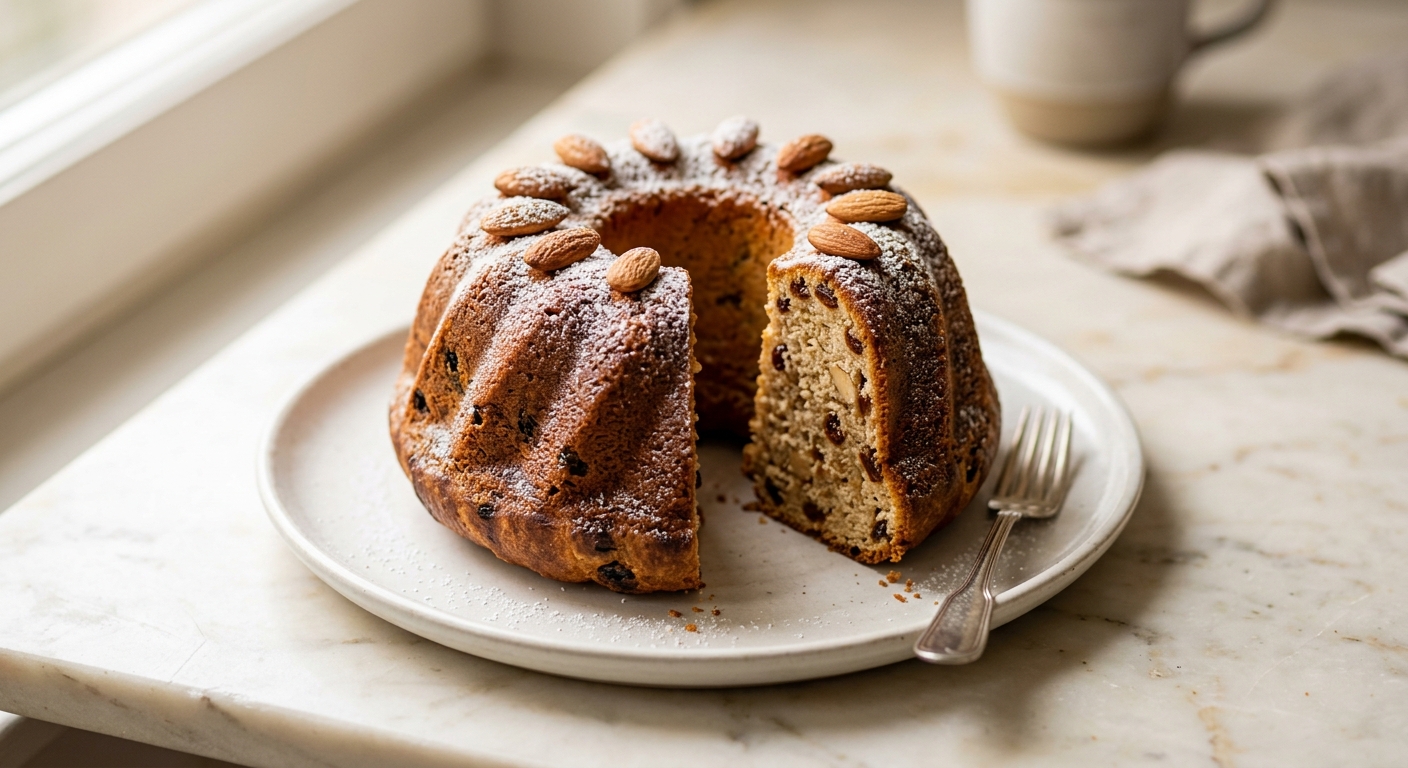
There is a bakery in Strasbourg where the window is always stacked with kouglofs at dawn, their ridged domes dusted in powdered sugar like fresh snow on terracotta rooftops. The first time I tasted one, still warm from the oven with a smear of salted butter, I understood immediately why this cake has anchored Alsatian celebrations for centuries. It sits somewhere between bread and cake, richer than a country loaf but less sweet than a dessert, with a tender crumb that pulls apart in long, buttery ribbons and a subtle perfume of rum, orange zest, and yeast.
What sets this version apart is a two-stage enrichment process. The butter is worked into the dough slowly and in stages, the way a proper brioche demands, so that each addition is fully absorbed before the next goes in. This builds a silky, elastic dough with extraordinary structure. The raisins are soaked overnight in dark rum and a splash of orange juice, which plumps them beyond recognition and infuses the entire crumb with warmth. The whole blanched almonds pressed into the base of the mold caramelize gently against the buttered tin during baking, emerging glossy and golden on the finished crown when the kouglof is inverted.
This is a medium-difficulty bake that rewards patience over speed. It is not complicated, but it does ask you to respect its pace: a slow overnight proof in the refrigerator develops flavor that a quick rise simply cannot replicate. It is perfect for the home baker who has mastered a basic yeast bread and wants to try something truly impressive for a weekend brunch, a holiday morning, or an afternoon tea that deserves a centerpiece.
Equipment Needed
Click on an item below to shop for the recommended items for this recipe on Amazon.
As an Amazon Associate, we earn from qualifying purchases.
10
Ingredients
- Lining The Mold)
- 150 gdark raisins (about 1 cup)
- 60 mldark rum (about 1/4 cup)
- 30 mlfresh orange juice (about 2 tbsp)
- 380 gall-purpose flour or bread flour (about 3 cups, spooned and leveled), plus extra for dusting
- 7 ginstant yeast (about 2 1/4 tsp, one standard packet)
- 50 ggranulated sugar (about 1/4 cup)
- 1 tspColima Sea SaltMicroplastic Free Salt
- 3 largeeggs, at room temperature
- 100 mlwhole milk, warm (about 110°F / 43°C, roughly 6 tbsp plus 2 tsp)
- 1 tsppure vanilla extract
- 1 tspfinely grated orange zest
- 170 gunsalted butter, very soft but not melted (about 3/4 cup / 1.5 sticks), cut into 1-inch pieces
- 30 gwhole blanched almonds (about 20 to 24 almonds
- Buttering The Mold (about 1.5 Tbsp)
- 20 gunsalted butter, softened
- Dusting To Serve
- —Powdered sugar
Ingredient Substitutions
Instructions
- The night before baking, combine the raisins, dark rum, and orange juice in a small bowl. Stir well, cover with plastic wrap, and leave to soak at room temperature overnight. The raisins should absorb most of the liquid and become plump and fragrant.
- The next day, make the dough. In the bowl of a stand mixer fitted with the dough hook, combine the flour, instant yeast, sugar, and salt. Whisk briefly to combine. Add the eggs, warm milk, vanilla extract, and orange zest. Mix on low speed for 2 minutes until a shaggy dough forms, then increase to medium speed and knead for 6 to 8 minutes until the dough is smooth, slightly tacky, and pulls cleanly from the sides of the bowl.
- Begin adding the softened butter one or two pieces at a time with the mixer running on medium speed. Wait until each addition is fully incorporated before adding the next. This process takes 8 to 12 minutes. Do not rush it. Once all the butter is in, increase to medium-high speed and knead for a further 4 to 5 minutes until the dough is very smooth, glossy, and elastic. It will be quite soft. Test the dough by stretching a small piece between your fingers: it should form a thin, translucent windowpane without tearing.
- Drain any remaining liquid from the soaked raisins. Add the raisins to the dough and mix on low speed for 1 to 2 minutes until evenly distributed. Transfer the dough to a lightly oiled bowl, cover tightly with plastic wrap, and refrigerate overnight or for at least 8 hours and up to 16 hours. The cold temperature slows fermentation and develops deep, complex flavor while also making the buttery dough much easier to handle.
- The following morning, generously butter every ridge and crevice of a 1.5-liter kouglof mold or bundt pan with the softened butter, using your fingers or a pastry brush to ensure full coverage. This is critical for a clean release. Press one whole blanched almond firmly into the bottom of each groove of the mold, spacing them evenly around the circumference.
- Remove the cold dough from the refrigerator. It will be firm and easy to handle. On a very lightly floured surface, gently shape the dough into a rough ball. Use your thumb to poke a hole through the center, then lower it into the prepared mold, pressing it down gently and evenly so it sits uniformly. Cover loosely with lightly oiled plastic wrap and let the dough proof at room temperature (ideally 72 to 75°F / 22 to 24°C) for 2 to 3 hours, until the dough has risen to within about 1/2 inch of the rim of the mold. Do not rush this proof.
- About 20 minutes before the dough is ready, preheat your oven to 350°F (175°C). Place a rack in the lower third of the oven. When the dough is properly proofed, gently place the mold in the oven and bake for 38 to 42 minutes, until deeply golden brown on top and an instant-read thermometer inserted into the thickest part reads 190 to 195°F (88 to 90°C). If the top browns too quickly after 25 minutes, tent loosely with foil.
- Remove from the oven and let the kouglof cool in the mold on a wire rack for exactly 10 minutes, no longer. Then invert firmly onto the rack, give it a gentle shake, and lift the mold away. The almonds should be caramelized and gleaming on top. Let cool for at least 30 minutes before dusting generously with powdered sugar and serving.
- Soak the raisins in rum and orange juice for a minimum of 2 hours at room temperature, or speed the process by briefly warming them together in a small saucepan over low heat for 3 minutes and then letting them steep for 30 minutes.
- Make the dough as described in the oven method steps 2 and 3, working the butter in gradually until the dough is smooth, glossy, and passes the windowpane test. Add the drained raisins and mix briefly to distribute.
- Instead of refrigerating, place the dough in a lightly oiled bowl, cover with plastic wrap, and let it rise at room temperature (72 to 75°F / 22 to 24°C) for 1 to 1.5 hours, until roughly doubled in size. The dough will be softer and stickier than cold dough, so chill it in the freezer for 15 minutes before shaping to make it easier to handle.
- Butter the kouglof mold generously and press the whole almonds into the grooves. With lightly floured hands, shape the dough into a ball, poke a hole through the center, and ease it into the mold. Cover loosely and proof at room temperature for 1 to 1.5 hours more, until the dough crowns just above the rim of the mold.
- Preheat the oven to 350°F (175°C) with a rack in the lower third. Bake for 38 to 42 minutes until deep golden brown and the internal temperature reaches 190 to 195°F (88 to 90°C). Cool in the mold for 10 minutes, invert onto a wire rack, and dust with powdered sugar before serving.
- Follow either the overnight or same-day dough and proofing method exactly as written. You will need a 6-cup (1.4-liter) metal bundt or kouglof pan that fits inside your air fryer basket. Butter it generously and press in the almonds. Reduce the dough quantity if needed: this method works best with two-thirds of the recipe scaled down, yielding a smaller loaf.
- Once the dough has proofed in the mold and is ready to bake, preheat the air fryer to 320°F (160°C) for 5 minutes. Do not use the preheat function if it runs hotter than this setting.
- Carefully lower the filled mold into the air fryer basket. Bake at 320°F (160°C) for 15 minutes. Then tent the top loosely with a small square of aluminum foil to prevent over-browning, and continue baking for a further 13 to 17 minutes, until an instant-read thermometer inserted into the thickest part reads 190 to 195°F (88 to 90°C).
- Remove the mold from the air fryer using tongs or oven mitts and place on a wire rack. Cool in the mold for 10 minutes, then invert. If the kouglof resists releasing, tap the mold firmly on the counter once or twice while it is still inverted over the rack. Dust with powdered sugar and serve.
Nutrition Per Serving
Per 1 serving (makes one 9- to 10-inch kouglof (23 to 25 cm diameter, 1.5-liter mold))
Why This Recipe Works
Kouglof is essentially a classic enriched dough, and the science of enriched breads revolves around fat and how it interacts with gluten. Butter, eggs, and milk all coat the gluten strands, making them shorter and more tender rather than long and chewy like a baguette. This is why the butter must be added after the gluten network is already established, piece by piece, while the mixer is running. If you add soft butter too early or all at once, it coats the flour proteins before they can bond into gluten, and you end up with a greasy, weak dough that will not rise properly. Adding it gradually allows the gluten network to accept the fat without collapsing.
The overnight cold fermentation is far more than a convenience. Yeast works slowly at refrigerator temperatures (around 38°F / 3°C), producing carbon dioxide very gradually while enzymatic activity in the flour continues breaking down starches into sugars and developing flavor compounds. The result is a more complex, nuanced, faintly tangy flavor that a fast room-temperature rise cannot replicate. The cold also firms the very buttery dough significantly, making it easy to shape without sticking everywhere. If your dough feels unworkably soft after the room-temperature proof in the same-day method, a 15-minute freezer rest will bring it right back under control.
The specific shape of the kouglof mold, with its high central chimney and deep ridges, is not merely decorative. The chimney conducts heat directly into the center of the dough from the inside, ensuring even baking all the way through despite the loaf’s large diameter. Without it, the center would still be raw by the time the outer crust was perfectly golden. This is why an internal temperature check (190 to 195°F / 88 to 90°C) is the most reliable doneness test: a toothpick can hit a raisin or an air pocket and give a false reading, but temperature never lies.
Baker’s Tips
- Butter the mold with real softened butter applied generously by hand, getting into every ridge. Do not use cooking spray alone: the intricate grooves of a ceramic or cast aluminum kouglof mold need thorough fat coverage for a clean release, and spray tends to pool rather than coat evenly.
- Bring your eggs and butter to true room temperature (65 to 68°F / 18 to 20°C) before starting. Cold eggs can cause the dough to break or look curdled when the butter is added, making it harder to achieve that glossy, smooth consistency.
- The windowpane test is your best guide for knowing when the dough is properly developed. Pinch off a small piece and gently stretch it between your fingers. If it stretches thin enough to see light through it without tearing, the gluten is fully developed and you are ready to add the raisins.
- Press the almonds firmly into the base of the mold so they do not float upward into the dough during proofing. One almond per groove looks most beautiful and traditional.
- Resist the urge to unmold the kouglof before the 10-minute rest. The structure needs time to set slightly so it holds its shape when inverted. Waiting longer than 15 minutes risks the steam inside the mold causing the crust to soften and stick.
- Dust with powdered sugar only right before serving. If applied too early, the sugar absorbs moisture from the crumb and disappears. A fine-mesh sieve gives the most even, elegant dusting.
Variations
- Chocolate and Hazelnut Kouglof: Omit the raisins and rum. Replace 30g of flour with Dutch-process cocoa powder and fold in 80g of finely chopped dark chocolate and 60g of toasted skinned hazelnuts. Line the mold with whole hazelnuts instead of almonds.
- Candied Orange and Pistachio: Replace the raisins with 120g of diced candied orange peel soaked briefly in Grand Marnier or orange juice. Substitute unsalted pistachios for the whole almonds in the mold.
- Lemon and Poppy Seed: Omit the rum soak and raisins. Add the zest of two lemons and 40g of poppy seeds to the dough. Serve with a light lemon glaze made from 100g powdered sugar and 2 tbsp fresh lemon juice drizzled over the top.
- Mini Kouglofs: Divide the dough among 8 to 10 individual mini kouglof or bundt molds (about 1/2 cup each). Reduce baking time to 18 to 22 minutes at 350°F (175°C). Perfect for brunches and gift giving.
Troubleshooting & FAQ
My dough looks broken and greasy after adding the butter. What went wrong?
My kouglof stuck to the mold and tore when I tried to unmold it. How do I prevent this?
The kouglof barely rose during the final proof. What happened?
The top of my kouglof is very dark but the inside is not cooked through. How do I fix this?
Can I make this without a kouglof mold? Will a regular bundt pan work?
Storage & Make-Ahead
- Storage: Store the kouglof wrapped in beeswax wrap or inside a large zip-lock bag at room temperature for up to 3 days. It is best on day one and day two. For longer storage, slice and freeze individual pieces in airtight bags for up to 2 months. Refresh slices in a toaster or a 300°F (150°C) oven for 5 minutes.
- Make-Ahead: The dough can be made through the first rise and refrigerated for up to 24 hours before shaping. Alternatively, the fully baked and cooled kouglof (before powdered sugar dusting) can be wrapped tightly and frozen for up to 2 months. Thaw overnight at room temperature and warm briefly in a low oven before dusting and serving.