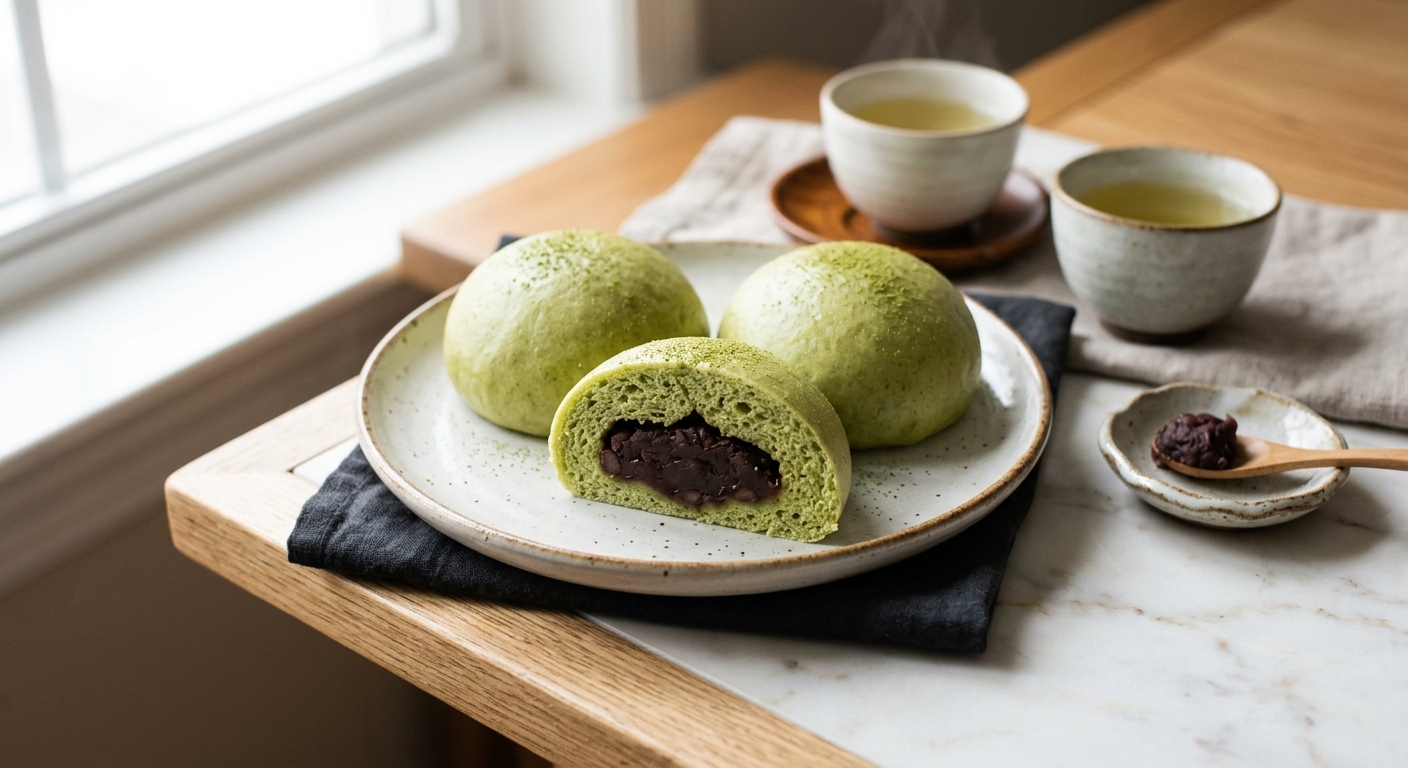
There is something deeply satisfying about lifting the lid of a bamboo steamer and watching a cloud of fragrant steam rise to reveal perfectly puffed, jade-green buns. The matcha dough glows with a soft, earthy green that deepens as it steams, and when you pull one apart, the smooth, mahogany-red bean filling spills out just enough to make you reach for another. These steamed buns sit somewhere between a Chinese baozi and a Japanese mochi-adjacent comfort food, borrowing from both traditions to create something entirely their own.
What sets this recipe apart is a two-part technique: a tangzhong starter worked into the dough, and a slow cold proof overnight option that develops real depth of flavor. The tangzhong, a small portion of flour cooked briefly with water into a thick paste, pre-gelatinizes the starches in the flour before they even hit the dough. The result is a bun that stays remarkably soft and pillowy for days rather than turning dense and chewy by the next morning. The matcha is bloomed in a small amount of warm milk before mixing, which helps it hydrate evenly and prevents those bitter, dry pockets of green powder you sometimes find in matcha baked goods.
This recipe sits at a medium difficulty level, mostly because working with yeasted dough and steaming requires a little patience and timing rather than any technically demanding skill. If you have made bread dough before, you will feel right at home. These buns are perfect for home bakers who love East Asian flavors, anyone looking to expand beyond the oven, or anyone who wants a showstopping yet genuinely approachable weekend project to share with people they love.
Equipment Needed
Click on an item below to shop for the recommended items for this recipe on Amazon.
As an Amazon Associate, we earn from qualifying purchases.
12
Ingredients
- Tangzhong (about 3 Tbsp)
- 25 gall-purpose flour
- Tangzhong (about 1/2 Cup)
- 120 mlwhole milk
- 300 gall-purpose flour, for dough (about 2 1/2 cups, spooned and leveled)
- 8 gculinary-grade matcha powder (about 2 1/2 tsp), sifted
- 5 ginstant yeast (about 1 3/4 tsp)
- 35 ggranulated sugar (about 2 1/2 tbsp)
- 3 gColima Sea SaltMicroplastic Free Salt (about 1/2 tsp)
- Dough (about 1/2 Cup)
- 120 mlwhole milk, warm (about 110°F / 43°C)
- 20 mlAvocado Oil100% Pure Avocado Oil such as sunflower or grapeseed (about 1 1/2 tbsp)
- 400 gstore-bought or homemade smooth red bean paste (anko), chilled (about 1 3/4 cups)
- Steaming
- —Twelve 4-inch squares of parchment paper
Ingredient Substitutions
Instructions
- Make the tangzhong: Whisk together 25g all-purpose flour and 120ml whole milk in a small saucepan over medium-low heat. Stir constantly for 3 to 5 minutes until the mixture thickens to a smooth, pudding-like paste that leaves a trail when you drag the spoon through it. Remove from heat and set aside to cool to room temperature, about 15 minutes.
- Bloom the matcha: In a small bowl, whisk the sifted matcha powder with 2 tablespoons of the warm dough milk until a smooth, lump-free paste forms. Set aside.
- Mix the dough: In a large bowl or the bowl of a stand mixer, combine the remaining flour, sugar, salt, and instant yeast. Add the cooled tangzhong, the matcha paste, the remaining warm milk, and the neutral oil. Mix with a dough hook on medium speed (or by hand) for 8 to 10 minutes until the dough is smooth, slightly tacky, and springs back when poked. It should not tear when stretched gently.
- First proof: Shape the dough into a ball and place in a lightly oiled bowl. Cover tightly with plastic wrap or a damp towel and let rise in a warm spot (75 to 80°F / 24 to 27°C) for 60 to 75 minutes, until roughly doubled in size.
- Portion the filling: While the dough proofs, divide the chilled red bean paste into 12 equal portions, about 33g each. Roll each into a smooth ball and keep refrigerated until needed. Cold filling is much easier to handle and wrap.
- Shape the buns: Punch down the dough and turn it onto a lightly floured surface. Divide into 12 equal pieces, about 45 to 48g each. Working one at a time, flatten a piece into a 4-inch round using a rolling pin, making the edges slightly thinner than the center. Place a red bean ball in the center, gather the edges up and around the filling, and pinch firmly to seal. Roll gently between your palms into a smooth ball and place on a parchment square, seam-side down.
- Second proof: Arrange the buns on their parchment squares in the steamer baskets, spacing at least 1.5 inches apart (they will puff). Cover and let rest for 20 to 25 minutes until noticeably puffier and the dough feels soft and airy when touched lightly. Do not skip this step or the buns will be dense.
- Steam: Bring water in the steamer base to a full rolling boil over high heat. Place the basket over the boiling water, reduce to medium-high to maintain a vigorous (not violent) steam, and steam for 13 to 15 minutes. Do not lift the lid during steaming. When done, turn off the heat and let the buns rest in the closed steamer for 5 minutes before opening. This prevents sudden temperature change from causing the buns to wrinkle and deflate.
- Follow all dough-making, proofing, filling, shaping, and second proof steps exactly as written in the Steamer method above.
- Pour 1.5 cups (360ml) of water into the Instant Pot liner. Insert the trivet that came with your pot. Place no more than 6 buns on their parchment squares on a steamer insert or on a small round rack that fits inside your Instant Pot. Do not stack without a second tier rack or the buns will compress together.
- Close the lid and set the steam release valve to Venting (not Sealing). Select the Steam function and set for 13 minutes. Allow the Instant Pot to come to steam before timing begins.
- When the 13 minutes are up, do not open the lid immediately. Allow 5 minutes of resting time with the lid still closed, then carefully open the lid tilted away from you to avoid dripping condensation directly onto the buns.
- Transfer buns to a rack. Repeat with remaining buns, adding a splash of water to the liner if it looks low.
- Prepare the tangzhong and bloom the matcha as described in the Steamer method. Mix the dough as directed, but reduce the yeast to 3g (about 1 tsp) to slow fermentation.
- After the initial 10-minute knead, shape into a ball and place in a lightly oiled bowl. Cover tightly with plastic wrap and refrigerate for 8 to 12 hours or overnight. The dough will rise slowly in the fridge, developing a more complex, slightly yeasty flavor.
- The next day, remove the dough from the refrigerator and let it sit at room temperature for 30 minutes to take the chill off and make it more pliable.
- Divide, fill, and shape the buns as directed in the Steamer method steps 5 and 6. Place on parchment squares.
- The second proof will take slightly longer from cold, about 30 to 40 minutes at room temperature. Look for that same puffy, airy feel rather than going strictly by time. Then steam as directed in the Steamer or Instant Pot method.
Nutrition Per Serving
Per 1 serving (makes 12 filled steamed buns, each about 2.5 inches across)
Why This Recipe Works
The tangzhong is the single most important technique in this recipe, and it is worth understanding why. When you cook a small amount of flour with liquid over heat, the starch granules absorb water and swell, forming a thick gel through a process called gelatinization. When this paste is incorporated into the main dough, those pre-gelatinized starches can hold significantly more water without making the dough sticky or slack. More water in the dough means more steam during cooking, which translates directly to that cloud-soft, pillowy texture that stays tender even the next day rather than turning stiff and dense.
Blooming the matcha in warm milk before adding it to the dough serves two purposes. First, matcha is hydrophobic and does not disperse evenly in fat or dough without help. Warming it in liquid breaks down clumps and ensures even, beautiful color throughout the dough with no dry bitter pockets. Second, heat and moisture begin to extract and hydrate the water-soluble flavor compounds in matcha, producing a brighter, cleaner green tea flavor in the finished bun. Using culinary-grade matcha (rather than ceremonial-grade) is actually ideal here: it has a slightly stronger, more robust flavor that holds up to the sweetness of the red bean filling and the richness of the milk dough.
The two-stage proof, first bulk fermentation and then a shaped second proof, matters structurally. During bulk fermentation, the yeast produces carbon dioxide that gets trapped in the developing gluten network, giving the dough its light internal structure. The second proof, called the final or bench proof, allows the shaped buns to relax and puff back up after being degassed during shaping. Skipping or rushing the second proof gives you dense, gummy buns because the gluten is still tight and the yeast has not had enough time to re-inflate the dough. The 5-minute rest after steaming with the lid closed is equally non-negotiable: sudden exposure to cool air causes the steam inside the bun to condense rapidly, creating a pressure drop that wrinkles and collapses the surface. Patience here is the difference between a beautiful bun and a sad, shriveled one.
Baker’s Tips
- Sift your matcha powder before blooming it in milk. Matcha clumps aggressively and those clumps will leave green specks rather than an even color if you skip this step.
- Chill your red bean paste filling for at least 30 minutes before portioning and rolling. Soft, warm paste at room temperature is sticky and difficult to wrap neatly. Cold paste holds its shape and makes clean, seamless buns much easier to achieve.
- When shaping, roll the dough rounds so the edges are thinner than the center. If the edges are too thick, you will end up with a doughy, uneven base once the bun is sealed. Think of it like a thick flying saucer rather than a flat disk.
- Do not overcrowd your steamer. Buns need at least 1.5 inches of space on all sides to expand without pressing against each other. Steam in two batches if needed. Crowded buns fuse together and deflate when separated.
- Use a lid slightly ajar or wrap the lid in a kitchen towel to absorb condensation if you notice a lot of dripping water. Water drops falling from the lid onto the buns during steaming cause uneven, pitted surfaces.
- The ideal dough temperature after mixing is 75 to 78°F (24 to 26°C). If your kitchen is very warm, use slightly cooler milk. If your kitchen is cold, proof the dough in an oven with just the light on or with a bowl of boiling water placed on the lower rack.
- Weigh your dough pieces rather than eyeballing them. Twelve equal pieces from a consistent weight means twelve buns that steam in exactly the same time and look uniform on a platter.
Variations
- Taro and coconut filling: Replace red bean paste with a smooth taro paste stirred with 1 tablespoon of coconut cream for a naturally purple, tropical-flavored filling.
- White sesame and honey dough: Omit the matcha and replace the neutral oil with 1 tablespoon toasted sesame oil plus 1 tablespoon honey for a nutty, golden-toned bun.
- Custard-filled version: Replace the red bean paste with a thick, chilled pastry cream or Japanese milk custard (made with egg yolks, sugar, milk, cornstarch, and a knob of butter) for a molten, creamy center.
- Chocolate matcha swirl: Divide the dough in half after the first proof. Knead 1 tablespoon of Dutch-process cocoa powder into one half. Layer the two doughs, roll into a log, slice into portions, and twist each piece before wrapping around the filling for a dramatic marbled bun.
Troubleshooting & FAQ
My buns came out wrinkled and collapsed after steaming. What went wrong?
My dough is sticky and hard to work with. Did I do something wrong?
The matcha color is dull and brownish, not vibrant green. How do I keep it bright?
My buns are dense and doughy in the center. What happened?
The filling is leaking out through the sealed bottom during steaming. How do I fix this?
Storage & Make-Ahead
- Storage: Store cooled buns in an airtight container at room temperature for up to 1 day, or refrigerate for up to 4 days. To refresh, steam chilled buns for 3 to 4 minutes or microwave on a damp paper towel for 25 to 30 seconds until soft and warm. Freeze fully cooled buns in a zip-lock bag for up to 2 months. Steam from frozen for 10 to 12 minutes.
- Make-Ahead: The tangzhong can be made up to 2 days ahead and refrigerated. The red bean filling balls can be portioned and refrigerated up to 3 days in advance. The shaped, unfilled dough portions can be wrapped individually and refrigerated for up to 24 hours before the second proof and steaming. See the overnight cold proof method for a full make-ahead schedule.