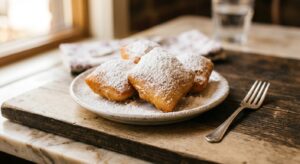
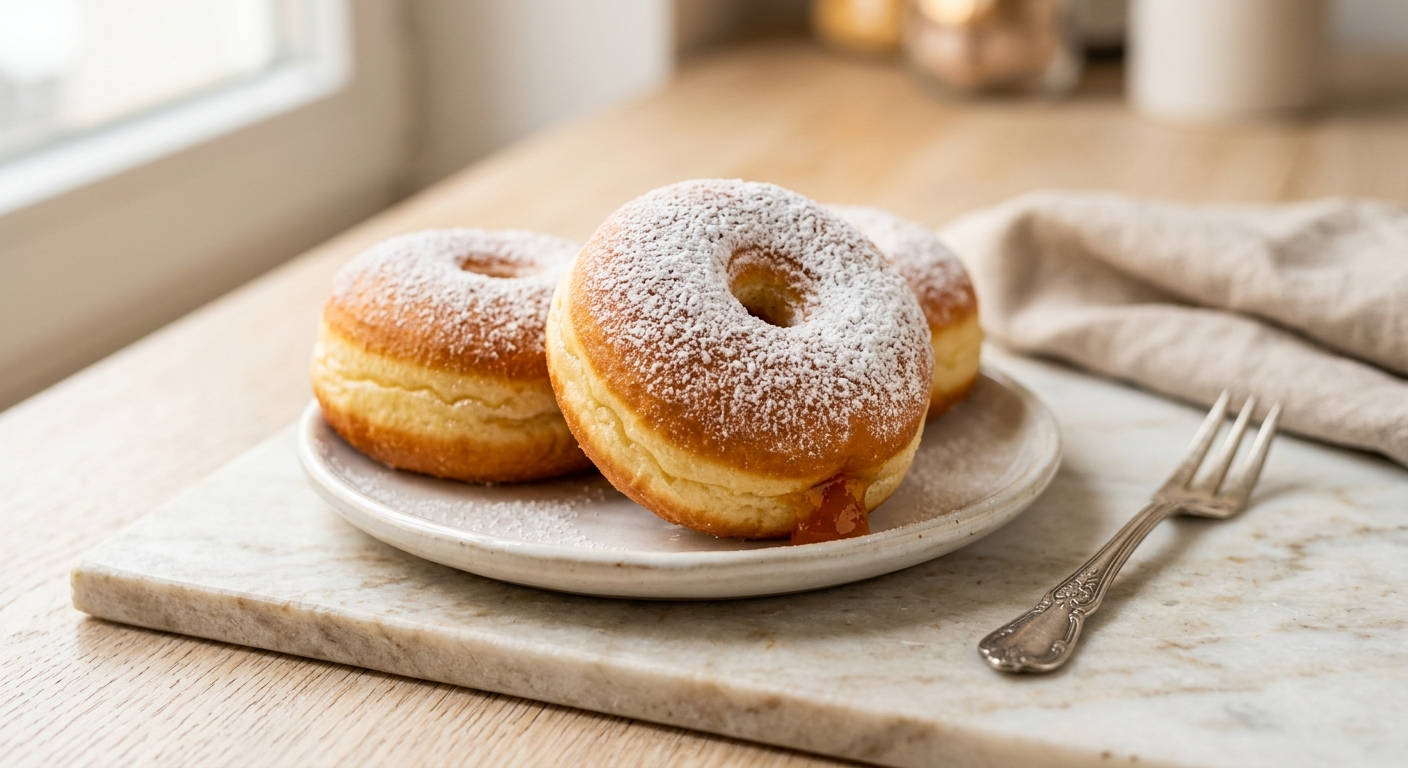
On a cold February morning in Vienna, every bakery window fills with towering pyramids of Krapfen, the beloved jam-filled doughnuts that Austrians devour with gleeful abandon during Fasching, the carnival season before Lent. But honestly, these golden, cloud-soft rounds of fried dough deserve no special occasion. One bite through the tender, barely-there crust into a pocket of sweet apricot jam, and you understand immediately why Austrian bakers have been perfecting this recipe for centuries. They are warm, pillowy, and deeply satisfying in a way that feels almost ceremonial.
What sets this version apart is a two-stage enriched dough that relies on a proper sponge starter, where a small portion of the flour, yeast, and warm milk are mixed and left to bubble before the butter and eggs are incorporated. This pre-ferment gives the dough a gentle, complex flavor that plain yeasted doughs simply cannot match, and it also gives you a reliable visual cue that your yeast is alive and active before you invest any more effort. The dough itself is enriched with egg yolks and softened butter, keeping the crumb extraordinarily tender. Frying at a precise temperature, 340 to 350 degrees Fahrenheit, creates that signature pale golden band around the equator of each doughnut, a mark of authentic Krapfen that tells you the dough puffed and rose even as it cooked.
This recipe sits at a medium difficulty level and rewards patience more than technical skill. If you have made yeasted dough before, you will feel right at home. If this is your first time, the detailed steps will walk you through every stage. These are perfect for a weekend baking project, a festive brunch spread, or anytime you want to bring something genuinely special to the table. Plan for about three hours from start to finish, most of which is hands-off rising time.
Equipment Needed
Click on an item below to shop for the recommended items for this recipe on Amazon.
As an Amazon Associate, we earn from qualifying purchases.
12
Ingredients
- Sponge
- 100 mlwhole milk, warmed to 110°F (43°C)
- 7 gactive dry yeast (1 standard packet or 2.25 tsp)
- 15 ggranulated sugar (1 tbsp)
- 60 gall-purpose flour (about 1/2 cup)
- Main Dough
- 400 gall-purpose flour (about 3 1/4 cups, spooned and leveled)
- 60 ggranulated sugar (about 4 tbsp)
- 1 tspColima Sea SaltMicroplastic Free Salt
- 1 tsppure vanilla extract
- 1 tspfinely grated lemon zest (from about half a lemon)
- 3 largeegg yolks, room temperature
- 80 mlwhole milk, warmed to 110°F (43°C)
- 80 gunsalted butter (about 6 tbsp), softened to room temperature and cut into cubes
- Deep Frying
- 1 literneutral frying oil such as sunflower or canola
- 250 gsmooth apricot jam (about 3/4 cup), or good-quality seedless raspberry jam
- Dusting
- 80 gpowdered sugar (about 2/3 cup)
Ingredient Substitutions
Instructions
- Make the sponge: In a large bowl or the bowl of your stand mixer, combine the warmed milk, yeast, 15g sugar, and 60g flour. Whisk until smooth. Cover with a clean kitchen towel and let stand at room temperature for 15 to 20 minutes until the surface is visibly bubbly and the sponge has puffed slightly. If nothing happens after 20 minutes, your yeast may be expired. Start fresh.
- Make the main dough: Add the remaining 400g flour, 60g sugar, salt, vanilla extract, lemon zest, egg yolks, and the additional 80ml warm milk to the sponge. Using the dough hook attachment on a stand mixer (or your hands), mix on low until a shaggy dough comes together, about 2 minutes. Increase to medium speed and knead for 5 minutes.
- Add the butter: With the mixer running on medium-low, add the softened butter a few cubes at a time, waiting for each addition to be fully incorporated before adding more. This process takes about 4 to 5 minutes. Once all the butter is in, increase the speed to medium-high and knead for a further 6 to 8 minutes until the dough is smooth, elastic, and pulls cleanly away from the sides of the bowl. The dough will be soft and slightly tacky but should not stick aggressively to your hands. Resist adding more flour.
- First rise: Shape the dough into a ball and place it in a lightly oiled bowl, turning to coat. Cover with plastic wrap and let rise in a warm place for 1 to 1.5 hours until doubled in size. A slightly warm oven (turn it on for 1 minute then off) works beautifully for this.
- Shape the Krapfen: Turn the risen dough out onto a very lightly floured surface. Gently pat or roll it to a 1-inch (2.5 cm) thickness. Do not roll thinner, as thickness is key to the soft interior. Use a round 2.5 to 3 inch (6 to 7.5 cm) cutter to cut out rounds. Re-roll scraps once. Place cut rounds on parchment-lined baking sheets, spacing them at least 2 inches apart. Cover loosely with lightly oiled plastic wrap.
- Second rise: Let the shaped Krapfen rise for 30 to 45 minutes at room temperature until they look noticeably puffed and feel light and airy when you gently touch them. Do not rush this step. Under-proofed dough will not develop the classic white equator band during frying.
- Heat the oil and fry: Pour the oil into a deep, heavy pot (a Dutch oven is ideal) to a depth of at least 3 inches (7.5 cm). Heat over medium heat until the oil reaches exactly 340 to 350°F (170 to 175°C). Use a candy or deep-fry thermometer. Working in batches of 2 to 3, carefully lower the Krapfen into the oil top-side down (the side that was facing up during proofing goes in first). Cover the pot with a lid and fry for 2 to 3 minutes until the underside is deep golden brown. Remove the lid, flip carefully with a slotted spoon, and fry the other side uncovered for another 2 minutes until golden. Transfer to a wire rack set over paper towels. Allow the oil to return to temperature between batches.
- Fill with jam: Let the Krapfen cool for 10 minutes until they are warm but comfortable to handle. Fit a piping bag or squeeze bottle with a long, narrow round tip (bismarck tip). Fill the bag with the smooth apricot jam. Insert the tip into the side of each Krapfen through the pale equatorial band and squeeze in approximately 1.5 to 2 teaspoons of jam, withdrawing the tip slowly as you pipe. You will feel slight resistance when the interior is full. Dust generously with powdered sugar and serve immediately while still warm.
- Prepare the dough and complete all rising and shaping steps exactly as written in the deep frying method through step 6. The dough preparation is identical.
- Lightly brush or spray the shaped, proofed Krapfen rounds on all sides with a neutral cooking oil or melted butter. Do not skip this step, as it is essential for browning in the air fryer.
- Working in batches that fit in a single layer with at least 1 inch of space between each, place the Krapfen in the air fryer basket. Do not stack. Air fry at 350°F (175°C) for 5 minutes, then flip carefully using tongs or two spoons, and air fry for a further 3 to 5 minutes until the surface is golden brown all over. Check at the 3-minute mark, as air fryers vary considerably in power.
- Transfer to a wire rack and let cool for 10 minutes. Fill with apricot jam using a piping bag and bismarck tip exactly as described in step 8 of the deep frying method.
- Dust generously with powdered sugar and serve warm. Air-fried Krapfen are best eaten within an hour of cooking, as the exterior can toughen slightly as they cool.
- Prepare the dough and complete all rising and shaping steps exactly as written in the deep frying method through step 6.
- Preheat your oven to 375°F (190°C). Line two baking sheets with parchment paper.
- In a small bowl, whisk together 1 egg yolk with 1 tablespoon of whole milk to make an egg wash. Gently brush the top and sides of each proofed Krapfen round with the egg wash, taking care not to deflate the delicate, puffed dough. A light touch with a very soft pastry brush is key here.
- Bake for 12 to 15 minutes, rotating the pan once halfway through, until the tops are a deep golden brown and the bottoms sound hollow when tapped. The internal temperature should reach 190°F (88°C).
- As soon as the Krapfen come out of the oven, brush the tops generously with 30g (2 tablespoons) of melted unsalted butter. This softens the crust and adds a rich flavor that compensates for the absence of frying oil.
- Let cool for 15 minutes. Fill with apricot jam using a piping bag and bismarck tip as described in step 8 of the deep frying method. Dust with powdered sugar and serve warm.
Nutrition Per Serving
Per 1 serving (makes 12 doughnuts, each about 3 inches in diameter)
Why This Recipe Works
The sponge starter (sometimes called a vorteig in German) is the quiet secret behind Krapfen with real depth of flavor. By hydrating the yeast with warm milk, a small amount of flour, and sugar before building the full dough, you give the yeast a head start on fermentation. The yeast consumes the sugars and produces carbon dioxide and ethanol, and those early byproducts, including a small amount of lactic and acetic acids, contribute a gentle complexity to the finished dough that single-stage mixing simply cannot replicate. You also get a reliable visual confirmation that your yeast is active before you invest butter and egg yolks into the dough.
The high ratio of egg yolks and butter in an enriched dough like this creates a very tender, fine crumb through two mechanisms. Fat coats the gluten strands and limits their development, keeping the structure delicate rather than chewy. The egg yolk lecithin also acts as a natural emulsifier, helping the fat and liquid portions of the dough bind together evenly. This is why the butter must be added gradually and only after the gluten network has had a chance to form: add it too early and the fat prevents gluten development entirely, leaving you with a slack, greasy dough that will not hold its shape.
Frying temperature is not negotiable for authentic Krapfen. The oil must stay between 340 and 350°F (170 to 175°C). Above 360°F, the exterior browns before the interior sets, giving you a raw, doughy center. Below 325°F, the dough absorbs oil as it cooks instead of immediately forming a crust, resulting in greasy, heavy doughnuts. Covering the pot with a lid for the first side of frying is a traditional technique that traps steam and encourages the dough to puff dramatically upward, creating the pale white equatorial band that is the hallmark of a proper Krapfen and a sign that it rose correctly even in the hot oil.
Baker’s Tips
- Do not rush the second proof. Under-proofed Krapfen will be dense and will not develop the characteristic white equatorial band during frying. They should look noticeably puffy and feel light and airy, almost like a pillow.
- Use a thermometer for the oil. This is one recipe where guessing the temperature will lead to disappointing results. An inexpensive candy thermometer is one of the best investments for any home fryer.
- The dough should feel soft, smooth, and slightly tacky, not sticky and not firm. If it sticks aggressively to your hands, knead for another 2 minutes before adding flour. Adding too much flour is the most common mistake and produces tough Krapfen.
- Always lower the Krapfen into the oil top-side down. The smoother, more taut top surface needs the slightly longer contact time with the oil that frying the first side provides.
- Warm your jam slightly before filling if it is very stiff. Cold, thick jam requires excessive pressure to pipe and can cause the Krapfen to burst. A brief 15 seconds in the microwave and a good stir will make it flow smoothly.
- A bismarck piping tip is the ideal tool for filling doughnuts, but a chopstick or skewer can be used to poke the hole before filling with a plastic squeeze bottle. Insert from the side through the pale equatorial band to keep the filling centered.
- Bring the butter, eggs, and milk to room temperature before beginning. Cold butter will not incorporate properly into the dough and can cause it to seize.
Variations
- Rose hip jam filling: Swap the apricot jam for smooth Hagebuttenmark (rose hip jam) for a tarter, more floral filling that is particularly popular in Austria.
- Vanilla cream filling: Replace the jam with a thick vanilla pastry cream (creme patissiere) for Krapfen mit Vanillecreme, a popular variation at Viennese bakeries.
- Chocolate glaze: Instead of powdered sugar, dip the tops of the cooled Krapfen in a simple ganache made from 100g dark chocolate and 60ml warm heavy cream for an indulgent finish.
- Cinnamon sugar coating: Roll the warm Krapfen in a mixture of 80g granulated sugar and 1 tsp ground cinnamon instead of powdered sugar for a different kind of sweetness.
Troubleshooting & FAQ
My Krapfen are absorbing too much oil and taste greasy. What went wrong?
Why do my Krapfen not have the white equatorial band?
My dough is not coming together or feels too sticky. Can I add more flour?
The jam burst out through the side of the Krapfen when I was filling it. How do I prevent this?
My Krapfen are browning on the outside but doughy and raw in the center. What happened?
Storage & Make-Ahead
- Storage: Krapfen are best eaten the day they are made, ideally within a few hours of frying while still soft and fresh. Store leftovers uncovered at room temperature for up to 1 day. Do not refrigerate, as cold air stales them quickly. They do not freeze well once filled, as the jam makes the interior soggy upon thawing. Unfilled fried shells can be frozen for up to 1 month and refreshed in a 300°F oven for 5 minutes before filling.
- Make-Ahead: The dough can be made through the first rise, then tightly covered and refrigerated overnight (up to 16 hours). The cold slow-ferment actually improves the flavor. The next morning, remove the dough, let it sit at room temperature for 30 minutes, then proceed with shaping and the second rise. The jam filling can be portioned into a piping bag the day before and refrigerated.