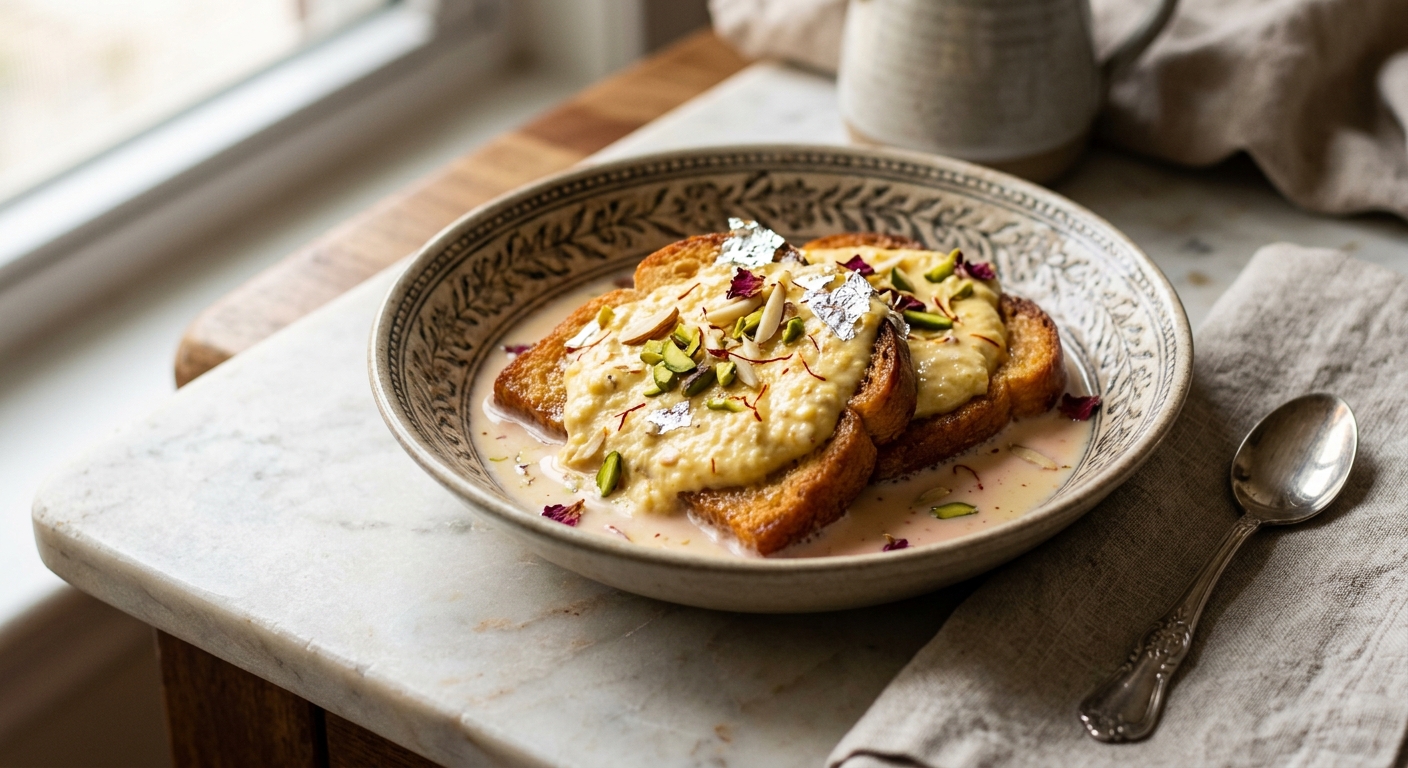
Somewhere between a bread pudding and a royal dream, Shahi Tukda has been gracing the tables of Mughal feasts for centuries. The name itself means “royal piece,” and the moment you take your first bite – creamy, perfumed, faintly crunchy at the edges, drenched in rose-scented milk – you will understand exactly why. This is the kind of dessert that makes a room go quiet. Thick, golden triangles of bread are fried in clarified butter until impossibly crisp, then soaked in a delicate rose and cardamom milk syrup before being crowned with rabri, a slow-cooked reduced milk that thickens into something between clotted cream and silk. A scatter of pistachios, a few dried rose petals, and a thread of saffron finish the dish with the kind of beauty that feels effortless but tastes like it took all day.
What sets this version apart is the treatment of the rabri. Rather than a quick condensed-milk shortcut (though that option is here if you need it), the rabri is made the traditional way – a full slow reduction of whole milk that clings to the sides of the pan in layers, scooped back in, and coaxed into a thick, deeply flavored cream. The rose milk base uses both rose water and a touch of rose syrup for a more layered, natural floral note, and the saffron is bloomed in warm milk before it goes in, releasing every bit of its golden color and honey-like fragrance. These small commitments make an extraordinary difference.
In terms of difficulty, this recipe falls somewhere in the middle – there is nothing technically difficult here, but the rabri does require patience and attention. If you are new to Indian sweets, think of it as a gentle introduction to a deeply rewarding tradition. This recipe is perfect for Eid, Diwali, a dinner party centerpiece, or any occasion when you want to serve something that feels genuinely special. The components can all be made ahead, making it far more practical than it might appear at first glance.
Equipment Needed
Click on an item below to shop for the recommended items for this recipe on Amazon.
As an Amazon Associate, we earn from qualifying purchases.
8
Ingredients
- Blooming Saffron (divided Into 2 Tbsp Portions)
- 8 slicesthick white sandwich bread or brioche, crusts removed (about 1.5 cm / 0.6 inch thick)
- 80 gghee (about 5.5 tbsp), for frying, plus more if needed
- 1200 mlwhole full-fat milk (about 5 cups), divided – 900 ml for rabri, 300 ml for rose milk
- 150 gcaster sugar (about 3/4 cup), divided – 100 g for rabri, 50 g for rose milk
- 0.5 tspsaffron strands, divided – a generous pinch for rabri, a pinch for rose milk
- 4 tbspwarm whole milk
- 1.5 tspground cardamom, divided – 1 tsp for rabri, 0.5 tsp for rose milk
- 2 tbsprose water
- 1 tbsprose syrup (such as Rooh Afza), plus extra for drizzling
- 30 gpistachios, roughly chopped (about 3 tbsp)
- 15 gblanched almonds, thinly slivered (about 2 tbsp)
- Garnish
- —Small handful of dried edible rose petals
- A Traditional Presentation
- —Silver leaf (varak), optional
Ingredient Substitutions
Instructions
- Make the saffron rabri first, as it takes the longest. Pour 900 ml of whole milk into a wide, heavy-bottomed saucepan (a stainless steel or light-colored pan helps you see the milk solids forming). Bring to a boil over medium-high heat, stirring occasionally to prevent scorching. Once it boils, reduce the heat to medium-low. Bloom a generous pinch (about 0.3 tsp) of saffron strands in 2 tbsp of warm milk and set aside. Add 100 g caster sugar and 1 tsp cardamom to the simmering milk. Let the milk simmer uncovered, stirring every 4 to 5 minutes and scraping the dried milk solids (malai) from the sides and bottom back into the pan. Do this patiently for 35 to 45 minutes, until the milk has reduced to roughly one third of its original volume and is thick, creamy, and golden. Stir in the bloomed saffron milk. Taste and adjust sugar. Remove from heat and let cool – the rabri will thicken further as it cools.
- While the rabri simmers, prepare the rose milk. In a small saucepan, gently warm 300 ml of whole milk with 50 g caster sugar over low heat, stirring until the sugar dissolves completely. Do not boil. Bloom the remaining pinch of saffron in 2 tbsp of warm milk. Remove the pan from heat and stir in the rose water, rose syrup, 0.5 tsp cardamom, and bloomed saffron. Taste – it should be lightly sweet, floral, and warmly spiced. Pour into a wide, shallow dish large enough to hold the bread slices. Set aside to cool to room temperature.
- Cut each slice of bread diagonally into 2 triangles, giving you 16 triangles total. Place the bread pieces on a wire rack or a tray lined with a clean kitchen towel and let them sit uncovered for 10 to 15 minutes to dry out slightly on the surface. This step is important – slightly dried bread absorbs the rose milk beautifully without becoming completely mushy.
- Heat 40 g of ghee in a wide, heavy skillet over medium heat until shimmering and fragrant. Working in batches to avoid crowding, fry the bread triangles for 2 to 3 minutes per side until deeply golden and crisp. Press them gently with a spatula – you are listening for that satisfying sizzle. Add more ghee between batches as needed. Transfer fried bread to the wire rack. Do not stack them or they will steam and lose their crispness.
- While the fried bread is still warm (but not hot enough to make the milk syrup boil), arrange the triangles in a single layer in the dish of rose milk. Let them soak for 3 to 4 minutes per side – just enough time to absorb the fragrant milk without losing all their structure. They should be tender and perfumed but still hold their shape when lifted. Arrange the soaked triangles in a serving dish (a large platter or individual shallow bowls both work beautifully).
- Spoon the cooled saffron rabri generously over the bread triangles, ensuring every piece is partially covered. Scatter over the chopped pistachios and slivered almonds. Add a few dried rose petals and a drizzle of extra rose syrup for color. If using silver leaf, lay it delicately over the top just before serving. Refrigerate for at least 1 hour before serving – the dessert improves significantly as it chills and the flavors meld. Serve cold or at cool room temperature.
- Preheat your oven to 375°F (190°C). Line a large rimmed baking sheet with parchment paper. Cut each bread slice into 2 triangles (16 triangles total). Melt the 80 g of ghee and brush both sides of each bread triangle generously and evenly – do not skip this step, as the ghee is what gives the toasts their richness and color in the absence of direct frying.
- Arrange the buttered triangles in a single layer on the prepared baking sheet. Bake for 10 to 12 minutes, then flip each triangle carefully with a spatula and bake for a further 8 to 12 minutes until both sides are deep golden brown and completely crisp. Watch closely in the final few minutes as they can go from golden to burnt quickly. Transfer to a wire rack and allow to cool for 5 minutes.
- Make the rabri using the stovetop method described above (Steps 1 of the stovetop method). Prepare the rose milk soaking liquid as described in Step 2 of the stovetop method and pour it into a wide, shallow dish.
- Soak the oven-toasted bread triangles in the rose milk for 4 to 5 minutes per side (slightly longer than the fried version, as oven-toasted bread is drier and benefits from a little more soaking time). The pieces should feel tender and saturated but still hold their shape.
- Arrange the soaked triangles in a serving dish or individual bowls. Spoon the cooled saffron rabri over generously. Garnish with chopped pistachios, slivered almonds, dried rose petals, a drizzle of rose syrup, and silver leaf if using. Refrigerate for at least 1 hour before serving.
- Pour 900 ml of whole milk into the slow cooker insert. Add 100 g caster sugar and 1 tsp ground cardamom. Stir well to dissolve the sugar. Set the slow cooker to Low heat, prop the lid open about 1 cm with a wooden spoon handle (this allows steam to escape and the milk to reduce), and cook for 4 to 5 hours, stirring every 45 to 60 minutes. The milk will gradually reduce and thicken into a creamy, lightly golden rabri. During the last 30 minutes, bloom a generous pinch of saffron in 2 tbsp warm milk and stir it into the slow cooker.
- About 30 minutes before the rabri is done, prepare the rose milk soaking liquid. In a small saucepan, warm 300 ml whole milk with 50 g caster sugar over low heat until sugar dissolves. Remove from heat. Stir in rose water, rose syrup, 0.5 tsp cardamom, and the remaining bloomed saffron (a pinch bloomed in 2 tbsp warm milk). Pour into a wide, shallow dish and allow to cool.
- Cut the bread slices into triangles and fry in ghee on the stovetop (see stovetop method, Step 3 and 4) or brush with melted ghee and oven-toast at 375°F (190°C) for 20 to 22 minutes, flipping halfway, until deeply golden and crisp. Both options work well alongside this slow cooker method.
- Soak the crisp bread triangles in the rose milk for 3 to 5 minutes per side. Arrange in a serving dish. Spoon the warm or cooled slow cooker rabri generously over the bread. The rabri can be used slightly warm for a comforting, softly melting effect or chilled for a firmer, colder presentation.
- Garnish with chopped pistachios, slivered almonds, dried rose petals, a drizzle of rose syrup, and silver leaf if desired. Refrigerate for at least 1 hour before serving for best flavor. The dessert will keep refrigerated for up to 2 days.
Nutrition Per Serving
Per 1 serving (makes 8 generous individual servings (2 bread triangles per person))
Why This Recipe Works
The magic of Shahi Tukda is entirely about contrasts that resolve into harmony. Frying the bread in ghee does two critical things: the high smoke point of clarified butter allows the bread surface to reach temperatures that drive off moisture rapidly and trigger the Maillard reaction, creating a deeply golden, nutty crust. That sturdy fried exterior then acts as a slow-release sponge for the rose milk – it holds its structure just long enough to absorb the fragrant soaking liquid without disintegrating, giving you bread that is simultaneously crisp at the first bite and custard-tender within. If you use fresh, soft bread without drying it first, the structure will be too fragile and the pieces will fall apart during soaking. Letting the slices air-dry for 10 to 15 minutes before frying makes a real difference.
The rabri works through patient evaporation and protein concentration. As the milk reduces, water content drops dramatically and the milk solids – primarily casein proteins and lactose – concentrate and interact. The lactose undergoes gentle caramelization at the surface of the pan, contributing subtle nutty-sweet notes. Scraping those dried solids (malai) back into the milk is not just traditional practice – it is how the rabri develops its characteristic slightly grainy, layered texture and complex flavor. Using full-fat milk is non-negotiable here: low-fat milk lacks sufficient protein and fat to develop that characteristic richness and will take considerably longer to reduce to the right consistency.
Blooming saffron in warm (not hot) milk before adding it is a step many recipes skip, but it is genuinely important. Saffron’s key flavor compounds, including safranal and picrocrocin, are not fully soluble in cold liquid and can be destroyed by very high heat. A warm milk bloom, at roughly 60 to 70°C (140 to 158°F), extracts the full color (from crocin) and the full fragrance in a way that simply adding strands directly to the hot pan never quite achieves. If your saffron bloom is not producing a vivid orange-gold color within 10 minutes, your saffron may be old or low quality and you may need a little more.
Baker’s Tips
- Use bread that is at least one day old, or let fresh bread slices sit uncovered for an hour before using. Slightly stale bread fries more evenly and absorbs the rose milk without falling apart.
- Keep the heat at medium when frying in ghee – too high and the outside will brown before the interior dries out, resulting in bread that goes soggy quickly. You want a steady, controlled golden crust that develops over 2 to 3 minutes per side.
- Taste your rose milk before soaking the bread. It should be pleasantly sweet and clearly floral. Rose water brands vary enormously in strength – some are very potent, others nearly flavorless. Adjust by adding more rose syrup for sweetness and aroma, or a touch more cardamom for warmth.
- Do not skip the chill. Shahi Tukda is one of those desserts that genuinely transforms in the refrigerator. After an hour (or overnight), the bread absorbs more of the rabri’s flavor, the texture becomes more uniform, and the saffron fragrance deepens. It is noticeably better cold.
- For an elegant individual presentation, serve two soaked triangles slightly overlapping in a shallow bowl or a small deep plate, then spoon the rabri over generously and garnish just before bringing to the table.
- If your rabri thickens too much upon refrigerating, stir in a splash of cold whole milk and gently mix – it will loosen to a pourable cream consistency without any loss of flavor.
Variations
- Mango Shahi Tukda: Replace the rose milk soak with a lightly sweetened mango puree thinned with a little milk (about 200 ml mango puree to 100 ml milk, 1 tbsp sugar). Garnish with fresh mango slices and skip the rose petals.
- Chocolate and Cardamom version: Add 2 tbsp of dark cocoa powder to the rose milk soaking liquid and omit the rose water and syrup. The rabri stays the same and the cardamom-chocolate combination is unexpected and wonderful.
- Gluten-free option: Use thick slices of gluten-free white sandwich bread. The texture will be slightly more crumbly after soaking, so handle with care and consider serving in individual ramekins to hold the shape.
- Condensed milk shortcut for the rabri: Combine one 400 g can of sweetened condensed milk with 200 ml of whole milk, a generous pinch of saffron (bloomed), and 1 tsp cardamom. Heat gently for 8 to 10 minutes, stirring constantly, until slightly thickened. This saves 30 to 40 minutes and the result is quite good, if sweeter and less nuanced than the traditional method.
Troubleshooting & FAQ
My bread fell apart completely when I soaked it in the rose milk. What went wrong?
My rabri is taking much longer than expected to thicken. Is something wrong?
My rose milk soaking liquid smells very strongly of rose water. Did I add too much?
The saffron is not giving much color or fragrance. Why?
Can I assemble the whole dish a day ahead, or will it get too soggy?
Storage & Make-Ahead
- Storage: Store assembled Shahi Tukda covered in the refrigerator for up to 2 days. The rabri can be stored separately in an airtight container in the refrigerator for up to 4 days. The fried or toasted bread is best made on the day of serving for optimal texture, though leftover assembled dessert still tastes wonderful the next day as the flavors deepen.
- Make-Ahead: The rabri can be made up to 3 days ahead and refrigerated. The rose milk soaking liquid can be made 1 day ahead and refrigerated. The bread is best fried or toasted within a few hours of serving, though it can be made several hours ahead and stored uncovered at room temperature to stay crisp. Assemble and refrigerate at least 1 hour before serving.