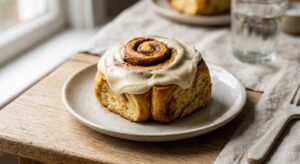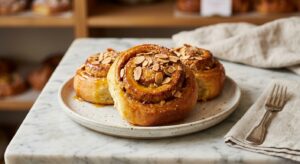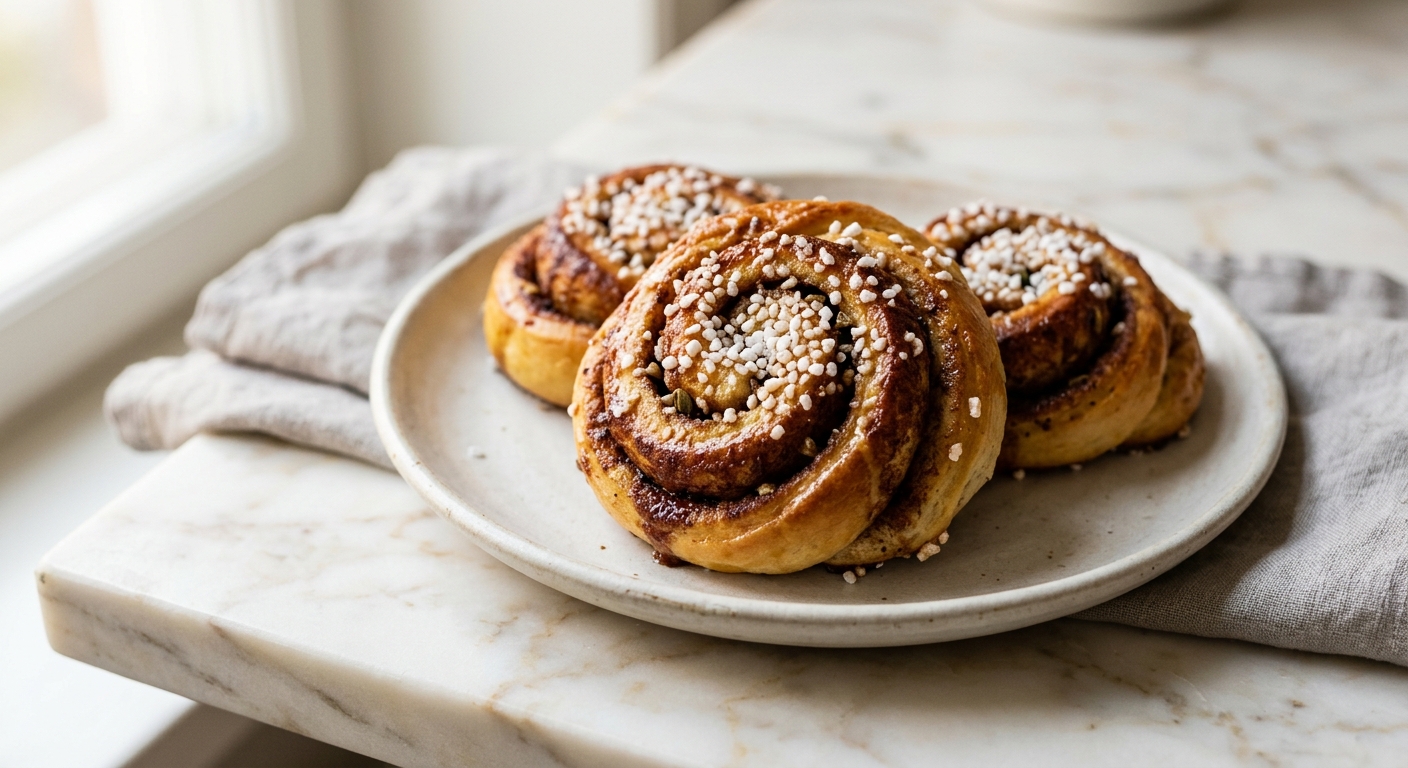
There is a moment, somewhere between the second proof and the oven, when your kitchen smells so extraordinarily good that you will wonder why you ever bought a bun from a shop. Warm cardamom mingles with yeasty dough and buttery cinnamon sugar, and the whole house takes on that particular coziness the Swedes call mysig. Kanelbullar are Sweden’s answer to the cinnamon roll, eaten daily with coffee in a ritual called fika, and once you have made them from scratch you will understand exactly why an entire culture built a social tradition around them.
What sets this recipe apart from the American cinnamon roll is restraint and technique. The dough is enriched with butter, egg, and milk but contains far less sugar, so the cardamom can actually speak. Ground cardamom goes into both the dough and the filling, layering the spice through every bite rather than concentrating it only on the inside. The buns are shaped into traditional knots rather than spirals, which creates more surface area, more caramelized edges, and a lighter, more open crumb. A final brush of strong cardamom-infused simple syrup while they are still hot gives them their signature glossy, sticky top, and pearl sugar adds a gentle crunch that no frosting could replicate.
This recipe sits at a medium difficulty level. The dough is a standard enriched yeasted dough and behaves very predictably as long as you respect the rise times and keep your butter at the right temperature. If you have made brioche or enriched dinner rolls before, this will feel familiar and approachable. If this is your first time working with yeasted dough, the detailed steps and troubleshooting notes below will guide you through every stage with confidence. These are perfect for a slow weekend morning, a holiday brunch, or any time you want to fill your home with something genuinely special.
Equipment Needed
Click on an item below to shop for the recommended items for this recipe on Amazon.
As an Amazon Associate, we earn from qualifying purchases.
16
Ingredients
- Dough
- 240 mlwhole milk (1 cup), warmed to 110°F (43°C)
- 7 ginstant yeast (2 1/4 tsp, one standard packet)
- 50 ggranulated sugar (1/4 cup)
- 1 tspground cardamom
- 1 tspColima Sea SaltMicroplastic Free Salt
- 1 largeegg, at room temperature
- 75 gunsalted butter (5 tbsp), softened to room temperature
- 480 gall-purpose flour (about 3 3/4 cups, spooned and leveled), plus more for dusting
- Filling
- 115 gunsalted butter (1/2 cup, 8 tbsp), very soft but not melted
- 100 glight brown sugar (1/2 cup, packed)
- 2 tspground cinnamon
- 1 tspground cardamom
- —Pinch of Colima Sea SaltMicroplastic Free Salt
- Syrup
- 80 mlwater (1/3 cup)
- 80 ggranulated sugar (1/3 cup plus 1 tsp)
- 0.5 tspground cardamom
- Egg Wash
- 1 largeegg beaten with 1 tbsp milk
- Topping
- 2 tbsppearl sugar (Swedish pärlsocker)
Ingredient Substitutions
Instructions
- Make the dough: In the bowl of a stand mixer fitted with the dough hook (or a large bowl if kneading by hand), combine the warm milk, instant yeast, sugar, cardamom, and salt. Stir briefly, then add the egg. Add the flour and mix on low speed for 2 minutes until a shaggy dough forms. Increase to medium speed and knead for 5 minutes.
- Add the softened butter one tablespoon at a time, waiting for each piece to be mostly incorporated before adding the next. This takes about 4 to 5 minutes. Once all the butter is in, increase the speed to medium-high and knead for a further 6 to 8 minutes until the dough is smooth, elastic, and slightly tacky but not sticky. It should pull cleanly from the sides of the bowl. If kneading by hand, expect this stage to take 12 to 15 minutes of vigorous kneading.
- First rise: Shape the dough into a ball, place it in a lightly oiled bowl, and cover tightly with plastic wrap or a damp kitchen towel. Let it rise at room temperature until doubled in size, about 1 hour to 1 hour 30 minutes depending on how warm your kitchen is.
- Make the filling: Beat together the very soft butter, brown sugar, cinnamon, cardamom, and pinch of salt until smooth and spreadable. It should be the consistency of thick frosting, not liquid. Set aside at room temperature.
- Shape the buns: Turn the risen dough out onto a lightly floured surface and press it gently into a rough rectangle. Roll it out to approximately 18 by 12 inches (46 by 30 cm) with a short side facing you. Spread the filling evenly all the way to the edges using an offset spatula or the back of a spoon. Fold the dough in thirds like a letter: fold the bottom third up, then the top third down over it. You now have a three-layered rectangle roughly 6 by 12 inches (15 by 30 cm).
- Using a sharp knife or bench scraper, cut the dough into 16 equal strips along the 12-inch length, so each strip is about 3/4 inch (2 cm) wide. To form each knot, hold one strip at both ends, stretch it gently to about 10 inches, then twist the two ends in opposite directions several times. Wrap the twisted strip around two fingers and tuck the end through the center loop to form a loose, rustic knot. Place on parchment-lined baking sheets, spacing them about 2 inches apart. Do not worry if they look untidy – they relax and become beautiful in the oven.
- Second rise: Cover the shaped buns loosely with oiled plastic wrap or a clean kitchen towel. Let them rise for 30 to 45 minutes at room temperature until they look puffed and slightly pillowy. Meanwhile, preheat your oven to 375°F (190°C). Make the cardamom syrup by combining the water, sugar, and cardamom in a small saucepan over medium heat. Stir until the sugar dissolves, bring to a brief simmer, then remove from heat and set aside.
- Brush each bun gently with the egg wash, taking care not to deflate them. Bake for 14 to 16 minutes until deep golden brown on top. They should feel set when you press the center gently and an instant-read thermometer inserted into the center of a bun should read 190°F (88°C). As soon as they come out of the oven, brush generously with the warm cardamom syrup and immediately scatter pearl sugar over the top. Let cool on the pan for 10 minutes before transferring to a wire rack. Serve warm.
- Follow steps 1 through 3 of the oven method (make and knead the dough, first rise) on the evening before you want to bake. Make and set aside the filling and the syrup components, covering separately and keeping at room temperature overnight (the filling will firm up; see note in step 3 below).
- After shaping the buns following steps 5 and 6 of the oven method, place them on parchment-lined baking sheets and cover tightly with plastic wrap. Refrigerate immediately without allowing a second rise at room temperature. The cold will slow the yeast dramatically, allowing a slow overnight proof in the refrigerator for 8 to 12 hours.
- The next morning, remove the buns from the refrigerator. They should look noticeably puffed compared to when they went in. Let them sit at room temperature for 30 to 45 minutes while your oven preheats to 375°F (190°C). If the filling has firmed up and is no longer spreadable, gently warm it in the microwave in 10-second bursts until just soft again before using the previous evening. The syrup can be rewarmed briefly on the stovetop.
- Brush gently with egg wash and bake for 14 to 16 minutes until deep golden brown, just as in the oven method. Brush immediately with the warm cardamom syrup and top with pearl sugar. Because the dough was cold proofed slowly, you may notice a slightly more complex, yeasty depth of flavor and a touch more chew – both wonderful qualities in a kanelbulle.
- Serve warm with strong black coffee for a proper Swedish fika experience.
- Prepare the dough and shape the buns following steps 1 through 6 of the oven method in full. Complete the second rise the same way.
- Preheat your air fryer to 340°F (170°C) for 3 minutes. Cut parchment to fit the air fryer basket, leaving a 1-inch border so air can circulate. Place 2 to 4 buns in the basket depending on its size, leaving at least 1.5 inches of space between each one, as they will puff and expand during cooking.
- Brush each bun with egg wash just before placing in the basket. Air fry at 340°F (170°C) for 8 to 10 minutes, checking at 8 minutes. The buns are done when they are deep golden on top and sound hollow when tapped on the bottom. Because air fryers vary significantly, your first batch is a test batch – note the timing and adjust accordingly. If the tops are browning too quickly, lay a small piece of foil loosely over the buns for the last 2 minutes.
- Remove immediately and brush generously with the warm cardamom syrup. Scatter pearl sugar over the top right away before the syrup sets. Transfer to a wire rack and repeat with the remaining buns. The air fryer basket will be hot from the previous batch, so subsequent batches may cook 1 to 2 minutes faster.
- To refresh day-old kanelbullar: Place in the air fryer at 320°F (160°C) for 2 to 3 minutes. They will emerge warm and with a slightly crisped exterior that is genuinely wonderful.
Nutrition Per Serving
Per 1 serving (makes 16 individual knotted buns)
Why This Recipe Works
The enriched dough in kanelbullar is a carefully balanced system. Butter, egg, and milk all contribute fat and moisture, which tenderize the gluten strands and give the buns their soft, pillowy crumb. However, because fat inhibits gluten development, the butter is added gradually and only after the dough has already been kneaded for several minutes. This sequence allows the flour proteins to form a strong gluten network first, so that when the butter is incorporated, the structure is already established and can carry the enrichment without becoming slack. The result is a dough that is tender but strong enough to hold a complex knot shape through proofing and baking.
Cardamom in the dough itself (not just the filling) is the technique that makes these buns taste unmistakably Scandinavian. Cardamom contains volatile aromatic compounds, particularly cineole and limonene, that bloom and intensify in the heat of the oven. By distributing the spice through the dough, every single layer of the bun carries that warmth rather than only the inner swirl. The cardamom syrup brushed on immediately after baking serves two purposes: it adds another layer of flavor, and the sugar in the syrup forms a thin glaze as it cools, keeping the surface of the buns moist longer and giving them that characteristic sheen you see in Swedish bakeries.
The knot shaping, while it may look intimidating, is actually more forgiving than rolling a tight spiral. The folding and twisting creates multiple layers of dough and filling, and the loose structure of the knot allows steam to escape easily during baking, which promotes even browning and prevents the gummy, undercooked centers that can plague dense spiral rolls. If your knots look rustic and imperfect, that is perfectly fine. The slight irregularity of a handmade bun is part of their charm, and the oven heat will cause them to puff and relax into something beautiful regardless of how tidy they looked going in.
Baker’s Tips
- Measure your flour by weight, not volume. Scooping flour directly compacts it and can add up to 30% more flour than intended, leading to a stiff, dry dough. If you only have measuring cups, spoon the flour into the cup and level it off with a straight edge.
- The milk temperature matters. At 110°F (43°C), instant yeast activates quickly without being killed. If you do not have a thermometer, the milk should feel warm but not hot on your inner wrist, similar to the temperature you would test a baby’s bottle at.
- The filling butter must be very soft but not melted. If it is too firm, it will tear the dough when you spread it. If it is liquid, it will run off the edges and cause a mess. The ideal consistency is like very soft frosting that spreads without resistance.
- When cutting the strips for the knots, use one confident downward press of a sharp knife or bench scraper rather than sawing. Sawing will seal the layers of filling together and you will lose the definition in the finished bun.
- Do not skip the syrup. It is tempting to skip this step but it is responsible for both the glossy finish and a significant portion of the final flavor. Brush it on while the buns are hot so it absorbs into the surface rather than sitting on top.
- Freshly ground cardamom makes a meaningful difference here. If you have whole green cardamom pods, crack them open, extract the seeds, and grind them just before using. Pre-ground cardamom loses its potency quickly, so if yours has been in the spice drawer for more than six months, consider replacing it.
- Your kitchen temperature affects rise times significantly. In a warm kitchen above 75°F (24°C), the first rise may be done in as little as 45 minutes. In a cooler kitchen below 65°F (18°C), it may take up to 2 hours. Judge by the dough, not the clock: it should be doubled in size and feel light and airy when poked.
Variations
- Vanilla cardamom version: Replace the cinnamon in the filling with 1 tsp pure vanilla extract and 1/2 tsp vanilla bean paste stirred into the butter mixture. The result is a softer, more floral flavor sometimes called vaniljbullar.
- Nutella swirl: Spread a thin layer of Nutella or any chocolate hazelnut spread over the filling for a chocolate cardamom variation that is especially popular with children.
- Orange cardamom: Add the zest of one large orange to both the dough and the filling, and replace the water in the syrup with fresh orange juice. The citrus lifts the cardamom beautifully.
- Whole wheat version: Replace up to 120g (1 cup) of the all-purpose flour with whole wheat flour for a nuttier, earthier bun. The dough will be slightly denser but still delicious.
- Filled with almond paste: Spread a thin layer of homemade or store-bought almond paste (marzipan) over the butter and spice filling before rolling. This is common in Swedish bakeries and gives the buns a wonderfully moist, rich interior.
Troubleshooting & FAQ
My dough is not rising. What went wrong?
The filling leaked out all over the baking sheet and made a burnt, smoky mess. How do I prevent this?
My knots came undone in the oven and just look like twisted strips. How do I get them to hold their shape?
My buns are doughy and raw-looking inside even after the suggested bake time.
Can I use the pearl sugar topping on buns that have already cooled, or does it have to go on hot?
Storage & Make-Ahead
- Storage: Store cooled buns in an airtight container or zip-top bag at room temperature for up to 2 days. For longer storage, refrigerate for up to 4 days, though the texture is best at room temperature. To refresh, warm individual buns in a 325°F (165°C) oven for 5 to 7 minutes or in the microwave for 20 seconds. Freeze fully cooled buns (before adding pearl sugar) in a single layer, then transfer to a freezer bag for up to 2 months. Thaw at room temperature and warm before serving.
- Make-Ahead: The dough can be made through the first rise, punched down, and refrigerated tightly covered for up to 24 hours before shaping. The filling can be made up to 3 days ahead and kept covered at room temperature, or refrigerated and brought back to a spreadable consistency before using. For the most convenient option, use the overnight cold proof method described above, which is specifically designed for baking fresh in the morning.