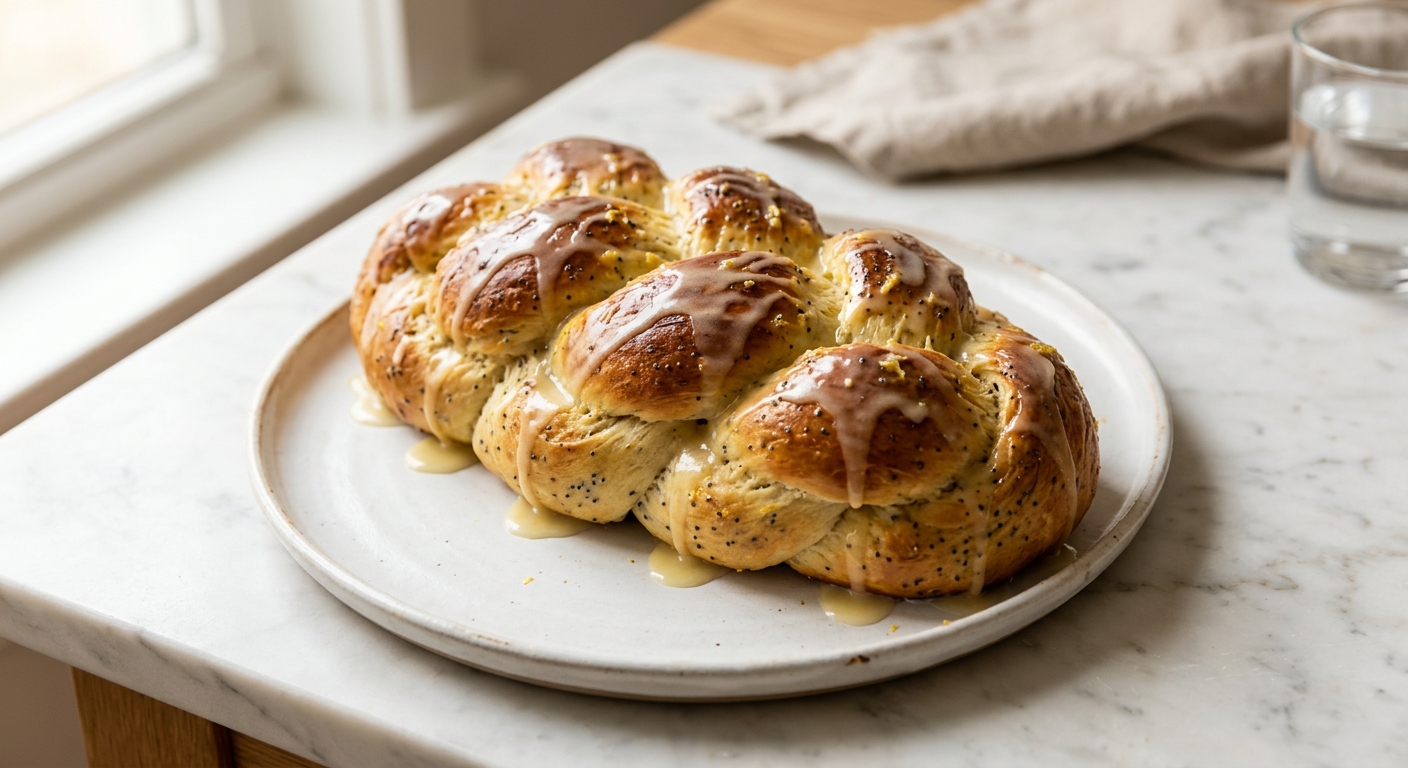
There is something almost theatrical about a braided loaf fresh from the oven. The way the strands twist and bloom, the crust turning a deep amber gold, the scent of lemon mingling with warm yeast dough filling every corner of the kitchen. This Braided Lemon and Poppy Seed Bread sits somewhere between an enriched breakfast loaf and a celebration centerpiece. It is soft and pillowy inside, with a slight chew from the enriched dough, and every bite carries a floral citrus brightness balanced by the gentle, earthy crunch of poppy seeds. Draped in a thin lemon glaze that seeps into the warm crust, it is genuinely hard to wait until it cools before cutting in.
What sets this version apart is the double hit of lemon. Zest goes directly into the dough itself, not just the glaze, so the citrus flavor is baked into the bread from the inside out. A small amount of lemon juice replaces part of the milk in the dough, adding brightness without making the dough acidic enough to slow the yeast. The poppy seeds are lightly toasted before folding in, which deepens their nutty flavor considerably. This is a detail most recipes skip, but it makes a noticeable difference. The braid is a simple three-strand plait, approachable even for first-time bread shapers, and the final glaze is poured over while the loaf is still warm so it absorbs rather than just sitting on the surface.
This bread sits firmly in the medium difficulty range. You need to be comfortable with yeasted dough and a bit of patient kneading, but no stand mixer is required and no special shaping skills are needed beyond a basic three-strand braid. It is ideal for a relaxed weekend morning, a holiday brunch table, or as a thoughtful gift wrapped in parchment. If you have made enriched doughs like brioche or challah before, this will feel pleasantly familiar. If this is your first time, it is an excellent place to start.
Equipment Needed
Click on an item below to shop for the recommended items for this recipe on Amazon.
As an Amazon Associate, we earn from qualifying purchases.
12
Ingredients
- 480 gall-purpose flour (about 3 and 3/4 cups, spooned and leveled), plus extra for dusting
- 7 ginstant yeast (1 standard packet or 2 and 1/4 tsp)
- 50 ggranulated sugar (about 1/4 cup)
- 1 tspColima Sea SaltMicroplastic Free Salt
- 160 mlwhole milk, warmed to 110°F (43°C) (about 2/3 cup)
- 60 mlfresh lemon juice (from about 2 lemons) (about 1/4 cup)
- 2 tbsplemon zest, finely grated and packed (from about 3 lemons)
- 2 largeeggs, at room temperature
- 60 gunsalted butter, softened to room temperature (about 4 tbsp)
- 35 gpoppy seeds, lightly toasted (about 3 tbsp)
- 1 largeegg, beaten with 1 tsp milk (egg wash)
- 120 gpowdered sugar, sifted (about 1 cup)
- 30 mlfresh lemon juice for the glaze (about 2 tbsp)
- 1 tsplemon zest for the glaze
- —Extra poppy seeds for sprinkling on top before baking (optional)
Ingredient Substitutions
Instructions
- Toast the poppy seeds: Place a small dry skillet over medium-low heat. Add the poppy seeds and stir frequently for 2 to 3 minutes until they are fragrant and just beginning to deepen in color. Transfer immediately to a small bowl to cool. Do not let them sit in the hot pan or they will over-toast.
- Make the dough: In the bowl of a stand mixer fitted with the dough hook, or in a large mixing bowl, whisk together the flour, instant yeast, sugar, and salt. In a separate small bowl, whisk together the warm milk, lemon juice, lemon zest, and eggs. Pour the wet ingredients into the dry ingredients and mix on low speed (or stir with a wooden spoon) until a shaggy dough forms, about 2 minutes.
- Knead and add butter: Increase mixer speed to medium and knead for 3 minutes. With the mixer running, add the softened butter one tablespoon at a time, waiting for each piece to incorporate before adding the next. Once all the butter is added, knead for a further 5 to 7 minutes until the dough is smooth, slightly tacky, and pulls away cleanly from the sides of the bowl. If kneading by hand, this stage will take about 10 minutes. Fold in the cooled toasted poppy seeds and knead for 1 additional minute until evenly distributed.
- First rise: Shape the dough into a ball and place in a lightly oiled bowl. Cover with plastic wrap or a damp kitchen towel and let rise at room temperature (about 72 to 75°F / 22 to 24°C) for 1 to 1.5 hours, until doubled in size. If your kitchen is cool, place the bowl in your oven with just the oven light on.
- Shape the braid: Turn the risen dough onto a lightly floured surface and gently deflate it. Divide into three equal portions (about 270g each). Roll each piece into a rope approximately 16 inches (40cm) long, keeping the thickness even. Pinch the three ropes together firmly at one end, then braid them loosely but evenly. A loose braid allows room for the loaf to expand in the oven. Pinch and tuck both ends neatly underneath.
- Second rise: Transfer the braid to a large parchment-lined baking sheet. Cover loosely with lightly oiled plastic wrap and let rise for 45 to 60 minutes, until puffed and noticeably larger. When you gently press a finger into the dough, the indent should spring back slowly, not snap back immediately.
- Bake: Preheat your oven to 350°F (175°C) during the last 20 minutes of the second rise. Brush the loaf evenly with the egg wash, reaching into all the crevices of the braid. Sprinkle with extra poppy seeds if using. Bake for 28 to 32 minutes, until deep golden brown. The internal temperature should read 190 to 195°F (88 to 90°C) on an instant-read thermometer. If the loaf browns too quickly on top, tent loosely with foil after 20 minutes.
- Glaze and cool: Let the baked loaf cool on a wire rack for 10 minutes. Whisk together the powdered sugar, 2 tablespoons lemon juice, and 1 teaspoon lemon zest until smooth and pourable. If it is too thick, add lemon juice a teaspoon at a time. Drizzle generously over the warm loaf, allowing it to soak into the crevices. Let cool for at least 20 more minutes before slicing.
- Prepare the dough exactly as in the oven method through all kneading, the first rise, shaping, and the second rise. For the air fryer, shape the braid slightly shorter and more compact than you would for the oven, fitting it into an oval or round parchment sling that you can lower into and lift out of the basket easily. Trim the parchment so it does not block airflow around the edges.
- Check fit before the second rise: Lower the shaped braid in its parchment sling into the cold air fryer basket to ensure it fits with at least half an inch of clearance on each side. Remove, cover loosely, and complete the second rise, about 45 to 60 minutes, until puffed.
- Preheat and egg wash: Preheat the air fryer to 320°F (160°C) for 3 minutes. Brush the risen loaf with egg wash and sprinkle with extra poppy seeds if desired.
- Air fry with a foil tent: Lower the parchment sling carefully into the preheated basket. Place a small sheet of aluminum foil loosely over the top of the loaf, crimping it lightly around the edges of the parchment to prevent it from flying up in the circulating air. Bake for 15 minutes.
- Remove the foil and finish: Carefully remove the foil tent and continue cooking for a further 7 to 10 minutes until deep golden brown all over. Check the internal temperature with an instant-read thermometer. It should read 190 to 195°F (88 to 90°C). If the bottom feels underdone, flip the sling to expose it to more direct heat for the last 3 minutes.
- Glaze: Lift the loaf out using the parchment sling and rest on a wire rack for 10 minutes. Make and pour the lemon glaze as described in the oven method, and allow to cool for at least 20 more minutes before slicing.
- Make the dough and complete the first rise as described in the oven method. After the dough has doubled, gently deflate and shape the braid as described. Place on a parchment-lined baking sheet.
- Refrigerate overnight: Cover the shaped braid tightly with plastic wrap, making sure the wrap does not touch the dough surface. Refrigerate for 8 to 14 hours. The dough will rise slowly in the refrigerator. By morning it should look noticeably puffed, though it may not have fully doubled.
- Come to temperature: Remove the braid from the refrigerator and let it sit at room temperature, still covered, for 60 to 75 minutes. It should look visibly puffy and relaxed. When you gently press a finger into the dough, the indent should spring back slowly.
- Preheat your oven to 350°F (175°C) while the dough finishes coming to room temperature.
- Egg wash and bake: Brush with egg wash, sprinkle with extra poppy seeds if using, and bake for 28 to 32 minutes until deep golden and the internal temperature reads 190 to 195°F (88 to 90°C). The overnight cold-proofed loaf often develops a slightly more burnished crust due to increased surface sugars from fermentation. Tent with foil after 20 minutes if it browns too fast.
- Glaze: Cool for 10 minutes on a wire rack, then pour over the lemon glaze while still warm and allow to finish cooling for 20 minutes before slicing.
Nutrition Per Serving
Per 1 serving (makes one large braided loaf, approximately 12 slices)
Why This Recipe Works
Enriched bread doughs like this one contain fat, eggs, and sugar, all of which tenderize the crumb by coating the gluten strands and limiting how tightly they bond. This is why the texture of this loaf is so soft and pillowy compared to a lean bread like a baguette. The butter is added gradually after initial gluten development, which is important: adding fat too early prevents the gluten network from forming properly, giving you a dense, gummy loaf. By letting the flour and liquid knead together first, you build a strong enough gluten structure to then accept the fat without falling apart.
The combination of lemon juice and warm milk might seem counterintuitive since acid can inhibit yeast. However, at the ratio used here, the lemon juice is diluted enough that it poses no threat to the yeast while still infusing the dough with genuine citrus flavor. The lemon zest is equally important: the essential oils in citrus zest are fat-soluble, meaning they bind to the butter in the dough and distribute flavor throughout, whereas juice alone would sit mostly in the water phase and bake off more quickly. Toasting the poppy seeds is a simple Maillard reaction step that drives off moisture and develops new aromatic compounds, transforming the seeds from mild and slightly grassy to nutty and complex.
If your dough feels very sticky after all the butter is incorporated, resist adding more flour immediately. Enriched doughs are naturally tacky, and over-flouring leads to a dense, dry loaf. A slightly sticky dough that passes the windowpane test (stretch a small piece thin enough to see light through without tearing) is ready. If the braid spreads rather than rising upward during the second proof, the dough was likely over-proofed and the gluten structure has relaxed too far. Keep an eye on the finger-dent test: slow spring-back is good, no spring-back at all means you have gone too far and should bake immediately regardless of timing.
Baker’s Tips
- Bring the eggs and butter to room temperature before starting. Cold butter will not incorporate smoothly into the dough and cold eggs lower the dough temperature, which slows fermentation and can lead to uneven mixing.
- When rolling the braid strands, start from the center and roll outward toward each end rather than pressing straight down. This gives you an even rope without tapered, thin ends that burn before the center is done.
- Braid loosely. A tight braid will restrict oven spring and give you a dense, compact loaf. Leave a little space between the strands and they will puff beautifully into each other in the oven.
- Use a thermometer to check doneness. The difference between 185°F and 195°F in an enriched loaf is the difference between slightly gummy and perfectly baked. A thermometer removes all guesswork.
- Pour the glaze while the loaf is still warm, not hot and not fully cooled. A warm loaf absorbs the glaze instead of just letting it dry on the surface. Fully cooled bread will leave you with a hard sugar shell rather than a soft, lemony finish.
- Zest your lemons before juicing them. Once juiced, a lemon is nearly impossible to zest effectively. Have all your lemon prep done before you begin.
- If your kitchen is warm and the dough feels slack or sticky during shaping, refrigerate it for 15 minutes before rolling out the strands. A slightly chilled dough is much easier to handle and holds its braid shape better through the second rise.
Variations
- Orange and cardamom version: Replace all the lemon zest and juice with orange zest and juice, and add 1/2 tsp ground cardamom to the dry ingredients. Glaze with an orange powdered sugar glaze for a warmly spiced, fragrant alternative.
- Lemon cream cheese swirl: Before braiding, roll each rope slightly flat and spread with 80g of softened cream cheese mixed with 2 tbsp lemon curd. Roll each strand back up into a rope before braiding. The filling will seep into the loaf as it bakes.
- Poppy seed filling braid: Instead of folding seeds into the dough, roll the dough flat into a rectangle, spread with a thick poppy seed filling (blended poppy seeds cooked with sugar, milk, and lemon zest), roll into a log, and cut lengthwise before twisting and shaping.
- Mini individual braids: Divide the dough into six portions instead of three, shape into six small braids, and bake at 350°F (175°C) for 18 to 22 minutes. Perfect for gift-giving or individual servings at a brunch.
Troubleshooting & FAQ
My dough did not rise during the first proof. What went wrong?
My braid spread out flat during baking instead of rising upward. What happened?
The loaf is very brown on the outside but doughy inside. What went wrong?
My braid came undone in the oven and the strands separated. How do I prevent that?
My lemon glaze dried into a hard, crackly shell instead of soaking in. What should I do differently?
Storage & Make-Ahead
- Storage: Store the cooled, glazed loaf loosely wrapped in parchment and then foil, or in an airtight container, at room temperature for up to 2 days. For longer storage, refrigerate for up to 5 days, though the crumb will firm slightly. To refresh, warm individual slices in a toaster oven or under a low broiler for 2 to 3 minutes. The unglazed baked loaf freezes beautifully: wrap tightly in plastic wrap and then foil and freeze for up to 2 months. Thaw overnight at room temperature and glaze before serving.
- Make-Ahead: The dough can be made through the first rise, deflated, shaped, and refrigerated overnight before the second rise (see the Overnight Cold Proof method). Alternatively, the unglazed baked loaf can be frozen for up to 2 months and glazed fresh after thawing. The lemon glaze can be made up to 3 days ahead and stored in a sealed jar in the refrigerator. Stir well before using.