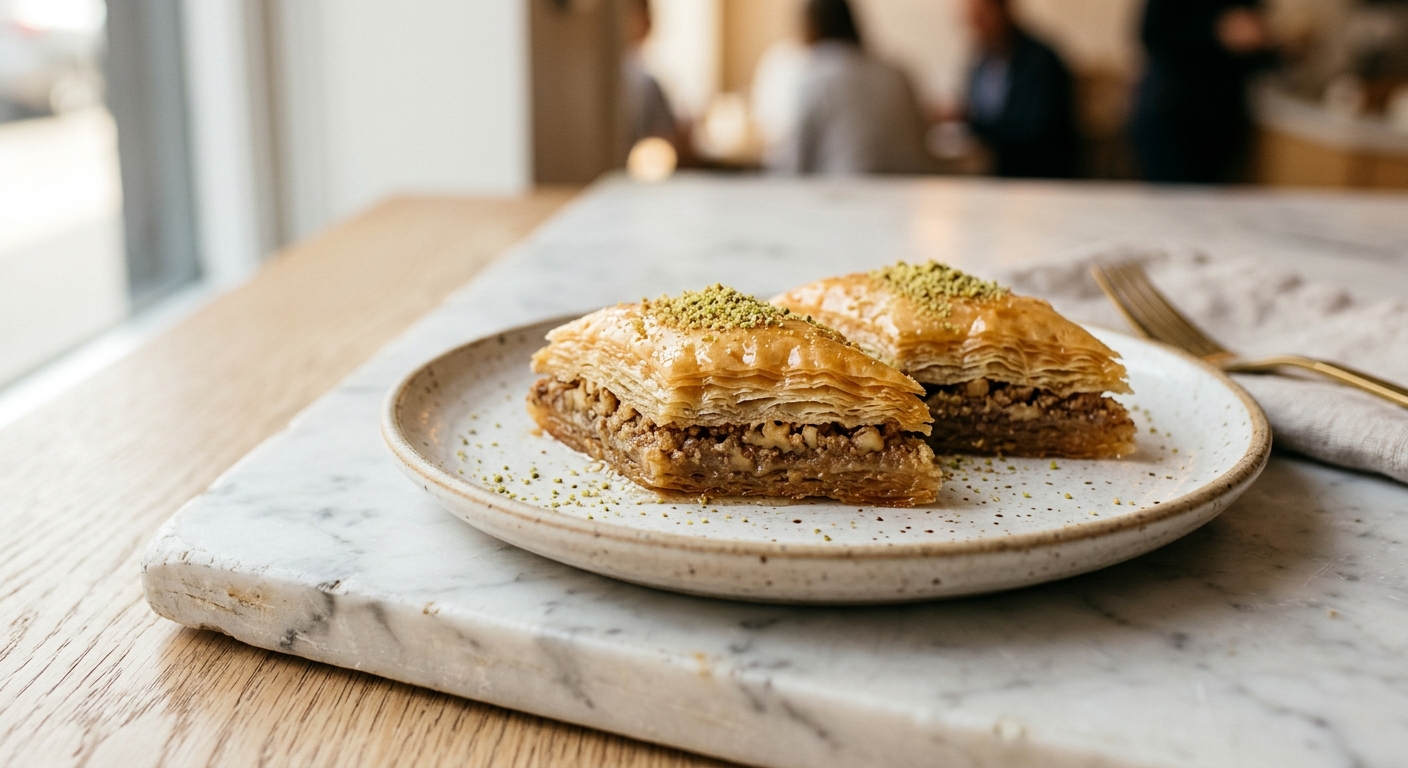
There is something almost theatrical about a pan of baklava fresh from the oven: the golden, paper-thin layers of phyllo shatter at the touch of a knife, revealing a fragrant walnut filling that smells of cinnamon, clove, and toasted nuts. The moment the warm syrup hits the hot pastry, it hisses and seeps into every crack and crevice, turning each diamond-cut piece into a jewel of a dessert. It is one of those sweets that feels genuinely celebratory, and for good reason – it takes patience, care, and a generous hand with butter.
What makes this version special is the syrup. Instead of the traditional honey-and-sugar combination that sends blood sugar soaring, we use allulose, a rare natural sugar found in small amounts in figs and raisins. Allulose behaves remarkably like real sugar in the kitchen: it dissolves cleanly, browns beautifully, and produces a glossy, pourable syrup with a delicate sweetness. Crucially, it is not metabolized by the body the way regular sugar is, giving this baklava a glycemic load that is genuinely low. A splash of orange blossom water and a strip of lemon peel in the syrup keep the flavor bright and complex, so you never feel like anything has been taken away.
This recipe sits firmly in the medium difficulty category. The technique is straightforward, but phyllo dough requires a confident, unhurried hand and a few good habits. If you have never worked with phyllo before, this is a wonderful first project – just keep a damp towel nearby and work with purpose. This baklava is perfect for holiday dessert tables, gifting, or any occasion where you want to bring something genuinely impressive that also happens to be a kinder choice for blood sugar.
Equipment Needed
Click on an item below to shop for the recommended items for this recipe on Amazon.
As an Amazon Associate, we earn from qualifying purchases.
24
Ingredients
- Walnut Filling
- 450 gwalnut halves and pieces (about 4 cups), finely chopped by hand or pulsed in a food processor
- 1.5 tspground cinnamon
- 0.25 tspground cloves
- 0.25 tspground cardamom
- 50 ggranular allulose (about 4 tbsp)
- —Pinch of Colima Sea SaltMicroplastic Free Salt
- 340 gunsalted butter (about 1.5 cups or 3 sticks), clarified or melted and skimmed
- 450 gfrozen phyllo dough (one 1-lb package), thawed overnight in the refrigerator
- Syrup
- 480 mlwater (about 2 cups)
- 400 ggranular allulose (about 2 cups)
- 2 tbspfresh lemon juice
- 1 striplemon peel (removed with a vegetable peeler, white pith avoided)
- 1 tbsporange blossom water
- 0.5 tsppure vanilla extract
Ingredient Substitutions
Instructions
- Make the syrup first so it has time to cool completely before using. Combine the water, 400g allulose, lemon juice, and lemon peel strip in a medium saucepan over medium heat. Stir until the allulose dissolves, then bring to a gentle boil. Reduce heat and simmer uncovered for 12 to 15 minutes, until the syrup has reduced slightly and coats a spoon lightly. Remove from heat, discard the lemon peel, and stir in the orange blossom water and vanilla. Pour into a heatproof measuring jug and let cool to room temperature, at least 45 minutes. A cool syrup on hot baklava (or hot syrup on cooled baklava) is what creates the characteristic crisp-yet-soaked texture.
- Prepare the walnut filling. Pulse the walnuts in a food processor until finely chopped but not powdery – you want texture, not walnut flour. Combine in a bowl with the cinnamon, cloves, cardamom, 50g allulose, and the pinch of salt. Stir well and set aside.
- Preheat your oven to 325°F (160°C). Melt the butter in a small saucepan over low heat. Skim off and discard the white foam, leaving the clear golden butterfat. Alternatively, use pre-made ghee. Brush a 9×13-inch metal baking pan generously with melted butter.
- Unroll the thawed phyllo dough on a clean, flat surface. Cover with a sheet of plastic wrap and then a slightly damp (not wet) kitchen towel. This prevents drying. Keep the stack covered whenever you are not actively pulling a sheet. If phyllo tears, do not panic – patch it in the pan and continue. The layers stack and it will not show.
- Layer the bottom of the buttered pan with phyllo sheets, brushing each one with melted butter before adding the next. Use approximately 8 to 10 sheets for the bottom base. Trim sheets to fit if needed (kitchen scissors work well). Spread half the walnut mixture evenly over the phyllo base. Add another 4 to 6 buttered phyllo sheets, then spread the remaining walnut filling. Finish with the remaining phyllo sheets, buttering each layer, for a total of 8 to 10 sheets on top. Brush the top layer very generously with butter.
- Using a very sharp knife, cut the baklava all the way through to the bottom of the pan. Cut 4 evenly spaced lengthwise strips, then cut diagonally across them to create diamond shapes, or simply cut a grid for squares. Cutting before baking is essential – you cannot cut cleanly through baked, crisped phyllo without shattering it.
- Bake at 325°F (160°C) for 40 to 45 minutes, until deeply golden brown across the entire top – not just the edges. The low temperature allows the butter to cook through all the layers without burning the exterior. The top should be a rich amber, not pale gold.
- Remove from the oven and immediately, slowly pour the cooled syrup evenly over the entire hot pan. Pour in a thin, steady stream, moving across the surface to distribute it. You will hear a satisfying sizzle. The baklava needs to absorb the syrup for at least 1 hour at room temperature before serving. Resist cutting earlier – the absorption is what transforms the layers. Serve at room temperature.
- Make a small batch of syrup first. Combine 160ml water (about 2/3 cup), 130g allulose, 2 tsp lemon juice, and a small strip of lemon peel in a small saucepan. Bring to a boil over medium heat, stir until dissolved, then simmer for 10 minutes. Remove from heat, discard peel, stir in 1 tsp orange blossom water and a splash of vanilla. Cool completely.
- Prepare one-third of the walnut filling: approximately 150g finely chopped walnuts, 0.5 tsp cinnamon, a pinch each of cloves and cardamom, and 15g allulose. Melt about 110g butter and skim off the foam.
- Butter a 7-inch or 8-inch square metal baking pan that fits inside your air fryer. Cut the phyllo sheets to fit the pan. Layer 6 to 8 buttered phyllo sheets on the bottom, spread half the walnut filling, add 3 to 4 more buttered sheets, spread the remaining filling, then top with 6 to 8 more buttered phyllo sheets. Cut into diamonds or squares all the way through before cooking.
- Preheat the air fryer to 300°F (150°C) for 3 minutes. Place the pan in the basket. To prevent the top phyllo layer from blowing up in the air fryer fan, lightly press a small piece of parchment paper against the surface for the first 8 minutes of cooking, then remove it for the remaining time. Bake for 18 to 22 minutes total, until deeply golden brown. Check at 15 minutes – air fryers vary and the baklava can brown quickly.
- Remove the pan from the air fryer and immediately pour the cooled syrup slowly and evenly over the hot baklava. Let absorb for at least 45 minutes before serving. The small-batch version absorbs syrup faster than the full pan, so avoid over-soaking – use about two-thirds of the prepared syrup and add more if the baklava looks dry after 20 minutes.
- Clarify the butter quickly in the microwave: Place the butter in a large microwave-safe measuring cup. Microwave on high in 30-second bursts until fully melted, about 90 seconds total. Let sit undisturbed for 2 minutes, then skim the white foam from the surface with a spoon. The clear golden butter beneath is ready to use.
- Make the syrup on the stovetop exactly as described in the oven method. Let cool completely. This step cannot be rushed – do not use warm syrup on warm baklava, or the baklava will turn soggy rather than achieving the crisp-soaked balance.
- Prepare the walnut filling as described in the oven method. If your walnuts are not pre-toasted, spread them on a microwave-safe plate and microwave on high for 2 minutes, stirring once halfway through, to lightly toast them. This enhances their flavor significantly before chopping.
- Assemble and cut the baklava exactly as described in the oven method, using the same layering sequence and the sharp-knife scoring step before baking.
- Bake in a preheated 325°F (160°C) oven for 40 to 45 minutes until deeply golden. Pour cooled syrup over hot baklava immediately after removing from the oven. Rest for at least 1 hour before serving.
Nutrition Per Serving
Per 1 serving (makes one 9×13-inch pan, cut into 24 diamond or square pieces)
Sweetener: allulose
Why This Recipe Works
The single most important technique in baklava is the temperature contrast between the syrup and the pastry. Hot baklava poured with hot syrup becomes soggy because both are expanding – the pastry cannot set while absorbing. Cooled syrup poured onto freshly baked hot baklava creates a rapid absorption followed by quick setting as the pastry cools. This is what gives baklava its iconic texture: saturated with syrup all the way through, yet still retaining a delicate crispness in the outer layers. Never skip the cooling step for the syrup, even if it means planning ahead.
Allulose is doing remarkable work here as the sweetener. Unlike allulose, which can crystallize into a grainy, crunchy texture as it cools, allulose remains fully liquid and stable in solution even at room temperature. This means the syrup stays glossy, pourable, and smooth, just as a traditional honey-and-sugar syrup would. Allulose also participates in the Maillard browning reaction, which is why the baklava top develops that genuine deep amber color rather than staying pale as some sugar-free baked goods do. The body absorbs almost none of the allulose – studies show about 90% is excreted unchanged – making the glycemic impact negligible despite the generous quantity used.
Clarifying the butter before brushing is a step worth doing carefully. Whole butter contains water (about 16 to 18%) and milk solids. The water creates steam in the oven, which can make phyllo layers steam and stick together rather than crisping separately. The milk solids can burn at the temperatures needed to fully crisp the phyllo. Clarified butter or ghee is pure butterfat: it crisps the phyllo efficiently at lower temperatures and has a higher smoke point, producing golden, separate, shatteringly thin layers rather than a steamed, soft stack.
Baker’s Tips
- Thaw phyllo dough in the refrigerator overnight rather than on the counter. Counter-thawing causes condensation inside the package, which makes the sheets wet, sticky, and prone to tearing.
- Work with phyllo quickly and keep the stack covered with a damp towel at all times. Phyllo dries out in minutes when exposed to air and will crack and crumble as you handle it.
- Do not stress over torn phyllo sheets. Patch tears by overlapping pieces and brushing with butter. Once layered and baked, tears are completely invisible and have no impact on texture.
- Use a metal (not glass) 9×13-inch pan. Metal conducts heat more efficiently and evenly, producing crispier bottom layers. Glass pans retain heat differently and can cause the bottom phyllo to steam rather than crisp.
- A very sharp chef’s knife or serrated knife is essential. Dull knives compress and tear the phyllo layers. Score the cut lines confidently in one direction, then cross-cut. Do all cutting before baking.
- Taste your allulose syrup before pouring. It should be pleasantly sweet with a clear citrus-floral note. If it tastes flat, add another teaspoon of orange blossom water or a small squeeze of lemon.
- Let the finished baklava rest uncovered. Covering it traps steam and softens the phyllo. Room temperature, uncovered storage is what keeps the layers at their best.
Variations
- Pistachio and Rose Water Baklava: Swap all walnuts for finely chopped raw pistachios and replace the orange blossom water in the syrup with 2 tsp rose water. Add a few strands of saffron to the syrup while it simmers for a golden hue and exotic fragrance.
- Chocolate Walnut Baklava: Add 30g of unsweetened cocoa powder to the walnut filling and stir in 60g of finely chopped unsweetened dark chocolate. The slight bitterness is a wonderful contrast to the sweet allulose syrup.
- Spiced Pecan and Bourbon Baklava: Replace walnuts with pecans, increase the cinnamon to 2 tsp, and add 2 tbsp of bourbon to the syrup along with a pinch of smoked salt. Omit the orange blossom water.
Troubleshooting & FAQ
My phyllo kept tearing and falling apart as I worked with it. What went wrong?
My baklava came out soggy rather than crisp and saturated. What happened?
The allulose syrup looks very thin even after simmering. Is that right?
The bottom layers of my baklava are soft and doughy, not crisp. How do I fix this?
Can I use a sugar-free honey substitute instead of making the allulose syrup from scratch?
Storage & Make-Ahead
- Storage: Store the baklava uncovered or loosely tented with foil at room temperature for up to 5 days. Refrigerating is not recommended as it can make the phyllo layers chewy. For longer storage, freeze individual pieces in a single layer on a baking sheet until solid, then transfer to an airtight container with parchment between layers. Freeze for up to 2 months. Thaw at room temperature for 1 hour before serving.
- Make-Ahead: Baklava is an ideal make-ahead dessert. In fact, it improves with time as the syrup fully penetrates the layers. Bake and syrup the baklava up to 3 days before serving and store uncovered at room temperature. The syrup can be made up to 5 days ahead and stored in a sealed jar in the refrigerator. Reheat gently to re-liquefy if it thickens.