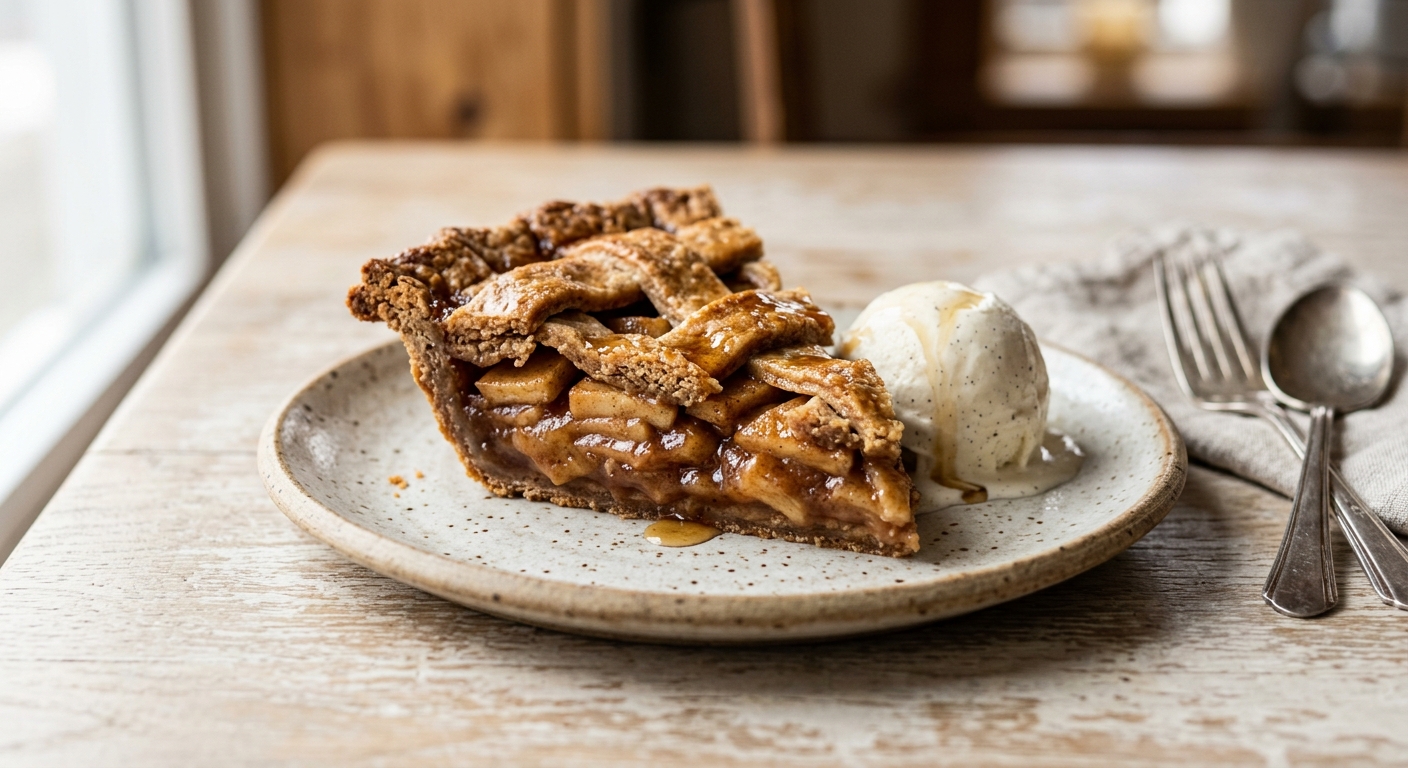
There is something almost ceremonial about making an apple pie from scratch. The way the kitchen fills with cinnamon and brown-butter warmth, the soft hiss of the oven, the moment you lift a slice and see those glossy, tender apples tucked beneath a golden lid. This version carries all of that magic, but it belongs to a quieter, more wholesome tradition. The filling is sweetened entirely with pure maple syrup and a whisper of monk fruit granules, and the crust is made with whole-grain spelt flour, giving it a gentle nuttiness and a tenderness that rivals any all-purpose pastry you have ever made.
What sets this pie apart is a double technique borrowed from professional pastry kitchens. First, the apple filling is pre-cooked briefly on the stovetop to drive off excess liquid before it ever touches the crust, which means no more soggy bottoms and no more filling that slumps into a watery pool when you cut into it. Second, the spelt crust is made with cold grated butter rather than cubed, which distributes fat more evenly and creates an exceptionally flaky, short crumb. Spelt contains gluten, but a weaker, more extensible form of it, so the dough is forgiving and easy to roll without springing back. A splash of apple cider vinegar in the dough inhibits gluten development just enough to keep it tender.
This recipe sits comfortably at a medium difficulty level. If you have made pie dough before, it will feel familiar with a few welcome upgrades. If this is your first pie, the detailed steps and tips below will walk you through every stage with confidence. It is a perfect weekend bake, a centerpiece for a casual autumn dinner, and genuinely good news for anyone managing blood sugar without wanting to sacrifice dessert.
Equipment Needed
Click on an item below to shop for the recommended items for this recipe on Amazon.
As an Amazon Associate, we earn from qualifying purchases.
10
Ingredients
- Crust
- 300 gwhole-grain spelt flour (about 2 1/2 cups, spooned and leveled), plus more for dusting
- 1 tspColima Sea SaltMicroplastic Free Salt
- 5 gmonk fruit granules (about 1 1/4 tsp)
- 170 gunsalted butter, frozen for 20 minutes then coarsely grated (about 3/4 cup or 12 tbsp)
- 60 mlice-cold water (about 1/4 cup), plus more by the teaspoon if needed
- 15 mlapple cider vinegar (1 tbsp)
- 1.3 kgmixed apples, peeled, cored, and sliced 1/4-inch thick (about 2 3/4 lbs, roughly 8 to 9 medium apples). Use a mix of Granny Smith and Honeycrisp.
- 120 mlpure maple syrup, Grade A Dark Robust (about 1/2 cup)
- Filling
- 20 gmonk fruit granules (about 5 tsp)
- 30 gcornstarch (about 3 1/2 tbsp), used as thickener
- 1.5 tspground cinnamon
- 0.5 tspground cardamom
- 0.25 tspground nutmeg, freshly grated if possible
- 15 mlfresh lemon juice (about 1 tbsp)
- 1 tsppure vanilla extract
- Dotting The Filling
- 15 gunsalted butter (1 tbsp), cut into small pieces
- Egg Wash
- —1 large egg + 1 tbsp cold water, whisked together
- —Coarse turbinado sugar for sprinkling on top crust (optional but recommended for crunch and appearance)
Ingredient Substitutions
Instructions
- Make the spelt crust: In a large bowl, whisk together the spelt flour, salt, and 5g monk fruit granules. Add the frozen grated butter and toss quickly with a fork or your fingertips until the flour-coated butter strands are distributed throughout, resembling coarse, shaggy crumbs. Work fast; cold butter is the key to flakiness.
- Stir the apple cider vinegar into the ice-cold water. Drizzle about half of this liquid over the flour mixture and stir with a fork. Add the remaining liquid a tablespoon at a time, stirring after each addition, until the dough just comes together when you squeeze a handful. It should look shaggy and rough, not smooth. Divide the dough into two discs, about 55% and 45% of the total dough (the larger disc is for the bottom crust). Wrap each in plastic wrap and refrigerate for at least 1 hour, or up to 2 days.
- Prepare the apple filling: Combine the sliced apples, maple syrup, 20g monk fruit granules, cornstarch, cinnamon, cardamom, nutmeg, lemon juice, and vanilla in a large heavy-bottomed saucepan. Stir well to coat the apples. Cook over medium heat, stirring occasionally, for 8 to 10 minutes until the apples have softened slightly, released their juices, and the liquid has thickened into a glossy, syrupy coating. Remove from heat and let the filling cool to room temperature, about 20 to 30 minutes. Do not skip this step; it is what prevents a watery, sunken pie.
- Preheat your oven to 400°F (205°C) with a rack in the lower third. Place a heavy baking sheet on the rack to preheat with the oven. This preheated surface will help the bottom crust cook through and stay crisp.
- On a lightly floured surface, roll the larger dough disc into a circle about 12 inches in diameter and roughly 1/8-inch thick. Work from the center outward, rotating the dough a quarter turn after each pass of the rolling pin. Carefully transfer to a 9-inch deep-dish pie plate by rolling the dough loosely around your rolling pin and then unrolling it over the pan. Gently press the dough into the bottom and sides without stretching it. Let the overhang drape over the edges. Refrigerate the lined pie plate while you roll the top crust.
- Roll the smaller dough disc into a circle about 11 inches in diameter. Pour the cooled apple filling into the chilled bottom crust and dot the surface with the tablespoon of butter pieces. Drape the top crust over the filling. Trim both crusts to about 3/4-inch overhang, then fold the overhang under itself so it sits on the rim of the pie plate. Crimp decoratively using your fingers or a fork. Cut 6 to 8 steam vents in the top crust using a sharp knife or the tip of kitchen scissors.
- Brush the top crust and crimped edges evenly with the egg wash. Sprinkle with turbinado sugar if using. Place the pie directly on the preheated baking sheet in the oven.
- Bake at 400°F (205°C) for 20 minutes, then reduce the oven temperature to 375°F (190°C) without opening the door and bake for a further 35 to 40 minutes, until the crust is a deep golden brown and the filling is bubbling actively through the vents. If the edges brown too quickly, tent them with strips of aluminum foil or a pie shield after the first 25 minutes. Transfer to a wire rack and cool for at least 2 to 3 hours before slicing. The filling needs this time to set completely.
- Prepare the crust and filling exactly as described in steps 1 through 3 of the oven method. Scale ingredients down if needed for your air fryer size. For a 7-inch pie, use about 65% of the ingredient quantities.
- Line a 7-inch or 8-inch metal or foil pie plate with the bottom crust and fill it with the cooled apple filling as described. Add the top crust, crimp, and cut steam vents. Brush with egg wash and add turbinado sugar if desired. Refrigerate the assembled pie for 15 minutes while you preheat the air fryer.
- Preheat the air fryer to 320°F (160°C) for 5 minutes. Place the pie plate directly in the air fryer basket. Bake at 320°F (160°C) for 20 minutes. Check at this point; if the edges or top are browning faster than you’d like, tent loosely with a small piece of foil.
- Continue baking for 15 to 20 more minutes until the crust is deep golden and the filling is bubbling through the vents. Because air fryers vary in power, begin checking at 30 minutes total. The bottom crust should be visibly golden and set when you gently lift an edge with a spatula.
- Remove carefully from the air fryer basket using heat-safe tongs or oven mitts. Let the pie cool on a wire rack for at least 2 hours before slicing. The filling will appear loose when hot and will set to a sliceable consistency as it cools.
- Make the spelt-oat crumble topping: In a medium bowl, combine 120g (1 cup) whole-grain spelt flour, 80g (1 cup) old-fashioned rolled oats, 25g monk fruit granules, 1 tsp cinnamon, and 1/4 tsp fine sea salt. Add 115g (1/2 cup) cold grated butter and toss with your fingers until the mixture clumps into rough, pea-to-hazelnut-sized pieces. Refrigerate the crumble while you cook the filling.
- Preheat your oven to 375°F (190°C). In a 10-inch or 12-inch oven-safe cast-iron skillet, combine all filling ingredients (sliced apples, maple syrup, 20g monk fruit granules, cornstarch, spices, lemon juice, and vanilla). Cook over medium heat, stirring gently, for 10 to 12 minutes until the apples are just tender and the liquid is thick and glossy. Dot the surface with the tablespoon of butter pieces.
- Remove the skillet from the heat. Scatter the chilled crumble topping evenly over the apple filling, covering it in a generous, rustic layer. Do not press it down; loose crumble bakes crisper.
- Transfer the skillet to the preheated oven and bake for 20 to 25 minutes until the crumble is golden brown and the filling is bubbling around the edges. If the crumble browns before the filling bubbles, reduce heat to 350°F (175°C) and bake 5 minutes more.
- Remove from the oven and let cool for at least 20 minutes before serving. Serve warm, directly from the skillet. This version does not hold neat slices and is best scooped into bowls and served with a dollop of unsweetened whipped cream or a small scoop of vanilla-flavored coconut cream ice cream.
Nutrition Per Serving
Per 1 serving (makes one 9-inch deep-dish pie)
Sweetener: monk fruit and pure maple syrup
Why This Recipe Works
The pre-cooking step for the apple filling is the most important technique in this recipe, and here is why it matters so much. Raw apples release a significant amount of water as they bake, steam, and shrink inside the pie shell. If you pour a raw filling into an unbaked crust, you end up with a gap between the shrunken apples and the top crust, a soggy bottom, and a filling that is either too wet or needs so much thickener it becomes gummy. By cooking the apples briefly on the stovetop first, you drive off much of that excess liquid before it ever enters the oven. The cornstarch activates in the simmering juices, pre-thickening the sauce so it bakes to a glossy, sliceable consistency rather than a soup. You are essentially finishing 70% of the filling’s work before baking even begins.
Spelt flour behaves differently from all-purpose flour in pastry because its gluten network is weaker and more soluble. All-purpose flour develops elastic, strong gluten strands quickly, which is why overworked pie dough becomes tough and rubbery. Spelt’s gluten is more extensible and less elastic, meaning the dough is more forgiving if you handle it a little longer, and it rolls out without as much spring-back. The apple cider vinegar in the dough reinforces this by slightly acidifying the environment, which inhibits gluten bond formation and contributes to a notably tender crumb. Grating frozen butter rather than cubing it distributes the fat in thin, irregular strands throughout the flour. As those strands melt in the oven, they release steam and create thin, papery layers. This is flakiness at a structural level.
Monk fruit granules contribute sweetness without affecting the structure of the crust the way sugar does. In conventional pastry, sugar draws water, tenderizes, and promotes browning through caramelization. Monk fruit does none of these things, so the crust may appear slightly paler than a sugar-sweetened one. This is why the egg wash and turbinado sugar on top are so valuable here: the egg wash provides its own Maillard browning, and the turbinado crystals (which do contain a small amount of cane sugar) give the top crust its appealing crunch and color. If you are avoiding all added sugar including turbinado, brushing with oat milk and dusting with a light pinch of cinnamon still yields a beautiful result.
Baker’s Tips
- Keep everything cold. The single most important rule in pie making is cold fat and cold liquid. If at any point your butter looks greasy or your dough feels warm and sticky, put it back in the refrigerator for 15 minutes before continuing.
- Do not rush the cooling time. A hot apple pie filling is liquid. It only sets as it cools and the starch gel firms up. Cutting into it within an hour will give you a runny filling. Two to three hours of cooling is not optional.
- Use a mix of apple varieties. Granny Smith apples hold their shape and provide tartness that balances the sweetness of the maple syrup. Honeycrisp (or Braeburn or Golden Delicious) add a softer, sweeter contrast. An all-Granny-Smith pie can taste sharp; an all-sweet-apple pie turns to mush.
- The preheated baking sheet trick is not just a rumor. A hot surface under your pie plate conducts heat directly into the bottom crust from the very first minute in the oven. This dramatically reduces the chance of a raw, doughy bottom, which is the most common pie complaint.
- Roll the dough between two sheets of parchment paper if it sticks to your counter. This eliminates the need for excess flour, which can toughen the crust and make it taste dry.
- Taste your apples before you start. Very tart batches may need the full amount of monk fruit; naturally sweeter apples may need slightly less. The recipe is calibrated for average-tartness store-bought apples, but adjusting to your fruit is good cooking sense.
- If your crust edges are browning too fast, do not panic. Tear strips of aluminum foil and loosely tent just the edges while leaving the center exposed, or use a silicone pie shield if you have one. This is completely normal and does not mean anything went wrong.
Variations
- Pear and Ginger variation: Swap half of the apples for firm Bartlett or Bosc pears and add 1 tsp freshly grated ginger and 1/4 tsp ground cloves to the filling spice mix.
- Salted Maple version: Increase the maple syrup to 150ml (2/3 cup), reduce the monk fruit to 10g, and stir 1/2 tsp flaky sea salt into the finished filling for a salted maple caramel apple profile.
- Lattice top: Instead of a full top crust, cut the second dough disc into 10 strips about 3/4-inch wide and weave a lattice over the filling. Brush with egg wash and bake as directed. The lattice allows more steam to escape, resulting in an even firmer, less wet filling.
- Vegan option: Replace the butter in both the crust and filling with vegan butter sticks (frozen and grated for the crust). Replace the egg wash with 2 tbsp oat milk. All other ingredients are already plant-based.
Troubleshooting & FAQ
My pie filling is watery and soupy even after cooling. What went wrong?
My spelt crust cracked when I tried to transfer it to the pie plate. How do I fix it?
The bottom crust is pale and doughy even though the top looks perfectly golden. What happened?
My monk fruit granules left a strange crystallized texture in the crust. Is that normal?
The pie filling tastes undersweetened compared to a traditional apple pie. How do I adjust?
Storage & Make-Ahead
- Storage: Store the pie loosely covered at room temperature for up to 2 days, or refrigerate for up to 5 days. Bring to room temperature or warm individual slices in a 300°F (150°C) oven for 10 minutes before serving. The crust will soften slightly in the refrigerator but remains delicious.
- Make-Ahead: The pie dough discs can be made up to 2 days ahead and refrigerated, or wrapped tightly and frozen for up to 2 months. Thaw overnight in the refrigerator before rolling. The apple filling can be cooked and cooled up to 1 day ahead and stored covered in the refrigerator. The fully assembled, unbaked pie can be frozen for up to 3 months; bake directly from frozen at 375°F (190°C), adding 20 to 25 minutes to the bake time.