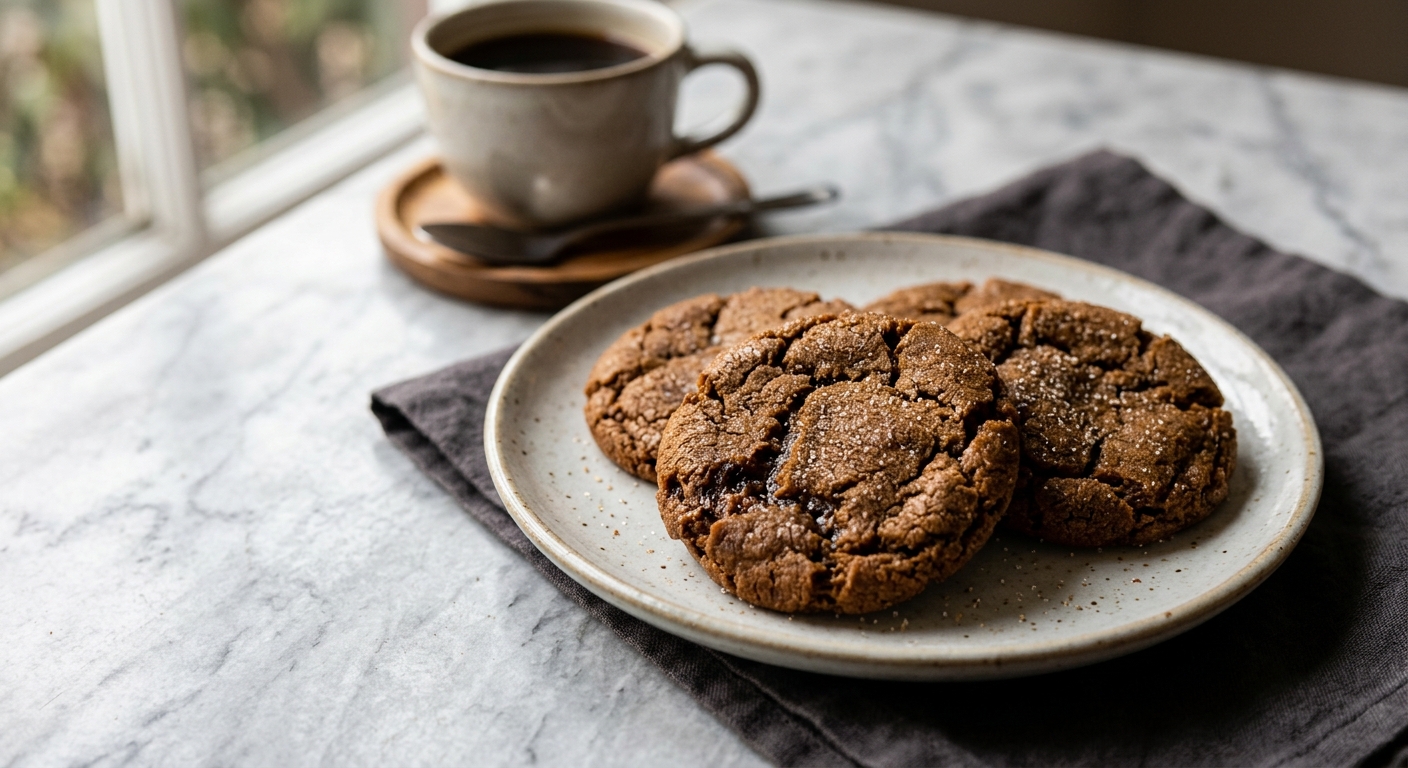
There is something almost nostalgic about a molasses spice cookie. The moment they hit the oven, the kitchen fills with the scent of ginger, cinnamon, and clove, and that dark, bittersweet ribbon of molasses turns the whole house warm and cozy. For anyone managing blood sugar or simply cutting back on refined sugar, these cookies can feel like something off-limits. But they absolutely are not, and this recipe is the proof.
What makes this version work is a careful balance between allulose as the primary bulk sweetener and a small but meaningful amount of real unsulfured molasses. Molasses itself is low in free glucose relative to its flavor impact, and the quantity used here is just enough to deliver authentic color, chewiness, and that slightly smoky depth without meaningfully raising the glycemic load. Allulose mimics the bulk and slight crystalline crunch of sugar without being metabolized for energy, making it the ideal base. A touch of blackstrap molasses deepens the flavor even further if you want a more robust cookie.
These cookies sit comfortably at a medium difficulty level. There is no chilling required (though a short rest in the fridge does improve the texture), and the dough comes together quickly in one bowl. They are perfect for anyone baking for a diabetic friend or family member, for anyone on a low-glycemic eating plan, or honestly for anyone who just wants a deeply spiced, chewy cookie that does not leave them feeling heavy afterward.
Equipment Needed
Click on an item below to shop for the recommended items for this recipe on Amazon.
As an Amazon Associate, we earn from qualifying purchases.
24
Ingredients
- 240 gall-purpose flour (about 2 cups, spooned and leveled)
- 1 tspbaking soda
- 2 tspground ginger
- 1.5 tspground cinnamon
- 0.5 tspground cloves
- 0.25 tspground black pepper (finely ground)
- 0.25 tspColima Sea SaltMicroplastic Free Salt
- 170 ggranular allulose (about 3/4 cup plus 2 tbsp), plus extra for rolling
- 115 gunsalted butter, softened to room temperature (1/2 cup, 1 stick)
- 60 mlunsulfured molasses (about 3 tbsp plus 1 tsp; use blackstrap for a deeper flavor)
- 1 largeegg, at room temperature
- 1 tsppure vanilla extract
Ingredient Substitutions
Instructions
- Preheat your oven to 350°F (175°C). Line two large baking sheets with parchment paper and set aside. Place about 3 tablespoons of granular allulose in a small shallow bowl for rolling.
- In a medium bowl, whisk together the flour, baking soda, ginger, cinnamon, cloves, black pepper, and sea salt until evenly combined. Set aside.
- In a large bowl using a hand mixer, or in the bowl of a stand mixer fitted with the paddle attachment, beat the softened butter and allulose together on medium speed for 2 to 3 minutes until light and slightly fluffy. Allulose does not cream quite as airy as sugar, but the mixture should lighten in color.
- Add the molasses, egg, and vanilla extract to the butter mixture and beat on medium speed until fully incorporated, about 1 minute. Scrape down the sides of the bowl.
- Add the flour mixture all at once and mix on low speed just until no dry streaks remain. Do not overmix. The dough will be soft and slightly sticky. For best results, cover and refrigerate for 20 minutes, which firms the dough and helps the cookies hold their shape and crinkle more dramatically.
- Scoop the dough into balls about 1.5 inches in diameter (roughly 1.5 tablespoons each). Roll each ball between your palms to smooth it, then roll generously in the granular allulose to coat.
- Place the coated dough balls at least 2 inches apart on the prepared baking sheets. Bake one sheet at a time on the center rack for 10 to 11 minutes. The cookies will look very soft and underdone in the center when you pull them out. This is correct. They firm up as they cool.
- Allow cookies to cool on the baking sheet for 8 minutes before transferring to a wire rack. They will be too fragile to move before this. Cool completely for a fully set, chewy texture.
- Prepare the dough exactly as described in the oven method through step 6, including the optional 20-minute chill. The chilling step is more important for the air fryer as the moving hot air can cause unchilled dough to spread too quickly.
- Cut a piece of parchment paper to fit the base of your air fryer basket, trimming it so it does not block the airflow around the edges. Do not use parchment without cookies on top to weigh it down, as it can fly into the heating element.
- Preheat your air fryer to 325°F (163°C) for 3 minutes. Place 4 to 5 dough balls (rolled in allulose) in the basket at least 1.5 inches apart. Do not overcrowd.
- Air fry for 7 to 8 minutes. The cookies will look slightly underdone and puffed when you open the basket. They will sink and set into chewy cookies as they cool. Do not add more time chasing a browned top, as allulose does not brown the same way sugar does.
- Carefully slide the parchment with the cookies onto a cooling rack and allow to rest for 10 minutes before eating. Repeat with remaining dough.
- Prepare the full dough recipe through step 6 of the oven method. Roll all dough balls and coat them in allulose as directed.
- Arrange the coated dough balls on a parchment-lined baking sheet so they are not touching. Freeze uncovered for 1 to 2 hours until solid.
- Transfer the frozen dough balls to a zip-top freezer bag or airtight container, layered between sheets of parchment. Label with the date and baking instructions. Freeze for up to 3 months.
- When ready to bake, preheat your oven to 350°F (175°C). Place frozen dough balls directly on a parchment-lined baking sheet. Do not thaw.
- Bake for 13 to 14 minutes. The cookies will look just barely set in the center when done. Cool on the baking sheet for 10 minutes before moving to a rack. The texture once cooled is indistinguishable from fresh-baked.
Nutrition Per Serving
Per 1 serving (makes about 24 cookies (1.5-inch balls))
Sweetener: allulose
Why This Recipe Works
Allulose is a sugar alcohol that provides bulk, mild sweetness, and that satisfying crystalline exterior when used as a rolling sugar, but because it is not metabolized by the body the way glucose is, it contributes almost nothing to blood sugar. However, allulose does behave differently from sucrose in baking: it does not caramelize, it absorbs less moisture from the environment, and it has a slight cooling sensation when eaten in large quantities. To compensate for the reduced moisture retention and the lack of caramelization browning, the butter is fully softened and creamed to introduce air, and the molasses does the heavy lifting for both color and that characteristic sticky chewiness.
The molasses here is doing two important jobs beyond flavor. First, it is hygroscopic, meaning it attracts and holds onto moisture, which is exactly what keeps these cookies chewy for days. Second, the invert sugars in molasses (fructose and glucose in free form) keep the cookie structure tender by interfering with gluten development. Yes, there is a small amount of real sugar in the molasses, which is why the glycemic load is not zero. But at 60ml spread across 24 cookies, the impact per serving is minimal, particularly when paired with the fat and protein in the dough, which slow glucose absorption further.
The single most important technique here is pulling the cookies from the oven while they still look underdone. Allulose does not provide the same structural moisture cues as sugar, meaning these cookies will appear softer and puffier at the correct bake time than a traditional cookie would. Overbaking allulose cookies results in a crumbly, almost sandy texture once cooled. The residual heat of the pan continues cooking them during the 8-minute rest, which is non-negotiable. Trust the process, and you will be rewarded with a genuinely chewy, satisfying cookie.
Baker’s Tips
- Use softened, not melted, butter. Melted butter will cause the cookies to spread too thin and become crispy rather than chewy.
- Granular allulose varies by brand in grind size. Finer grinds (like Swerve granular) cream more smoothly into butter. Coarser grinds work fine but may leave a very slight graininess in the finished cookie.
- Do not skip the rolling-in-allulose step. It creates a delicate, sparkly crust that offsets the soft center and adds a pleasant textural contrast.
- The 20-minute chill is optional but genuinely worthwhile. Chilled dough spreads more slowly, producing thicker cookies with more pronounced crinkles and better chew.
- These cookies are best eaten once fully cooled. Straight from the oven they will taste under-sweetened and slightly grainy from the allulose. After 20 minutes of cooling, the texture sets and the sweetness perception improves.
- If your dough feels very sticky and hard to roll, your butter was too warm. Pop the bowl in the fridge for 15 minutes and try again.
Variations
- Chocolate-dipped: Dip cooled cookies halfway into melted 85% dark chocolate and set on parchment. The bittersweet chocolate plays beautifully against the spice.
- Lemon glaze: Whisk together 3 tbsp powdered allulose with 1.5 tsp fresh lemon juice for a tart, bright drizzle that cuts through the molasses richness.
- Orange spice: Add 1 teaspoon of finely grated orange zest to the butter before creaming, and swap the cloves for an equal amount of cardamom for a more floral, festive profile.
- Extra-gingery: Add 1 tablespoon of finely grated fresh ginger along with the molasses for a sharper, more fiery heat that pairs well with tea.
Troubleshooting & FAQ
My cookies came out crumbly and dry instead of chewy. What went wrong?
I notice a cooling or minty aftertaste. Is this normal?
My cookies spread into flat puddles. What happened?
The allulose coating on the outside recrystallized into a hard white crust. Is this a problem?
Can I double the recipe? Will anything need to change?
Storage & Make-Ahead
- Storage: Store in an airtight container at room temperature for up to 4 days. The cookies actually improve in chewiness on day two as the allulose moisture-equalizes. Refrigerate for up to 10 days. For longer storage, freeze baked cookies in a single layer, then transfer to a bag for up to 2 months. Thaw at room temperature for 20 minutes.
- Make-Ahead: The dough can be made up to 3 days ahead and refrigerated, tightly wrapped. Frozen dough balls (see Freeze-Ahead method) keep for up to 3 months. Baked cookies can be made 2 days ahead and stored in an airtight container.