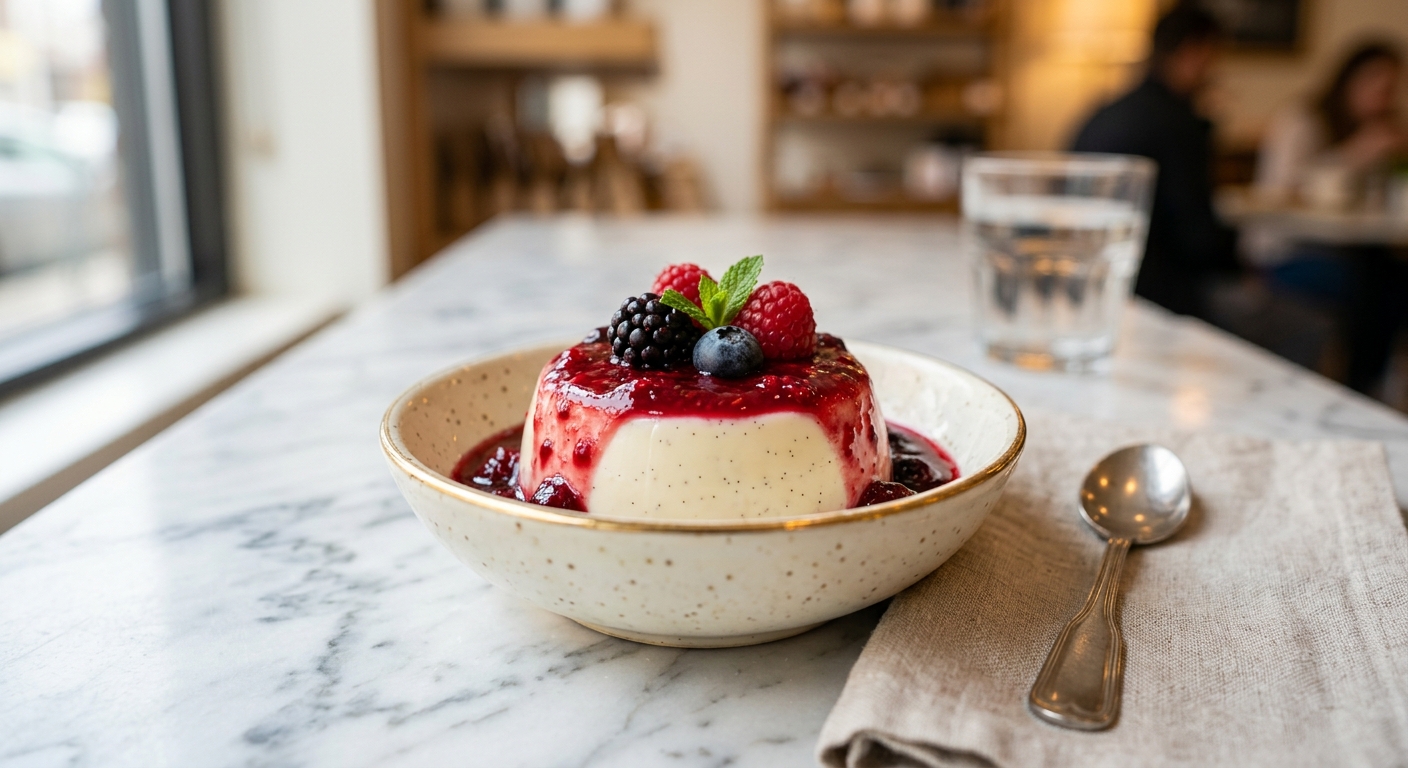
There is something almost magical about panna cotta. You stir a handful of ingredients together, pour them into little cups, and a few hours later you unmold something that looks like it came from a Michelin-starred kitchen. The name means ‘cooked cream’ in Italian, and that is exactly what it is: lightly sweetened cream set with just enough gelatin to hold its shape while still trembling, almost breathing, on the plate. Add a vanilla bean split down the middle and scraped of its tiny, fragrant seeds, and you have a dessert that smells like a French patisserie and tastes like pure luxury.
What makes this version special is the combination of allulose as the sweetener and a careful gelatin ratio. Allulose is a rare sugar that behaves almost identically to regular sugar in cold applications, dissolving smoothly and contributing a clean, round sweetness without any of the cooling aftertaste that allulose can sometimes leave behind. It also does not recrystallize when chilled, which means your panna cotta stays perfectly smooth from the first spoon to the last. The berry sauce is made with a mix of fresh or frozen raspberries, blueberries, and blackberries cooked briefly with a splash of lemon juice and just enough allulose to balance their tartness, creating a glossy, vibrant compote that pools around each panna cotta like a ruby crown.
This recipe sits comfortably at the easy end of the skill spectrum. If you can bloom gelatin and warm cream on the stovetop, you can make this. It is an ideal make-ahead dessert for dinner parties because it must chill for at least four hours and actually improves overnight. It is also perfectly suited to anyone following a ketogenic, low-carb, or diabetic-friendly diet who refuses to compromise on elegance.
Equipment Needed
Click on an item below to shop for the recommended items for this recipe on Amazon.
As an Amazon Associate, we earn from qualifying purchases.
6
Ingredients
- Panna Cotta
- 720 mlheavy whipping cream (about 3 cups), divided
- 120 mlunsweetened almond milk or whole milk (about 1/2 cup)
- 2 tspunflavored powdered gelatin (one standard 7g packet)
- 80 gallulose (about 6 tbsp)
- 1 wholevanilla bean, split lengthwise and seeds scraped
- 1 tsppure vanilla extract
- —Pinch of Colima Sea SaltMicroplastic Free Salt
- 200 gmixed fresh or frozen berries (raspberries, blueberries, blackberries), about 1.5 cups
- Berry Sauce
- 30 gallulose (about 2 tbsp)
- 1 tbspfresh lemon juice
- 0.5 tsplemon zest
- Garnish (optional)
- —Fresh mint leaves or extra berries
Ingredient Substitutions
Instructions
- Pour the almond milk into a small bowl and sprinkle the gelatin evenly over the surface. Do not stir. Let it sit undisturbed for 5 to 7 minutes until the gelatin has absorbed the liquid and looks wrinkled and swollen. This step is called blooming and it ensures the gelatin dissolves without lumps.
- Meanwhile, prepare your ramekins or glasses. For unmolded panna cotta, lightly brush the inside of six 180ml (6 oz) ramekins with a neutral oil (like avocado or light olive oil) using a paper towel. For panna cotta served directly in the vessel, skip the oil and use clear glasses or small bowls for a beautiful presentation.
- Combine 600ml (2.5 cups) of the heavy cream, the allulose for the panna cotta, the scraped vanilla bean seeds, and the vanilla pod in a medium saucepan over medium-low heat. Add the pinch of sea salt. Heat gently, stirring occasionally, until the mixture is steaming and just beginning to show tiny bubbles at the edges, about 5 to 6 minutes. Do not boil. Remove the vanilla pod.
- Add the bloomed gelatin mixture to the warm cream. Whisk constantly and gently for 2 full minutes until the gelatin is completely dissolved. To check, rub a little of the mixture between your fingertips. It should feel completely smooth with no gritty or granular texture. If you feel any granules, return the pan to low heat and whisk for another minute.
- Remove from heat and whisk in the remaining 120ml (1/2 cup) of cold heavy cream and the vanilla extract. This helps cool the mixture quickly and produces a creamier final texture. Strain the mixture through a fine-mesh sieve into a large liquid measuring cup or pitcher with a pourable spout.
- Divide the mixture evenly among the prepared ramekins or glasses. Let them cool to room temperature for about 15 to 20 minutes, then cover each loosely with plastic wrap (do not let the wrap touch the surface) and refrigerate for at least 4 hours, or overnight for best results.
- While the panna cotta chills, make the berry sauce. Combine the berries, allulose, lemon juice, and lemon zest in a small saucepan over medium heat. Cook, stirring and gently pressing the berries with a spoon, until the mixture comes to a simmer and the berries break down into a thick, glossy sauce, about 8 to 10 minutes. Taste and adjust sweetness. Transfer to a jar and refrigerate until ready to serve.
- To unmold, run a thin knife or offset spatula around the edge of each panna cotta. Place a serving plate face-down on top of the ramekin, then flip both together with confidence. Give it a gentle shake if needed. The panna cotta should release cleanly. Spoon the berry sauce generously around and over each one, garnish with fresh mint or extra berries, and serve immediately.
- Follow steps 1 through 5 of the classic method exactly, blooming the gelatin, warming the cream with vanilla and allulose, dissolving the gelatin, and adding the cold cream and extract.
- Strain the mixture into a pitcher and let it cool at room temperature for 10 minutes, stirring occasionally, until it is no longer hot to the touch but still completely liquid. Skipping this cooling step risks cracking delicate glassware in the freezer.
- Pour the mixture into individual clear glasses or silicone molds (silicone is ideal for freezer use). Set them on a flat tray for stability. Place the tray in the freezer, uncovered, for 45 minutes to 1 hour. Check at 45 minutes. The panna cotta should be set at the edges and just barely jiggly in the very center. Do not freeze solid.
- Transfer the set panna cottas to the refrigerator for 15 minutes before serving to take off any icy chill and equalize the texture throughout.
- Make the berry sauce while the panna cotta sets, following step 7 of the classic method. Because this is a faster process, let the sauce cool for at least 10 minutes before spooning it over the panna cotta so it does not melt the surface. Serve directly in the glasses, garnished with fresh berries and mint.
- Bloom the gelatin in the almond milk as described in step 1 of the classic method, using a large microwave-safe bowl or 4-cup microwave-safe liquid measuring cup.
- Add 600ml (2.5 cups) of the heavy cream, the allulose, the vanilla bean seeds and pod, and the pinch of salt to the same bowl with the bloomed gelatin. Stir gently to combine.
- Microwave on 50% power (medium) in 60-second bursts, stirring well between each burst, for a total of 3 to 4 minutes until the cream is steaming and the gelatin and allulose are fully dissolved. Do not let the mixture boil. After 3 minutes, test for dissolved gelatin by rubbing a small amount between your fingers. It must feel completely smooth.
- Remove the vanilla pod. Stir in the remaining 120ml (1/2 cup) of cold heavy cream and the vanilla extract. Pour through a fine-mesh sieve directly into your prepared ramekins or glasses.
- Cool at room temperature for 15 minutes, then cover and refrigerate for at least 4 hours or overnight. Make the berry sauce by combining berries, allulose, lemon juice, and zest in a microwave-safe bowl and microwaving on high in 90-second intervals, stirring between each, for 4 to 5 minutes total until thick and saucy. Cool before serving over the panna cotta.
Nutrition Per Serving
Per 1 serving (makes 6 individual panna cottas in 180ml (6 oz) ramekins or glasses)
Sweetener: allulose
Why This Recipe Works
Panna cotta is built on the science of hydrocolloid gels, specifically the protein chains in gelatin that unwind when heated and then re-link as the mixture cools, trapping liquid within a three-dimensional network. The ratio of gelatin to liquid is everything here. At 7g of gelatin to 840ml of total liquid, the result is what pastry chefs describe as a ‘trembling set,’ firm enough to hold a shape when unmolded but yielding instantly the moment a spoon touches it. Any more gelatin and it becomes bouncy and rubbery. Any less and it will not release cleanly from the mold. Blooming the gelatin in cold liquid first is not optional; it allows the dry granules to hydrate evenly so they dissolve completely without creating gummy clumps in the finished cream.
Allulose is the hero sweetener here for several reasons rooted in food chemistry. Like sucrose, allulose is a monosaccharide, meaning it dissolves completely in liquid without the grainy, crystalline texture that allulose can develop when chilled. Critically, allulose has a glycemic index of essentially zero and is not metabolized for energy by the body, making it ideal for keto and diabetic applications. It also does not interfere with the gelatin network the way highly concentrated sugar solutions can, so the set remains clean and predictable. In the berry sauce, allulose’s inability to recrystallize means the sauce stays glossy and pourable straight from the refrigerator, which is something regular allulose cannot reliably do.
Adding the reserved cold cream at the end of the process, after the gelatin is dissolved, serves two purposes. First, it rapidly cools the mixture, reducing the risk of the gelatin beginning to set unevenly before it is poured. Second, the fat globules in cold cream that have not been heated are slightly different in structure from those in cooked cream, and their inclusion contributes to a more complex, lush mouthfeel in the finished dessert. Straining through a fine-mesh sieve removes the vanilla pod, any unmelted gelatin fragments, and the small amount of skin that can form on warmed cream, guaranteeing a perfectly smooth, restaurant-quality result.
Baker’s Tips
- Use a vanilla bean with a plump, moist pod. Dry, shriveled beans have lost most of their essential oils and will contribute very little flavor. Madagascar Bourbon vanilla is the classic choice for its creamy, rich profile.
- Lightly oiling the ramekins with a neutral oil applied on a paper towel, not poured directly in, gives just enough release for clean unmolding without leaving any oily residue on the finished dessert.
- When warming the cream, keep the heat at medium-low. You want it to steam gently, never simmer or boil. Boiling drives off flavor, can cause the gelatin to weaken if it gets too hot for too long, and creates a skin that wastes precious cream.
- If your berry sauce is too thin after cooking, continue simmering for another 2 to 3 minutes. It will also thicken further as it cools in the refrigerator.
- For the most elegant presentation, unmold panna cotta onto slightly chilled plates. A warm plate will cause the edges to begin softening and melting before you get it to the table.
- Do not skip the room-temperature resting step before refrigerating. Placing very hot cream directly in the refrigerator can raise the internal temperature of the fridge and result in uneven setting near the edges.
Variations
- Coconut vanilla version: Replace all the cream with full-fat coconut cream and use coconut extract in place of vanilla extract for a tropical, dairy-free panna cotta.
- Lemon ricotta panna cotta: Replace 120ml of the heavy cream with full-fat ricotta blended smooth, and add 2 tsp of lemon zest to the warm cream base for a tangier, denser dessert.
- Espresso panna cotta: Whisk 2 tsp of instant espresso powder into the warm cream base before adding the gelatin. Serve with a dark chocolate drizzle instead of berry sauce.
- Rose and cardamom: Add 1/4 tsp ground cardamom and 1 tsp food-grade rose water to the cream base along with the vanilla. Top with a strawberry and rose sauce instead of mixed berries.
Troubleshooting & FAQ
My panna cotta did not set and is still liquid after 4 hours. What went wrong?
My panna cotta has a rubbery, bouncy texture instead of being silky and soft. How do I fix it?
There are lumps or strings in my finished panna cotta. What are they?
My berry sauce crystallized and turned grainy in the refrigerator overnight. What happened?
My panna cotta stuck to the ramekin and tore when I tried to unmold it. How do I get it out cleanly?
Storage & Make-Ahead
- Storage: Store covered panna cottas in the refrigerator for up to 4 days. Keep the berry sauce in a sealed jar in the refrigerator for up to 5 days. Do not freeze finished panna cotta as the gelatin structure will weep and become grainy upon thawing.
- Make-Ahead: Panna cotta is an ideal make-ahead dessert. Make it up to 3 days in advance and keep covered in the refrigerator. The berry sauce can be made up to 5 days ahead and stored in a sealed jar in the refrigerator. Simply plate just before serving for the cleanest presentation.