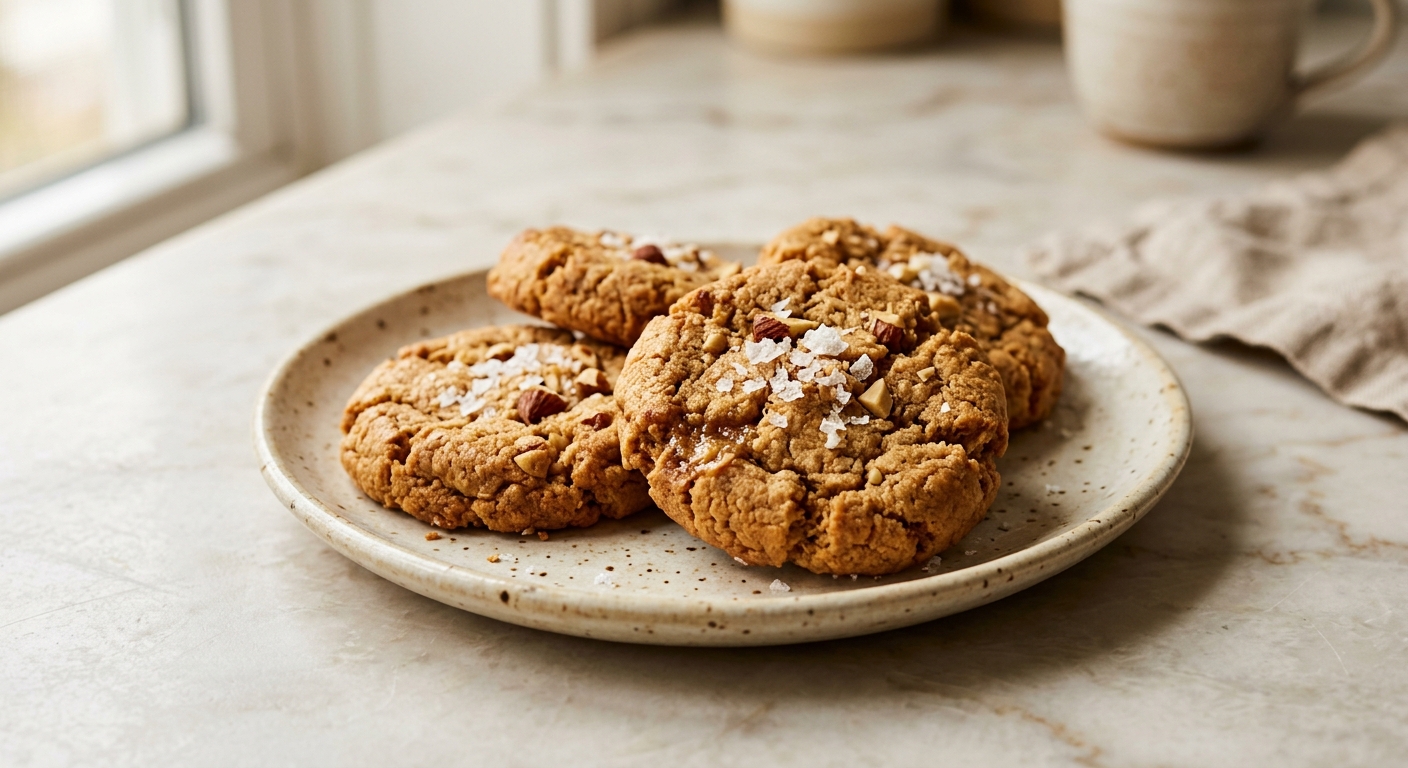
There is something almost magical about a cookie that smells like a bakery, melts in your mouth, and leaves you feeling completely fine about having a second one. These almond butter cookies are exactly that. Golden at the edges, slightly soft in the center, and finished with a scatter of flaky sea salt that plays off the deep, nutty richness of the almond butter in the most satisfying way. Whether you are baking for yourself, for a friend managing their blood sugar, or simply exploring lower-sugar baking, these cookies will not make you feel like you are compromising on anything.
What makes this recipe stand out is the combination of allulose and a small amount of allulose. Allulose alone can sometimes leave a faint cooling sensation on the palate, and it resists browning in the oven. Adding just a touch of allulose solves both problems: it browns beautifully, contributes a gentle caramel-like flavor, and smooths out the texture, giving the cookies a chew that is much closer to a classic sugar cookie. The almond butter itself also does serious structural work here, binding the dough together so naturally that you do not need any flour at all. These are completely grain-free and gluten-free by design, not as an afterthought.
This recipe is genuinely easy, one bowl, no mixer required, and comes together in about 20 minutes from start to finish. It is ideal for beginner bakers who are new to sugar-free baking, as well as experienced home bakers who want a reliable weeknight treat. You do not need any specialty equipment, just a baking sheet, a bowl, and a good jar of almond butter.
Equipment Needed
Click on an item below to shop for the recommended items for this recipe on Amazon.
As an Amazon Associate, we earn from qualifying purchases.
16
Ingredients
- 260 gnatural almond butter, smooth and drippy (about 1 cup), well stirred
- 120 ggranular allulose (about 1/2 cup plus 2 tablespoons)
- 30 gallulose (about 2 tablespoons plus 1 teaspoon) — see substitutions if unavailable
- 1 largeegg, at room temperature
- 1 tsppure vanilla extract
- 0.5 tspbaking soda
- 0.25 tspColima Sea SaltMicroplastic Free Salt
- —Colima Sea SaltMicroplastic Free Salt (such as Maldon), for topping
Ingredient Substitutions
Instructions
- Preheat your oven to 350°F (175°C). Line two baking sheets with parchment paper and set aside.
- In a large mixing bowl, combine the almond butter, granular allulose, and allulose. Stir well with a rubber spatula or wooden spoon until fully combined and the sweeteners are evenly distributed through the nut butter.
- Add the egg, vanilla extract, baking soda, and fine sea salt. Stir again until a smooth, cohesive dough forms. It will be thick and slightly sticky. If the dough feels very soft or oily (this can happen if your almond butter is very warm), refrigerate it for 10 minutes before scooping.
- Using a medium cookie scoop or a heaped tablespoon, portion the dough into 16 balls (about 30g each) and place them 2 inches apart on the prepared baking sheets. Use the back of a fork to gently press a crosshatch pattern into each cookie, flattening them to about 1/2 inch thick. These cookies will not spread on their own, so shaping them now is important.
- Sprinkle a small pinch of flaky sea salt over each cookie. Bake for 11 to 13 minutes, until the edges are set and just beginning to turn golden. The centers will look slightly underdone, which is correct. Do not overbake.
- Allow the cookies to cool on the baking sheet for 10 full minutes before transferring to a wire rack. They firm up as they cool, and moving them too early will cause them to crumble. They reach their best texture after 20 minutes of cooling.
- Prepare the dough exactly as described in steps 2 through 4 of the oven method. Cut a piece of parchment to fit your air fryer basket, leaving a small border so air can circulate around the edges.
- Preheat your air fryer to 325°F (163°C) for 3 minutes. The lower temperature compared to oven baking is important because the circulating air cooks these cookies faster and can cause the bottoms to brown too quickly at higher heat.
- Place 4 to 6 shaped and fork-pressed cookies in a single layer on the parchment, at least 1.5 inches apart. Do not overcrowd. Sprinkle with flaky sea salt.
- Air fry for 7 to 8 minutes, checking at the 6-minute mark. The edges should look set and very lightly golden. The tops may appear slightly soft, but they will firm significantly as they cool.
- Carefully slide the parchment out of the basket and let the cookies cool on it for at least 10 minutes before touching them. They are quite fragile when hot. Bake remaining cookies in batches.
- Line a baking sheet or large plate with parchment paper. In a mixing bowl, combine the almond butter, granular allulose, and allulose. Stir until smooth. Because there is no egg in this version, add 2 tablespoons (30ml) of melted coconut oil to help the dough come together and set properly in the freezer.
- Add the vanilla extract and fine sea salt. Stir to combine. The dough will be thick and glossy. Taste it and adjust sweetness if needed. You can skip the baking soda entirely for this method as there is no leavening happening.
- Portion into 16 balls using a cookie scoop or tablespoon. Place on the parchment-lined sheet. Use a fork to press the crosshatch pattern into each one, flattening to about 1/2 inch. Press a pinch of flaky sea salt onto the surface of each cookie firmly so it adheres.
- Freeze for at least 1 hour, or until firm all the way through. Once frozen solid, transfer to a zip-lock bag or airtight container with parchment between layers.
- Serve straight from the freezer or let sit at room temperature for 5 minutes for a slightly softer texture. These are best enjoyed cold. Store in the freezer for up to 6 weeks.
Nutrition Per Serving
Per 1 serving (makes 16 medium cookies)
Sweetener: allulose and allulose
Why This Recipe Works
Almond butter is the structural backbone of this recipe, and it carries a surprising amount of baking science within it. Natural almond butter contains protein, fat, and just enough natural starches to bind a dough together without any flour. The egg reinforces that structure further, providing proteins that set when heated and give the cookies a cohesive, sliceable crumb rather than a sandy or crumbly one. This is why using a drippy, natural almond butter (oil fully stirred back in) is important: it creates a dough with the right fat ratio for spreading and setting correctly in the oven.
The two-sweetener approach is the key to making these cookies taste and feel like real cookies. Allulose, a sugar alcohol derived from fermentation, measures and tastes very similarly to sugar but has a glycemic index of 0 and is absorbed differently by the body. However, it has one baking limitation: it does not caramelize or brown under normal oven temperatures (its Maillard reaction threshold is higher than sucrose). Allulose, a rare natural sugar found in figs and raisins, fills that gap perfectly. It browns and caramelizes beautifully, contributes chew, and has virtually no effect on blood sugar despite being technically classified as a sugar. Together, they replicate the sensory experience of baked-with-regular-sugar cookies far more convincingly than either one could alone.
If your cookies come out very pale and crumbly, your almond butter was likely too dry or stiff, or you may have overbaked them slightly. Allulose continues to firm up as cookies cool, so always pull them when the centers look just barely set. If they spread too much and turn greasy, your almond butter was too warm when you mixed the dough. A 10-minute rest in the fridge before scooping fixes this immediately.
Baker’s Tips
- Stir your almond butter thoroughly before measuring. The oil that separates to the top needs to be fully incorporated, otherwise your dough will be too dry and crumbly.
- Weigh your allulose rather than measuring by volume. Granular allulose can vary significantly in how it packs into a cup, and too much will make the cookies taste overly sweet with a stronger cooling sensation.
- Do not skip the flaky sea salt. It is not just garnish. Salt suppresses bitterness and enhances sweetness, which is especially important in sugar-free baking where sweeteners can sometimes taste slightly flat or one-dimensional.
- Let the cookies cool completely on the baking sheet. This is non-negotiable. They are genuinely fragile when warm and will hold together beautifully once cooled.
- If you want perfectly round cookies, immediately after pulling them from the oven, use a round cookie cutter slightly larger than the cookie to gently swirl around each one and nudge it into a perfect circle. This trick (called the scoot method) works while the cookie is still warm and pliable.
Variations
- Chocolate chip version: Fold in 60g of sugar-free dark chocolate chips (such as Lily’s brand) after mixing the dough. The bittersweet chocolate pairs beautifully with the almond butter.
- Spiced version: Add 1/2 teaspoon cinnamon and 1/4 teaspoon cardamom to the dough for a warmly spiced cookie with an almost snickerdoodle quality.
- Double almond version: Press a whole roasted almond into the center of each cookie before baking instead of using the fork pattern, and add 1/4 teaspoon almond extract to the dough alongside the vanilla.
Troubleshooting & FAQ
My cookies came out crumbly and fell apart when I tried to lift them.
My cookies did not brown at all and look very pale, even after 13 minutes.
There is a strange cooling or minty sensation when I eat these. What went wrong?
My dough is extremely oily and soft and the cookies spread into flat puddles in the oven.
Can I double the recipe, and will the cookies still turn out the same?
Storage & Make-Ahead
- Storage: Store baked cookies in an airtight container at room temperature for up to 4 days, or refrigerate for up to 10 days. They actually improve in texture after a day as the allulose fully crystallizes and sets. Freeze baked cookies in a single layer, then transfer to a bag, for up to 2 months. Thaw at room temperature for 15 minutes.
- Make-Ahead: The dough can be made up to 3 days ahead and refrigerated, tightly covered. Scoop and shape directly from the cold dough, adding 1 to 2 minutes to the bake time. Portioned raw dough balls can also be frozen for up to 2 months and baked straight from frozen at 350°F for 14 to 15 minutes.