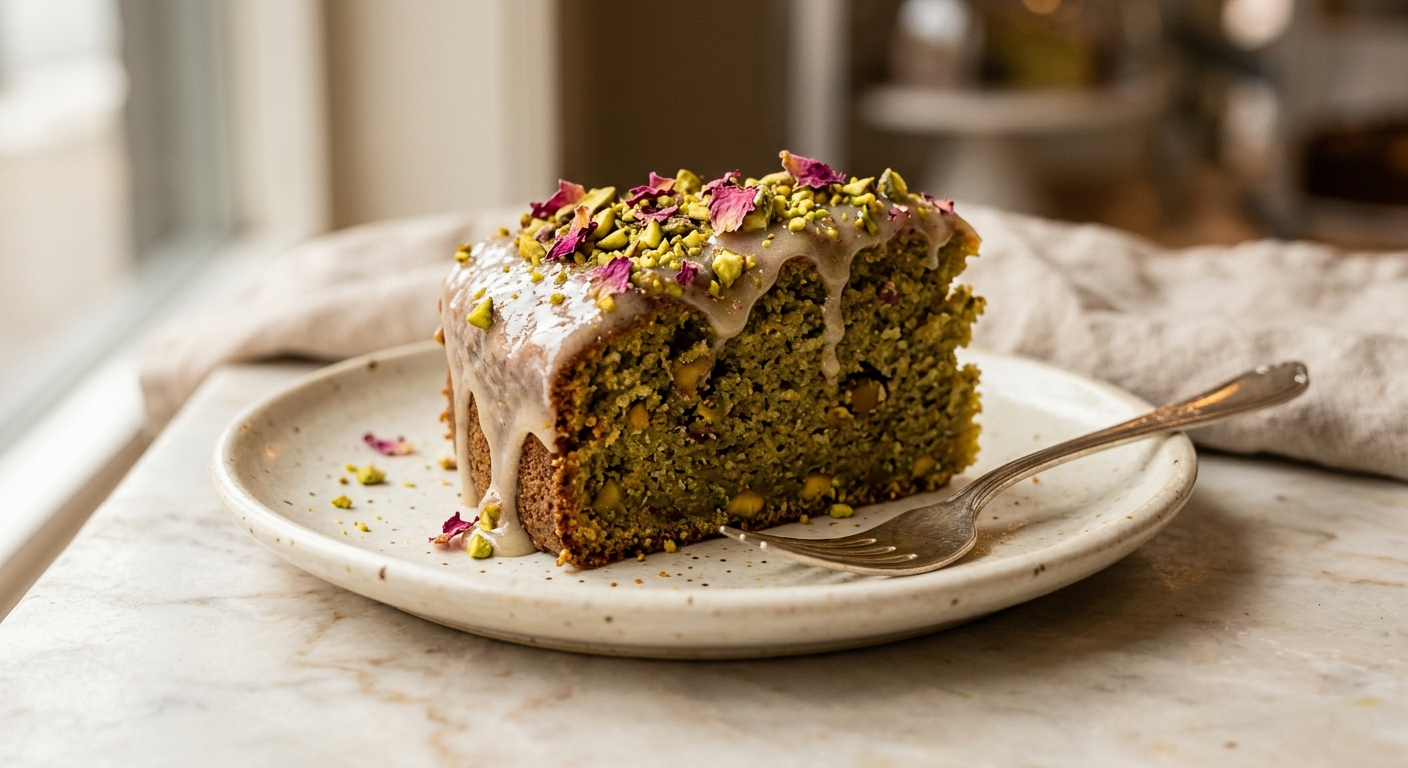
There is something quietly magical about a pistachio cake. The crumb is a soft, dusty green, the flavor is nutty and subtly sweet, and when you finish it with a rosewater glaze, the whole thing takes on an almost floral elegance that feels like it belongs on a table in a sun-drenched garden somewhere in the Middle East. This cake smells extraordinary as it bakes, the toasted pistachios and warm cardamom filling the kitchen with a scent that is genuinely hard to resist.
What makes this version stand out is the combination of finely ground pistachios and almond flour as the base, which produces a naturally moist, tender crumb without relying on refined sugar to retain moisture. The sweetener here is a monk fruit and allulose blend, which behaves remarkably like granulated sugar in baking, giving the cake structure and a clean, neutral sweetness that lets the pistachio and rosewater flavors shine rather than compete. The glaze is made with powdered monk fruit sweetener whisked with just enough rosewater and cream to create a silky, fragrant drizzle that sets to a soft finish.
This cake sits comfortably in the medium difficulty range. There is nothing technically intimidating here, but you do need a food processor to grind the pistachios properly, and a little patience during the cooling step before glazing. It is perfect for anyone managing blood sugar who refuses to miss out on a truly lovely dessert, and equally wonderful for anyone who simply wants something beautiful and a little different on a weekend afternoon.
Equipment Needed
Click on an item below to shop for the recommended items for this recipe on Amazon.
As an Amazon Associate, we earn from qualifying purchases.
12
Ingredients
- Garnish
- 150 graw shelled pistachios (about 1 cup), plus extra for topping
- 120 gblanched almond flour (about 1 1/4 cups, spooned lightly)
- 60 gall-purpose flour (about 1/2 cup, spooned and leveled)
- 180 gmonk fruit and allulose blend sweetener (about 3/4 cup; use a 1:1 sugar-replacement blend such as Lakanto Classic)
- 1.5 tspbaking powder
- 0.5 tspground cardamom
- 0.25 tspColima Sea SaltMicroplastic Free Salt
- 3 largeeggs, at room temperature
- 115 gunsalted butter, melted and cooled (about 1/2 cup)
- 120 gfull-fat plain Greek yogurt (about 1/2 cup)
- 2 tsppure vanilla extract
- 1 tspalmond extract
- 80 mlwhole milk (about 1/3 cup)
- —Rosewater Glaze:
- 90 gpowdered monk fruit and allulose blend (about 3/4 cup; use a powdered version such as Lakanto Powdered)
- 2 tbsprosewater
- 2 tbspheavy cream
- —Pinch of Colima Sea SaltMicroplastic Free Salt
- 2 tbspfinely chopped pistachios
- Garnish (optional But Beautiful)
- 1 tbspdried rose petals
Ingredient Substitutions
Instructions
- Preheat your oven to 325°F (165°C). Grease a 9-inch round cake pan with butter or nonstick spray, line the bottom with a round of parchment paper, and lightly flour the sides. Set aside. The lower temperature than a standard cake is intentional: almond flour and monk fruit sweetener both brown faster than all-purpose flour and sugar, and the gentler heat gives the center time to cook through without the edges over-browning.
- Spread the 150g of raw pistachios on a dry baking sheet and toast in the preheated oven for 7 to 8 minutes until fragrant and very lightly golden. Remove and let cool completely, about 10 minutes. Once cool, transfer to a food processor and pulse until they are finely ground to a coarse flour. Be careful not to over-process into pistachio butter, you want a sandy, slightly textured crumb. Set aside.
- In a large bowl, whisk together the ground pistachios, almond flour, all-purpose flour, monk fruit blend sweetener, baking powder, cardamom, and sea salt until evenly combined. Break up any clumps of almond flour with your fingers.
- In a separate medium bowl, whisk together the eggs, melted and cooled butter, Greek yogurt, vanilla extract, almond extract, and whole milk until smooth and well combined. The yogurt adds moisture and a gentle tang that balances the sweetness of the monk fruit.
- Pour the wet ingredients into the dry ingredients and fold together with a rubber spatula until just combined and no dry streaks remain. The batter will be thicker than a standard cake batter, similar to a muffin batter. Do not overmix, as overdeveloping the gluten in the all-purpose flour will make the cake tough.
- Transfer the batter to the prepared pan and smooth the top evenly with the spatula. Bake for 38 to 42 minutes, until the top is golden and a toothpick inserted into the center comes out with just a few moist crumbs. Begin checking at 35 minutes. The cake will feel set to a gentle press in the center when done.
- Allow the cake to cool in the pan for 15 minutes before turning out onto a wire rack. Remove the parchment and let the cake cool completely, at least 30 more minutes, before glazing. Glazing a warm cake will cause the glaze to run off and lose its opacity.
- To make the glaze, whisk together the powdered monk fruit sweetener, rosewater, heavy cream, and pinch of salt in a small bowl until completely smooth. The glaze should be thick enough to coat the back of a spoon but still pourable. If it is too thick, add rosewater a few drops at a time. If too thin, add a teaspoon more powdered sweetener. Pour the glaze over the cooled cake, letting it drip naturally down the sides. Immediately scatter the chopped pistachios and rose petals over the top before the glaze sets. Allow to set for 10 minutes before slicing.
- Prepare the batter exactly as described in steps 2 through 5 of the oven method. Toast the pistachios in the air fryer at 300°F (150°C) for 4 to 5 minutes, shaking once, before grinding them. Watch carefully as nuts toast faster in an air fryer.
- Grease a 7-inch round cake pan (at least 2 inches deep) and line the bottom with parchment. Pour in the batter, smoothing the top. This pan size will yield a slightly taller, more domed cake than the 9-inch version. You may have a small amount of leftover batter depending on your pan depth, which can be baked as a single muffin alongside.
- Preheat the air fryer to 300°F (150°C) for 3 minutes. Place the pan in the basket and bake for 20 minutes. At the 20-minute mark, check the top. If it is browning faster than it is cooking through, tent loosely with a small piece of aluminum foil. Continue baking for another 10 to 15 minutes, until a toothpick inserted into the center comes out with just a few moist crumbs.
- Carefully remove the pan from the basket using silicone gloves and set on a wire rack. Cool in the pan for 15 minutes, then turn out and cool completely before glazing. Because the cake is slightly taller in a 7-inch pan, give it a full 40 minutes to cool through to the center before adding the glaze.
- Make and apply the rosewater glaze as described in step 8 of the oven method. Garnish with chopped pistachios and rose petals. Slice into 10 portions rather than 12 given the smaller diameter.
- Toast the pistachios in a dry skillet over medium heat for 4 to 5 minutes, stirring frequently, until fragrant. Let cool completely, then grind in a food processor as described in the oven method. Prepare the batter exactly as described in steps 3 through 5 of the oven method.
- Tear a large piece of parchment paper and press it into the bottom and up the sides of the slow cooker insert, leaving an overhang you can use as handles later. Lightly grease the parchment with butter or nonstick spray. This is essential: without parchment, the cake will stick and you will not be able to remove it cleanly.
- Pour the batter into the lined slow cooker insert and smooth the top. Lay two layers of paper towels flat across the top of the slow cooker before placing the lid on. The paper towels absorb the condensation that collects inside the lid, preventing water droplets from dripping onto the cake and creating wet, gummy patches on the surface.
- Cook on High for 2 to 2.5 hours. Begin checking at the 2-hour mark by inserting a toothpick into the center. The edges will feel set and the center should be just barely firm, not wet or jiggly. The top will not brown as it does in the oven and will remain pale, which is normal.
- Turn off the slow cooker, remove the lid, and allow the cake to rest in the insert for 15 minutes. Then lift it out using the parchment overhang and transfer to a wire rack to cool completely, about 45 minutes to 1 hour. The slow cooker cake needs longer cooling time than the oven version because it retains heat longer. Do not rush this step or the glaze will not set.
- Once fully cooled, peel away the parchment and transfer the cake to a serving plate. Make and apply the rosewater glaze as described in step 8 of the oven method. Because the slow cooker cake has a flatter, slightly rustic top, the glaze pools beautifully in the center and the garnish of pistachios and rose petals makes it look intentional and lovely.
Nutrition Per Serving
Per 1 serving (makes one 9-inch single-layer round cake, serving 12)
Sweetener: monk fruit and allulose blend
Why This Recipe Works
The combination of finely ground pistachios and almond flour is the heart of this cake’s texture. Both are high in fat and low in starch compared to all-purpose flour, which means the cake stays naturally moist and tender without needing large amounts of butter or oil to compensate. The small amount of all-purpose flour in the recipe provides just enough gluten structure to give the cake lift and hold, preventing it from becoming too dense or crumbly, which is a common pitfall when baking entirely with nut flours. The Greek yogurt reinforces moisture and adds a gentle acidity that reacts with the baking powder, creating extra lift and a softer crumb.
Monk fruit and allulose blend sweeteners behave very similarly to granulated sugar in most baking applications because allulose, the bulk component, has a crystal structure and hygroscopic properties close to sucrose. This means it helps aerate the batter when combined with fat, and it holds onto some moisture during baking. However, allulose does not caramelize or brown the same way sugar does, which is why this cake is baked at 325°F (165°C) rather than the more typical 350°F (175°C). The lower temperature gives the center time to cook through before the almond flour and pistachio-rich exterior, which conduct heat efficiently due to their fat content, over-brown. The result is an evenly baked cake with a golden crust and a fully set, moist interior.
The rosewater glaze uses powdered monk fruit sweetener rather than the granulated version because powdered sweeteners dissolve readily in the small amount of liquid and cream, creating a smooth, cohesive glaze without graininess. If you find your glaze feels slightly gritty after mixing, let it sit for 2 minutes and stir again. Powdered allulose can take a moment to fully dissolve. If grittiness persists, warm the cream slightly before whisking it in, which helps the sweetener dissolve completely.
Baker’s Tips
- Toast the pistachios before grinding, even if they are already roasted. That additional few minutes in dry heat deepens the flavor significantly and makes a noticeable difference in the finished cake.
- Grind the pistachios in short pulses rather than a continuous run. Stop the food processor every 5 to 6 seconds and check the texture. You want a fine, sandy crumb, not a paste. If the nuts start clumping and releasing oil, they have gone too far.
- Bring the eggs, Greek yogurt, and milk to room temperature before starting. Cold dairy added to melted butter can cause the butter to seize and solidify in streaks, making it difficult to incorporate evenly.
- Rosewater varies significantly in strength by brand. Start with 2 tablespoons in the glaze and taste it. If the floral flavor seems faint, add more a teaspoon at a time. A high-quality culinary rosewater should be fragrant and clean, not soapy or perfumy.
- Do not glaze the cake until it is fully cooled to room temperature. Even a slightly warm cake will cause the glaze to thin out and slide off rather than setting to a soft, opaque finish.
- For the cleanest slices, use a sharp knife dipped in warm water and wiped dry between each cut. The ground nuts in the batter can make the crumb a little more fragile than a standard cake, and a clean knife prevents tearing.
Variations
- Lemon pistachio version: Replace the rosewater in the glaze with 1.5 tbsp fresh lemon juice and add 1 tsp lemon zest to the batter along with the wet ingredients for a brighter, citrusy flavor profile.
- Orange cardamom version: Add 1 tbsp fresh orange zest to the batter and replace the rosewater in the glaze with fresh orange juice for a warming, aromatic alternative.
- Chocolate-pistachio version: Add 2 tbsp unsweetened cocoa powder to the dry ingredients and replace the rosewater glaze with a simple ganache made from 60g sugar-free dark chocolate melted with 3 tbsp heavy cream.
- Dairy-free version: Swap the butter for refined coconut oil, the Greek yogurt for full-fat coconut yogurt, the milk for unsweetened almond milk, and the heavy cream in the glaze for full-fat coconut cream. The cake is still beautifully moist.
Troubleshooting & FAQ
My cake is browning on the outside but still wet in the center. What is happening?
My glaze is grainy or gritty. How do I fix it?
The cake is very dense and flat. What went wrong?
The cake tastes noticeably cool or minty after eating. Is that normal?
Can I use pre-ground pistachio flour instead of grinding my own?
Storage & Make-Ahead
- Storage: Store the glazed cake covered at room temperature for up to 2 days, or refrigerate in an airtight container for up to 5 days. The glaze may absorb slightly in the fridge but the flavor is unaffected. Bring to room temperature for 20 minutes before serving for the best texture.
- Make-Ahead: The cake can be baked up to 2 days ahead, wrapped tightly in plastic wrap once fully cooled, and stored at room temperature or refrigerated. Glaze on the day you plan to serve it for the freshest appearance. The unglazed cake also freezes well for up to 2 months. Thaw overnight in the refrigerator, bring to room temperature, then glaze before serving.