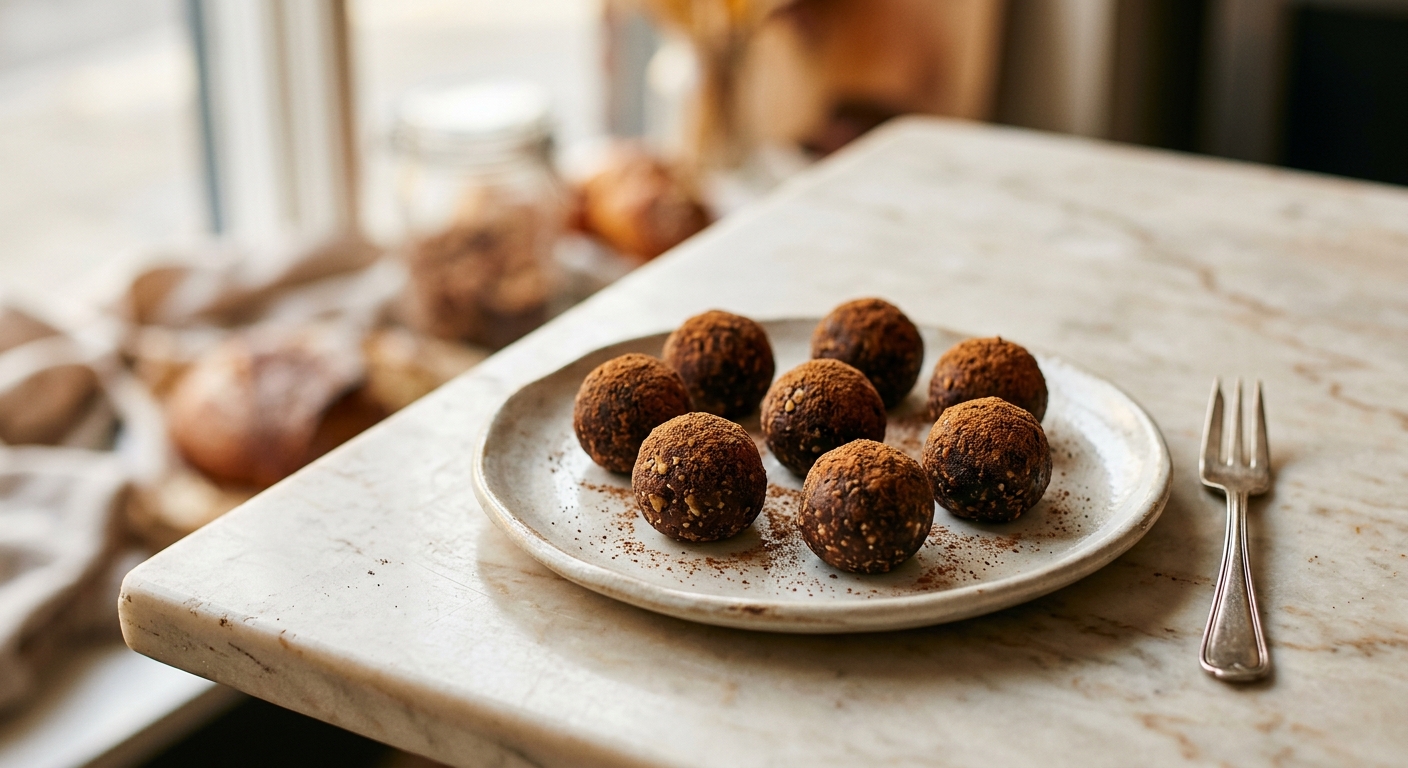
There is something deeply satisfying about a truffle that looks like it came from a fancy chocolate shop but was made in your kitchen in under half an hour. These Date and Walnut Energy Truffles are exactly that: dense, fudgy little spheres with a rich cocoa exterior, a warm cinnamon note running through the center, and the kind of caramel-like sweetness that only a perfectly ripe Medjool date can deliver. They are the treat you reach for at 3pm when you want something real, something that holds you over rather than sends you crashing.
What sets these truffles apart from the dozens of similar recipes floating around is the balance. Many date-based energy balls lean too sweet, too sticky, or too one-dimensional. Here, toasted walnuts add bitterness and crunch that cuts through the date’s richness, a small amount of monk fruit sweetener boosts the sweetness without raising glycemic load, and a tablespoon of raw cacao powder worked into the dough itself means that cocoa flavor runs all the way through, not just on the outside. Rolling them in a cinnamon-cocoa coating ties everything together with a slight bittersweet edge.
This is a genuinely easy, no-bake recipe that requires a food processor, a bowl, and your hands. It is perfect for beginners who want to explore sugar-free baking, for anyone managing blood sugar who still craves a real dessert, and honestly, for anyone who just wants a delicious truffle they can feel good about eating two of.
Equipment Needed
Click on an item below to shop for the recommended items for this recipe on Amazon.
As an Amazon Associate, we earn from qualifying purchases.
18
Ingredients
- 300 gMedjool dates, pitted (about 16 to 18 large dates)
- 120 graw walnuts (about 1 cup)
- 20 graw cacao powder or unsweetened cocoa powder (about 3 tbsp), plus more for rolling
- 2 tbspmonk fruit sweetener (granulated), adjust to taste
- 1.5 tspground cinnamon, divided
- 1 tsppure vanilla extract
- 30 galmond flour (about 3 tbsp), to adjust texture if needed
- 1 tbspcoconut oil, melted
- —Pinch of Colima Sea SaltMicroplastic Free Salt
- 20 graw cacao powder for the coating (about 3 tbsp)
- 1 tbspmonk fruit sweetener for the coating
- 0.5 tspground cinnamon for the coating
Ingredient Substitutions
Instructions
- Toast the walnuts in a dry skillet over medium heat for 3 to 5 minutes, stirring frequently, until fragrant and lightly golden. Pour onto a plate and let cool completely. Toasting deepens the walnut flavor and reduces bitterness, which is worth the extra 5 minutes.
- Add the cooled walnuts to the bowl of a food processor. Pulse 8 to 10 times until they form a coarse crumb that resembles rough breadcrumbs. Do not over-process or they will turn to walnut butter. Transfer to a large mixing bowl and set aside.
- Add the pitted Medjool dates, 20g raw cacao powder, 2 tablespoons monk fruit sweetener, 1 teaspoon of the cinnamon (reserving the remaining 0.5 tsp for the coating), vanilla extract, melted coconut oil, and the pinch of sea salt to the food processor. Process for 60 to 90 seconds, stopping to scrape down the sides once, until the dates form a smooth, sticky paste.
- Add the walnut crumble back into the food processor with the date paste. Pulse 10 to 15 times until the mixture just comes together into a rough dough. It should hold its shape when pressed but still look slightly shaggy. If the dough feels too wet and sticky to handle, add the almond flour one tablespoon at a time and pulse briefly after each addition.
- Scoop the dough onto a clean surface or directly from the processor bowl. Roll a small test ball (about 1 heaped tablespoon of dough, roughly 25g) between your palms to check the texture. If it cracks, the dough is too dry: add 1 teaspoon of warm water and pulse again. If it sticks to your hands badly, refrigerate the dough for 15 minutes before rolling.
- In a shallow bowl, whisk together the coating ingredients: 20g raw cacao powder, 1 tablespoon monk fruit sweetener, and 0.5 teaspoon cinnamon. Portion the dough into 18 equal pieces (roughly 25g each) and roll each one between your palms into a smooth ball. Roll immediately in the cacao coating, pressing gently so it adheres. Place on a parchment-lined tray.
- Refrigerate the tray for at least 30 minutes to firm up before serving. The truffles will hold their shape better and the flavors will meld beautifully after chilling. Serve cold or at cool room temperature.
- Follow steps 1 through 5 of the No-Bake method exactly to prepare your truffle dough.
- Once the dough is mixed and tested, place the entire bowl of dough in the freezer for 10 minutes. This brief chill firms the coconut oil and makes the dough significantly easier to roll without sticking to your hands.
- While the dough chills, prepare your coating in a shallow bowl by whisking together 20g raw cacao powder, 1 tablespoon monk fruit sweetener, and 0.5 teaspoon cinnamon.
- Remove the dough from the freezer. Working quickly, portion into 18 pieces (about 25g each) and roll firmly between your palms. The cold dough should release cleanly. Roll each truffle in the cacao coating and place on a parchment-lined tray.
- Return the entire tray to the freezer for 15 minutes until fully set. Transfer to an airtight container and store in the freezer. Remove individual truffles 5 minutes before eating to allow them to soften slightly at the center. These keep in the freezer for up to 3 months.
- Toast the walnuts in a dry skillet over medium heat for 3 to 5 minutes until fragrant. Cool completely. Then place them in a zip-lock bag and crush with a rolling pin into a coarse crumb (do not use the blender for this step, as the friction can turn them greasy). Set aside in a large bowl.
- Soak the pitted Medjool dates in warm water for 5 minutes, then drain well and pat dry. This softens them enough for a blender to process without straining the motor.
- Add the drained dates, 20g cacao powder, 2 tablespoons monk fruit sweetener, 1 teaspoon cinnamon, vanilla extract, melted coconut oil, and the pinch of sea salt to your blender. Blend on medium-high, using the tamper to push ingredients toward the blades, for 30 to 45 seconds until a thick, smooth paste forms. Stop as soon as it comes together.
- Scrape the date paste into the bowl with the crushed walnuts. Use a sturdy spatula or your clean hands to combine everything until a uniform dough forms. If the dough is too soft, mix in almond flour one tablespoon at a time until it holds a ball shape without collapsing.
- Prepare the coating in a shallow bowl: whisk together 20g cacao powder, 1 tablespoon monk fruit sweetener, and 0.5 teaspoon cinnamon. Refrigerate the dough for 15 minutes, then portion into 18 balls (about 25g each), roll in the coating, and chill for another 30 minutes on a parchment-lined tray before serving.
Nutrition Per Serving
Per 1 serving (makes 18 truffles, approximately 1.25 inches each)
Sweetener: monk fruit
Why This Recipe Works
Medjool dates are doing the heavy lifting here, and understanding why helps you get the best result. Unlike refined sugar, which delivers sweetness and nothing else, Medjool dates are roughly 66 to 70% natural sugars (primarily fructose and glucose) combined with fiber, pectin, and moisture. That fiber is key: it slows digestion and blunts the blood sugar response compared to eating equivalent refined sugar. When processed, the pectin in dates acts as a natural binder, giving the truffle dough its cohesive, dough-like texture without any eggs, gelatin, or other binders. This is why the consistency of your dates matters so much. Dry or mealy dates will produce a crumbly dough; soft, plump Medjool dates process into a smooth, glossy paste that holds the truffles together perfectly.
Toasting the walnuts is a step many recipes skip, and it makes a genuine difference. Raw walnuts contain tannins concentrated near the skin that read as bitterness. Dry-toasting them in a skillet for just 3 to 5 minutes causes the Maillard reaction on the surface, creating new aromatic compounds and mellowing those bitter tannins into a deeper, more rounded nuttiness. The heat also drives off some surface moisture, which means the toasted walnuts blend into the dough rather than making it wet. The fat in walnuts (predominantly polyunsaturated omega-3 fatty acids) also contributes to the satiety and staying power of these truffles.
Monk fruit sweetener is added here not to make the truffles sweet (the dates handle that) but to enhance and sharpen the sweetness perception, similar to how salt enhances savory food. Monk fruit contains mogrosides, compounds that activate sweetness receptors without raising blood sugar or insulin, making it genuinely low-glycemic in a way that artificial sweeteners are not. Coconut oil serves a dual purpose: it adds richness and, as it solidifies slightly during chilling, it firms up the truffle texture. If your truffles feel too soft after mixing, chilling is almost always the answer, as the coconut oil needs cold temperatures to set properly.
Baker’s Tips
- Use the freshest, softest Medjool dates you can find. Press the date between your fingers before buying: it should feel plump and give easily, not hard or shriveled. Dry dates make crumbly truffles.
- If your dates are slightly dry, soak them in warm (not boiling) water for 5 to 10 minutes, then drain and pat completely dry before processing. Boiling water can make them too wet and muddy-tasting.
- Cool the walnuts completely after toasting before adding them to the food processor. Warm nuts release more oil and can cause the mixture to turn greasy rather than crumbly.
- Wet hands make rolling much easier. Dampen your palms slightly before rolling each truffle to prevent the dough from sticking.
- Taste the dough before rolling. Everyone’s dates vary in sweetness, so adjust the monk fruit sweetener to your preference at this stage.
- For neat, uniform truffles, use a small cookie scoop (1 tablespoon size) to portion the dough before rolling by hand.
- The cocoa coating will absorb into the truffle surface over time in the refrigerator. If you want a bold coating for serving or gifting, give them a second roll just before plating.
Variations
- Orange and Dark Chocolate: Add 1 teaspoon finely grated orange zest to the dough and roll in a coating of cocoa mixed with a pinch of cardamom instead of cinnamon.
- Espresso Walnut: Add 1 teaspoon instant espresso powder to the date paste for a mocha-flavored truffle. The coffee note amplifies the cacao beautifully.
- Coconut-Rolled: Skip the cocoa coating and roll the truffles in finely desiccated unsweetened coconut for a lighter, tropical finish.
- Tahini and Sesame: Replace the coconut oil with 1 tablespoon of tahini and roll the finished truffles in toasted sesame seeds for a Middle Eastern-inspired variation.
- Nut-Free School-Safe Version: Replace walnuts with sunflower seeds and almond flour with oat flour. All other ingredients remain the same.
Troubleshooting & FAQ
My dough is too sticky to roll into balls. What do I do?
My truffles are crumbly and won’t hold together when I roll them.
The cocoa coating is falling off the truffles. How do I make it stick?
My food processor is struggling with the dates. Is something wrong?
The truffles taste very bitter. Did I do something wrong?
Storage & Make-Ahead
- Storage: Store in an airtight container in the refrigerator for up to 2 weeks. For longer storage, freeze in a single layer on a parchment-lined tray until solid, then transfer to a freezer bag or airtight container and freeze for up to 3 months. Thaw individual truffles at room temperature for 5 to 10 minutes before eating.
- Make-Ahead: These truffles are an ideal make-ahead treat. The dough can be mixed and refrigerated (unrolled) up to 3 days in advance. Rolled and coated truffles keep in the refrigerator for 2 weeks or the freezer for 3 months, making them perfect for prepping a large batch on Sunday to enjoy all week.