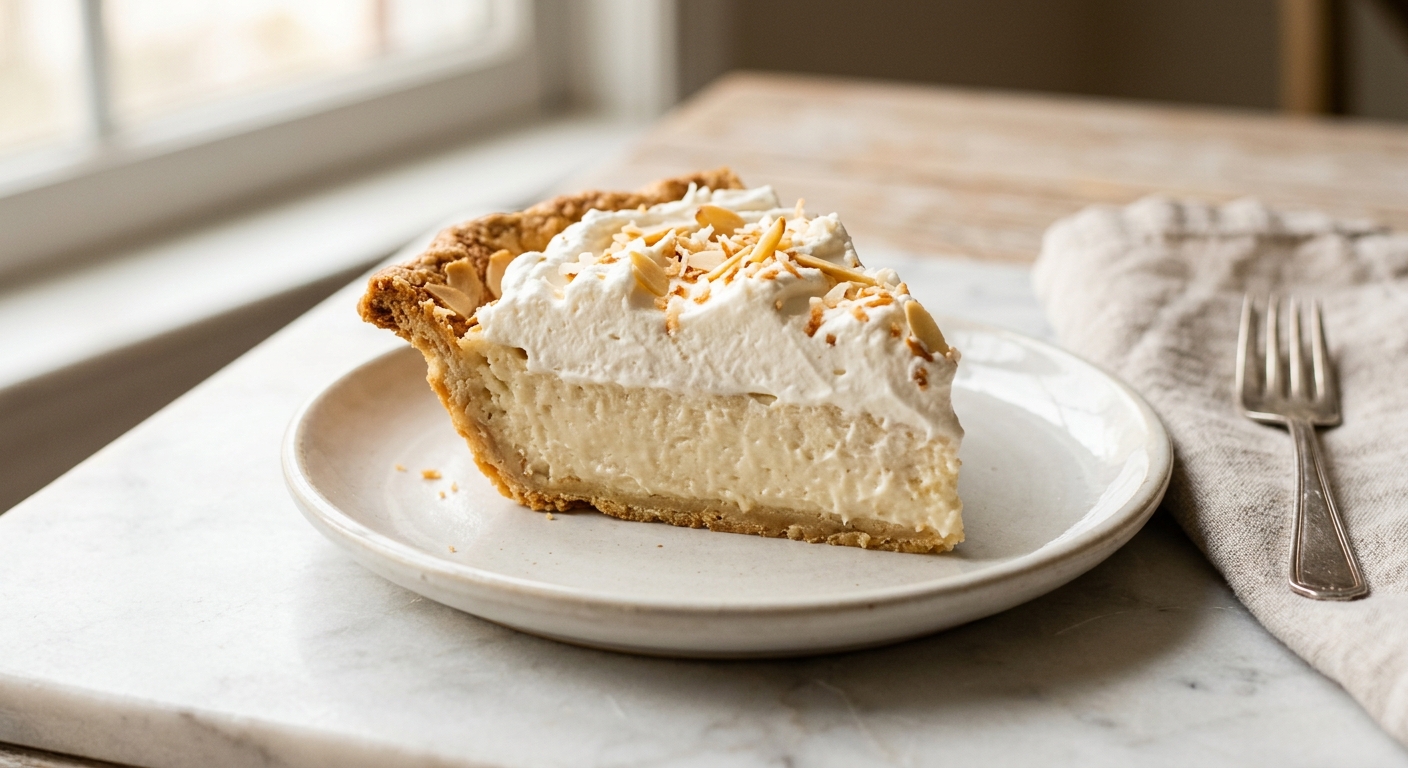
Close your eyes and picture a slice of coconut cream pie: that billowing, lightly perfumed filling, the gentle give of cool custard against a buttery, crumbly crust, and a crown of whipped cream that melts on your tongue. Now imagine that every dreamy bite comes without a grain of refined sugar. That is exactly what this Monk Fruit Coconut Cream Pie delivers, and the first time you serve it to someone who doesn’t know it’s sugar-free, their genuine surprise will become your favorite kitchen story.
What sets this pie apart is a two-part commitment to flavor over compromise. The crust is built from finely ground blanched almond flour, toasted until golden and bound with coconut oil and a touch of monk fruit sweetener, giving you a nutty, crisp foundation that holds its shape beautifully when sliced. The filling leans on full-fat coconut milk and a second kiss of coconut cream, thickened with arrowroot starch rather than cornstarch, which keeps the glycemic load low while producing a filling that is genuinely glossy and sliceable. Monk fruit sweetener carries all the sweetness without bitterness, and toasted coconut flakes stirred into the filling add little pockets of chew and fragrance throughout.
This pie sits at a medium difficulty level, mostly because the custard filling requires a bit of patience and constant stirring over the stove, but every step is clearly mapped out and very forgiving. It is the perfect weekend project for anyone following a keto, diabetic-friendly, or low-sugar lifestyle, and equally wonderful for anyone who simply wants a lighter dessert that doesn’t taste like a sacrifice.
Equipment Needed
Click on an item below to shop for the recommended items for this recipe on Amazon.
As an Amazon Associate, we earn from qualifying purchases.
10
Ingredients
- Crust
- 240 gblanched almond flour (about 2 1/2 cups, lightly spooned)
- 30 gmonk fruit sweetener, powdered (about 3 tbsp)
- 0.25 tspColima Sea SaltMicroplastic Free Salt
- 60 gcoconut oil, melted and slightly cooled (about 4 tbsp)
- 1 largeegg, at room temperature
- 0.5 tsppure vanilla extract
- 800 mlfull-fat coconut milk, from two 400ml (13.5 oz) cans, well shaken
- 120 mlcoconut cream (about 1/2 cup), from the top of a chilled can
- Filling
- 90 gmonk fruit sweetener, powdered (about 1/2 cup plus 2 tbsp)
- 45 garrowroot starch (about 1/3 cup)
- 0.25 tspColima Sea SaltMicroplastic Free Salt
- 3 largeegg yolks, at room temperature
- 30 gunsalted butter or coconut oil (2 tbsp), cut into small pieces
- 1.5 tsppure vanilla extract
- 0.5 tspcoconut extract
- 60 gunsweetened coconut flakes (about 3/4 cup), toasted, divided
- Topping
- 240 mlheavy whipping cream or full-fat coconut cream (chilled), about 1 cup
- Whipped Topping
- 15 gmonk fruit sweetener, powdered (about 1 tbsp)
- 0.5 tsppure vanilla extract
Ingredient Substitutions
Instructions
- Preheat your oven to 350°F (175°C). Lightly grease a 9-inch deep-dish pie pan with coconut oil. In a large bowl, whisk together the almond flour, 30g powdered monk fruit sweetener, and 1/4 tsp sea salt until evenly combined and no clumps remain.
- Add the melted coconut oil, egg, and 1/2 tsp vanilla extract to the almond flour mixture. Stir with a fork until the mixture comes together into a soft, pliable dough that holds its shape when pressed. It will be slightly greasy, which is normal.
- Press the dough evenly into the bottom and up the sides of the prepared pie pan, using the flat bottom of a measuring cup or your fingertips to create an even layer about 1/4 inch thick. Crimp the edges if you like, or press them flush with the rim. Prick the bottom a dozen times with a fork to prevent bubbling.
- Bake the crust for 13 to 16 minutes, until it is deep golden brown at the edges and set in the center. It will firm up further as it cools. Transfer to a wire rack and allow to cool completely, at least 30 minutes, before adding the filling.
- While the crust cools, make the filling. In a medium heavy-bottomed saucepan, whisk together the 90g powdered monk fruit sweetener, arrowroot starch, and 1/4 tsp sea salt. Gradually whisk in the full-fat coconut milk and coconut cream until smooth with no lumps.
- In a small bowl, lightly whisk the 3 egg yolks. Set aside. Place the saucepan over medium heat and cook, whisking constantly, until the mixture begins to steam and thicken, about 8 to 10 minutes. Do not walk away, as arrowroot can go from liquid to lumpy quickly once it approaches the thickening point.
- Once the mixture is steaming and beginning to thicken, remove about 1/2 cup of the hot coconut mixture and slowly drizzle it into the egg yolks while whisking vigorously. This tempers the yolks so they do not scramble. Pour the tempered yolk mixture back into the saucepan and return to medium heat.
- Cook, whisking constantly, for another 2 to 3 minutes until the filling is thick, glossy, and coats the back of a spoon. Remove from heat and stir in the butter or coconut oil pieces, 1.5 tsp vanilla extract, and coconut extract until fully melted and incorporated. Fold in 45g (about half) of the toasted coconut flakes.
- Pour the warm filling into the cooled almond crust. Lay a piece of plastic wrap directly on the surface of the filling (pressing it gently to contact the custard) to prevent a skin from forming. Refrigerate for at least 4 hours, or overnight, until fully set and cold throughout.
- When ready to serve, make the whipped topping. Beat the cold heavy cream or chilled coconut cream with the 15g powdered monk fruit sweetener and 1/2 tsp vanilla in a chilled bowl until medium-to-stiff peaks form, about 3 to 4 minutes with a hand mixer on medium-high. Spread or pipe over the chilled pie and finish with the remaining 15g toasted coconut flakes.
- Lightly grease a 9-inch deep-dish pie pan with coconut oil. In a food processor, pulse 200g of blanched almond flour with 40g of unsweetened coconut flakes, 30g powdered monk fruit sweetener, and 1/4 tsp sea salt until the coconut is finely chopped and evenly distributed.
- Add 60g of melted coconut oil and 1 tbsp of cold water. Pulse again until the mixture clumps together when pressed between your fingers. If it feels dry, add cold water one teaspoon at a time.
- Press the no-bake crust firmly and evenly into the bottom and sides of the prepared pie pan, using the flat bottom of a measuring cup to pack it tightly. A firmly packed crust is essential here since there is no egg or oven heat to bind it. Place the pan in the freezer for at least 30 minutes to set completely.
- Prepare the filling exactly as described in steps 5 through 8 of the oven method, cooking the custard on the stovetop, tempering the yolks, and finishing with butter, extracts, and half the toasted coconut flakes.
- Remove the frozen crust from the freezer. Pour the warm filling into the set crust. Smooth the top with an offset spatula. Lay plastic wrap directly on the surface of the custard and refrigerate for at least 5 hours, or overnight, until fully firm. The longer chill time compensates for starting with a cold crust that slightly slows the custard from setting.
- Top with whipped cream and remaining toasted coconut flakes just before serving. Slice cleanly with a sharp knife dipped in hot water and wiped dry between cuts.
- Prepare and bake or freeze-set your crust using either the oven or no-bake method described above. Allow it to cool or remain in the freezer while you make the filling.
- In a large microwave-safe bowl (at least 2-quart capacity to prevent boilovers), whisk together the 90g powdered monk fruit sweetener, arrowroot starch, and 1/4 tsp sea salt. Gradually whisk in the full-fat coconut milk and coconut cream until completely smooth.
- Microwave on High in 2-minute intervals, whisking thoroughly between each interval, for a total of 8 to 10 minutes. The mixture will begin to look steamy and slightly thickened around the 6-minute mark. Stop and whisk vigorously each time to prevent lumps from forming at the edges of the bowl.
- In a small bowl, whisk the 3 egg yolks until smooth. Once the coconut mixture has thickened to a pudding-like consistency, remove from the microwave. Slowly ladle about 1/2 cup of the hot mixture into the yolks while whisking constantly to temper them. Pour the yolk mixture back into the large bowl and whisk well to combine.
- Return the bowl to the microwave and cook on Medium power (50%) for 1-minute intervals, whisking between each, for another 2 to 4 minutes, until the filling is very thick, glossy, and holds a ribbon when the whisk is lifted. Stir in the butter or coconut oil pieces, vanilla extract, coconut extract, and half the toasted coconut flakes until everything is incorporated.
- Pour into the prepared crust, cover the surface with plastic wrap, and refrigerate for at least 4 hours. Top with whipped cream and toasted coconut flakes before serving.
Nutrition Per Serving
Per 1 serving (makes one 9-inch deep-dish pie)
Sweetener: monk fruit
Why This Recipe Works
The magic of this custard filling lies in arrowroot starch, which is doing the heavy lifting that cornstarch usually handles in a conventional cream pie. Arrowroot gelatinizes at a lower temperature than cornstarch (around 140 to 149°F versus 203°F), which means it thickens gently and produces a clearer, more glossy gel. It also plays beautifully with acidic ingredients and doesn’t leave the chalky aftertaste that cornstarch can sometimes impart to dairy-free bases. The one nuance to understand: arrowroot loses its thickening power if overcooked or held at a boil for too long, which is why the recipe directs you to remove the pan from heat as soon as the filling is thick and glossy rather than continuing to cook it down.
Monk fruit sweetener behaves almost identically to granulated sugar in a custard application because sweetness here is not about structure. It dissolves cleanly in the liquid base without the cooling aftertaste sometimes found in allulose, and powdered monk fruit blends ensures no grittiness in the finished filling. The egg yolks are tempered rather than added directly to the hot liquid because egg proteins coagulate rapidly above 160°F. By introducing a small amount of the hot coconut mixture to the yolks gradually, you raise their temperature slowly before they join the saucepan, preventing scrambling and guaranteeing a smooth, cohesive custard.
The almond flour crust relies on the egg as its binder, which is what differentiates it from many almond flour crusts that crumble when sliced. The egg proteins set during baking and create a firm, cohesive structure, while the coconut oil keeps it tender rather than tough. Toasting the baked crust until deeply golden is not just for aesthetics: browning develops nutty, complex flavors through the Maillard reaction that balance the sweetness of the filling. If your crust is pale when it comes out of the oven, give it another 2 minutes; a golden-to-amber color is your target.
Baker’s Tips
- Use powdered monk fruit sweetener, not granulated. Powdered dissolves instantly into the custard and leaves no gritty texture. If you only have granulated, blend it in a high-speed blender or spice grinder for 30 seconds until finely powdered.
- Shake your cans of coconut milk well before opening. You want the cream and liquid fully combined for the filling. Reserve the thick cream from a separately chilled can specifically for the whipped topping.
- Whisk constantly during the stovetop cooking stage. Arrowroot custard can develop lumps in the bottom of the pan if left unattended even briefly. A silicone whisk gets into the corners of a saucepan better than a wire whisk.
- Press the plastic wrap directly onto the surface of the warm filling before refrigerating. Even a small gap allows condensation to form a rubbery skin on top of the custard.
- Toast the coconut flakes in a dry skillet over medium heat for 3 to 5 minutes, stirring frequently, until golden. Watch them carefully, as they go from golden to burnt very quickly. Cool completely before folding into the filling.
- Chill the bowl and beaters before whipping the topping for stiffer, more stable peaks, especially important when using coconut cream instead of heavy whipping cream.
- For the cleanest slices, run a sharp knife under hot water, wipe it dry, and slice in one smooth downward motion. Repeat between cuts.
Variations
- Lime-Coconut Version: Stir 2 tsp of lime zest and 1 tbsp of fresh lime juice into the finished custard along with the extracts for a bright, tropical twist.
- Chocolate-Coconut Version: Whisk 30g of unsweetened cocoa powder into the dry filling ingredients and increase monk fruit sweetener by 15g for a deep, dark chocolate coconut custard filling.
- Dairy-Free and Vegan Version: Use coconut oil in the crust instead of butter, increase arrowroot starch to 60g, omit the egg yolks, and whip two cans of chilled coconut cream for the topping. The filling will be slightly lighter in color and body but still fully sliceable after a full overnight chill.
- Individual Tartlets: Divide the crust dough and filling among 10 individual 3-inch tartlet pans, reduce the crust bake time to 10 to 12 minutes, and chill for 2 hours for elegant single-serve portions.
Troubleshooting & FAQ
My custard filling didn’t set and is still runny after 4 hours in the fridge. What went wrong?
My crust is crumbling and falling apart when I slice the pie. How do I fix it?
There are lumps in my custard filling. Can I salvage it?
The crust is browning too fast on the edges but the center still looks raw. What should I do?
My whipped coconut cream topping is too soft and won’t hold peaks. How do I fix it?
Storage & Make-Ahead
- Storage: Store the finished pie covered tightly in the refrigerator for up to 4 days. Add whipped topping only to portions you plan to serve immediately, as it can weep and deflate after sitting on the pie for more than a day. The baked, unfilled crust can be stored at room temperature, wrapped tightly, for up to 2 days.
- Make-Ahead: The crust can be baked up to 2 days ahead and stored covered at room temperature, or frozen (unfilled) for up to 1 month. The custard filling can be made up to 2 days ahead, stored with plastic wrap pressed directly to its surface in the refrigerator, and then poured into the crust for a final 2-hour set. Whip the topping fresh on the day of serving.