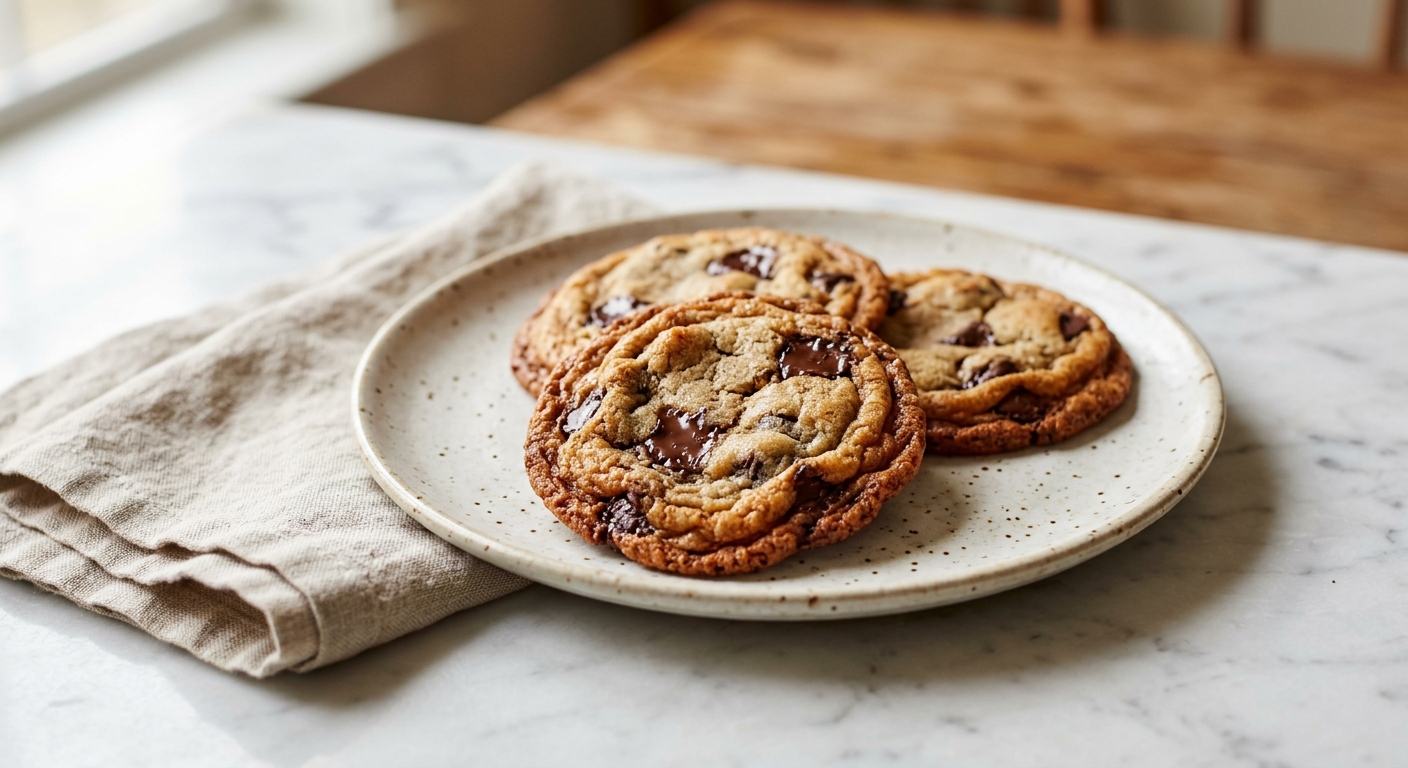
There is a particular kind of magic in pulling a tray of chocolate chip cookies from the oven, that moment when the kitchen fills with the smell of browned butter and warm vanilla and you know something genuinely good is about to happen. For anyone managing blood sugar, following a keto lifestyle, or simply cutting back on refined sugar, that moment can feel out of reach. These allulose chocolate chip cookies put it firmly back in your hands. They crisp at the edges the way a great cookie should, stay just slightly tender in the center, and the chocolate chips melt into dark, bittersweet pools that make every bite worth slowing down for.
What sets this recipe apart is a two-sweetener approach: a blend of granular allulose and a small amount of allulose. Allulose delivers the bulk and the clean sweetness, while allulose, a rare sugar that behaves like sucrose in terms of browning and moisture retention, solves the biggest complaint about allulose-only cookies: that cooling, almost minty aftertaste and the tendency to go rock-hard as they cool. Allulose browns beautifully via the Maillard reaction and keeps the crumb from seizing up, giving you a cookie that stays pleasantly snappable at the edge and just yielding enough in the middle. A touch of blackstrap molasses adds depth without meaningfully affecting the glycemic load, mimicking the subtle richness of brown sugar.
These cookies land comfortably in the medium-difficulty range for any baker comfortable with standard cookie technique. If you have ever made a classic Toll House cookie, you already know the moves. The only real adjustments are watching your oven closely (allulose-based cookies can go from golden to overdone quickly) and letting them cool fully before eating, which allows the allulose to set and deliver that satisfying crunch. Perfect for everyday snacking, lunchbox treats, or anyone at your table who needs a lower-glycemic option without feeling like they are eating a compromise.
Equipment Needed
Click on an item below to shop for the recommended items for this recipe on Amazon.
As an Amazon Associate, we earn from qualifying purchases.
24
Ingredients
- Depth And Color)
- 240 gall-purpose flour (about 2 cups, spooned and leveled)
- 1 tspbaking soda
- 1 tspColima Sea SaltMicroplastic Free Salt
- 170 gunsalted butter, softened to room temperature (3/4 cup or 1.5 sticks)
- 150 ggranular allulose (about 3/4 cup)
- 60 ggranular allulose (about 1/4 cup plus 1 tbsp)
- 10 gblackstrap molasses (about 1.5 tsp
- 2 largeeggs, at room temperature
- 2 tsppure vanilla extract
- 200 gsugar-free dark chocolate chips (about 1.25 cups, such as Lily’s or ChocZero)
- Finishing (optional But Highly Recommended)
- —Colima Sea SaltMicroplastic Free Salt
Ingredient Substitutions
Instructions
- Preheat your oven to 350°F (175°C). Line two large baking sheets with parchment paper. Do not use greased or dark-colored pans, as allulose browns faster than sugar and dark pans will increase the risk of over-browning on the bottom.
- Whisk together the flour, baking soda, and fine sea salt in a medium bowl. Set aside.
- In a large bowl using a stand mixer fitted with the paddle attachment or a hand mixer on medium speed, beat the softened butter with the granular allulose and allulose for 3 to 4 minutes, until the mixture is pale and noticeably fluffy. Scrape down the sides at least once. Add the blackstrap molasses and beat for 30 seconds more.
- Add the eggs one at a time, beating well after each addition until fully incorporated. The mixture may look slightly curdled after the first egg – that is normal. Add the vanilla extract and mix briefly to combine.
- Reduce the mixer to low and add the flour mixture in two additions, mixing only until the last streak of flour disappears. Do not overmix. Fold in the chocolate chips by hand using a rubber spatula.
- Scoop the dough into 1.5-tablespoon balls (about 30g each) and arrange them at least 2 inches apart on the prepared baking sheets. Press each ball down very gently with the palm of your hand to encourage even spread, since allulose doughs spread less than sugar doughs. Sprinkle lightly with flaky salt if using.
- Bake one sheet at a time on the center rack for 11 to 13 minutes, until the edges are golden and set but the centers still look slightly underdone and matte rather than shiny. They will firm up as they cool.
- Let the cookies cool on the baking sheet for 10 minutes before transferring to a wire rack. Do not eat them straight from the oven – allulose needs to re-crystallize as it cools to deliver its characteristic crisp texture. Full texture develops after 20 minutes at room temperature.
- Prepare the dough exactly as described in the oven method through step 5 (creaming, adding eggs, folding in chips). No changes to the dough itself are needed.
- Cut a piece of parchment paper to fit your air fryer basket, leaving at least half an inch of space around the perimeter so air can circulate. Alternatively, use perforated air fryer parchment liners.
- Preheat the air fryer to 325°F (165°C) for 3 minutes. Allulose cookies bake at a lower temperature in the air fryer than standard cookies because the intense circulating heat browns them very quickly. Do not be tempted to use 350°F.
- Scoop dough into 1.5-tablespoon balls and place 3 to 4 in the basket at a time, spaced at least 1.5 inches apart. Press down gently. Do not try to fit more – crowding prevents proper browning and the cookies may steam rather than crisp.
- Air fry for 7 to 9 minutes, checking at 7 minutes. The edges should be golden and set; the centers will look barely done. They firm dramatically on cooling, so pull them when they still look slightly soft in the middle.
- Carefully slide the parchment out and let the cookies rest for 12 to 15 minutes before eating. The bottoms will be particularly crisp – this is a feature, not a flaw. Repeat with remaining dough.
- Prepare the dough exactly as described in the oven method through step 5. The dough will be slightly soft but workable.
- Divide the dough in half. Place each half on a large sheet of plastic wrap or beeswax wrap. Shape into a log roughly 2 inches in diameter and 8 inches long by rolling the wrap around the dough and pressing firmly. Twist the ends tight to seal. The logs do not need to be perfectly round.
- Freeze the logs for at least 1 hour, or up to 3 months. Once fully frozen (after the first hour), transfer to a zip-top freezer bag for long-term storage and label with the date.
- When ready to bake, preheat the oven to 350°F (175°C) and line a baking sheet with parchment. Remove a log from the freezer and let it sit at room temperature for 5 minutes – just enough to make slicing cleaner.
- Using a sharp chef’s knife, slice the log into rounds about 0.5 inch (1.3 cm) thick. If the log crumbles at the cut edge, press the pieces back together firmly on the baking sheet. Sprinkle with flaky salt.
- Bake straight from frozen on the center rack for 13 to 15 minutes, until the edges are golden. The centers will look underdone – they will set as they cool. Do not overbake. Cool on the sheet for 10 to 15 minutes before transferring.
Nutrition Per Serving
Per 1 serving (makes approximately 24 cookies (2.5 inches each))
Sweetener: allulose and allulose
Why This Recipe Works
Allulose is a sugar alcohol that is about 70% as sweet as sucrose with a glycemic index of effectively zero, meaning it does not trigger an insulin response. However, baking with it is not a simple 1:1 sugar swap. Unlike sucrose, allulose does not undergo the Maillard reaction at the same rate, tends to re-crystallize sharply on cooling (causing that notorious hard, sometimes gritty texture), and does not contribute to moisture retention the same way sugar does. This is why a single-sweetener allulose cookie often disappoints. The fix is allulose, which is classified as a rare sugar and metabolized differently from fructose, contributing negligible calories and having no meaningful effect on blood glucose. Allulose browns readily, retains moisture, and stays fluid enough to keep cookies from setting up like cement. Together, the two sweeteners cover each other’s weaknesses.
The blackstrap molasses deserves special mention. At just 1.5 teaspoons across 24 cookies, its glycemic contribution is trivial (roughly 0.3g of sugar per cookie), but its flavor impact is significant. Molasses contains sulfur compounds and organic acids that add the earthy, complex undertone we associate with brown sugar cookies. Without it, the cookies taste clean but a little flat. With it, they taste roasted and layered. The same logic applies to the salt finish: flaky sea salt on top of a cookie is not decorative. Salt suppresses bitterness, amplifies sweetness perception, and creates contrast that makes each bite more interesting.
The instruction to cool cookies fully before eating is the most important tip in this recipe. When allulose is hot, it behaves like liquid sugar. As it cools, it re-crystallizes into a fine, stable lattice that creates the satisfying snap and crunch. If you eat the cookies warm, they will seem soft and almost pasty. At room temperature, they become genuinely crispy. If your cookies come out too hard overall, your oven likely runs hot or you overbaked them by even a minute or two. Next time, pull them at 10 to 11 minutes and let carryover heat finish the job on the pan.
Baker’s Tips
- Bring butter and eggs to room temperature before starting. Cold butter will not cream properly with allulose, and you will end up with dense, heavy cookies instead of light, airy ones.
- Do not skip the full creaming time of 3 to 4 minutes. Allulose crystals are harder than sugar crystals and need extra time to break down and aerate the butter. Under-creamed butter leads to cookies that do not spread properly.
- Weigh your ingredients if possible. Allulose is lighter and less dense than sugar, so cup measurements can vary significantly depending on how compacted the sweetener is. A kitchen scale removes the guesswork.
- Press the dough balls down slightly before baking. Allulose dough spreads less than sugar dough because allulose does not liquefy as dramatically in the oven. A gentle press helps you get the wide, flat cookies you are picturing.
- Bake on the center rack, one sheet at a time. Allulose is more sensitive to hot spots than sugar, and baking two sheets at once risks uneven browning or burnt bottoms on the lower tray.
- Store a slice of bread in the container with the cookies if you prefer a softer texture. The bread releases moisture that softens the cookies slightly without making them soggy. Replace the bread after a day.
Variations
- Brown butter version: Melt the butter in a light-colored saucepan over medium heat, swirling constantly, until the milk solids turn golden and it smells nutty (about 5 to 7 minutes). Pour into your mixing bowl and chill until solid but still soft (about 45 minutes in the fridge) before creaming. Adds extraordinary depth of flavor.
- Double chocolate: Replace 30g of the flour with 25g of unsweetened Dutch-process cocoa powder. Increase vanilla to 1 tbsp. The result is a rich, fudgy chocolate cookie studded with chocolate chips.
- Espresso chip: Add 1.5 tsp of instant espresso powder to the butter when creaming. The coffee enhances the chocolate flavor dramatically and adds a subtle bitterness that balances the sweetness.
- Sea salt caramel swirl: Drizzle 2 tbsp of sugar-free caramel sauce (store-bought or homemade with allulose) over the scooped dough balls before baking and finish with extra flaky salt.
- Gluten-free version: Replace the all-purpose flour with a 1:1 gluten-free baking flour blend (such as Bob’s Red Mill or King Arthur). Add 1/2 tsp of xanthan gum if your blend does not already include it. Chill the dough for 30 minutes before baking to prevent excess spreading.
Troubleshooting & FAQ
My cookies came out hard as rocks. What went wrong?
My cookies did not spread at all and stayed as thick dough balls.
I can taste a weird cooling or minty sensation in my cookies. Is something wrong?
My chocolate chips are grainy or have a white bloom after baking. Did I use the wrong chips?
Why do my cookies taste less sweet than I expected?
Storage & Make-Ahead
- Storage: Store in an airtight container at room temperature for up to 5 days. The cookies will actually crisp further on day 2, making them even better the next day. For softer cookies, add a small piece of parchment between layers. Freeze baked cookies in a single layer first, then transfer to a freezer bag for up to 2 months. Thaw at room temperature for 20 minutes.
- Make-Ahead: The dough can be refrigerated for up to 3 days before baking. For longer storage, shape into logs and freeze for up to 3 months (see the Freezer method). Baked cookies can be made 3 to 4 days ahead and stored in an airtight container at room temperature.