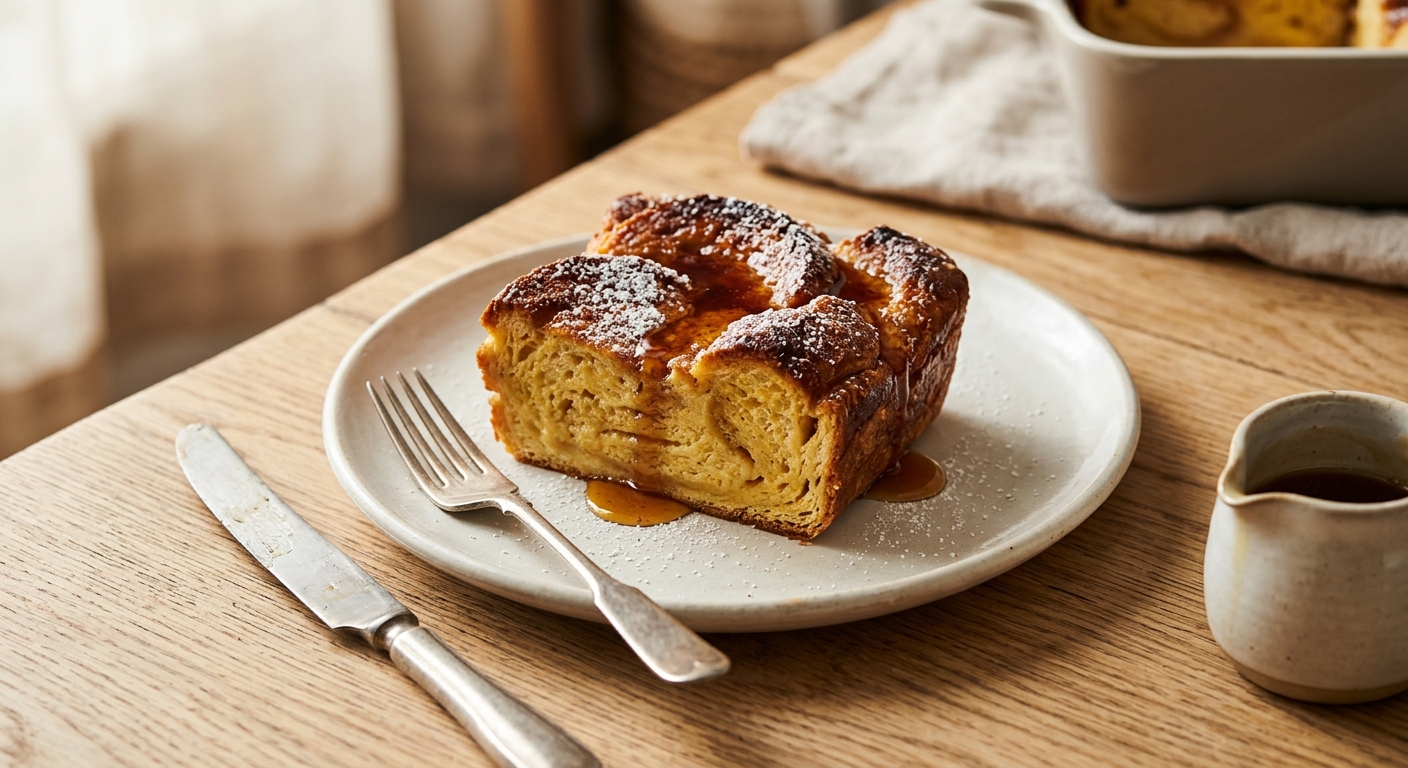
There is a particular kind of weekend morning magic that only a French toast bake can deliver: the kitchen slowly filling with the scent of vanilla and cinnamon, a bubbling, golden casserole emerging from the oven, and a table full of people who cannot wait to dig in. This version starts with pillowy brioche, which soaks up a rich custard of eggs, cream, and a carefully chosen pair of sweeteners overnight. By morning, every cube of bread is saturated all the way through, and the top bakes up with a lightly crisp, caramelized crust that shatters deliciously under a spoon.
What sets this casserole apart is the combination of monk fruit concentrate and allulose, and that pairing is deliberate. Monk fruit provides clean, intense sweetness with zero glycemic impact, while allulose is a rare sugar that behaves almost identically to table sugar in cooking: it dissolves smoothly into custard, caramelizes under heat (giving you that gorgeous bronzed top), and keeps the texture moist without any cooling aftertaste. Together they deliver a sweetness profile that is genuinely convincing, without allulose’s grittiness or any artificial flavor. The streusel topping, made with almond flour and a touch of monk fruit, adds a nutty, crumbly contrast to the soft interior.
This recipe is rated medium difficulty, mostly because of the overnight chill and the streusel assembly, but the active hands-on time is brief and forgiving. It is ideal for anyone managing blood sugar who refuses to give up a decadent weekend breakfast, for families with guests who eat low-glycemic or diabetic-friendly diets, and honestly for anyone who simply wants a deeply satisfying breakfast casserole without the sugar crash that follows.
Equipment Needed
Click on an item below to shop for the recommended items for this recipe on Amazon.
As an Amazon Associate, we earn from qualifying purchases.
10
Ingredients
- Custard
- 450 gbrioche loaf, cut into 1.5-inch cubes and left uncovered overnight to stale (about 10 to 12 thick slices)
- 6 largeeggs
- 360 mlheavy cream (about 1.5 cups)
- 240 mlwhole milk (about 1 cup)
- 120 gallulose granules (about 0.5 cup)
- 2 tsppure monk fruit sweetener (liquid or powdered concentrate, not a blend)
- 2 tsppure vanilla extract
- 1.5 tspground cinnamon
- 0.5 tspground nutmeg
- —Pinch of Colima Sea SaltMicroplastic Free Salt
- Streusel
- 85 galmond flour (about 0.75 cup)
- 45 gallulose granules (about 3 tbsp)
- 1 tspground cinnamon
- 56 gcold unsalted butter, cut into small cubes (about 4 tbsp)
- Dusting Before Serving (optional)
- —Powdered monk fruit sweetener
Ingredient Substitutions
Instructions
- Prepare the bread the night before: cut the brioche into 1.5-inch cubes and spread them in a single layer on a baking sheet. Leave uncovered at room temperature overnight, or bake at 250°F (120°C) for 20 minutes to dry them out quickly. Dry bread absorbs the custard without going mushy.
- Make the custard: in a large bowl, whisk together the eggs, heavy cream, whole milk, allulose, monk fruit sweetener, vanilla extract, cinnamon, nutmeg, and salt until completely smooth and the allulose has dissolved, about 2 minutes of vigorous whisking.
- Assemble the casserole: grease a 9×13-inch baking dish generously with butter or cooking spray. Arrange the stale brioche cubes evenly in the dish. Pour the custard slowly and evenly over the bread, pressing the cubes down gently with your hands or the back of a spoon so every piece starts to absorb liquid. Cover tightly with plastic wrap and refrigerate for at least 8 hours or overnight.
- Make the streusel: in a small bowl, combine the almond flour, allulose, and cinnamon. Add the cold butter cubes and use your fingertips to press the butter into the dry ingredients until the mixture resembles coarse, clumpy crumbs with some pea-sized butter pieces remaining. Cover and refrigerate until ready to use.
- When ready to bake, remove the casserole from the refrigerator and let it sit at room temperature for 20 minutes while you preheat the oven to 350°F (175°C).
- Scatter the streusel evenly over the top of the soaked bread. Bake uncovered for 50 to 55 minutes, until the custard is fully set in the center (a knife inserted in the middle should come out clean, with no liquid custard), the top is deep golden brown, and the edges are bubbling. If the top browns too quickly, tent loosely with foil after 35 minutes.
- Remove from the oven and let the casserole rest for 10 minutes before serving. This allows the custard to firm up slightly for cleaner slicing. Dust with powdered monk fruit sweetener if desired and serve warm with a drizzle of sugar-free maple syrup.
- Prepare and soak the bread exactly as in the oven method: stale the brioche cubes, make the custard, combine in a greased 9×13 dish, cover, and refrigerate overnight.
- In the morning, line the insert of a 6-quart slow cooker with parchment paper, letting the edges overhang for easy lifting. Lightly grease the parchment. Transfer the soaked bread and custard mixture from the baking dish into the prepared slow cooker insert, spreading it evenly.
- Place a double layer of paper towels under the lid before closing. The paper towels absorb condensation that would otherwise drip back onto the casserole and make the top soggy. Cook on High for 2.5 to 3 hours or on Low for 5 to 6 hours, until the custard in the center is set and the edges are cooked through.
- Check doneness by pressing gently on the center: it should feel firm and spring back, not jiggle like liquid. If the center is still very soft after the minimum time, replace the lid and continue cooking in 20-minute increments.
- Optional crispy top: once cooked, carefully lift the casserole out using the parchment overhang and transfer it to a baking sheet. Scatter the prepared streusel over the top and broil on high for 3 to 4 minutes, watching constantly, until the top is golden and the streusel is lightly toasted. Serve immediately.
- For the air fryer method, a full overnight soak is not necessary. Cut the brioche into 1-inch cubes. Make a half-batch of the custard using 3 eggs, 180ml heavy cream, 120ml milk, 60g allulose, 1 tsp monk fruit, 1 tsp vanilla, 0.75 tsp cinnamon, a pinch of nutmeg, and a pinch of salt. Whisk until smooth.
- Combine the bread cubes and custard in a bowl, pressing the bread down to submerge. Let the mixture soak at room temperature for 30 minutes, stirring gently once halfway through, until the bread has absorbed most of the liquid.
- Grease two 6-ounce ramekins or one 6-inch round cake pan (must fit inside your air fryer basket) with butter or cooking spray. Divide the soaked bread mixture evenly among the ramekins or the pan. Scatter a small amount of streusel (use a half batch of the streusel recipe) over the tops.
- Preheat your air fryer to 320°F (160°C) for 3 minutes. Place the ramekins or pan in the basket. Air fry for 14 to 16 minutes, until the tops are golden brown and the custard is set. Check at 12 minutes: if browning too quickly, cover loosely with a small piece of foil.
- Let the individual portions cool for 5 minutes before serving directly in the ramekins, or carefully unmold onto plates. Dust with powdered monk fruit sweetener and serve warm.
Nutrition Per Serving
Per 1 serving (makes one 9×13-inch casserole, about 10 generous portions)
Sweetener: allulose and monk fruit
Why This Recipe Works
The overnight soak is the single most important technique in this recipe, and it is worth understanding why. Stale brioche has had time for surface moisture to evaporate, which means its structure is firm and open enough to absorb the custard deeply without collapsing into a paste. As the cubes sit submerged in the egg and cream mixture overnight, the proteins in the egg begin to loosely denature and the liquid migrates all the way to the center of each cube. By morning, the bread is saturated with custard rather than merely coated in it. When that mixture hits a 350°F oven, the eggs set throughout the casserole simultaneously, giving you a texture that is genuinely custardy and cohesive rather than wet in the center and dry at the edges.
The pairing of monk fruit and allulose is the core of what makes this recipe work as a sugar-free dish rather than merely a sugar-reduced one. Monk fruit is an intensely sweet, zero-calorie extract with a glycemic index of zero, but used alone in a bake it can produce a slightly hollow sweetness and, critically, it will not caramelize. Allulose fills both of those gaps. It is a rare sugar found naturally in small amounts in figs and raisins. The body does not metabolize it for energy (it is absorbed but excreted, contributing virtually no calories and having a glycemic index of essentially zero), yet it behaves almost identically to sucrose in a baking context: it dissolves readily, it caramelizes and browns under heat (via the Maillard reaction), and it keeps the crumb moist by attracting and holding water molecules. The result is a casserole with a genuinely bronzed, caramelized top and a soft, moist interior that table-sugar versions achieve, but with a glycemic load low enough for most people managing blood sugar.
The almond flour streusel also pulls double duty. Almond flour is high in fat and low in starch, so it crisps differently from an all-purpose flour streusel: rather than forming a thick, doughy crust, it toasts into a sandy, crumbly, nutty layer that provides textural contrast without going dense or gummy. If your streusel seems very dark after 40 minutes, tent the dish loosely with foil. This is allulose browning faster than sugar would at the same temperature, which is a known characteristic: allulose begins to brown at a lower temperature than sucrose, so watch carefully in the final 15 minutes of baking.
Baker’s Tips
- Do not skip the bread-staling step. Fresh, soft brioche will turn to mush after an overnight soak. If you forgot to leave it out, dry the cubes in a 250°F (120°C) oven for 20 minutes and let them cool completely before assembling.
- Taste your custard before pouring it over the bread. Monk fruit concentrate brands vary significantly in intensity. Adjust sweetness at this stage, not after baking.
- Keep the streusel cold until you scatter it on the casserole. Cold butter melts slowly in the oven, which creates distinct crumble clusters rather than melting into a smooth paste.
- Allulose browns faster than regular sugar. Start checking the casserole at the 35-minute mark. If the top is deeply golden but the center is still loose, tent loosely with foil and continue baking.
- Let the baked casserole rest for 10 minutes before serving. The custard continues to firm up during this time, making it much easier to portion cleanly.
- For a make-ahead streusel, the crumble mixture can be made up to 3 days ahead and stored in an airtight container in the refrigerator, or frozen for up to 1 month.
- If you prefer a less eggy flavor, reduce the eggs to 5 and increase the cream by 60ml. The custard will be slightly softer and richer.
Variations
- Berry swirl: scatter 150g of fresh or frozen blueberries or raspberries over the bread before pouring the custard. The berries release their juices during baking, creating tart, jammy pockets throughout.
- Cream cheese ribbon: drop spoonfuls of 115g softened cream cheese (whisked with 1 tbsp allulose and 0.5 tsp vanilla) over the soaked bread before adding the streusel. It melts into rich, cheesecake-like ribbons as it bakes.
- Pumpkin spice version: reduce cinnamon to 1 tsp and add 0.5 tsp each of ground ginger and allspice. Whisk 120g pure pumpkin puree into the custard and increase bake time by 5 minutes.
- Dairy-free: replace heavy cream with full-fat coconut cream, use unsweetened almond milk in place of whole milk, and swap butter in the streusel for cold solid refined coconut oil.
Troubleshooting & FAQ
The center of my casserole is still wet and jiggly after 55 minutes. What do I do?
My streusel topping turned very dark but the casserole is not done yet. Did I burn it?
My bread turned to mush instead of holding its shape in a custardy casserole. What went wrong?
I can taste a slightly cooling or odd aftertaste. Is that normal?
Can I assemble this the morning of instead of overnight, and will it still be good?
Storage & Make-Ahead
- Storage: Cover the baking dish tightly with plastic wrap or an airtight lid and refrigerate for up to 4 days. Reheat individual portions in a 325°F (165°C) oven for 10 to 12 minutes, or in the microwave for 60 to 90 seconds. The streusel will soften slightly on reheating but the flavor remains excellent. To freeze, portion cooled leftovers into individual servings, wrap tightly, and freeze for up to 2 months. Thaw overnight in the refrigerator before reheating.
- Make-Ahead: This casserole is designed to be assembled the night before. Combine the soaked bread and custard in the baking dish, cover tightly, and refrigerate for 8 to 12 hours. Prepare the streusel separately, cover, and refrigerate. In the morning, scatter the cold streusel over the top and bake, adding 5 to 8 extra minutes to account for the cold start.