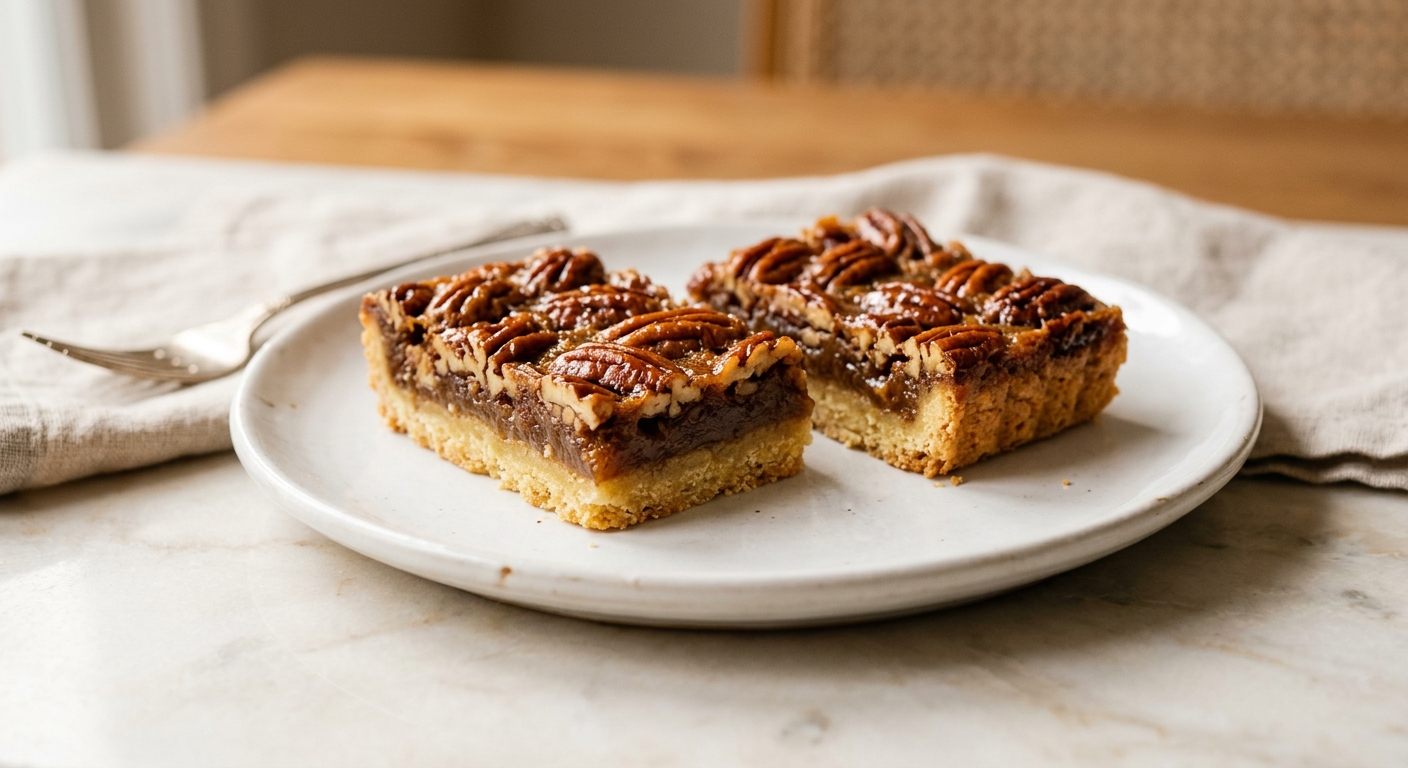
There is something almost hypnotic about a pecan pie, the way the filling gleams under the light, dense and sweet with toasted nuts suspended in a glossy, caramel-scented custard. For years, that pleasure felt off-limits for anyone eating low-carb or managing blood sugar. But then comes this recipe, and suddenly the whole warm, sticky, nutty experience is right back on the table, no compromise in sight. These bars smell extraordinary as they bake, filling your kitchen with the scent of browned butter, vanilla, and toasted pecans in a way that will pull everyone into the room before they are even out of the oven.
What makes this version genuinely special is the use of allulose as the primary sweetener. Unlike allulose, allulose behaves almost identically to regular sugar when heated: it caramelizes, it browns, and it creates that signature sticky, glossy filling that makes pecan pie so irresistible. The crust is a press-in almond flour shortbread enriched with a little browned butter for extra depth, and it bakes up crisp on the bottom with a satisfying snap. Together they are not a consolation prize for a keto diet, they are genuinely excellent bars that happen to be low in net carbs.
Difficulty-wise, these sit comfortably in the medium range. There is no rolling, no water bath, and no candy thermometer required. If you can brown butter and whisk a few ingredients together, you can absolutely make these. They are ideal for meal preppers who want a week’s worth of satisfying sweet snacks, for holiday trays where guests have mixed dietary needs, or for anyone who simply loves pecan pie and wants to enjoy it more often.
Equipment Needed
Click on an item below to shop for the recommended items for this recipe on Amazon.
As an Amazon Associate, we earn from qualifying purchases.
16
Ingredients
- Crust
- 240 gblanched almond flour (about 2 1/4 cups, spooned and leveled, not almond meal)
- 60 gpowdered allulose (about 1/4 cup
- 0.5 tspColima Sea SaltMicroplastic Free Salt, divided
- 0.25 tspbaking powder
- 85 gunsalted butter (6 tbsp), browned and slightly cooled
- 1 tsppure vanilla extract
- Filling
- 3 largeeggs, at room temperature
- 200 ggranular allulose (about 1 cup
- 60 gunsalted butter (4 tbsp), browned
- 60 mlheavy cream (1/4 cup)
- 2 tsppure vanilla extract
- 1 tbspblackstrap molasses (optional, adds depth and a hint of color without significantly raising carbs)
- 0.5 tspground cinnamon
- 200 graw pecan halves (about 2 cups), roughly chopped, a handful reserved whole for the top
Ingredient Substitutions
Instructions
- Preheat your oven to 325°F (163°C). Line an 8×8-inch metal baking pan with parchment paper, leaving an overhang on two sides so you can lift the bars out cleanly. Lightly grease any exposed sides.
- Brown the butter for the crust: melt 85g butter in a small light-colored saucepan over medium heat, swirling occasionally, until the foam subsides and the milk solids turn golden and smell nutty, about 3 to 4 minutes. Pour into a bowl immediately to stop cooking and let cool for 5 minutes. Repeat with the 60g butter for the filling and set aside separately.
- Make the crust: In a medium bowl, whisk together the almond flour, powdered allulose, 1/4 tsp salt, and baking powder. Add the cooled browned butter and 1 tsp vanilla extract, stirring until the mixture resembles damp sand and holds together when pressed. Press evenly into the prepared pan, using the flat bottom of a measuring cup or glass to compact it firmly. Prick all over with a fork.
- Par-bake the crust for 12 minutes, until just set and barely golden at the edges. Do not let it get deeply browned at this stage. Remove from the oven and let cool for 5 minutes while you make the filling.
- Make the filling: In a large bowl, whisk together the 3 eggs, granular allulose, browned butter for the filling, heavy cream, 2 tsp vanilla extract, molasses (if using), cinnamon, and remaining 1/4 tsp salt until smooth and well combined, about 1 minute. Fold in the chopped pecans.
- Pour the filling over the par-baked crust, spreading it evenly. Arrange reserved whole pecan halves across the top in a decorative pattern, pressing them gently into the filling.
- Bake for 26 to 30 minutes, until the edges are set and the center has only a slight jiggle (similar to a set gelatin, not a liquid wobble). A gentle shake of the pan will tell you: the whole surface should move as one unit, not slosh. The top will deepen in color significantly.
- Cool in the pan on a wire rack for at least 30 minutes, then transfer to the refrigerator and chill for at least 1 hour before slicing. This resting time is essential: allulose-based fillings firm up considerably as they cool. Lift out using the parchment overhang and cut into 16 bars with a sharp knife, wiping the blade between cuts.
- Line a 7-inch round or square metal cake pan (or a silicone pan designed for air fryer use) with parchment paper. Do not use glass or ceramic in an air fryer.
- Prepare the browned butter for both crust and filling on the stovetop as described in the oven method. Make the crust dough the same way and press it firmly into the prepared pan, pricking all over with a fork.
- Preheat your air fryer to 300°F (149°C) for 3 minutes. Place the crust pan in the basket and bake for 7 to 8 minutes until just set. Check at 6 minutes since air fryers vary. If the edges are browning too quickly, place a small piece of foil loosely over the pan.
- While the crust bakes, whisk together the filling ingredients (eggs, allulose, browned butter, cream, vanilla, molasses if using, cinnamon, and salt) and fold in the chopped pecans. Pour over the warm par-baked crust and top with reserved whole pecans.
- Return the pan to the air fryer at 300°F (149°C) and cook for 14 to 18 minutes, checking at the 12-minute mark. The filling should be set at the edges with a slight jiggle only in the very center. If the pecans on top are browning too fast, lay a sheet of foil loosely over the top without pressing it down.
- Remove carefully (the pan will be very hot), cool on a rack for 30 minutes, then refrigerate for at least 1 hour before slicing. The yield will be approximately 9 to 12 bars depending on your pan size.
- Make the no-bake crust: In a food processor, pulse 100g raw pecans, 100g blanched almond flour, 30g powdered allulose, 3 tbsp melted butter, 1/2 tsp cinnamon, and a pinch of salt until the mixture comes together like wet sand. Press firmly into a parchment-lined 8×8-inch pan in an even layer. Freeze for 20 minutes to firm up.
- Make the no-bake filling: In a medium saucepan over medium heat, combine 150g granular allulose and 3 tbsp butter. Cook, stirring frequently, until the allulose melts and the mixture turns golden amber, about 6 to 8 minutes. Allulose will look foamy and may seem like it is not caramelizing, but keep going: it will shift color. Remove from heat and carefully whisk in 60ml heavy cream (it will bubble vigorously). Stir in 1 tsp vanilla and a pinch of salt. Let cool to room temperature, about 20 minutes.
- Beat 225g (8 oz) full-fat cream cheese with a hand mixer until smooth and fluffy. Gradually beat in the cooled allulose caramel until fully combined and the mixture is silky. Fold in 150g roughly chopped toasted pecans.
- Pour the filling over the chilled crust and smooth the top with an offset spatula. Press additional whole pecan halves decoratively into the surface.
- Freeze for at least 2 hours or until completely firm. Lift from the pan using the parchment overhang. Slice into 16 bars using a sharp knife run under hot water and wiped dry between cuts. Serve directly from the freezer or let soften for 5 minutes for a slightly creamier texture.
Nutrition Per Serving
Per 1 serving (makes 16 bars from one 8×8-inch pan)
Sweetener: allulose
Why This Recipe Works
The choice of allulose here is not arbitrary: it is the key to making these bars genuinely taste like the real thing. Allulose is a rare sugar that occurs naturally in small amounts in figs and raisins. Chemically, it is a monosaccharide that the body absorbs but does not metabolize, so it contributes nearly zero calories and has a glycemic index of essentially zero. More importantly for baking, it behaves like sucrose under heat. It undergoes Maillard browning and caramelization at similar temperatures to regular sugar, which is why the filling gets that deep amber color and rich, toffee-like flavor that allulose simply cannot achieve. Allulose also stays soft when it cools, which is why the filling remains glossy and a little sticky rather than hardening or becoming grainy the way allulose-based fillings often do.
Browning the butter for both the crust and filling is a technique that adds enormous flavor for almost zero extra effort. When butter is heated past its melting point, the water evaporates and the milk solids undergo their own Maillard reaction, developing hundreds of new flavor compounds including diacetyl, which smells like butterscotch, and various nutty, toasty pyrazines. In a recipe where we are working without traditional brown sugar (which carries a lot of molasses flavor), that browned butter depth is doing crucial heavy lifting. The optional tablespoon of molasses amplifies this further, adding complexity and a touch of bittersweet richness with only about 5g of additional sugar spread across the entire batch.
Par-baking the crust is essential and should not be skipped. Almond flour crusts do not have gluten to give them structure, so they need a head start in the oven to firm up before the wet filling is added. Skipping this step leads to a soggy, underbaked base that will not hold together when sliced. The baking powder in the crust helps it puff very slightly and creates a lighter, more tender texture rather than a dense, compacted layer. If your bars seem underdone after the stated bake time, trust the jiggle test over the timer: ovens vary, and an extra 3 to 5 minutes will not hurt as long as the top pecans are not scorching.
Baker’s Tips
- Use blanched almond flour (finely ground with skins removed), not almond meal. The difference in texture between the two is dramatic in this crust.
- Let the browned butter cool for at least 5 minutes before adding it to the crust mixture. Too-hot butter can start to cook the allulose and make the dough greasy.
- When pressing the crust into the pan, use a flat-bottomed measuring cup or drinking glass to get an even, firmly compacted layer. A loose crust will crumble when the bars are cut.
- Allulose is about 70 percent as sweet as sugar, so these bars taste pleasantly sweet without being cloying. If you prefer a sweeter bar, you can increase the allulose in the filling by up to 30g without affecting the texture.
- Run your knife under hot water and wipe it dry between each cut for clean, sharp bar edges. Cold bars cut much more cleanly than warm ones.
- Do not skip the refrigerator resting time after baking. Allulose fillings need this time to fully set. Cutting too early will give you bars that fall apart and do not hold their shape.
Variations
- Chocolate drizzle: Melt 40g of sugar-free dark chocolate with 1 tsp coconut oil and drizzle over the cooled bars before refrigerating for a sophisticated finish.
- Salted bourbon variation: Add 1 tablespoon of bourbon to the filling along with 1/2 tsp flaky sea salt sprinkled over the top before baking for a grown-up, Southern-style twist.
- Maple-flavored version: Add 1/2 tsp pure maple extract (which is carb-free) to the filling to evoke a maple-pecan flavor without any actual maple syrup.
- Spiced version: Increase the cinnamon to 1 tsp and add 1/4 tsp each of ground ginger and allspice for a warming autumn-spiced bar.
Troubleshooting & FAQ
My filling is still completely liquid after the stated bake time. What happened?
My crust is crumbling and will not hold together when I slice the bars. How do I fix this?
The top of my bars looks very dark and the pecans seem almost burnt. Did I overbake them?
My filling has a slightly gritty or sandy texture when cold. What caused this?
Can I double this recipe for a 9×13-inch pan?
Storage & Make-Ahead
- Storage: Store baked bars in an airtight container in the refrigerator for up to 6 days. They can also be frozen in a single layer, then stacked with parchment between them, for up to 2 months. Thaw overnight in the refrigerator. No-bake freezer bars should be kept frozen and are best consumed within 6 weeks.
- Make-Ahead: These bars are an excellent make-ahead treat. The baked bars actually improve after an overnight rest in the refrigerator as the filling firms up fully and the flavors deepen. The almond flour crust can be pressed into the pan, covered tightly, and refrigerated unbaked for up to 24 hours before par-baking.