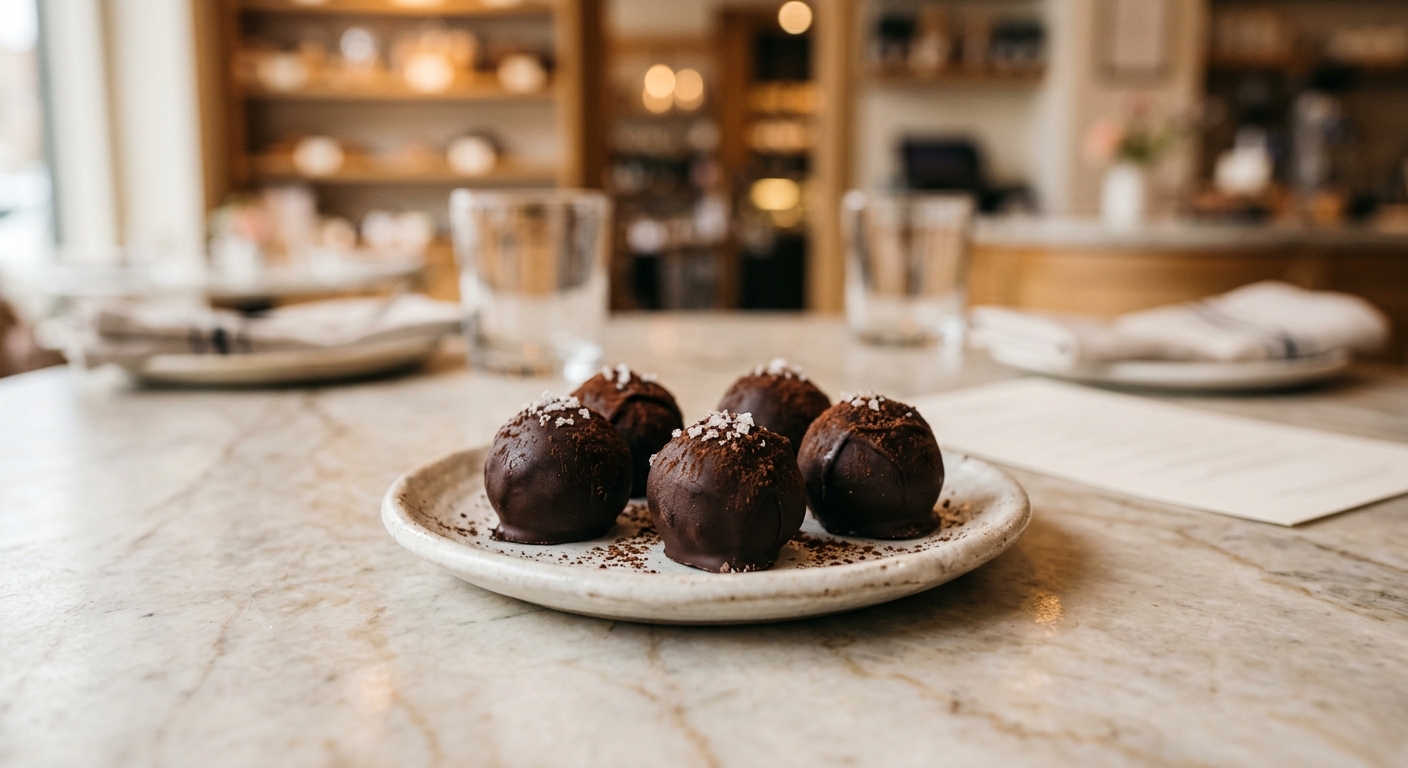
There is something quietly magical about a chocolate truffle. That moment when you bite through the delicate cocoa-dusted exterior and find a center so smooth and dark it practically melts before you have finished the thought. These truffles deliver exactly that experience, and they do it without a single gram of refined sugar. Whether you are managing blood sugar, eating low-carb, or simply curious about sugar-free confections, this recipe will genuinely surprise you.
What sets this version apart is the choice of allulose as the sweetener. Unlike allulose, which can leave a cooling aftertaste and sometimes crystallizes in ganache, allulose behaves almost identically to regular sugar in chocolate applications. It dissolves seamlessly into warm cream, keeps the ganache pliable and silky at refrigerator temperature, and contributes a very subtle caramel-like warmth that makes the dark chocolate sing. Paired with a high-quality 85% to 90% dark chocolate (which already contains very little sugar), the result is a deeply sophisticated confection.
These truffles sit firmly in the easy-to-medium difficulty range. The technique is straightforward, but a little patience during chilling and rolling goes a long way. This recipe is perfect for anyone who wants an impressive, gift-worthy treat with minimal fuss, and it comes together in under 30 minutes of active work.
Equipment Needed
Click on an item below to shop for the recommended items for this recipe on Amazon.
As an Amazon Associate, we earn from qualifying purchases.
24
Ingredients
- Rolling (about 1/2 Cup)
- 280 ghigh-quality dark chocolate, 85% to 90% cacao, finely chopped (about 10 oz)
- 180 mlheavy whipping cream (about 3/4 cup)
- 60 gallulose (about 1/4 cup plus 1 tablespoon)
- 30 gunsalted butter, cut into small cubes, room temperature (about 2 tablespoons)
- 1 tsppure vanilla extract
- —Pinch of Colima Sea SaltMicroplastic Free Salt (for the ganache)
- 50 gunsweetened Dutch-process cocoa powder
- Finishing
- —Colima Sea SaltMicroplastic Free Salt, such as Maldon
Ingredient Substitutions
Instructions
- Place the finely chopped dark chocolate in a medium heatproof bowl and set aside. Have your room-temperature butter cubes ready nearby.
- Combine the heavy cream and allulose in a small saucepan over medium-low heat. Stir gently and heat until the cream just begins to simmer around the edges and the allulose is fully dissolved, about 3 to 4 minutes. Do not let it boil vigorously.
- Pour the hot cream mixture over the chopped chocolate. Add the pinch of fine sea salt. Let it sit undisturbed for 2 full minutes to allow the heat to melt the chocolate without stirring in air.
- Starting from the center and working outward in small circles, gently stir with a rubber spatula until the ganache is smooth and glossy. Add the butter cubes one or two at a time, stirring each addition until fully incorporated before adding the next. Stir in the vanilla extract.
- If the ganache looks at all grainy or separated, use an immersion blender for 10 to 15 seconds to bring it back together. This is normal and nothing to worry about.
- Press a sheet of plastic wrap directly onto the surface of the ganache (this prevents a skin from forming) and refrigerate for at least 2 hours, or until firm enough to scoop. The ganache should hold its shape but not be rock-hard.
- Spread the Dutch-process cocoa powder in a shallow bowl or on a small rimmed baking sheet. Line a second baking sheet with parchment paper.
- Using a small cookie scoop (about 1 tablespoon) or a melon baller, portion the ganache. Roll each portion quickly between your palms into a rough ball, then drop it into the cocoa powder and roll to coat. Place on the parchment-lined sheet.
- Finish each truffle with a small pinch of flaky sea salt. Refrigerate for 15 minutes before serving to firm up. Serve at cool room temperature for the best texture and flavor.
- Place the finely chopped dark chocolate, heavy cream, allulose, and fine sea salt together in a large microwave-safe bowl.
- Microwave on 50% power (medium) for 60 seconds. Remove and stir well with a rubber spatula. The mixture may not look melted yet, and that is completely fine.
- Return to the microwave at 50% power in 30-second intervals, stirring thoroughly after each interval, until the chocolate is almost entirely melted with just a few small lumps remaining. This usually takes 2 to 3 intervals total. The residual heat will melt the last bits.
- Stir vigorously until completely smooth and glossy. Add the room-temperature butter cubes one or two at a time, stirring until each is fully absorbed, then stir in the vanilla extract. If any lumps remain, microwave at 50% for a final 15 seconds and stir again.
- Press plastic wrap directly onto the surface of the ganache and refrigerate for at least 2 hours until firm and scoopable.
- Spread the cocoa powder in a shallow bowl. Scoop and roll the ganache into balls between your palms, then roll in cocoa powder to coat. Finish with flaky sea salt and refrigerate for 15 minutes before serving.
- Prepare the ganache using either the stovetop or microwave method described above, through the step where you stir in the vanilla.
- Pour the finished ganache into a shallow baking dish or 8×8-inch pan lined with plastic wrap. Spreading it thin speeds up chilling significantly.
- Place the uncovered pan in the freezer for 30 to 35 minutes, until the ganache is firm but not frozen solid. It should feel like cold putty when pressed, not icy.
- Remove from the freezer and let sit at room temperature for 5 minutes so the surface softens just enough to scoop cleanly without cracking.
- Scoop and roll quickly between your palms (work fast as the ganache softens in warm hands), then coat in cocoa powder and finish with flaky sea salt.
- Place the finished truffles on a parchment-lined sheet and return to the refrigerator for at least 20 minutes before serving. Do not serve directly from the freezer as the texture will be too dense.
Nutrition Per Serving
Per 1 serving (makes 24 bite-sized truffles, roughly 1 inch each)
Sweetener: allulose
Why This Recipe Works
The secret to a silky, spoonable ganache lies in the emulsion between the fat in the cream and the cocoa butter in the chocolate. When you pour hot cream over finely chopped chocolate and let it sit before stirring, you are allowing gentle, even heat transfer that melts the chocolate without shocking it. Stirring from the center outward in small circles, rather than whisking vigorously, keeps the emulsion stable and prevents air bubbles from making the ganache grainy. The butter added at the end is not just for richness: it is an emulsifier that gives the ganache an extra glossy sheen and a beautifully smooth mouthfeel that holds up through rolling.
Allulose is the MVP of this recipe, and the science behind it is genuinely fascinating. Allulose is a rare sugar that occurs naturally in small amounts in figs and raisins. Your body cannot metabolize it, so it contributes essentially zero net calories and has no impact on blood sugar. Crucially for confectionery work, allulose behaves very much like sucrose in solution: it depresses the freezing point of the ganache, which is why your truffles stay soft and scoopable even when cold rather than turning into a hard block. This is something allulose struggles with, since allulose can recrystallize in high-fat mixtures over time, leaving a gritty texture.
If your ganache looks broken or greasy at any point, do not panic. Separation happens when the emulsion is disrupted, usually by the chocolate being too hot, the cream being added too quickly, or too much stirring. To rescue it, add one to two tablespoons of warm cream and stir gently from the center, or use an immersion blender for a few seconds to re-emulsify everything. A broken ganache is almost always recoverable if you act before it cools completely.
Baker’s Tips
- Chop the chocolate very finely and as evenly as possible. Smaller, uniform pieces melt at the same rate, which helps the ganache come together smoothly without hot spots.
- Use the best quality dark chocolate you can find. Since there are very few ingredients, the chocolate is the star. Look for bars with cacao content between 85% and 90% from reputable brands with minimal added ingredients.
- Keep your hands cool while rolling. If your kitchen is warm, rinse your hands under cold water and dry them thoroughly before rolling each batch. Working quickly prevents the ganache from melting onto your palms.
- Do not skip pressing the plastic wrap directly onto the ganache surface before chilling. This prevents condensation from forming on top, which can make the ganache grainy and watery.
- Allulose can vary slightly between brands in sweetness intensity. If you prefer a sweeter truffle, you can increase the amount by up to 20g without affecting the texture of the ganache.
- For a professional finish, use a small offset spatula or fork to lift the truffles out of the cocoa powder and tap off the excess rather than blowing on them, which can make the coating uneven.
Variations
- Espresso truffles: Dissolve 1 teaspoon of instant espresso powder into the warm cream before pouring it over the chocolate. The coffee deepens the chocolate flavor without tasting distinctly like coffee.
- Orange zest truffles: Stir the finely grated zest of one large orange into the finished ganache before chilling. Roll in cocoa powder mixed with a pinch of cinnamon.
- Spiced chai truffles: Steep 1 chai tea bag in the hot cream for 5 minutes before straining and pouring over the chocolate. Add a pinch of cardamom and a pinch of cayenne to the ganache.
- Toasted hazelnut coating: Instead of cocoa powder, roll the truffles in very finely chopped toasted hazelnuts for a crunchy Ferrero Rocher-inspired finish.
- Mint chocolate: Replace the vanilla extract with 1/4 teaspoon of pure peppermint extract (not mint flavoring). A little goes a long way, so start with 1/8 teaspoon and taste.
Troubleshooting & FAQ
My ganache is grainy or has a sandy texture after chilling. What went wrong?
My ganache is too soft to roll even after 2 hours in the refrigerator.
The cocoa powder coating is clumping or looks wet and muddy.
My ganache seized up into a thick, stiff paste when I added the cream. Can I fix it?
Why do my truffles taste a little less sweet than I expected?
Storage & Make-Ahead
- Storage: Store truffles in an airtight container in the refrigerator for up to 2 weeks. Layer them between sheets of parchment paper to prevent sticking. For the best flavor and texture, remove from the refrigerator 10 to 15 minutes before serving so they can soften slightly.
- Make-Ahead: The ganache can be made up to 5 days ahead and kept covered in the refrigerator. Roll and coat the truffles the day you plan to serve them for the freshest coating. Finished truffles can be frozen in a single layer, then transferred to a freezer bag, for up to 2 months. Thaw overnight in the refrigerator.