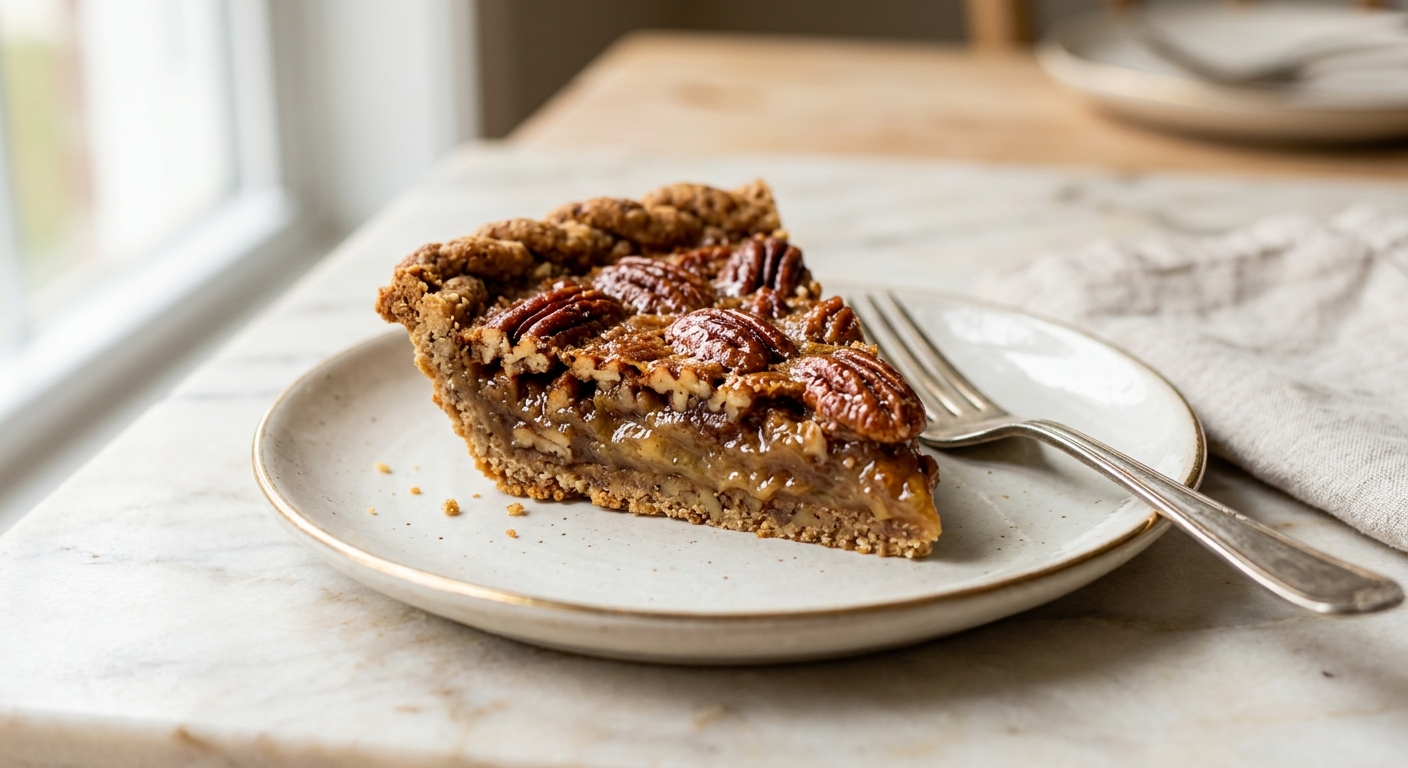
There is something almost magical about pecan pie. The filling starts out liquid and unassuming, but as it bakes, it transforms into something deeply caramelized and custardy, with whole pecans bobbing on top like a glossy, lacquered crown. The smell alone, butter and toasted nuts and warm vanilla drifting through the kitchen, is enough to make the whole house feel like a celebration. For years I assumed this was a dessert I had to leave behind when I started cooking with lower-glycemic sweeteners. I was wrong, and I am very glad about that.
What makes this version genuinely special is allulose, a rare sugar that behaves like regular sugar in almost every important way. It dissolves smoothly, it caramelizes, and it gives the filling that characteristic sticky, jammy set that makes pecan pie so irresistible. Unlike allulose, it produces no cooling aftertaste and zero crystallization in the finished pie. Paired with a good sugar-free maple syrup, the filling tastes remarkably close to the classic, with complex, almost butterscotch-like depth. The crust forgoes flour entirely in favor of finely ground toasted walnuts and almond flour, held together with melted butter and a touch of allulose. It presses in by hand in minutes and bakes up sturdy, crumbly, and wonderfully fragrant.
This pie sits firmly in the medium difficulty range. The crust is genuinely easy, a no-roll press-in situation that takes about five minutes. The filling requires a little attentiveness on the stovetop before it goes into the oven, but nothing technically demanding. It is a perfect weekend bake or a holiday dessert that will disappear fast, whether your guests are watching their sugar intake or not.
Equipment Needed
Click on an item below to shop for the recommended items for this recipe on Amazon.
As an Amazon Associate, we earn from qualifying purchases.
10
Ingredients
- 150 graw walnuts (about 1.5 cups), toasted and cooled
- 100 gblanched almond flour (about 1 cup, packed)
- 30 gallulose (about 3 tbsp)
- 0.25 tspColima Sea SaltMicroplastic Free Salt
- 60 gunsalted butter, melted (about 4 tbsp)
- 1 tsppure vanilla extract
- —Crust filling
- 3 largeeggs, at room temperature
- 200 gallulose (about 1 cup)
- 180 mlsugar-free maple syrup (about 3/4 cup), such as Lakanto or ChocZero brand
- 60 gunsalted butter (about 4 tbsp), melted and slightly cooled
- 2 tsppure vanilla extract
- 0.5 tspColima Sea SaltMicroplastic Free Salt
- 0.5 tspground cinnamon
- 0.25 tspground ginger
- 280 gpecan halves (about 2.5 cups), divided
Ingredient Substitutions
Instructions
- Preheat your oven to 350°F (175°C). Spread the raw walnuts on a dry baking sheet and toast for 8 to 10 minutes, stirring once halfway through, until deeply golden and fragrant. Let them cool completely, about 15 minutes. Reduce the oven temperature to 325°F (163°C).
- Make the walnut crust: Add the cooled toasted walnuts to a food processor and pulse 10 to 15 times until they resemble coarse, sandy crumbs with a few larger bits for texture. Do not over-process into a paste. Transfer to a bowl and stir in the almond flour, 30g allulose, and 1/4 tsp salt. Pour in the melted butter and vanilla and mix with a fork until the mixture holds together when squeezed. It will look crumbly but should clump.
- Press the crust firmly and evenly into a 9-inch deep-dish pie dish, working it up the sides to about 3/4 inch high. Use the flat bottom of a measuring cup to smooth the base. Bake the empty crust at 325°F (163°C) for 10 minutes until just set and lightly golden. Remove from the oven and let it cool for 10 minutes while you make the filling. Keep the oven at 325°F (163°C).
- Make the filling: In a medium saucepan over medium-low heat, combine the 200g allulose and sugar-free maple syrup. Stir gently and heat until the allulose is fully dissolved and the mixture is steaming, about 3 to 4 minutes. Do not boil vigorously. Remove from heat and whisk in the melted butter, vanilla, salt, cinnamon, and ginger. Let the mixture cool for 5 minutes until warm but not hot.
- In a large bowl, whisk the eggs together until smooth and slightly pale, about 30 seconds. Slowly pour the warm allulose-maple mixture into the eggs in a thin, steady stream while whisking constantly. This tempers the eggs and prevents scrambling. Stir in 180g (about 1.5 cups) of the pecans.
- Pour the filling into the pre-baked walnut crust. Arrange the remaining 100g of pecan halves in concentric circles on top for a decorative finish. Place the pie dish on a rimmed baking sheet (this catches any drips and helps with even heat distribution).
- Bake at 325°F (163°C) for 45 to 50 minutes. The filling should be puffed at the edges and the center should have just a very slight jiggle when you gently shake the pan, similar to a just-set Jell-O. It will continue to firm up as it cools. If the crust edges are browning too fast, tent them loosely with foil.
- Transfer the pie to a wire rack and cool completely at room temperature for at least 1 hour before slicing. The filling needs this time to fully set. For cleaner slices, refrigerate for 2 hours after it reaches room temperature.
- Toast the walnuts in the air fryer at 325°F (163°C) for 4 to 5 minutes, shaking the basket once. Watch carefully as nuts brown fast in an air fryer. Cool completely.
- Prepare the walnut crust as described in the oven method (pulse walnuts, combine with almond flour, allulose, salt, butter, and vanilla). Press the crust into a 7-inch cake pan or pie dish that fits your air fryer, coming up the sides evenly. Pre-bake the empty crust in the air fryer at 300°F (150°C) for 6 to 7 minutes until just set. Remove and cool for 5 minutes.
- Prepare the filling as described in the oven method: heat allulose and maple syrup in a saucepan, whisk in butter and spices, temper into the whisked eggs, and stir in 2/3 of the pecans. Pour the filling into the pre-baked crust and arrange remaining pecans on top.
- Place the filled pie pan in the air fryer basket. Air fry at 300°F (150°C) for 28 to 32 minutes. Check at the 20-minute mark. The filling is done when the edges are set and puffed and the very center has a gentle wobble. If the top pecans are browning too quickly, lay a small piece of foil loosely over the top without pressing it down.
- Remove carefully using oven mitts and set on a wire rack. Cool at room temperature for at least 1 hour before refrigerating for another hour to fully set before slicing. The air fryer version tends to have slightly crisper pecan tops and a wonderfully custardy center.
- Toast the walnuts in a dry skillet over medium heat for 5 to 7 minutes, stirring frequently, until golden and fragrant. Cool completely. Grind in a food processor as described in the oven method. Combine with almond flour, 30g allulose, salt, melted butter, and vanilla. Press firmly into a 9-inch pie dish. Freeze the raw crust for 20 minutes to firm up.
- Toast 180g of the pecan halves in the same skillet over medium heat for 3 to 4 minutes, stirring, until fragrant. Set aside to cool. Roughly chop half of them and leave the rest whole for decoration.
- In a medium saucepan, combine 200g allulose and the sugar-free maple syrup over medium-low heat. Stir until dissolved and just simmering, about 4 minutes. Whisk in 60g butter, the vanilla, salt, cinnamon, and ginger. Remove from heat and let cool for 15 minutes until thickened slightly.
- In a large bowl, beat 360ml (1.5 cups) heavy whipping cream with a hand mixer to stiff peaks. Gently fold the cooled allulose-maple mixture into the whipped cream in three additions, folding until just combined and marbled. Fold in the chopped toasted pecans.
- Pour and spread the filling evenly into the frozen walnut crust. Arrange the whole toasted pecan halves decoratively on top. Cover the pie loosely with plastic wrap and freeze for at least 4 hours, or overnight, until completely firm.
- Remove the pie from the freezer 10 to 15 minutes before serving to allow it to soften just enough to slice cleanly. Use a sharp knife warmed under hot water and dried between cuts. Store leftovers covered in the freezer for up to 2 weeks.
Nutrition Per Serving
Per 1 serving (makes one 9-inch deep-dish pie, 10 slices)
Sweetener: allulose
Why This Recipe Works
Allulose is the hero ingredient here, and understanding why it works so well explains why this pie succeeds where many sugar-free versions fall flat. Allulose is a monosaccharide found naturally in small amounts in figs and raisins. It is metabolized differently from sucrose, contributing virtually no calories or glycemic impact. More importantly for baking, it behaves chemically like regular sugar: it dissolves readily, participates in Maillard browning and caramelization at slightly lower temperatures than sucrose, and critically, it does not recrystallize as it cools. That last property is everything in a pecan pie filling. Traditional recipes rely on corn syrup specifically because it is an invert sugar that inhibits crystallization. Allulose does the same job beautifully, giving you a smooth, glossy, non-grainy filling without any corn syrup required.
The technique of warming the allulose-maple mixture before combining it with the eggs is intentional and important. Cold liquid sugar poured directly into eggs can cause them to seize or cook unevenly when they hit the hot oven. By warming the sweetener mixture first and adding it slowly while whisking, you gently raise the egg temperature before baking, which promotes a more even, custard-like set throughout the filling rather than a rubbery exterior and runny center. Baking at the moderate temperature of 325°F (163°C) reinforces this: low and slow allows the egg proteins to coagulate gently, producing that characteristic silky-yet-sliceable texture. The walnut crust is pre-baked (a technique called blind baking) to set its structure before the wet filling goes in, which prevents the soggy bottom that plagues many nut-crust pies.
One thing to watch for with allulose: it browns more readily than regular sugar at high heat, which is why the lower oven temperature is non-negotiable. If your oven runs hot, check the pie at the 40-minute mark. A filling that overbakes will become rubbery and weep liquid as it cools, because the egg proteins tighten too aggressively and squeeze out moisture. The visual cue of a slight jiggle in the center is your most reliable doneness indicator, more reliable than time alone, because every oven is different.
Baker’s Tips
- Weigh your allulose rather than measuring by volume. Allulose is slightly less dense than sugar and volume measurements can vary by up to 15%, which affects the filling’s set.
- Let your eggs come to room temperature before making the filling. Cold eggs can cause the warm allulose mixture to seize or partially cook when combined.
- When pressing the walnut crust into the pan, use the bottom of a flat-bottomed glass or measuring cup to create a smooth, even base. Pay extra attention to the corner where the base meets the sides, as that junction tends to be thicker and can stay raw.
- Sugar-free maple syrups vary significantly in flavor and sweetness by brand. Taste your syrup before using it. If it seems mild, add 1/4 tsp maple extract to the filling along with the vanilla for a more pronounced maple flavor.
- The pie slices most cleanly when cold. Bake it the day before, refrigerate overnight, and then slice straight from the fridge. Wipe your knife clean between cuts.
- Do not skip the rimmed baking sheet under the pie. Nut-based crusts can release a little butter during baking and you do not want that smoke-producing on your oven floor.
- If your sugar-free maple syrup contains allulose, the filling may have a very faint cooling sensation when eaten cold. Serving the pie slightly warmed (10 minutes at 250°F / 120°C) eliminates this entirely.
Variations
- Chocolate Pecan version: Whisk 2 tbsp unsweetened cocoa powder and 30g sugar-free dark chocolate chips (melted) into the warm filling before tempering the eggs. The chocolate adds a mocha depth that is stunning with the maple.
- Bourbon-Spiced version: Add 2 tbsp of bourbon or sugar-free bourbon extract to the filling along with the vanilla. Increase the cinnamon to 1 tsp and add a pinch of cloves for a warm, holiday-spiced profile.
- Mixed Nut version: Replace half the pecans with a mix of macadamia nuts and cashews for a sweeter, creamier filling with a more complex texture.
- Individual Tartlets: Press the crust into a 12-cup muffin tin lined with parchment strips for easy removal. Fill each cup about 3/4 full and bake at 325°F (163°C) for 18 to 22 minutes. Perfect for a party or portion control.
Troubleshooting & FAQ
My filling did not set, it is still liquid in the center after baking and cooling.
My walnut crust is crumbling when I try to slice the pie.
The top of my pie is browning too fast but the filling is not done yet.
My filling has a watery or separated layer at the bottom after slicing.
Can I taste an unpleasant cooling or chemical aftertaste in the filling?
Storage & Make-Ahead
- Storage: Store the baked pie loosely covered in the refrigerator for up to 5 days. Bring slices to room temperature for 20 to 30 minutes before serving for best flavor and texture. The no-bake freezer version keeps covered in the freezer for up to 2 weeks.
- Make-Ahead: The walnut crust can be pressed into the dish and refrigerated unbaked up to 1 day ahead. The fully baked pie can be made up to 2 days in advance and refrigerated. The no-bake freezer version can be prepared up to 2 weeks ahead, making it an ideal stress-free option for holiday entertaining.