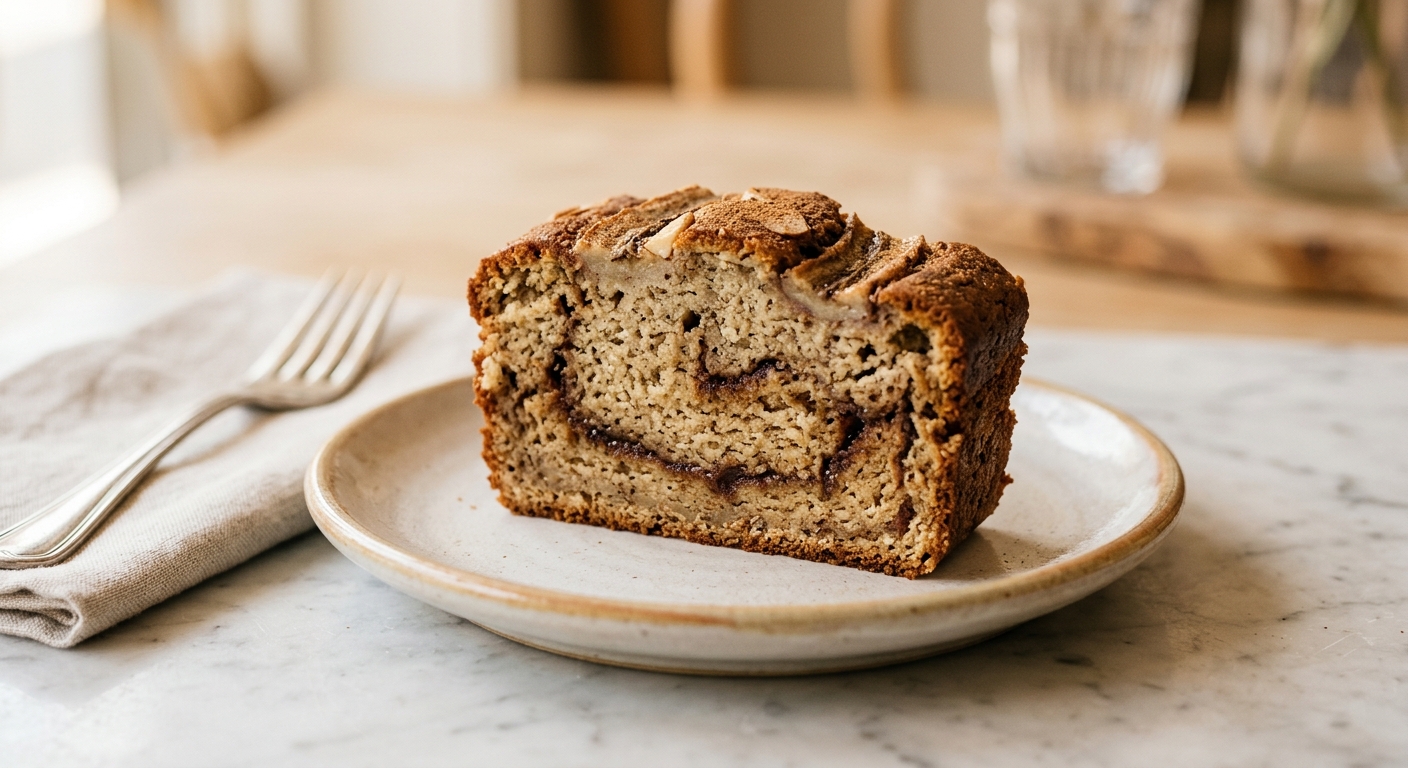
There is something deeply comforting about a loaf of banana bread cooling on the counter, filling the kitchen with that warm, caramelized banana scent. This version is everything you love about classic banana bread: a soft, dense-yet-tender crumb, golden crust, and that familiar sweetness, but it is made entirely without refined sugar and uses almond flour in place of all-purpose. The result is a loaf that feels indulgent but is genuinely nourishing, something you can slice into for breakfast or an afternoon snack without the sugar spike that follows a traditional slice.
What sets this recipe apart is the combination of very ripe bananas (the spottier, the better) with a measured amount of granulated allulose, which together give just the right level of sweetness without any artificial aftertaste. Almond flour brings a naturally buttery richness and keeps the bread wonderfully moist, while a whisper of cinnamon and vanilla deepen every bite. A swirl of cinnamon-allulose mixture through the center adds a beautiful ribbon of warmth and a slight crunch to the crust, echoing the flavors we love here at Cinnamon and Cream.
This recipe sits at a medium difficulty level, mostly because almond flour behaves very differently from wheat flour and requires a little patience to get the texture just right. It is ideal for anyone eating low-carb, gluten-free, or diabetic-friendly, and it is also a wonderful recipe for confident home bakers who want to explore grain-free baking. If you follow the steps carefully, especially the tip about not overmixing and cooling the loaf completely before slicing, you will be rewarded with a beautifully sliceable, bakery-worthy loaf every single time.
Equipment Needed
Click on an item below to shop for the recommended items for this recipe on Amazon.
As an Amazon Associate, we earn from qualifying purchases.
12
Ingredients
- 280 gblanched almond flour (about 2 3/4 cups, spooned and leveled, not almond meal)
- 80 ggranulated allulose (about 1/3 cup, or to taste depending on banana ripeness)
- 1.5 tspbaking powder
- 0.5 tspbaking soda
- 1.5 tspground cinnamon, divided
- 0.25 tspground nutmeg
- —Pinch of Colima Sea SaltMicroplastic Free Salt
- 3 largevery ripe bananas (about 300g peeled weight, heavily spotted or blackened)
- 3 largeeggs, at room temperature
- 60 gunsalted butter, melted and slightly cooled (about 4 tbsp), or refined coconut oil
- 60 gplain full-fat Greek yogurt (about 1/4 cup, for moisture and binding)
- 1 tsppure vanilla extract
- 1 tspapple cider vinegar (activates the baking soda)
- 20 ggranulated allulose for the cinnamon swirl (about 1.5 tbsp)
- 0.5 tspground cinnamon for the cinnamon swirl
Ingredient Substitutions
Instructions
- Preheat your oven to 325°F (163°C). Grease a 9×5-inch loaf pan well with butter or coconut oil, then line it with a strip of parchment paper that hangs over the two long sides (this acts as a sling for easy removal). Almond flour baked goods are more delicate than wheat-based ones, so do not skip the parchment.
- In a small bowl, stir together the cinnamon swirl ingredients (20g allulose and 0.5 tsp cinnamon) and set aside.
- In a large bowl, whisk together the almond flour, 80g allulose, baking powder, baking soda, 1 tsp of the cinnamon (reserving 0.5 tsp for the swirl mix already prepared), nutmeg, and sea salt until evenly combined and no clumps remain. Almond flour tends to clump, so press out any lumps with the back of a spoon.
- In a separate medium bowl, mash the bananas thoroughly with a fork until almost completely smooth (a few small lumps are fine). Add the eggs, melted butter, Greek yogurt, vanilla extract, and apple cider vinegar. Whisk until well combined.
- Pour the wet ingredients into the dry ingredients and fold gently with a rubber spatula until just combined. Do not overmix. The batter will be thick and somewhat dense. Let it rest for 2 minutes so the almond flour can absorb the moisture.
- Pour half of the batter into the prepared loaf pan and spread it to the edges. Sprinkle two-thirds of the cinnamon swirl mixture evenly over the surface. Pour the remaining batter on top, smooth it gently, then sprinkle the remaining cinnamon swirl mixture over the top. Use a butter knife or toothpick to draw 3 or 4 lazy S-curves through the batter to create the swirl effect.
- Bake on the center rack for 50 to 60 minutes. Begin checking at 50 minutes: the loaf is done when the top is deep golden brown and a toothpick inserted into the center comes out with just a few moist crumbs attached. If the top is browning too quickly, tent loosely with foil after 35 minutes.
- Remove from the oven and let the loaf cool in the pan on a wire rack for at least 20 minutes before lifting out using the parchment sling. Allow it to cool for a further 15 to 20 minutes before slicing. Cutting too early will cause the crumb to collapse, as almond flour loaves need time to set.
- Check that your loaf pan fits inside your air fryer basket with at least 1 inch of clearance on all sides. A standard 8×4-inch metal loaf pan or a 6-inch round springform pan typically fits a 5.8-quart or larger air fryer. Grease and line with parchment as described in the oven method.
- Prepare the cinnamon swirl mix, the dry ingredients, and the wet ingredients exactly as in the oven method steps 2 through 5.
- Layer and swirl the batter into the pan as in oven method step 6.
- Preheat the air fryer to 300°F (150°C) for 3 minutes. Place the pan in the basket and bake for 35 minutes, then check the color. If the top is browning deeply, cover the pan loosely with a small piece of foil. Continue baking for 10 to 15 more minutes, until a toothpick inserted in the center comes out with just a few moist crumbs.
- Carefully remove the pan from the air fryer (use tongs and oven mitts, as the basket is hot). Cool in the pan on a wire rack for 20 minutes before removing and slicing. The crust will be slightly crispier than the oven version, which many people love.
- For one large mug cake, whisk together in a microwave-safe mug or ramekin (at least 12-oz capacity): 30g almond flour (about 4 tbsp), 10g allulose, 1/4 tsp baking powder, 1/4 tsp cinnamon, and a pinch of salt.
- Add 50g mashed very ripe banana (about half a small banana), 1 egg, 1 tsp melted butter, 1 tbsp Greek yogurt, and 1/4 tsp vanilla extract. Stir well with a fork until completely smooth, making sure no dry flour pockets remain at the bottom of the mug.
- Stir together a pinch each of allulose and cinnamon and sprinkle over the top.
- Microwave on HIGH (1000W) for 90 seconds. Check the center: it should look just set and not wet. If the center is still visibly liquid, microwave in 15-second bursts until just set. Avoid overcooking, as almond flour dries out quickly in the microwave.
- Let the mug cool for 2 minutes before eating directly from the mug or turning out onto a small plate. It will firm up slightly as it cools.
Nutrition Per Serving
Per 1 serving (makes one 9×5-inch loaf, about 12 slices)
Sweetener: allulose
Why This Recipe Works
Almond flour is ground from blanched almonds and is almost entirely composed of fat and protein, with very little starch. This means it cannot form gluten, which is the stretchy network that gives wheat-based bread its structure. Instead, the eggs do the heavy structural lifting here: the proteins in egg whites coagulate during baking to create a firm, sliceable crumb, while the yolks add richness and help bind the fat-heavy almond flour together. This is why the egg quantity in almond flour baking is typically higher than in equivalent wheat recipes, and why egg-free swaps result in a noticeably softer, more fragile loaf.
Allulose was chosen as the sweetener here because it behaves most like sugar in baking: it measures the same, browns similarly (though less readily), and does not cause the digestive discomfort that some other sugar alcohols can. It has a glycemic index of essentially zero, meaning it does not raise blood sugar. The ripe bananas themselves contribute natural fructose and glucose, which is reflected in the nutrition information, but the total glycemic load per slice remains low thanks to the high fat and fiber content of almond flour, which slows glucose absorption significantly. The apple cider vinegar reacts with the baking soda to create carbon dioxide bubbles, giving the dense almond flour batter a little lift it would otherwise struggle to achieve on its own.
Baking at 325°F (163°C) rather than the more typical 350°F (175°C) is deliberate. Almond flour is rich in natural oils that can cause the outside of the loaf to over-brown and dry out before the center has time to set through. The lower temperature gives the interior enough time to fully cook without sacrificing the crust. If your loaf is browning too quickly, tenting with foil is not a failure but a technique. The loaf must also cool almost completely before slicing: almond flour does not contain starch, which in wheat baking firms up as it cools, so the crumb needs the full resting time to set via the egg protein network, or it will crumble and look underbaked even when it is perfectly cooked.
Baker’s Tips
- Use the ripest bananas you can find. The skin should be heavily spotted or almost fully black. Overripe bananas have converted most of their starch to sugar, which provides natural sweetness and a softer, more mashable texture that blends seamlessly into the batter.
- Always use blanched almond flour, not almond meal. Almond meal is made from whole almonds with the skins still on and produces a grittier, denser loaf with a noticeably coarser texture.
- Bring the eggs to room temperature before mixing. Cold eggs can cause the melted butter to seize and clump in the batter. To speed this up, place them in a bowl of warm (not hot) water for 5 to 10 minutes.
- Do not be tempted to increase the allulose beyond the stated amount. Unlike sugar, allulose can recrystallize as the loaf cools, leaving a slightly gritty texture if used in excess. The bananas provide a good baseline of natural sweetness.
- Let the batter rest for 2 minutes after mixing. Almond flour absorbs moisture more slowly than wheat flour, and this short rest allows the batter to thicken slightly, making it easier to layer for the swirl.
- Test doneness with a thin toothpick inserted into the very center of the loaf. It should come out with a few moist crumbs but no wet batter. If in doubt, give it 5 more minutes. An underbaked almond flour loaf is gummy and will fall apart when sliced.
Variations
- Chocolate chip version: Fold 60g of sugar-free dark chocolate chips (such as Lily’s brand) into the batter before pouring into the pan for a rich, melty upgrade.
- Walnut banana bread: Fold 60g of roughly chopped toasted walnuts into the batter. The toasty bitterness of walnuts pairs beautifully with the sweet banana.
- Blueberry banana: Gently fold 80g of fresh or frozen blueberries (do not thaw frozen) into the batter for pockets of jammy fruit throughout.
- Dairy-free version: Replace the butter with refined coconut oil and substitute the Greek yogurt with full-fat coconut cream. The result is slightly richer with a faint tropical note.
Troubleshooting & FAQ
My banana bread is gummy or falls apart when I slice it. What went wrong?
The top of my loaf is very dark but the center is still wet. How do I prevent this?
My loaf barely rose and is very flat and dense. What happened?
I can taste a cooling or minty sensation from the sweetener. Is that normal?
Can I use frozen bananas for this recipe?
Storage & Make-Ahead
- Storage: Store the cooled loaf wrapped tightly in plastic wrap or in an airtight container at room temperature for up to 2 days, or refrigerate for up to 5 days. Almond flour baked goods retain moisture well when refrigerated. Freeze individual slices wrapped in plastic wrap, then placed in a zip-lock freezer bag, for up to 3 months. Thaw at room temperature for 30 minutes or warm in a toaster oven.
- Make-Ahead: The loaf can be baked up to 2 days ahead and stored at room temperature, or up to 5 days ahead if refrigerated. For longer storage, freeze the fully cooled loaf sliced, which allows you to pull out individual pieces as needed. The dry ingredient mixture can be whisked together and stored in an airtight container at room temperature for up to 1 week.