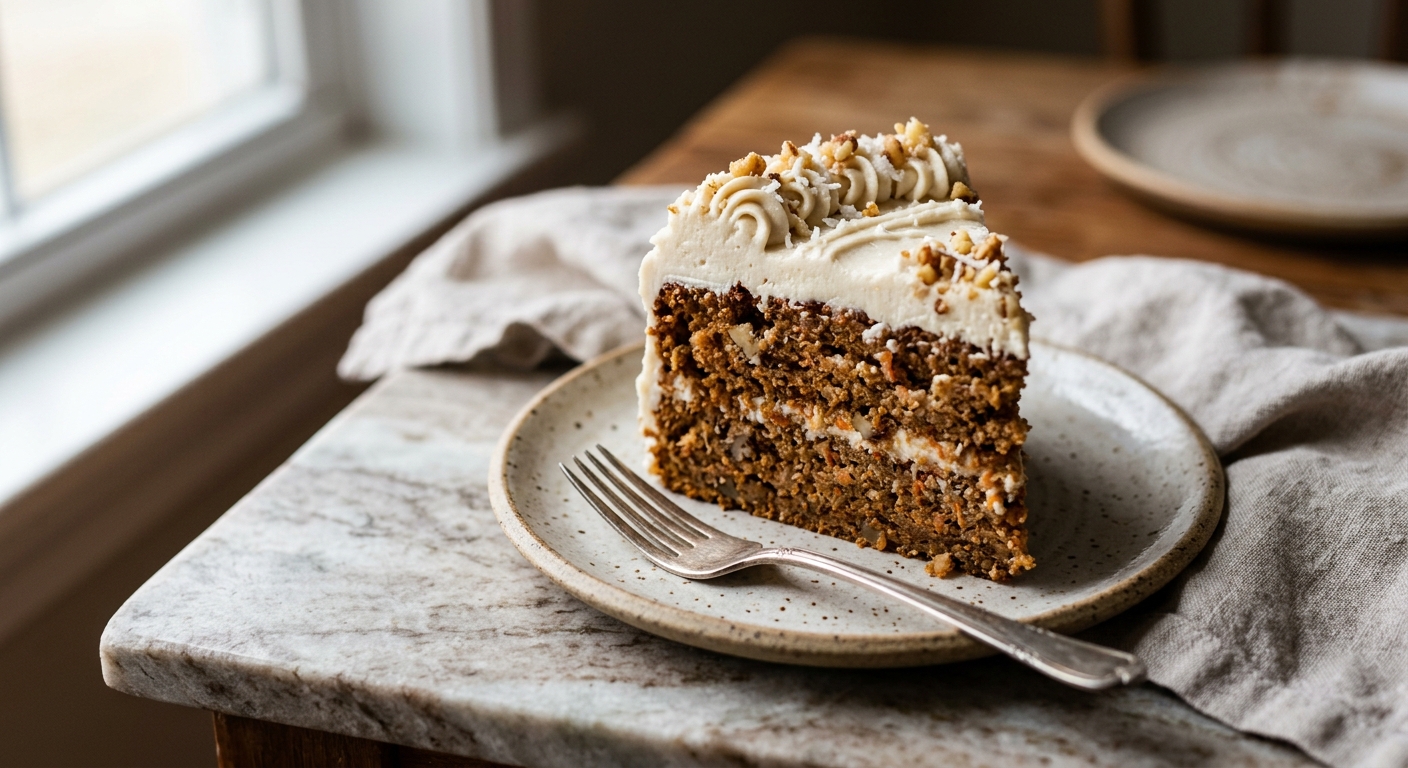
There is something deeply comforting about a carrot cake fresh from the oven, filling the kitchen with the scent of cinnamon, ginger, and toasted spice. This version leans into all of that familiar warmth but takes things a step further, building layers of flavor through coconut sugar’s naturally rich, almost molasses-like sweetness. The carrots, freshly grated and still tender, keep every crumb impossibly moist, while a generous hand with spice ensures this cake tastes vibrant and alive rather than merely virtuous.
What truly sets this cake apart is the frosting. Instead of the classic cream cheese version, we are making a cashew cream frosting: raw cashews soaked overnight and blended to an impossibly silky, thick cream, then sweetened with a touch of coconut sugar and brightened with lemon juice and vanilla. It pipes beautifully, holds its shape, and delivers that tangy richness you expect from a carrot cake topping, all without any dairy. The cake layers themselves use coconut oil in place of vegetable oil, which adds a faint tropical note that plays wonderfully against the spice blend.
This recipe is medium in difficulty, requiring some advance planning for soaking the cashews, but the actual baking is very straightforward and forgiving. It is perfect for bakers looking to reduce refined sugars without sacrificing celebration-worthy results, and it is naturally dairy-free and gluten-adaptable. Whether you are baking for a birthday, an Easter table, or simply a Sunday afternoon, this cake delivers the full experience.
Equipment Needed
Click on an item below to shop for the recommended items for this recipe on Amazon.
As an Amazon Associate, we earn from qualifying purchases.
12
Ingredients
- 280 gall-purpose flour (about 2 1/4 cups, spooned and leveled)
- 2 tspbaking powder
- 1 tspbaking soda
- 2 tspground cinnamon
- 1 tspground ginger
- 0.5 tspground nutmeg
- 0.25 tspground cloves
- 0.5 tspColima Sea SaltMicroplastic Free Salt
- 200 gcoconut sugar (about 1 cup)
- 120 mlmelted coconut oil (about 1/2 cup), cooled slightly
- 3 largeeggs, at room temperature
- 120 mlunsweetened almond milk or oat milk (about 1/2 cup), at room temperature
- 2 tsppure vanilla extract
- 300 gfresh carrots, peeled and finely grated (about 2 1/2 cups, loosely packed)
- 60 gunsweetened shredded coconut (about 3/4 cup), optional for added texture
- 60 gchopped walnuts or pecans (about 1/2 cup), optional
- —For the Cashew Cream Frosting:
- 300 graw cashews (about 2 cups), soaked in cold water 6 to 8 hours, then drained and rinsed
- 80 mlfull-fat coconut cream (about 1/3 cup), chilled
- 80 gcoconut sugar, finely ground in a blender or coffee grinder (about 6 tbsp)
- 3 tbspfresh lemon juice
- 2 tsppure vanilla extract
- —Pinch of Colima Sea SaltMicroplastic Free Salt
- 2 tbspmelted refined coconut oil (adds firmness to the frosting; refined has no coconut flavor)
Ingredient Substitutions
Instructions
- The night before (or at least 6 to 8 hours ahead), place the raw cashews in a bowl and cover generously with cold water. Let them soak at room temperature, then drain and rinse thoroughly. Soaking is essential: it softens the cashews so they blend into a completely smooth, creamy frosting without any grittiness.
- When you are ready to bake, preheat your oven to 350°F (175°C). Grease two 8-inch round cake pans with coconut oil, line the bottoms with parchment paper circles, and dust the sides lightly with flour. Set aside.
- In a large bowl, whisk together the flour, baking powder, baking soda, cinnamon, ginger, nutmeg, cloves, and salt until evenly combined. Whisking the dry ingredients thoroughly ensures the leaveners are evenly distributed, which prevents uneven rising.
- In a separate large bowl, whisk the coconut sugar and melted (but not hot) coconut oil together for about 1 minute until combined. Add the eggs one at a time, whisking well after each addition. Whisk in the almond milk and vanilla extract. The mixture should look smooth and glossy.
- Pour the wet ingredients into the dry ingredients and fold gently with a rubber spatula until just combined. Do not overmix: a few streaks of flour are fine at this stage. Fold in the grated carrots, and the shredded coconut and chopped nuts if using. The batter will be thick and hearty.
- Divide the batter evenly between the two prepared pans (a kitchen scale makes this easy). Smooth the tops with the spatula. Bake for 30 to 35 minutes, until the tops are set and a toothpick inserted in the center comes out with just a few moist crumbs. Because coconut sugar is darker than refined sugar, the cakes will look quite deep golden-brown, which is normal.
- Let the cakes cool in their pans on a wire rack for 15 minutes, then run a thin knife around the edges and turn them out onto the rack. Peel off the parchment and let cool completely before frosting, at least 1 hour. A warm cake will melt the cashew cream frosting.
- Make the cashew cream frosting: Add the drained cashews, chilled coconut cream, finely ground coconut sugar, lemon juice, vanilla, and salt to a high-powered blender. Blend on high for 2 to 4 minutes, stopping to scrape down the sides, until completely smooth and silky. Add the melted refined coconut oil and blend for another 30 seconds. Transfer the frosting to a bowl and refrigerate for 30 to 60 minutes until it is thick enough to spread and hold its shape.
- To assemble, place one cooled cake layer on your serving plate. Spread a generous layer of cashew cream frosting over the top. Place the second layer on top and frost the top and sides of the entire cake. Garnish with toasted coconut flakes, a few walnut halves, or a dusting of cinnamon. Refrigerate for at least 30 minutes before slicing so the frosting firms up fully.
- Soak the cashews as directed in the oven method, 6 to 8 hours ahead. Line a standard 12-cup muffin tin with paper liners. If you have a second tin, line it too since this batter makes 16 to 18 cupcakes. Preheat your oven to 350°F (175°C).
- Prepare the batter exactly as described in steps 3 through 5 of the oven method: whisk dry ingredients, whisk wet ingredients with coconut sugar, combine, then fold in carrots and any add-ins.
- Divide the batter evenly among the lined cups, filling each about three-quarters full. An ice cream scoop makes this quick and tidy. Do not overfill or the cupcakes will overflow and lose their domed shape.
- Bake for 20 to 23 minutes, until the tops spring back lightly when touched and a toothpick inserted in the center comes out with just a few moist crumbs. Because these are smaller than cake layers, check them at the 20-minute mark. Do not overbake or they will dry out quickly.
- Cool the cupcakes in the tin for 5 minutes, then transfer to a wire rack and cool completely, at least 45 minutes, before frosting.
- Prepare the cashew cream frosting as directed. Once chilled and thickened, transfer it to a piping bag fitted with a large round or star tip. Pipe a swirl onto each cooled cupcake. Top each with a small pinch of toasted coconut or a walnut half. Keep refrigerated until ready to serve.
- Soak the cashews as directed, 6 to 8 hours ahead. Grease the insert of a 6-quart slow cooker generously with coconut oil. Cut a circle of parchment paper to fit the bottom and press it in. This step is important because the long, gentle heat means the cake can stick without proper preparation.
- Prepare the full batter following steps 3 through 5 of the oven method. The batter will be the same thick consistency. Pour it all into the prepared slow cooker insert and smooth the top with a spatula.
- Lay two or three layers of paper towels across the top of the slow cooker insert before putting on the lid. The paper towels absorb condensation that would otherwise drip back down onto the cake and create a wet, soggy top. This is the single most important trick for slow cooker baking.
- Cook on High for 2 hours 30 minutes to 3 hours. Do not lift the lid before the 2-hour 30-minute mark. The cake is done when the edges are set and pulling away from the sides, the top feels firm and dry to a gentle touch, and a toothpick inserted in the center comes out with a few moist crumbs. The center may look slightly underdone at the edges of the toothpick test but will continue to set as it cools.
- Turn off the slow cooker and leave the lid slightly ajar for 20 minutes. Then carefully lift the parchment to remove the cake from the insert and transfer it to a wire rack. Cool completely, at least 1 to 1.5 hours, before frosting.
- Prepare the cashew cream frosting as directed. Spread it generously over the top of the cooled single layer. This rustic style looks beautiful with a scattering of toasted walnuts and a dusting of cinnamon over the frosting. Refrigerate for 30 minutes before slicing.
Nutrition Per Serving
Per 1 serving (makes one 8-inch two-layer round cake)
Sweetener: coconut sugar
Why This Recipe Works
Coconut sugar behaves differently from refined white sugar in a cake batter, and understanding why helps you get consistently great results. Coconut sugar retains trace minerals and a small amount of natural moisture from the palm sap it is derived from, which contributes to the cake’s noticeably tender, moist crumb. It also contains inulin, a soluble fiber that slows sugar absorption, giving it a lower glycemic index (around 35) compared to refined sugar (around 65). Because coconut sugar is less sweet per gram than refined sugar, this recipe uses a generous cup to achieve the right level of sweetness and the beautiful caramel undertone that makes this cake taste so rich and complex.
Freshly grated carrots are doing heavy structural and moisture work in this recipe. Carrots contain a high proportion of water, which releases into the batter during baking and essentially steams the crumb from the inside, keeping it moist for days. Finely grating the carrots (rather than coarsely grating) ensures they melt almost invisibly into the cake, contributing texture without any stringy pieces. Coconut oil, used here in place of a neutral vegetable oil, remains solid at cooler temperatures and liquid above about 76°F (24°C). This phase-changing property means the cake sets slightly firmer when chilled, making it easier to slice cleanly, which is particularly useful since the cashew frosting is also stored cold.
The cashew cream frosting works because raw cashews have a uniquely high fat-to-protein ratio among nuts, and when soaked and blended thoroughly, their cell walls break down completely to release a smooth, neutral cream that mimics the texture of cream cheese frosting remarkably closely. Grinding the coconut sugar finely before adding it is essential: whole coconut sugar granules do not fully dissolve in a blended frosting and will leave tiny crunchy specks. The addition of melted refined coconut oil gives the frosting body when chilled, since the coconut oil solidifies and acts as a setting agent, similar to how gelatin works in a mousse. If your frosting seems too soft after blending, chill it longer rather than adding more sweetener.
Baker’s Tips
- Grate your carrots fresh and fine: pre-shredded carrots from a bag are too dry and too coarsely cut to melt into the batter the same way. A box grater on the finest shredding holes is ideal.
- Grind the coconut sugar for the frosting in a blender or clean coffee grinder until it is a fine powder before adding it to the cashews. This is the difference between a silky frosting and a gritty one.
- Make sure your eggs and plant milk are at room temperature before mixing. Cold ingredients can cause the melted coconut oil to re-solidify into small white flecks in the batter. Functional, but not ideal.
- Use a high-powered blender (such as a Vitamix or Blendtec) for the smoothest cashew frosting. A standard blender can work but requires longer blending time and more frequent scraping down of the sides.
- Do not skip the refrigerator rest for the frosting before applying it to the cake. A freshly blended cashew cream is warm from the blender motor and too loose to spread cleanly. Thirty to sixty minutes of chilling makes it spreadable and pipeable.
- Coconut sugar gives these cakes a noticeably darker color than refined sugar cakes. Do not mistake deep golden-brown tops for overbaking. Always rely on the toothpick test and the spring-back test, not just visual color.
Variations
- Pineapple carrot cake: Fold in 80g (about 1/3 cup) well-drained crushed pineapple with the carrots for extra moisture and a tropical sweetness that pairs beautifully with the cashew frosting.
- Spiced orange version: Add 1 tablespoon of finely grated orange zest to the wet ingredients and replace 2 tablespoons of almond milk with fresh orange juice for a bright, citrusy lift.
- Single-layer snack cake: Bake the full batter in a greased 9×13-inch pan at 350°F for 28 to 32 minutes. Frost directly in the pan for an easy, shareable slab cake.
Troubleshooting & FAQ
My cashew cream frosting is grainy or gritty, not smooth. What went wrong?
Why did my cake layers sink in the center?
My cake is dense and heavy rather than light and tender. What happened?
The frosting melted and slid off the cake when I tried to assemble it. How do I fix this?
Can I taste raw coconut oil in the cake or the frosting?
Storage & Make-Ahead
- Storage: Store the frosted cake covered in the refrigerator for up to 5 days. The cashew cream frosting is perishable and must be kept cold. Bring individual slices to room temperature for 15 to 20 minutes before serving for the best texture. Unfrosted cake layers can be stored wrapped at room temperature for up to 2 days.
- Make-Ahead: The cashews can be soaked, drained, and stored in the refrigerator in a covered bowl for up to 24 hours before blending. The cake layers can be baked up to 2 days ahead, wrapped tightly in plastic wrap, and stored at room temperature or frozen for up to 2 months. The cashew cream frosting can be made up to 3 days ahead and stored in an airtight container in the refrigerator; if it softens, stir well and re-chill before using.