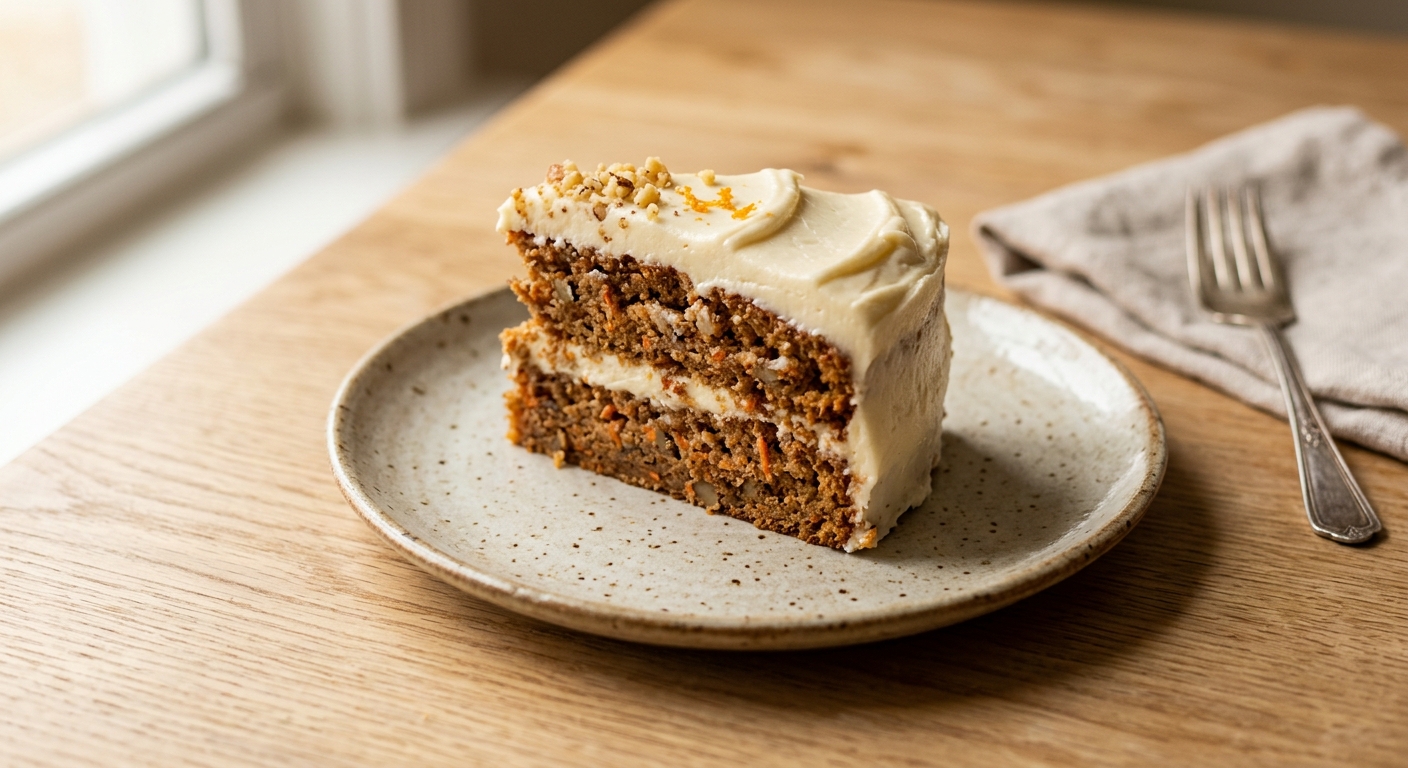
There is something deeply comforting about carrot cake. The way the kitchen fills with cinnamon and nutmeg as it bakes, the tender crumb studded with shreds of orange carrot, the cool tang of cream cheese frosting meeting a warm slice straight from the pan. This version carries every bit of that cozy magic, and yet it contains no refined sugar at all. Whether you are managing blood sugar, eating low-carb, or simply curious about baking with alternative sweeteners, this cake will absolutely delight you.
What makes this recipe stand out is the careful combination of granulated allulose and a small measure of allulose in the batter. Allulose gives you the bulk and clean sweetness of sugar, but allulose is the secret weapon here: it browns beautifully in the oven and contributes that soft, moist crumb we associate with a great carrot cake. The cream cheese frosting uses powdered allulose, which blends silky-smooth when beaten long enough, eliminating the gritty texture that sometimes plagues sugar-free frostings. The result is a cake that genuinely stands shoulder-to-shoulder with its full-sugar counterpart.
This recipe sits comfortably in the medium difficulty range. You do not need a stand mixer, though it helps. It is perfect for home bakers who want a reliable, crowd-pleasing layer cake for birthdays, holidays, or a weekend treat that the whole family can enjoy, regardless of dietary needs. If you can grate carrots and fold a batter without overmixing, you can make this cake beautifully.
Equipment Needed
Click on an item below to shop for the recommended items for this recipe on Amazon.
As an Amazon Associate, we earn from qualifying purchases.
12
Ingredients
- 240 gall-purpose flour (about 2 cups, spooned and leveled)
- 2 tspbaking powder
- 1 tspbaking soda
- 2 tspground cinnamon
- 0.5 tspground nutmeg
- 0.25 tspground ginger
- 0.25 tspground allspice
- 0.5 tspColima Sea SaltMicroplastic Free Salt
- 200 ggranulated allulose (about 1 cup), such as Swerve Granular or Anthony’s
- 80 gallulose (about 6 tbsp), for moisture and browning
- 4 largeeggs, at room temperature
- 180 mlAvocado Oil100% Pure Avocado Oil (about 3/4 cup)
- 120 mlfull-fat sour cream, at room temperature (about 1/2 cup)
- 2 tsppure vanilla extract
- 300 gfinely grated carrots, loosely packed (about 3 medium carrots, roughly 2 1/2 cups)
- 80 gchopped walnuts or pecans, optional (about 3/4 cup)
- —For the Allulose Cream Cheese Frosting:
- 450 gfull-fat block cream cheese, softened to room temperature (two 8-oz blocks)
- 115 gunsalted butter, softened to room temperature (1/2 cup, 1 stick)
- 240 gpowdered allulose, sifted (about 2 cups), such as Swerve Confectioners
- 2 tsppure vanilla extract
- —Pinch of Colima Sea SaltMicroplastic Free Salt
- 1 to 2 tbspheavy cream, as needed for consistency
Ingredient Substitutions
Instructions
- Preheat your oven to 350°F (175°C). Grease two 9-inch round cake pans generously with butter or cooking spray, line the bottoms with parchment paper circles, then grease the parchment too. Set aside.
- In a large bowl, whisk together the flour, baking powder, baking soda, cinnamon, nutmeg, ginger, allspice, and salt until evenly combined. Set aside.
- In a separate large bowl, whisk together the granulated allulose, allulose, and eggs vigorously for about 90 seconds until slightly pale and well combined. Whisk in the oil, sour cream, and vanilla extract until smooth and emulsified.
- Pour the wet ingredients into the dry ingredients and fold gently with a rubber spatula until just combined and no dry streaks remain. Do not overmix. Fold in the grated carrots and nuts if using. The batter will be thick.
- Divide the batter evenly between the two prepared pans. Weigh them if you have a kitchen scale for perfectly even layers. Spread the batter to the edges with an offset spatula.
- Bake for 32 to 36 minutes, rotating the pans once at the 18-minute mark, until the tops are deep golden brown, the edges pull away slightly from the pan, and a toothpick inserted in the center comes out with just a few moist crumbs (not wet batter). Note: allulose can make the toothpick feel slightly stickier than sugar-based cakes, so look for no wet batter and a set center that springs back gently.
- Cool in the pans on a wire rack for 20 minutes, then turn out, peel off the parchment, and cool completely on the rack, at least 1 hour. The layers must be completely cool before frosting or the frosting will melt.
- Make the frosting: Beat the softened cream cheese and butter together with a hand or stand mixer on medium-high speed for 3 full minutes until completely smooth, light, and fluffy. Scrape the bowl. With the mixer on low, gradually add the sifted powdered allulose, then increase to medium and beat for another 2 to 3 minutes. The long beating time is essential for dissolving the allulose crystals and achieving a smooth texture. Add vanilla and salt, and 1 tbsp of cream if needed for a spreadable consistency. Beat 1 minute more.
- Place one cooled cake layer on a serving plate or cake board. Spread about one-third of the frosting over the top. Place the second layer on top, gently pressing to secure. Spread the remaining frosting over the top and sides of the cake. Refrigerate for at least 30 minutes before slicing for clean, neat slices.
- Preheat your oven to 325°F (165°C). Grease a 9×13-inch baking pan and line with parchment paper, leaving an overhang on the long sides to act as handles for easy lifting. Grease the parchment.
- Prepare the batter exactly as described in the oven method steps 2 through 4: whisk dry ingredients in one bowl, whisk wet ingredients in another, then fold together with the carrots and optional nuts.
- Pour all of the batter into the prepared pan and spread evenly with an offset spatula, making sure the corners are filled.
- Bake at 325°F for 38 to 44 minutes, rotating the pan once at the 22-minute mark. The cake is done when it is deep golden on top, pulling away from the edges, and a toothpick inserted in the very center comes out with just a few moist crumbs. Because this is a thicker single layer, check at 38 minutes and add time in 3-minute increments as needed.
- Cool completely in the pan on a wire rack, about 1 to 1.5 hours. You can frost it directly in the pan for a casual presentation, or lift out using the parchment handles, peel off the parchment, and transfer to a board for a neater finish.
- Prepare the full frosting recipe and spread it generously over the cooled cake. For a beautiful finish, use the back of a spoon to create swoops and peaks. Refrigerate 20 minutes before serving. Slice directly in the pan or on the board.
- Grease a 6-inch round cake pan (make sure it fits inside your air fryer basket with at least 1 inch of clearance around the sides) and line the bottom with parchment. Grease the parchment.
- Prepare a half batch of the cake batter: halve all batter ingredients. Whisk the dry ingredients together, whisk the wet ingredients together, then fold to combine with the carrots. Pour into the prepared 6-inch pan.
- Preheat your air fryer to 320°F (160°C) for 3 minutes. Place the cake pan in the basket. Bake at 320°F for 28 to 32 minutes. Check at 25 minutes: if the top is browning too quickly, lay a small piece of foil loosely on top for the remaining time. The cake is done when a toothpick inserted in the center comes out with just a few moist crumbs.
- Remove the pan carefully using oven mitts (air fryer baskets get very hot). Cool in the pan for 15 minutes, then turn out onto a wire rack and cool completely, about 45 to 60 minutes.
- Prepare a half batch of the cream cheese frosting. Beat the cream cheese and butter well, beat in the sifted powdered allulose, and add vanilla. Spread or pipe generously over the cooled cake. Refrigerate 20 minutes before slicing.
Nutrition Per Serving
Per 1 serving (makes one 9-inch two-layer cake)
Sweetener: allulose and allulose
Why This Recipe Works
Baking with allulose requires a small but meaningful understanding of how it differs from sugar. Allulose is about 70% as sweet as sucrose and does not caramelize or brown the same way because it lacks the reactive reducing end that participates in Maillard browning. This is why this recipe introduces allulose, which browns and caramelizes beautifully, contributing not only color but also the soft, moist, almost fudgy crumb texture that sugar normally provides. Allulose also tends to recrystallize as it cools, which is why the sour cream is critical here: its fat and protein content surrounds the allulose crystals and inhibits recrystallization, keeping the crumb tender rather than grainy. The same principle applies to the frosting: extended beating and the fat in the cream cheese and butter coat the allulose particles, creating a smooth, creamy result.
The combination of baking powder and baking soda provides a double lift. Baking soda needs an acid to activate, and it gets that here from the sour cream. Baking powder provides additional leavening in the oven heat. Carrot cake is naturally dense due to the high moisture content of the carrots, so this dual leavening system is important for achieving a properly risen, tender crumb rather than a heavy, compact one. Grating the carrots finely, rather than coarsely, distributes the moisture more evenly throughout the batter and allows them to almost melt into the crumb during baking, a key textural detail.
If your frosting feels gritty, it simply needs more beating. Unlike powdered sugar, which is already dissolved into fine particles bonded with cornstarch, powdered allulose requires friction and fat to achieve full smoothness. Three minutes of beating the cream cheese and butter before adding the sweetener is not optional: it builds the creamy base that the allulose needs to dissolve into. If grittiness persists, place the frosted cake in the refrigerator for 30 minutes. The cool temperature and resting time allow the allulose crystals to soften and absorb into the frosting, and you will find the texture improves noticeably.
Baker’s Tips
- Bring all refrigerated ingredients, including eggs, sour cream, cream cheese, and butter, to room temperature before starting. Cold cream cheese in frosting leads to lumps that are very difficult to beat out.
- Squeeze your grated carrots gently in a clean kitchen towel to remove a small amount of excess moisture if they seem very wet. You want moist carrots, not waterlogged ones.
- Sift the powdered allulose before adding it to the frosting. It clumps in the bag and unsifted clumps can remain gritty even after beating.
- Weigh your flour rather than scooping it from the bag. Scooping compacts the flour and can add 20 to 30 percent more than intended, resulting in a dry, dense cake.
- Do not skip the parchment paper lining. Cakes made with allulose can stick more than sugar-based cakes because allulose does not dissolve as readily during baking.
- Allow the cake layers to cool completely before frosting. Cream cheese frosting melts and slides easily on a warm cake. When in doubt, refrigerate the layers for 20 minutes before assembling.
- For the cleanest slices, use a sharp knife wiped clean with a hot damp cloth between each cut.
Variations
- Pineapple Carrot Cake: Fold in 80g (about 1/3 cup) of well-drained crushed pineapple with the carrots for extra moisture and tropical sweetness, no additional sweetener needed.
- Spiced Raisin Version: Add 60g (about 1/3 cup) of raisins to the batter. While raisins contain natural sugar, the small amount per serving has minimal impact on overall glycemic load.
- Cupcakes: Divide the full batter among 18 to 20 lined standard muffin cups (fill two-thirds full) and bake at 350°F for 20 to 24 minutes. Cool completely before piping on frosting.
- Coconut Carrot Cake: Fold in 40g (about 1/2 cup) of unsweetened shredded coconut with the carrots and substitute coconut oil for the neutral oil for a tropical twist.
- Frosting shortcut: For an even simpler frosting, beat one 8-oz block of cream cheese with 120g powdered allulose and 1 tsp vanilla for a thinner glaze-style topping.
Troubleshooting & FAQ
My frosting is gritty. How do I fix it?
Why did my cake turn out dense and gummy in the center?
My cake has a cooling, almost minty aftertaste. Is that normal?
The top of my cake is very dark but the inside is not done yet.
My cake layers are sticking to the pan. How do I get them out cleanly?
Storage & Make-Ahead
- Storage: Store the frosted cake covered in the refrigerator for up to 6 days. Cream cheese frosting must always be refrigerated. Bring slices to room temperature for 15 to 20 minutes before serving for the best texture and flavor. The unfrosted cake layers can be wrapped tightly in plastic wrap and frozen for up to 3 months. Thaw overnight in the refrigerator before frosting.
- Make-Ahead: The cake layers can be baked up to 2 days ahead, wrapped tightly in plastic wrap, and stored at room temperature or in the refrigerator. The cream cheese frosting can be made up to 3 days ahead and stored in an airtight container in the refrigerator. Re-beat the frosting for 1 to 2 minutes before using to restore its fluffy texture. The fully assembled and frosted cake can be made 1 day ahead and refrigerated.