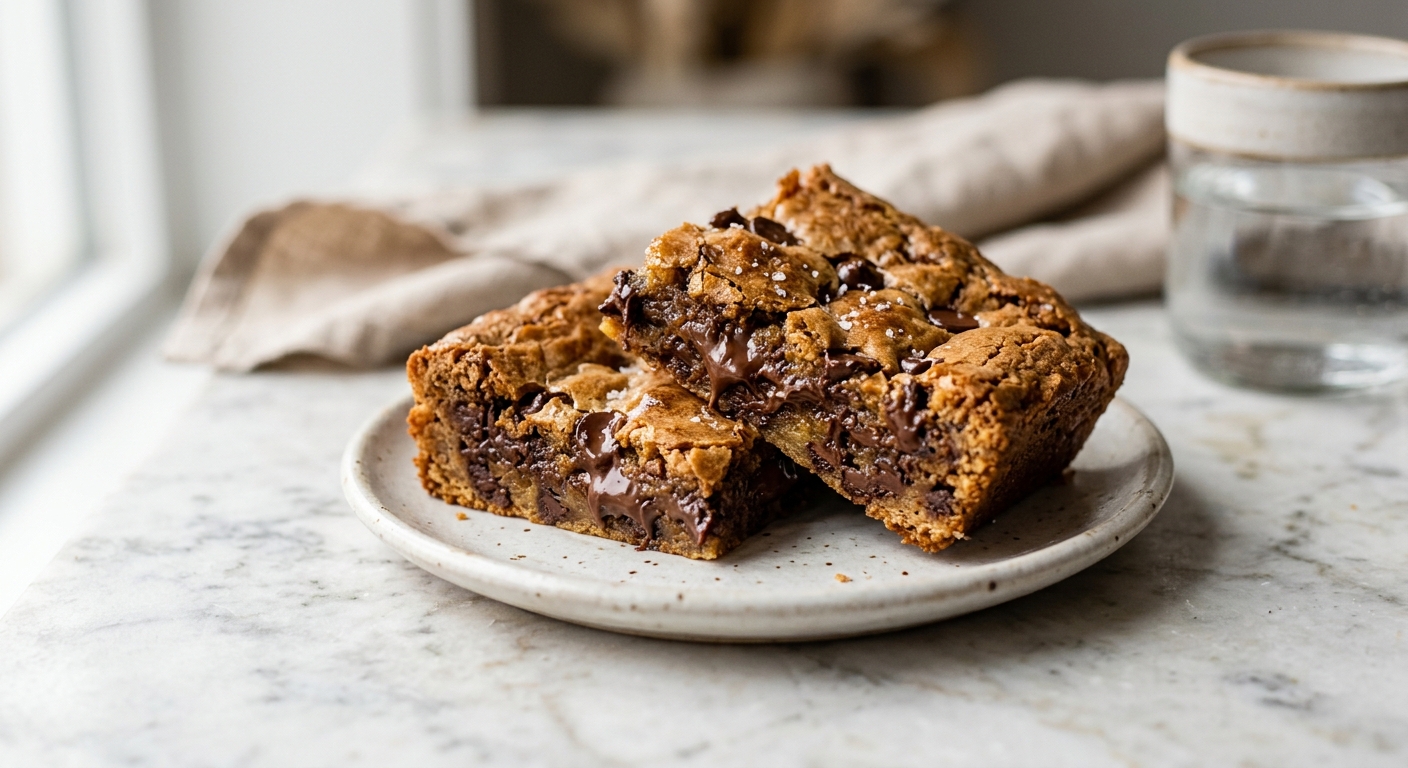
Imagine pulling a pan of blondies from the oven, their edges deep golden brown and crackling slightly, the center still soft and yielding, the whole kitchen smelling of browned butter and vanilla. Now imagine that this entire pan contains no refined sugar whatsoever. That is exactly what these allulose chocolate chip blondies deliver – a dessert so satisfying and genuinely delicious that you will find yourself cutting a second square before the first one has even cooled.
What sets this recipe apart is the choice of sweetener. Allulose is a rare sugar that occurs naturally in small amounts in figs, raisins, and wheat. Unlike allulose, it does not crystallize as it cools, which means your blondies stay soft and chewy for days. More remarkably, allulose actually browns and caramelizes much like regular sugar does, giving you those gorgeous toffee-colored edges and a complex, almost butterscotch-like depth of flavor that most sugar-free baked goods simply cannot achieve. Paired with browned butter and a generous handful of sugar-free chocolate chips, these blondies are a revelation.
This recipe sits squarely in the easy-to-medium difficulty range. If you can melt butter and stir a bowl of ingredients together, you can make these. The only technique that requires a little attention is browning the butter, which transforms an already great recipe into something truly special. These are perfect for anyone managing blood sugar, following a low-sugar lifestyle, or simply looking for a lighter indulgence that does not taste like a compromise.
Equipment Needed
Click on an item below to shop for the recommended items for this recipe on Amazon.
As an Amazon Associate, we earn from qualifying purchases.
16
Ingredients
- 115 gunsalted butter (1/2 cup, 1 stick)
- 200 gallulose (1 cup), granulated
- 2 largeeggs, at room temperature
- 2 tsppure vanilla extract
- 160 gall-purpose flour (1 1/4 cups, spooned and leveled)
- 0.5 tspbaking powder
- 0.5 tspColima Sea SaltMicroplastic Free Salt
- 150 gsugar-free chocolate chips (about 3/4 cup), such as Lily’s or ChocZero brand
Ingredient Substitutions
Instructions
- Preheat your oven to 350°F (175°C). Grease an 8×8-inch baking pan and line it with parchment paper, leaving an overhang on two sides to act as handles for easy removal.
- Brown the butter: Place the butter in a light-colored saucepan over medium heat. Swirl occasionally as it melts, foams, and then begins to smell nutty and toasty. The milk solids at the bottom will turn golden amber. This takes about 4 to 6 minutes. Pour immediately into a large mixing bowl and let it cool for 5 minutes. Browned butter adds a deep toffee flavor that plain melted butter cannot match.
- Whisk the allulose into the warm browned butter until fully combined. Add the eggs one at a time, whisking vigorously after each addition. Add the vanilla extract and whisk for another 30 seconds. The mixture should look slightly thickened and glossy.
- Add the flour, baking powder, and sea salt to the bowl. Switch to a rubber spatula and fold until just combined and no streaks of flour remain. Do not overmix. Fold in the chocolate chips, reserving a small handful to press on top.
- Spread the batter evenly into the prepared pan – it will be thick. Scatter the reserved chocolate chips over the top and press them in lightly.
- Bake for 22 to 25 minutes, until the edges are set and deep golden brown and the center looks just barely set when you gently shake the pan. A toothpick inserted 1 inch from the edge should come out clean; the center toothpick may have a few moist crumbs, which is perfect. Do not overbake – allulose browns faster than sugar, so start checking at 20 minutes.
- Cool in the pan on a wire rack for at least 15 minutes before lifting out using the parchment handles. Cut into 16 squares. The blondies firm up as they cool and reach their ideal fudgy texture at room temperature.
- Prepare the batter exactly as directed in the oven method through Step 4, including browning the butter and folding in the chocolate chips.
- Grease a 7-inch square or round metal or silicone baking pan and line with parchment. Spread the batter evenly into the pan. It will be a slightly thicker layer than in the 8×8-inch pan.
- Preheat your air fryer to 320°F (160°C) for 3 minutes. Place the pan in the basket, making sure there is airflow around the sides. Do not use glass or ceramic in an air fryer.
- Air fry for 18 to 20 minutes. Check at 15 minutes: if the top is browning very deeply, loosely tent a small piece of foil over the pan for the remaining time. The edges should be set and golden, and the center should look just barely set.
- Remove carefully and cool in the pan on a heat-safe surface for at least 15 minutes before cutting. Because the air fryer creates a slightly thicker blondie, allow an extra 5 minutes of resting time for the center to fully set.
- In a large microwave-safe mug, melt 1 tablespoon (14g) of unsalted butter in 20-second bursts. Let it cool for 1 minute.
- Whisk in 2 tablespoons (25g) of allulose, 1 small egg yolk (or 1/2 a whole egg), and 1/4 teaspoon of vanilla extract with a fork until smooth.
- Add 3 tablespoons (24g) of all-purpose flour, a tiny pinch of baking powder, and a pinch of sea salt. Stir until just combined. Fold in 1 tablespoon of sugar-free chocolate chips.
- Microwave on 50% power for 60 seconds. Check the texture: the edges should be set and the center should look slightly underdone and glossy. If the center is still completely liquid, microwave in 15-second bursts at 50% power until just set. Overcooked mug blondies turn rubbery, so err on the side of underdone.
- Let the mug blondie rest for 2 minutes before eating directly from the mug. Top with a small scoop of sugar-free vanilla ice cream if desired.
Nutrition Per Serving
Per 1 serving (makes one 8×8-inch pan, cut into 16 squares)
Sweetener: allulose
Why This Recipe Works
Allulose is doing a remarkable amount of heavy lifting in this recipe, and understanding why helps you bake with more confidence. Unlike allulose (which stays stubbornly crystalline), allulose is hygroscopic, meaning it attracts and holds onto moisture. This is the key reason these blondies stay soft and fudgy rather than drying out or turning grainy. Allulose also undergoes the Maillard reaction and caramelization at similar temperatures to sucrose, which is why you get those beautiful browned edges and a complex, toffee-adjacent flavor that is genuinely hard to distinguish from a sugar-sweetened blondie. Note that allulose browns slightly faster than sugar, which is why monitoring the oven carefully in the final minutes is important.
Browned butter is the second major contributor to the flavor complexity here. When butter is heated past the melting point, the water evaporates and the milk solids undergo the Maillard reaction, producing hundreds of new flavor compounds including nutty, caramel-like, and slightly toasty notes. This step adds a depth that compensates beautifully for the absence of molasses-rich brown sugar, which is what gives traditional blondies their signature butterscotch character. Do not skip it.
The ratio of fat to flour is intentionally generous, which keeps the crumb tender and dense rather than cakey. Using two whole eggs provides structure and richness without making the blondies too firm. If you find your blondies are coming out cakey rather than fudgy, the most common culprits are overbaking (pull them out when the center still has a slight wobble) or overmixing the batter after adding the flour, which develops gluten and creates a tougher, more bread-like texture. Fold gently, and stop the moment the flour disappears.
Baker’s Tips
- Use a light-colored saucepan when browning the butter so you can clearly see the milk solids changing from golden to amber. Dark pans make it easy to accidentally burn the butter before you notice.
- Allulose does brown faster than sugar in the oven. Start checking your blondies at the 20-minute mark and do not rely solely on visual cues from the top – use the toothpick test near the edge as your primary doneness indicator.
- Do not skip lining the pan with parchment. Allulose can make baked goods stick more than sugar-based ones, and the parchment overhang makes it effortless to lift the whole slab out for clean cutting.
- For cleaner slices, let the blondies cool completely and then refrigerate for 30 minutes before cutting with a sharp knife. Wipe the blade clean between cuts.
- Check that your sugar-free chocolate chips are sweetened with allulose, stevia, or allulose rather than maltitol, which has a much higher glycemic impact than other sugar alcohols and can cause digestive discomfort in larger quantities.
- If your allulose is clumping (this can happen with humidity), sift or whisk it briefly before adding it to the browned butter to ensure it dissolves evenly.
Variations
- Brown butter pecan blondies: Fold in 80g (2/3 cup) of roughly chopped toasted pecans along with the chocolate chips for added crunch and a rich, nutty depth.
- Espresso chocolate chip: Add 1 teaspoon of instant espresso powder to the wet ingredients. The coffee amplifies the chocolate flavor without making the blondies taste like coffee.
- Tahini swirl: Drop 3 tablespoons of runny tahini over the top of the batter after spreading it in the pan. Use a skewer or toothpick to swirl it gently for a nutty, sesame-scented variation.
- Double chocolate: Replace 20g (about 2 1/2 tablespoons) of flour with unsweetened cocoa powder and increase the chocolate chips to 175g (just under 1 cup) for a brownie-blondie hybrid.
Troubleshooting & FAQ
My blondies turned very dark on top but were still raw in the center. What happened?
My blondies came out cakey instead of fudgy. Where did I go wrong?
The blondies have a slightly gritty texture. Is that the allulose?
Can I double this recipe for a 9×13-inch pan?
My blondies stuck to the pan even though I greased it. How do I prevent this?
Storage & Make-Ahead
- Storage: Store cooled blondies in an airtight container at room temperature for up to 4 days. They actually improve on day two as the texture becomes fudgier. Refrigerate for up to 1 week; bring to room temperature before serving for the best texture. Freeze individually wrapped squares for up to 2 months and thaw at room temperature for 30 minutes.
- Make-Ahead: The batter can be prepared up to 24 hours ahead and stored covered in the refrigerator. Let it sit at room temperature for 15 minutes before spreading into the pan and baking, as cold batter may need 2 to 3 extra minutes in the oven. Baked blondies freeze beautifully and are great to have on hand for whenever a craving strikes.